The 9 Most Forbidden Places In The World
Some places put up a fence. These nine put up a fence, a legal threat, and in at least one case a few thousand venomous snakes. Scattered around the world are spots humanity has quietly agreed are off-limits, not because they are dull, but because they are some combination of deadly, sacred, classified, or so thoroughly cursed that nobody wants the liability. Here are nine of them, and the very good reasons you are not getting in.
Snake Island (Ilha da Queimada Grande)

Humans like to think of ourselves as apex predators, having adapted to deserts, mountains, and the deep sea. Then there is Ilha da Queimada Grande, a 106-acre rock off the coast of Brazil that we have simply agreed to leave alone. The reason is the golden lancehead, a pit viper found nowhere else on Earth, and the island holds an estimated 2,000 to 4,000 of them. That is far fewer than the lurid legends claim, but it is enough that the Brazilian Navy keeps everyone out, partly to protect us from the snakes and partly to protect the snakes from us.

The vipers got marooned here roughly 11,000 years ago, when rising seas cut the island off from the mainland and stranded their ancestors with the migrating birds and not much else. For all the fear the place inspires, there is not a single documented case of a golden lancehead killing a human, mostly because hardly anyone is willing to go find out. The grisly local tales of a banana-picking fisherman and a doomed lighthouse keeper are folklore. What is real is the automated lighthouse, and the rule that you need a Navy waiver and a doctor on standby just to step ashore.
Poveglia

Italy has no shortage of beautiful islands. Poveglia, a short boat ride south of Venice, is not one of the ones they print on postcards. For centuries it was where Venice sent the plague: a quarantine station where the infected were shipped to wait out the disease, which mostly meant waiting to die. The plague pits are real, though the popular claim that the soil is half human ash is the kind of figure that grows with every retelling. Then, in 1922, somebody looked at this island of mass graves and decided it would make a good site for a mental asylum, which ran until 1968. The legend that its director performed experiments until the ghosts drove him to leap from the bell tower is exactly that, a legend, but it has done wonders for the island's reputation. Today nobody is allowed ashore, officially because the ruins are a lawsuit waiting to happen.
North Sentinel Island

For something like 60,000 years, the Sentinelese have lived on North Sentinel Island and wanted nothing to do with the rest of us. The island sits in the Bay of Bengal, about 23 square miles of forest ringed by reef, roughly 30 kilometers off the larger Andaman Islands, and India has made it illegal to go within five nautical miles. That rule is less for the tribe's benefit than for everyone's: the Sentinelese have no immunity to outside disease, and they are emphatic about visitors. The British administrator who kidnapped several of them in 1880 found that out, and so did the American missionary who paddled ashore in 2018 and did not come back. The genuinely baffling part is that people keep trying. In 2025, a tourist landed just long enough to leave behind a can of Diet Coke and some coconuts before he was arrested. The Sentinelese have been clear for centuries, and somehow the message still has not landed.
Svalbard Global Seed Vault

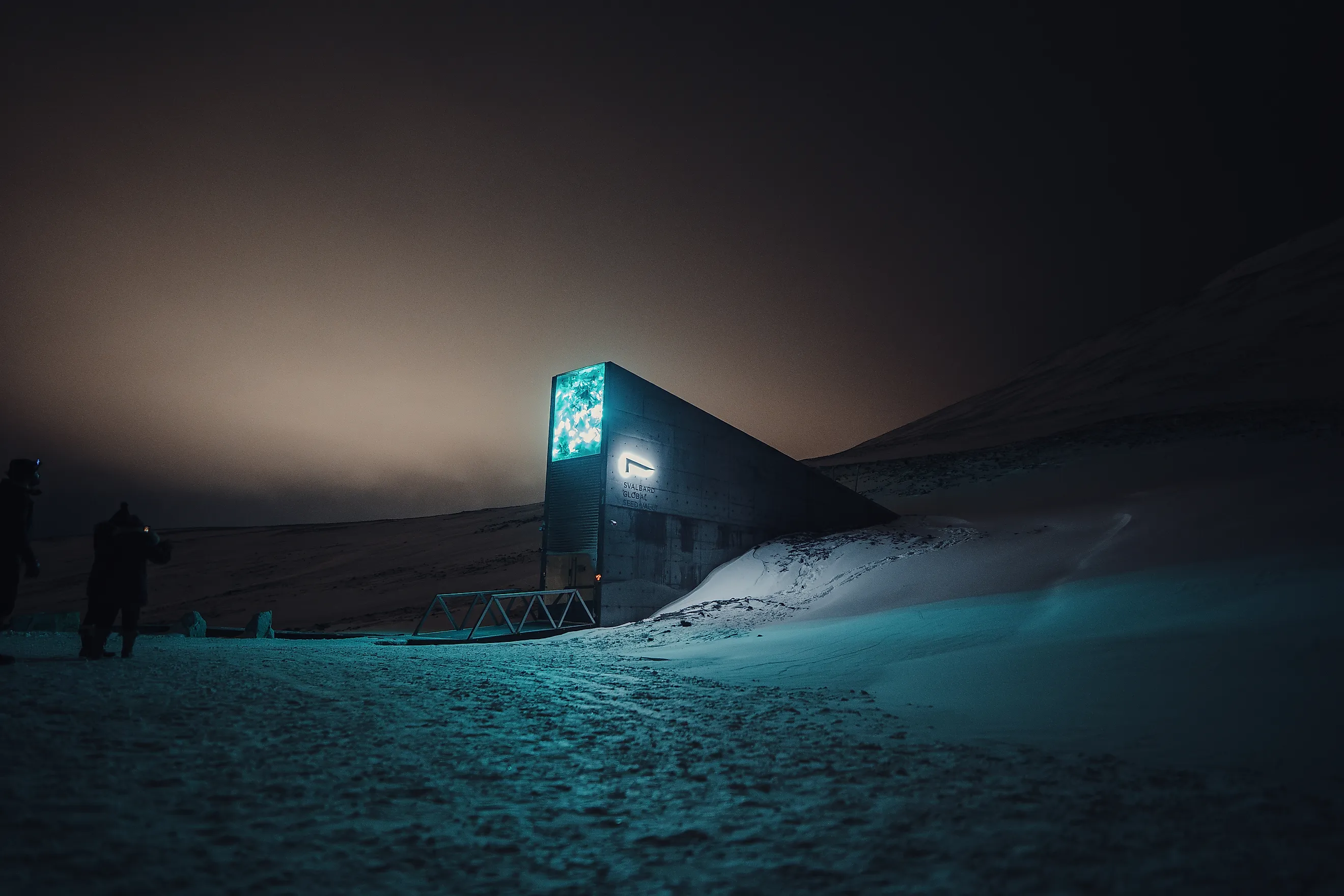
Most entries on this list are forbidden because they are dangerous or cursed. The Svalbard Global Seed Vault is forbidden because it is doing something genuinely important and would rather not be disturbed. Buried in a mountainside on a Norwegian archipelago far above the Arctic Circle, the so-called Doomsday Vault is a backup drive for the planet's food supply, holding seeds from around the world in case war, disaster, or general human carelessness wipes a crop out. It opened in 2008, and it has already been used in earnest: when the civil war in Syria forced a research center to flee Aleppo, the center withdrew the seeds it had banked here. The clever part is the paperwork. Depositors keep ownership of their seeds, like safe-deposit boxes, so no awkward "transfer of genetic resources" occurs and no international red tape kicks in. It is the rare doomsday plan that also accounts for bureaucracy.
Area 51

No list of forbidden places is complete without the one that became a meme. Area 51, a patch of Nevada desert, is a real US Air Force site where the military has tested experimental aircraft for decades, some of which probably explain a good chunk of the "UFO" sightings nearby. For years the government would not even admit it existed; that changed in 2013, when a Freedom of Information Act request pried loose documents acknowledging the base it had been denying since the 1950s. The secrecy is the whole appeal. In 2019, a joke Facebook event proposed that everyone simply "storm" the base to free the aliens, and roughly two million people clicked "going." When the day actually came that September, about 150 made it out to the gates, exactly one tried to step across (and got a stern talking-to), and the handful of arrests were mostly for things like public urination. The aliens, if any, stayed put.
Vatican Apostolic Archive
The Pope has been keeping receipts for nearly two thousand years. The Vatican Apostolic Archive, known until 2019 as the rather more sinister-sounding Vatican Secret Archive, holds an estimated 50 miles of shelving beneath Vatican City, stuffed with the correspondence, financial records, and private business of the Catholic Church across the centuries. For most of its history it was sealed entirely; only in 1881 did Pope Leo XIII let qualified scholars in, and even now access is tightly rationed. The restrictions have naturally bred theories, the wildest of which insist the archive hides proof of aliens, exorcism manuals, and a working time machine. The truth is almost certainly more boring and more interesting at once: the paper trail of one of the most powerful institutions in human history. Curiosity, in this case, might just kill the cat-holic.
North Brother Island

North Brother Island sits in New York City's East River, between the Bronx and Rikers Island, close enough to see the Manhattan skyline and yet entirely off-limits. For decades it was where the city sent the people it needed to isolate. Riverside Hospital treated the contagious, most famously Mary Mallon, better known as Typhoid Mary, the symptomless cook quarantined here for some 26 years until she died in 1938. The island also saw genuine catastrophe: in 1904, the steamship General Slocum caught fire in the East River, and more than 1,000 people, mostly women and children, died, with survivors and bodies washing up on its shore. The hospital later became a drug-treatment center that closed in the 1960s amid allegations that patients were being held against their will. Today the ruins belong to the herons. It is a protected bird sanctuary, and the cost of making it safe for anyone else is more than the city cares to spend.
The Burial Place of Genghis Khan

Genghis Khan built the largest contiguous land empire in history, the second-largest empire of any kind ever measured, and then pulled off one last logistical feat: he vanished. The location of his grave has been a mystery since 1227. Legend says he was buried in secret, that the soldiers who dug the grave were killed to keep it, and that the soldiers who killed them were killed in turn; there is no evidence for any of it, which is rather the point. The likeliest spot is Burkhan Khaldun, a mountain in the Khentii range where he is said to have prayed, and which a clan called the Darkhad guarded for generations. Then history added its own punchline: during the 20th century, Soviet authorities sealed off the area to suppress Mongolian nationalism, and in doing so accidentally granted Genghis Khan the exact undisturbed secrecy he is supposed to have wanted.
The Gate to Hell

The ancient world built a literal gate to the underworld, and the strange part is that it worked. The Ploutonion at Hierapolis, beneath a Greek city founded around 190 BC in what is now Turkey, was a shrine over a cave that priests advertised as an entrance to the realm of the dead. To prove it, they would lead animals to the opening, where the creatures promptly dropped dead, then walk in themselves and stroll back out unharmed, apparently divine. The trick was geology: the cave vents carbon dioxide, which pools close to the ground, suffocating any animal whose head hangs low while a priest standing upright breathes just fine. The cult faded by around the sixth century, but the gas never left, which is why the cave itself stays roped off. The thermal pools next door at Pamukkale are a far better way to spend an afternoon than an unplanned meeting with the lord of the dead.
Why the Fences Stay Up
The common thread is that every one of these places has a body count, or the firm potential for one, and the rules exist because somebody, somewhere, learned the hard way. Even Yellowstone, which lets four million people a year stroll right up to its hot springs, has lost more than 20 of them to the boiling water since the park's early days. These nine sites simply put the fence up before you can become the cautionary tale. Whether that is the authorities protecting us or just protecting their secrets is, naturally, exactly the kind of question they are not going to answer.