What Happens To Sound In The Deep Ocean
At the bottom of the Mariana Trench, nearly 36,000 feet beneath the surface of the Pacific Ocean, there is almost no light. Sound, however, can travel enormous distances through the water above it.
Sound behaves differently in the deep ocean than it does in the air. Sound travels much faster in water than in air, while changes in temperature, salinity, and pressure create sound-speed gradients that refract waves toward regions where sound travels more slowly. Under the right conditions, these effects create a natural underwater pathway called the SOFAR channel, allowing low-frequency sounds to travel hundreds or even thousands of miles.
In the deep ocean, sound travels as pressure waves that weaken with distance, bend as water conditions change, and sometimes become concentrated in natural sound channels that carry low frequencies across enormous distances.
Sound Behaves Differently Underwater

Sound moves through water at roughly 4,921 feet per second, or 1,500 meters per second, compared with about 1,115 feet per second, or 340 meters per second, in air. Sound travels faster in water because water is far less compressible than air, and this greater stiffness more than offsets the effect of its higher density.
Near the surface, warmer water generally allows sound to travel faster. As the water becomes colder with increasing depth, sound slows down. Eventually, the temperature becomes relatively stable while the pressure continues increasing. At greater depths, the increasing pressure causes sound to speed up again.
This creates an unusual pattern. Instead of traveling in a straight line, sound waves can bend, or refract, as they encounter layers of water where their speed changes.
That bending is what gives the deep ocean some of its remarkable acoustic properties.
The Ocean's Natural Sound Channel
The most important of these acoustic features is the SOFAR channel, short for Sound Fixing and Ranging channel. It is a layer of water in which sound can become trapped between areas where its speed is higher.
As a sound wave moves downward through colder water, it slows. Once it reaches the deeper water where pressure begins increasing its speed, the wave bends upward again. The same process happens in the opposite direction. The result is a sound wave repeatedly refracted toward the middle of the channel rather than escaping quickly toward the surface or seafloor.
In the mid-latitude open ocean, the channel axis (the depth of minimum sound speed) is often near 3,280 feet, or 1,000 meters, but it can lie at or near the surface at high latitudes. Hydrophones positioned in or near the channel can detect low-frequency sounds from extremely distant sources.
The effect is somewhat like a long underwater corridor. Sound does not travel through a literal tunnel, but the surrounding water layers repeatedly bend the waves back toward the center of the channel. This allows some sounds to travel across entire ocean basins.
How Whales Use Sound to Communicate

Long before humans understood the ocean's acoustic properties, whales were already using them to communicate across vast distances.
Many marine mammals depend on sound because light cannot travel very far underwater. Whales and dolphins use sound to communicate, find food, navigate, locate mates, and avoid predators. Low-frequency calls are particularly useful for long-distance communication because they can travel much farther through seawater than higher-frequency sounds.
NOAA notes that some whale calls can travel hundreds or even thousands of miles through the SOFAR channel. For animals living in environments where visibility is often limited, the ability to communicate over distance can be especially important.
The deep ocean is not silent, either. Even far from shore, underwater microphones can pick up the sounds of marine animals, earthquakes, volcanic activity, ships, and other human activity.
That creates a very different picture of the deep sea. It may be almost completely dark to a human observer, but acoustically, it can be surprisingly active.
How Scientists Listen to the Deep

The ability of sound to travel so far has made the ocean a giant listening environment for scientists.
During World War II, researchers at Woods Hole Oceanographic Institution investigated whether low-frequency underwater sounds could travel long distances. In one early experiment, scientists detected an underwater explosion roughly 900 miles from its source. Later experiments demonstrated that sounds could travel even farther through the ocean's deep sound channel.
The discovery had obvious military applications. During the Cold War, the US Navy used networks of underwater microphones called hydrophones to listen for submarines. The same basic acoustic principles are now useful for scientific research.
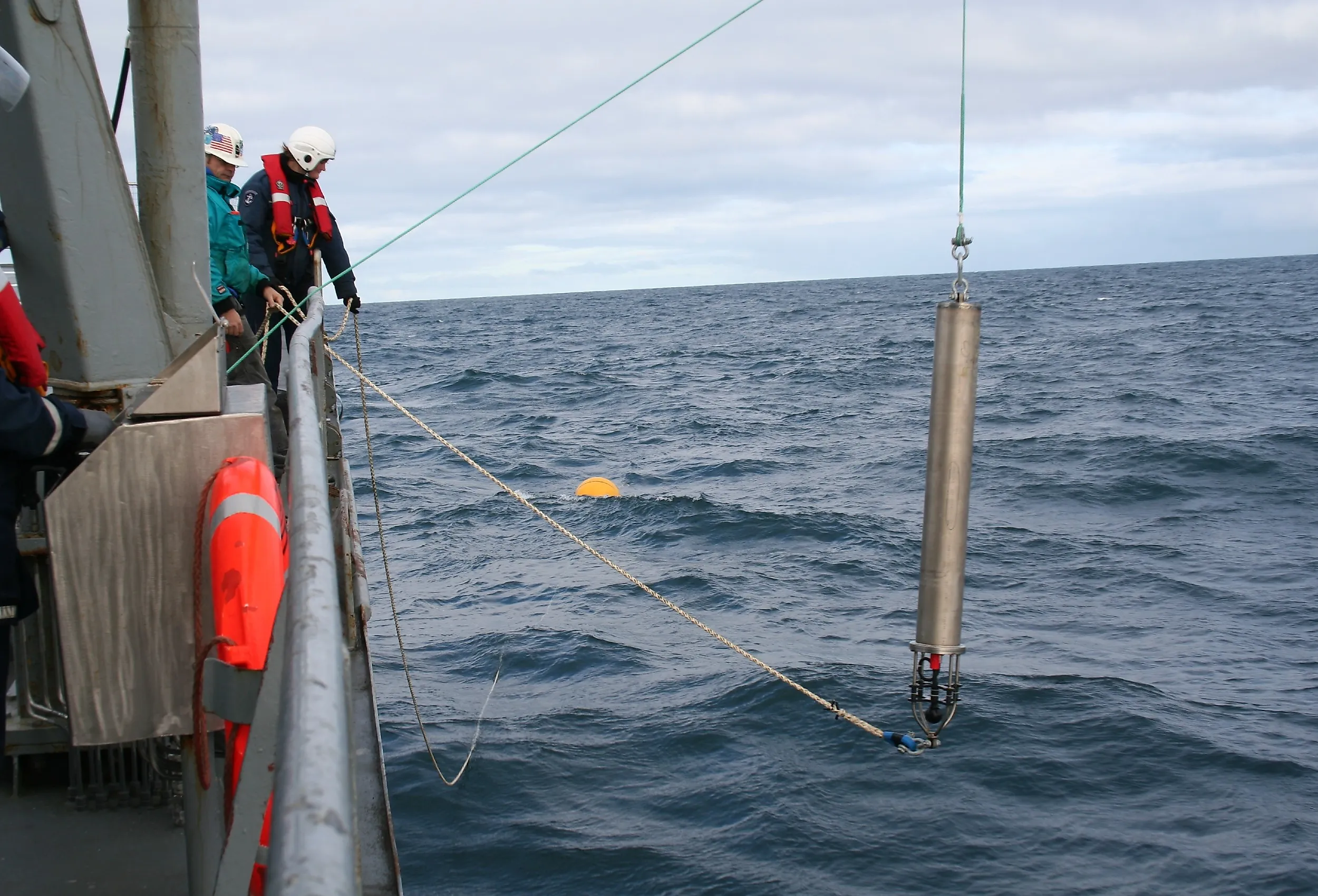
Scientists can deploy hydrophones to monitor whale populations, study earthquakes and underwater volcanoes, and investigate the sounds produced by human activity. Hydrophones positioned in the SOFAR channel can detect signals that would otherwise be difficult to hear from such great distances.
Sound Reaches the Deepest Point
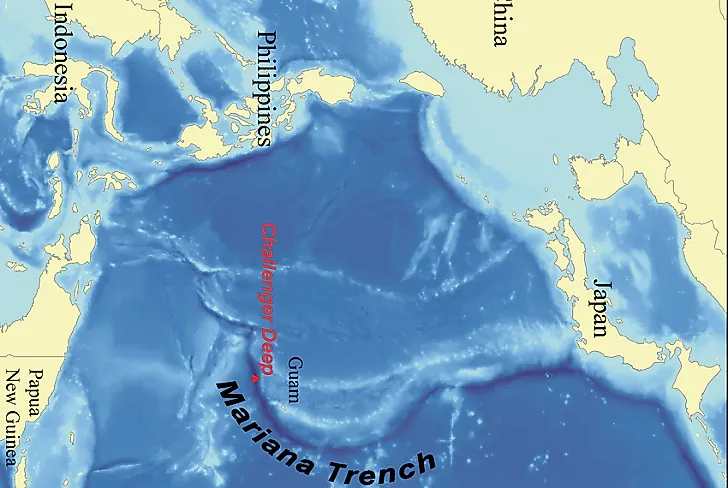
The Mariana Trench provides one of the most striking examples of how far sound can travel through the deep ocean.
Challenger Deep reaches approximately 35,876 feet, or 10,935 meters, below sea level. It is the deepest known point in the world's oceans. NOAA has deployed hydrophones in the trench to record sounds at depths where sunlight never reaches.
Researchers have recorded whale calls at Challenger Deep, demonstrating that sounds produced much closer to the surface can reach even this extraordinary environment. The recording does not mean the SOFAR channel extends to the trench floor, since sound can reach a seafloor hydrophone through direct, refracted, reflected, and scattered paths outside the channel. Hydrophones have also detected earthquakes and other underwater sounds there.
The recordings are a reminder that the deepest parts of the ocean are not acoustically isolated from the rest of the planet. A whale, ship, or earthquake can produce a signal that travels through thousands of feet of water and eventually reaches a listening instrument near the seafloor.
For a place that is nearly impossible for humans to visit, sound provides another way to explore it.
When Human Noise Enters the Ocean

The same properties that allow scientists to hear whales and earthquakes can also carry human-made noise through the ocean.
Commercial shipping, oil and gas exploration, and naval exercises all contribute sound to the marine environment. Because sound travels efficiently underwater, some of these noises can spread over substantial distances. NOAA Fisheries notes that this increasing underwater noise can interfere with animals that depend on sound for communication, navigation, and avoiding predators.
The effect varies depending on the type, intensity, duration, and location of the noise. A ship passing through an area creates a very different acoustic signal from a powerful industrial or military operation.
Still, the basic problem is the same: an ocean that carries natural sounds efficiently also carries human-made ones.
For animals that rely on hearing rather than sight, a noisier environment can make it harder to detect important signals.
The Soundscape of the Deep
Sound weakens as it spreads, scatters, and loses acoustic energy to heat, with higher-frequency sounds generally being absorbed more rapidly than lower-frequency sounds.
The result is an underwater world that is almost the opposite of what humans experience on land. Light quickly disappears with depth, but sound can continue moving through the darkness. A whale's call can travel across enormous distances, while a distant earthquake can send vibrations through the water to a hydrophone far from the source.
The Mariana Trench shows just how far this acoustic world extends. At Challenger Deep, more than six miles beneath the surface, instruments can still detect sounds originating elsewhere in the ocean.
The deep ocean may be one of the darkest places on Earth, but it is far from quiet. Beneath the surface, seawater carries biological, geological, and human-made signals that instruments and marine animals can detect far from their sources.