The Whirlpools Strong Enough To Pull Down Boats
Whirlpools have fascinated humans for centuries. You may have heard the dramatic stories of ships disappearing into spinning funnels or watched movies showing them surrounded by churning water, looking powerful enough to swallow anything in their path. Natural tidal whirlpools do not act like drains that pull large oceangoing ships vertically beneath the surface, although their currents and waves can still disrupt navigation or contribute to an accident. However, powerful tidal whirlpools do exist in places like Norway and Japan, and they can create extremely hazardous conditions for small boats and swimmers.
How Tidal Whirlpools Form

A tidal whirlpool forms when tide-driven currents accelerate through or across a restricted passage and interact with opposing flows, sharp depth changes, ridges, or other seabed features. Wind and storms can worsen conditions, but are not the primary cause. As the tide rises and falls, huge amounts of seawater are pushed through narrow channels and around underwater rocks and ridges. These ocean floor obstacles disrupt the flow and redirect water, causing it to spin and create powerful swirling currents.
The seafloor's shape also plays an important role. Deep trenches alongside shallow areas can make the water move at different speeds, while submerged rock formations can force currents upward or sideways. This creates the twisting motion seen at the surface. Despite their powerful appearance, tidal whirlpools are not giant holes draining the ocean. They are complex areas of fast-moving water and waves that can become extremely dangerous for small boats, fishing vessels, and swimmers caught in the strongest currents.
Moskenstraumen: Norway's Powerful Tidal System
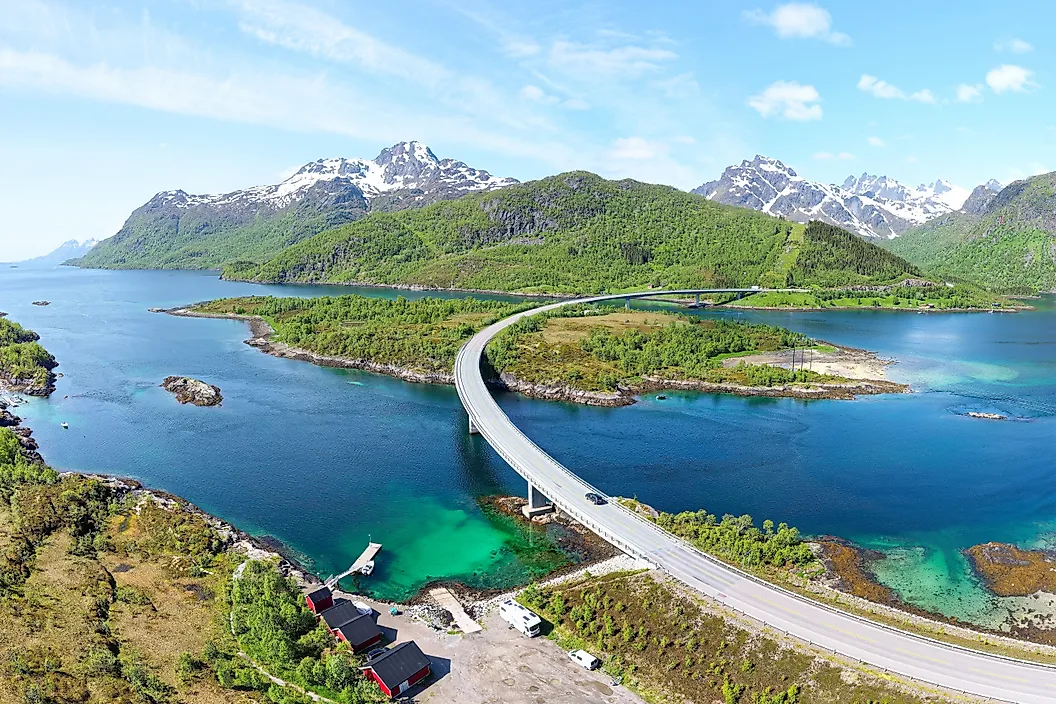
Off the coast of Norway's Lofoten Islands lies the Moskenstraumen, a powerful system of tidal currents and whirlpools. It is between Lofotodden on Moskenesøya and the island of Mosken in Værøy Municipality, where tides move water between the Norwegian Sea and Vestfjorden. Most great whirlpools form inside confined straits or channels. The Moskenstraumen is unusual because it forms in open water, where strong twice-daily tides cross a shallow ridge between the islands. The shape of the seafloor helps direct and speed up these currents. During strong tides, the water can move at roughly 28 kilometers per hour (17 miles per hour), while strong winds can make conditions even more challenging.
Local fishermen's boats, motorized utility boats, and sea kayaks face the greatest danger of losing control. Fast waters can push a vessel sideways, spin it around, or send it into larger waves. Steering becomes difficult when water moves in different directions simultaneously. If a small boat capsizes, powerful currents can sweep people underwater. The danger comes from the combination of fast-moving water, the waves, and choppy weather.
Corryvreckan: Scotland's Roaring Eddies

The Corryvreckan, a narrow strait with powerful tidal currents and swirling water, sits between the Isle of Jura and Scarba in Scotland. Its unusual seabed includes a deep hole and a basalt pinnacle known as An Cailleach, or the Old Hag, which rises to within about 29 meters (95 feet) of the surface. Flood tides reaching about 8.5 knots, or roughly 16 kilometers per hour (10 miles per hour), strike that obstruction and produce strong eddies and standing waves.
The Corryvreckan is also linked to a dangerous, albeit fascinating, incident involving writer George Orwell. In August 1947, Orwell was sailing in the area with his three-year-old son and two other family members when their outboard motor was torn from their small boat. Without engine power, the strong current began carrying them toward the intense whirlpool. The current and their oars carried them to Eilean Mòr, a rocky islet where the boat capsized as they tried to land, leaving them stranded until a passing lobster boat rescued them. Their experience shows how quickly conditions can become life-threatening. Even simple mechanical failures can leave a small vessel helpless when caught in a powerful tidal current.
Naruto Strait: Unstable Whirlpools in Japan

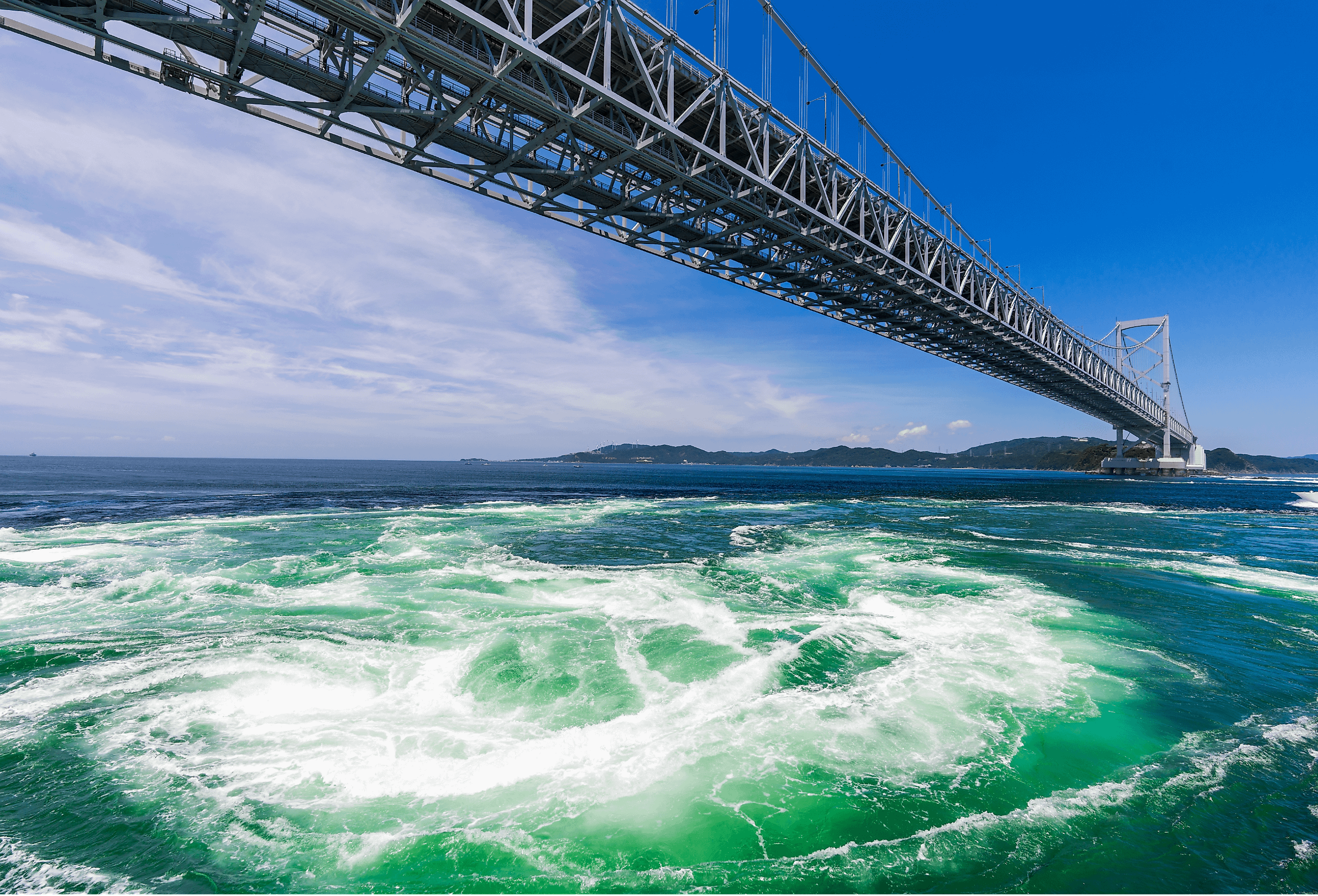
Japan's Naruto Strait is another spectacular example of a powerful tidal whirlpool system. Located between Shikoku and Awaji Island, the strait connects the Seto Inland Sea and the Kii Channel, where water levels can differ by about 1.5 meters (5 feet). As the tide changes, large volumes of water move quickly through a passage only about 1.3 kilometers (0.8 miles) wide. Strong tidal flows can create swirling water up to about 20 meters (66 feet) across, with speeds reaching roughly 20 kilometers per hour (12 miles per hour), the fastest tidal current in Japan.
The Wonder Naruto is actually a large sightseeing boat specifically designed to handle the waters around the Naruto Whirlpools. It takes passengers on professionally operated excursions that pass very close to the whirlpools, and sometimes directly over them. Smaller, less powerful vessels, however, are much more vulnerable to sudden changes. The main threat is losing control and being caught between opposing waters that can rotate, drift, or become unstable.
Old Sow: Canada's Whirlpool Piglets

Old Sow forms in Western Passage, near the international boundary between Deer Island in New Brunswick and Moose Island at Eastport, Maine. It forms when the strong tides of the Bay of Fundy meet the area's unusual underwater terrain and opposing waters. At peak flow, it can measure as much as 76 meters (250 feet) across, making it the largest tidal whirlpool in the Western Hemisphere. Although its smaller whirlpools are sometimes called "piglets," the origin of the name Old Sow is uncertain and may derive from "sough," a word associated with a sucking sound or drain.
These conditions can be especially dangerous for small boats. A kayak, canoe, or small sailboat caught in the strongest flows can quickly spin, lose direction, or be pushed off course. If the boat overturns, rapidly moving currents and turbulent water can separate people from the vessel and make rescue difficult.
Reality Versus Myth
Stories of enormous whirlpools swallowing ships, such as those in Homer's Odyssey and Edgar Allan Poe's A Descent into the Maelström, have circulated for centuries. Such tales and folklore make for exciting storytelling, but real tidal whirlpools are driven by physics rather than supernatural forces. For smaller boats, that power is very real, and a whirlpool does not need to swallow a ship whole to be perilous. Losing control, capsizing, or being swept into turbulent water can quickly turn a routine journey into a life-threatening emergency.
The most accurate way to understand these phenomena is not to picture an enormous drain beneath the ocean. Think instead of enormous volumes of tide-driven seawater accelerating through narrow passages and flowing over an irregular seabed. The resulting waves and currents make Moskstraumen, Corryvreckan, Naruto, and Old Sow fascinating, and their intensity and navigational risk vary with location and tidal conditions.