The Sea Creatures That Glow To Lure Their Prey
Beneath the first layer of the ocean, the sunlit epipelagic zone where most ocean life lives, are the deeper and darker layers that are home to marine predators that survive through highly specialized bioluminescent strategies. Instead of relying on speed or stealth, these animals have turned into masters of illusion that use illumination to trick their prey into swimming right up to their waiting jaws.
The primary mechanism relies on mimicry. Food is much more scarce in the deeper parts of the ocean. Any small point of light is highly attractive to lower-trophic organisms, which mistake the glow for small glowing prey or chunks of organic debris (marine snow) drifting down from the surface. By projecting an isolated point of light or a pulsating pattern in the dark, bioluminescent predators exploit this foraging instinct. The illumination effectively acts as an optical trap, drawing target species directly into the strike zone of a stationary or slow-moving predator that remains otherwise completely invisible in the surrounding dark.
The light they emit is created through a chemical reaction in which a molecule called luciferin interacts with oxygen. Many organisms also produce the catalyst, an enzyme called luciferase, which speeds up the reaction.
Some animals brew this glowing cocktail inside their own bodies, while others house glowing colonies of specialized bacteria in flesh pockets called photophores. Across the plunging submarine canyons off New England and the abyssal zone of the Pacific off the US West Coast, these animals have turned dark waters into an advantageous hunting ground.
Sloane's Viperfish

Sloane's viperfish (Chauliodus sloani) inhabit the mesopelagic, bathypelagic, and abyssopelagic, or twilight, midnight, and abyss zones at depths between 650 and 15,420 feet. They are distributed throughout the Atlantic, Indian, and Pacific Oceans, including populations inhabiting the deep waters of the Oceanographer Canyon and the San Clemente Basin, off the coasts of New England and southern California respectively.
The species is defined by their slender, iridescent silver-blue body and long, curved, fang-like teeth, which are so oversized that they do not fit inside their closed mouth and instead curve back near the eyes. They feature a modification of their first dorsal fin ray, which extends forward over the head like a fishing rod and measures about half the length of their body. The tip of this elongated filament houses a photopore that emits a steady blue-green light.
To hunt, the viperfish maneuvers the luminous tip directly in front of their mouth, and waits, motionless in the water. When their preferred prey, myctophids (lanternfish), or any other sea creature they can fit their oversized jaws around, move within striking distance, the viperfish launches an attack. A specialized hinge between the skull and spine lets the fish drop their lower jaw open to nearly 90 degrees, while a modified first vertebra acts as a shock absorber for the strike. This dramatic gape allows the oversized and hinged jaws, equipped with transparent, curved fangs, to lock the prey into place.
The Humpback Anglerfish

The humpback anglerfish (Melanocetus johnsonii) lives across the twilight, midnight, and abyss zones, at depths of 330 to 14,760 feet, with significant collection records from the Monterey Canyon off the coast of California.
This anglerfish has a rounded, soft-bodied, dark brown to black body with a disproportionately large head and mouth relative to their small size (up to six inches). Their tiny, skin-covered eyes suggest they rely little on vision to hunt. Females feature a modified spine on their back that acts as a fishing pole, called an illicium, tipped with a fleshy, glowing bulb called an esca. The anglerfish doesn't produce this light on her own; she keeps a thriving colony of glowing symbiotic bacteria packed inside the bulb, feeding them nutrients directly through her blood vessels.
According to the Monterey Bay Aquarium Research Institute (MBARI), the anglerfish controls the intensity and pulse rate of the glow by regulating blood and oxygen flow to the esca. It waves the apparatus slowly to mimic the movement of tiny prey, which lures in marine life thinking they've found a meal.
When a target species approaches, the anglerfish snaps open their oversized jaws while simultaneously dropping the floor of their mouth and flaring the gill covers outward in a fraction of a second. This sudden volume increase creates a massive internal drop in pressure, generating a localized suction vacuum that pulls the surrounding water, and the prey within it, whole into an elastic stomach.
The Black Dragonfish

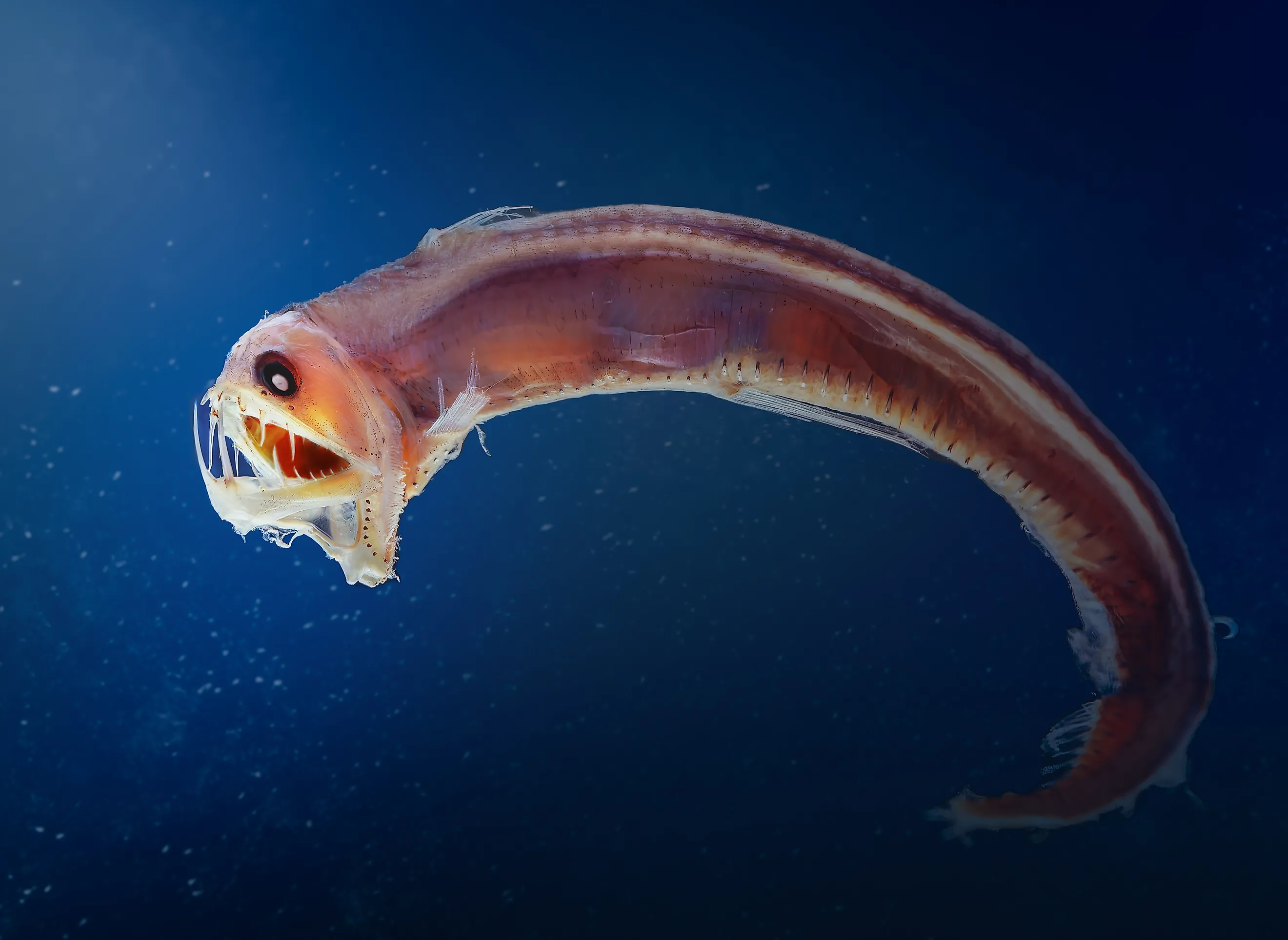
The black dragonfish occurs in the subtropical and temperate waters of the Atlantic Ocean, including the Blake Plateau and the Hatteras Abyssal Plain off the southeastern United States. The female black dragonfish reaches lengths up to 1.3 feet and has a long, slender, eel-like black body built for disappearing into the dark, with a mouth full of thin, needle-like, nearly transparent teeth. They feature a long, ribbon-like whisker dangling from their lower jaw (called a mental barbel) that ends in a glowing, twitching tip designed to look like a swimming shrimp.
NOAA expeditions have demonstrated that while dangling this chin lure to attract prey, the dragonfish hides from becoming a meal themself using ventral counterillumination (belly camouflage). Rows of photophores along their underside perfectly match the dim light filtering from the surface, erasing their silhouette so predators looking up from below cannot see them.
The Stoplight Loosejaw

Found below 1,640 feet in the deep basins of ocean, including the Gulf of Mexico and the Straits of Florida, the stoplight loosejaw (Malacosteus niger) is a marvel of deep-sea engineering. They are a small, dark-bodied fish whose most prominent feature is the lower jaw, which measures nearly a quarter of the fish's total length and tends to hang open. The fish features photophores under the eyes that can flash both green and red light. The green light acts as a close-range lure to attract tiny, drifting prey, while the red light, invisible to nearly everything else at that depth, lets the loosejaw illuminate and track prey without being detected.
The loosejaw's strike relies on a floorless lower jaw design. Most fish create a wall of water resistance when trying to snap their mouths open underwater, which creates a pressure wave that can accidentally push a tiny prey item away. The loosejaw solved this by completely getting rid of the skin and muscle floor of their mouth, leaving their lower jaw as an open, bare frame. When they strike, their jaw snaps forward and upward at blistering speeds with near-zero water resistance, scooping up prey before the target even realizes the green light was a trap.
The Deep-Sea Siphonophore Erenna
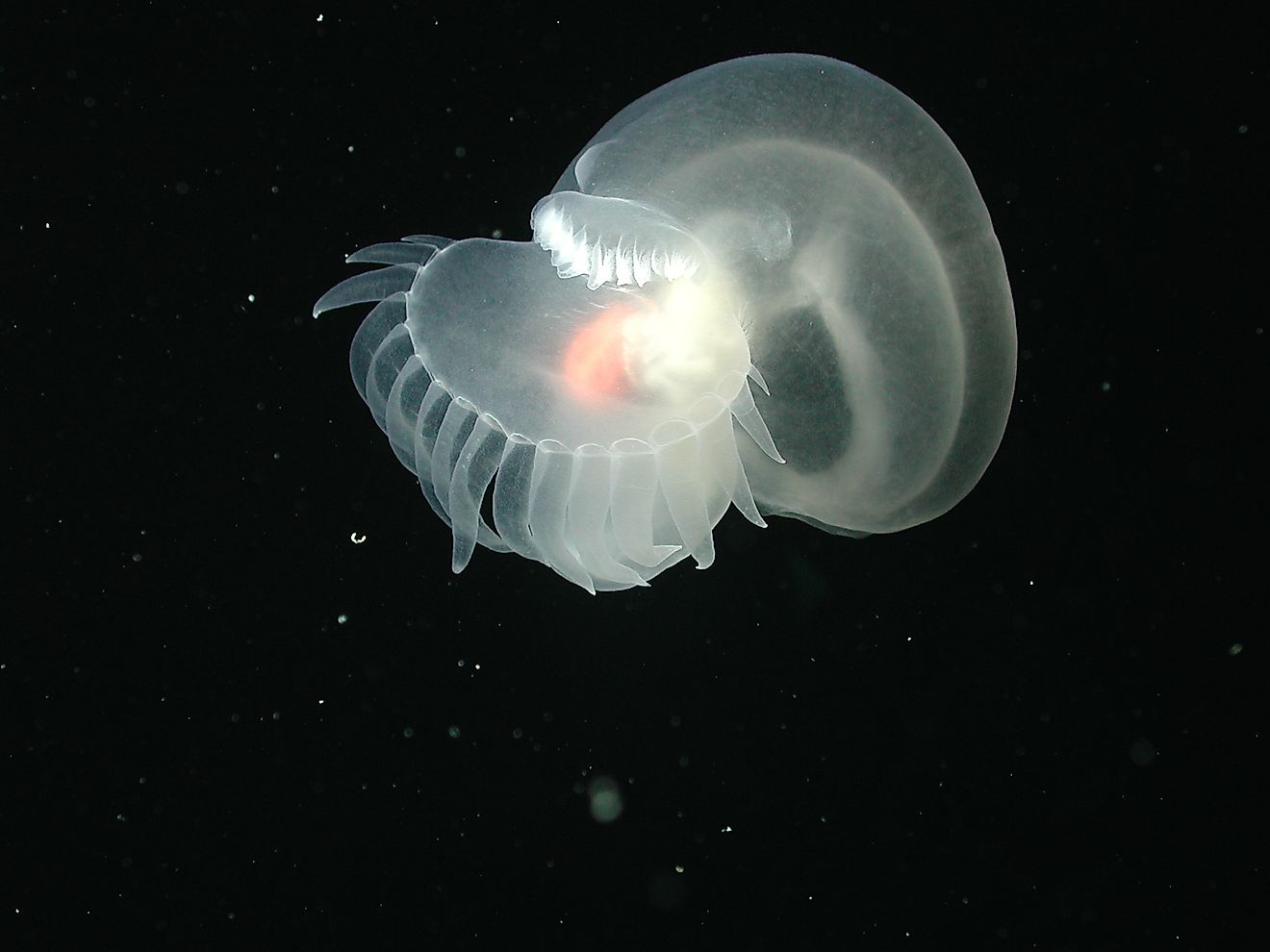
The siphonophore Erenna is a colonial predator first documented using bioluminescent lures by MBARI researchers working in the deep waters of Monterey Canyon off central California, at depths reaching several thousand feet in the bathypelagic zone. Unlike a single animal, Erenna is a chain of specialized, genetically identical units called zooids, each performing a different task such as feeding, reproduction, or defense, for the colony as a whole.
Along their trailing tentacles, Erenna grows small, red, fluorescent lures shaped and sized to resemble tiny swimming copepods, complete with fine, twitching appendages.
According to MBARI, the colony pulses these lures in the dark to imitate the movement of live prey. The color is unusual: most small crustaceans in the deep sea cannot see red light at all, which would make a red lure useless for attracting the copepods and shrimp most deep-sea predators target. But researchers who first described this species found fish, not crustaceans, in the gut contents, and fish eyes are more likely than crustacean eyes to retain some sensitivity to red wavelengths. The lure's color may therefore be tuned to the one class of prey equipped to actually see it, rather than serving as camouflage. Small fish drawn to the decoy swim directly into range of Erenna's stinging tentacles, which deliver venom before drawing the prey in to be digested by the colony's feeding zooids.
The Longfin Dragonfish

The longfin dragonfish (Tactostoma macropus) is a sleek, eel-like fish native to the cold North Pacific, with a home range spanning the North Pacific between the Aleutian Trench and the San Pedro Basin off Southern California, at depths of 650 to 3,280 feet. They carry a small, glowing mental barbel on the chin to attract food.
To conserve energy in the open ocean, this fish relies on a passive horizontal suspension tactic. They precisely adjust the gases inside the swim bladder until their body density perfectly matches the water, achieving a neutral buoyancy. By doing this, they can hang completely still and horizontal in the water column for hours without burning a single calorie, letting their glowing chin lure dangle beneath like a fishing line.
When prey approaches the lure, the dragonfish switches from a frozen statue to an active predator using a coiled ambush strike. They hold their elongated, flexible body in a slight muscular curve. The moment their sensitive body-line cells detect water vibrations from the prey near the lure, they snap their body straight to spring forward. Simultaneously, the dragonfish drops their lower jaw to form a wide cage of long, clear, needle-sharp teeth that curve backward toward the throat, ensuring the trapped meal cannot wiggle free in the dark.
The Cookiecutter Shark

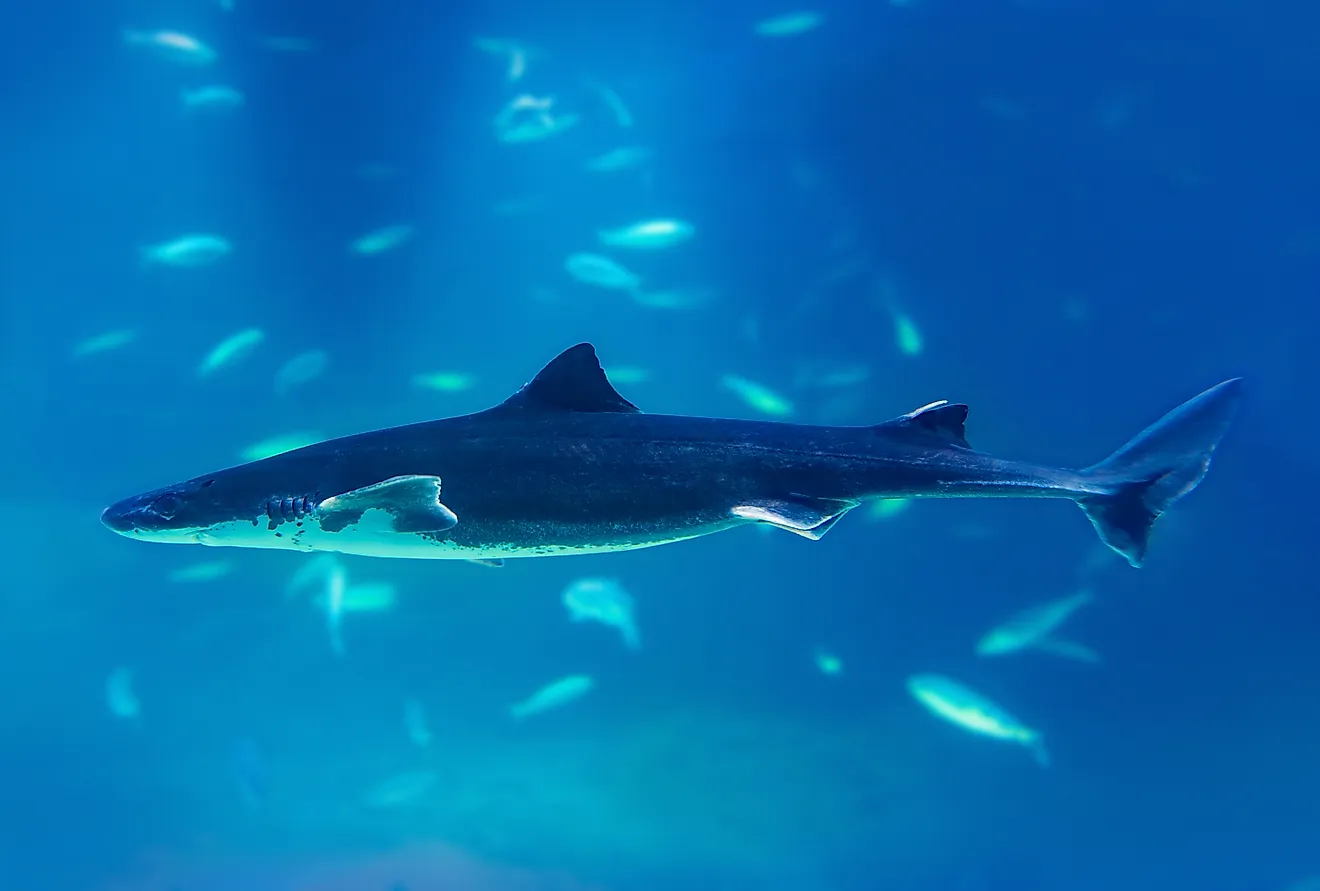
The cookiecutter shark (Isistius brasiliensis) is a small dogfish shark found in warm oceanic waters, with frequent records around the Hawaiian Ridge and near the Davidson Seamount off California. They inhabit waters as deep as 12,140 feet in the midnight zone during the day, and climb to a depth of around 300 feet at night to hunt.
Their entire belly is packed with thousands of tiny, surface-level photophores that cast a brilliant green glow.
According to the Florida Museum of Natural History, this glow acts as a trap through a strategy called aggressive silhouette mimicry. The shark features a small, dark collar patch on their throat that completely lacks photophores. As the rest of their body glows green to blend with the faint moonlight filtering into the upper twilight zone, this dark patch stands out as a clear silhouette. To large predators looking up from beneath, this dark spot looks exactly like a small, harmless fish. When a large predator strikes at what they think is an easy meal, the cookiecutter shark swerves, clamps their suction-cup mouth onto the victim's side, and uses their razor-sharp bottom teeth to scoop out a neat, circular plug of flesh.
Whipnose Anglerfish

The whipnose anglerfish (genus Gigantactis) has been documented at a depth of 19,245 feet, according to a 2024 study in the Journal of Fish Biology, a record that places it solidly within the true abyssal zone rather than the shallower bathypelagic waters where most anglerfish live. The same study recorded an observation of Gigantactis gargantua off the coast of California, made by deep-sea camera equipment.
Unlike the compact, stocky build of most anglerfish, the whipnose has an unusually slender, elongated body, and their illicium, the modified fin spine that carries the lure, stretches out several times the length of their own body rather than staying close to the head. Researchers documenting the species found them swimming upside down, with the long illicium hanging straight down beneath it and the glowing lure suspended below that. Scientists studying this behavior suggest the inverted position lets the fish keep the lure further from their mouth, allowing them to take down larger and faster prey without accidentally biting themself.
The Master Illusionists of the Depths
Through optical tricks that create enticing silhouettes and dazzling lures, these eight sea creatures demonstrate that survival in the ocean's deep and dark waters is less about chasing down prey or brute force and more about precise biological deception.
In an environment defined by extreme pressure, freezing temperatures, and a scarcity of food, evolution favors predators that minimize energy expenditure while maximizing capture success. Bioluminescence transforms what could be a crushing liability, visibility in the dark, into the ultimate hunting asset.