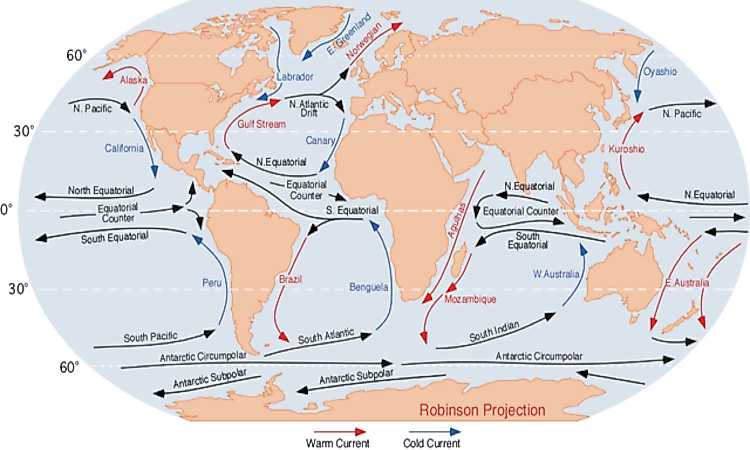
How Do Ocean Currents Affect Climate?
At roughly the same latitude as iced-over Labrador, palm trees grow in gardens on the west coast of Scotland. The difference is the ocean. Ocean currents are the planet's great heat engine, steady rivers of seawater that haul warmth out of the tropics and push it toward the poles, and where that water travels, climate follows.
A current is a continuous, directed flow of seawater, set in motion by wind, by the Earth's rotation through the Coriolis effect, and by differences in temperature and salinity that make some water denser than the rest. These flows can run for thousands of kilometers and link every ocean into a single system. Surface currents, driven mainly by wind, stir the upper few hundred meters; deep currents, driven by density, creep along far below. Together they shift an immense amount of heat, on the order of a petawatt (a quadrillion watts), away from the equator, and in doing so they help decide how warm or cold, wet or dry, a coastline turns out to be.
The Ocean's Global Conveyor Belt

Two engines drive the ocean. Near the surface, prevailing winds push water into five enormous rotating systems called gyres, one in each major ocean basin, which the Coriolis effect bends into clockwise loops north of the equator and counterclockwise loops to the south. These wind-driven currents ferry tropical heat toward higher latitudes, racing fastest along the western edges of the oceans.
Far below runs the second engine: the thermohaline circulation, or global conveyor belt, powered not by wind but by density. In the cold North Atlantic, surface water loses heat to the air and grows saltier as it evaporates, until it is dense enough to sink thousands of meters and spread out across the seafloor. That sinking pulls warm surface water north to replace it, while the cold deep water flows south and eventually rises again in the Pacific and Indian Oceans. A single parcel of water can take around 1,000 years to finish the loop. This slow overturning is what stitches the oceans into one circulation and moves heat on a planetary scale.
Warm and Cold Currents
Every current carries a temperature, and that temperature is what it hands to the air and the land it passes. Warm currents flow away from the equator, carrying sun-heated tropical water poleward and lifting the temperature of the air above them. The Gulf Stream and the Pacific's Kuroshio are the heavyweights, narrow, fast jets running up the eastern coasts of continents.
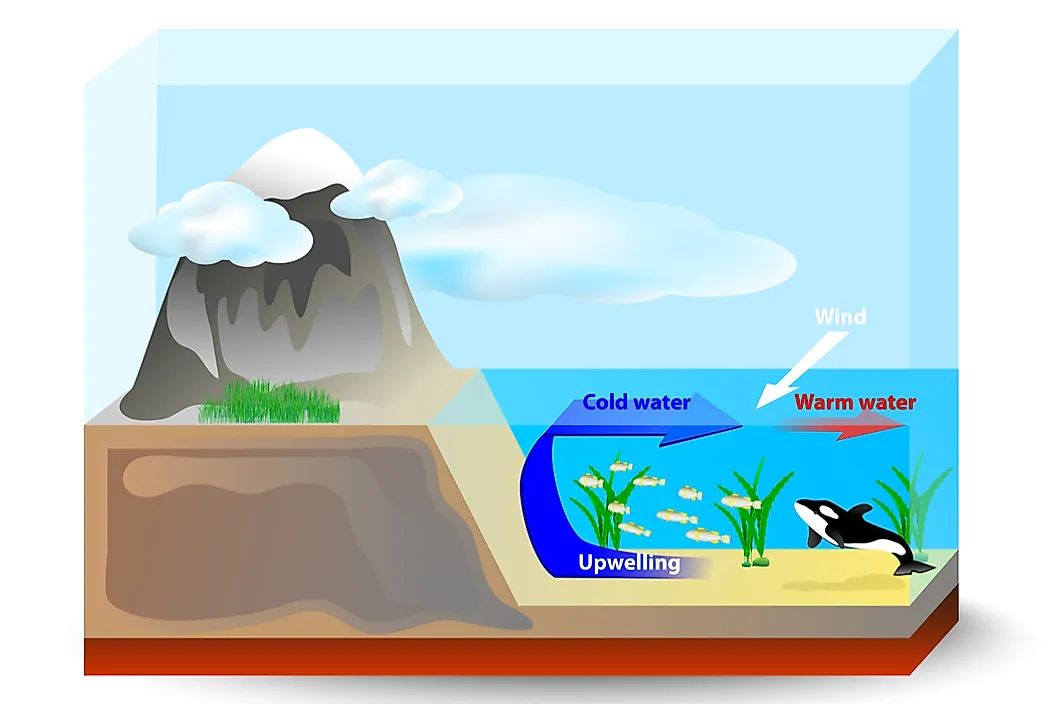
Cold currents do the reverse, sliding from high latitudes back toward the equator along the western coasts of continents and cooling the air overhead. They are reinforced by upwelling, in which winds blowing along a coast drag surface water out to sea and cold, deep water rises to take its place. Where a cold current meets a warm shore, the effect can be striking: persistent fog, stable air, and almost no rain.
How Currents Shape Regional Climate
The clearest example flows past Western Europe. The Gulf Stream gathers warm water in the Gulf of Mexico, races up the Atlantic coast of North America, then drifts northeast as the North Atlantic Current. The prevailing westerly winds lift that ocean heat and carry it ashore, which is a major reason Britain and Norway enjoy mild winters while Canada's Atlantic coast, on the same latitude, freezes. The current is not the whole story, since atmospheric heat transport matters too, but without it northwestern Europe would be a far colder place.

Cold currents leave just as sharp a signature. Off Peru and Chile, the Humboldt Current and its upwelling chill the coast so thoroughly that the overlying air carries little moisture, helping create the Atacama, the driest non-polar desert on Earth. The Benguela Current does the same along southwestern Africa, parching the Namib. Those same cold, upwelling waters feed the planet's richest fisheries: upwelling zones cover only a sliver of the ocean yet supply a large share of the world's catch, drawing nutrients and fish, and the industries that follow them, to otherwise barren coasts.
El Niño, La Niña, and the Whole Planet's Weather
Not every current effect is permanent. In the tropical Pacific, the climate flips every two to seven years in a cycle called the El Niño-Southern Oscillation. In an ordinary year, the trade winds drag warm surface water westward and let cold water well up off South America. During El Niño, those winds slacken, the warm water slides back east, and the upwelling shuts down. The warmed Pacific then rewires weather worldwide: drought across Indonesia and Australia, floods in Peru and the southern United States, weaker monsoons, and altered hurricane seasons. La Niña, the cold phase, winds the trades back up and tends to do the opposite. A single shift in one ocean's currents can swing harvests and disasters on the far side of the globe.
A Conveyor Belt Under Strain
The same circulation that keeps Europe mild is now under close watch. As Greenland's ice melts, it pours fresh water into the North Atlantic, and fresher water is less dense, so it resists the sinking that powers the conveyor belt. Measurements suggest the Atlantic overturning has been weakening, by some estimates to its slowest in a thousand years, and a stubborn patch of ocean south of Greenland has actually cooled while the rest of the planet warms.
How quickly it might weaken, and whether it could collapse this century, is still debated among scientists. The stakes, though, are not in doubt. A major slowdown would not warm Europe; it would chill it, bringing harsher winters and drier summers even as global temperatures climb, while disrupting the monsoons that billions of people farm by. It is the rare case in which a single ocean current could rewrite the climate of entire continents, which is why researchers track it so closely.
Why It All Matters
Ocean currents are the hidden machinery behind the weather outside the window. They settle why one coast grows palms and another grows ice, why some of the world's driest deserts sit right beside the sea, and why a pool of warm water in the Pacific can flood one country while it parches another. As the planet warms and that machinery begins to shift, understanding how the oceans move heat is no longer just a question for oceanographers. It is one of the keys to reading the climate's next move.