US National Parks Home to Animals Found Nowhere Else
Most animals in the National Park System have multiple habitat sites: a grizzly bear that calls Glacier home could just as easily be spotted in Yellowstone or Denali. The species on this list are different. Each one exists in exactly one national park and nowhere else in the country, sometimes nowhere else on Earth. A few live in a single flooded cavern, a single grove of trees, or a single island. These are the tightest ranges in the entire park system, and the parks protecting them are, quite literally, the last address these animals have.
Death Valley National Park: A Fish With the Smallest Range of Any Vertebrate on Earth

The Devils Hole pupfish doesn't just live in one national park. It lives in one hole. Devils Hole is a water-filled limestone cavern that drops more than 500 feet into the earth, a detached unit of Death Valley National Park tucked inside Nevada's Ash Meadows. The species has never been found breeding anywhere else, and its entire natural population depends on a single sunlit shelf near the surface where algae grows, the only food source stable enough to sustain them. Occasioanlly, its diet is supplemented with small aquatic invertebrates. That makes this fish's habitat the smallest range of any vertebrate species on the planet, according to the National Park Service.

The population is also volatile: after peaking at 191 fish in the spring 2024 count, two earthquakes in December 2024 and February 2025 sent waves through the cavern that stripped algae and eggs off the shelf, crashing the count to just 38 fish by spring 2025. Biologists responded with an unprecedented move, releasing 19 captive-raised fish from a backup facility into the wild population for the first time ever. It worked: the spring 2026 count found 77 fish, roughly four times the 2025 low. The species has hovered on this edge since being listed as endangered in 1967, and every recovery has happened in this one cavern.
Channel Islands National Park: The Rarest Songbird Confined To One Island

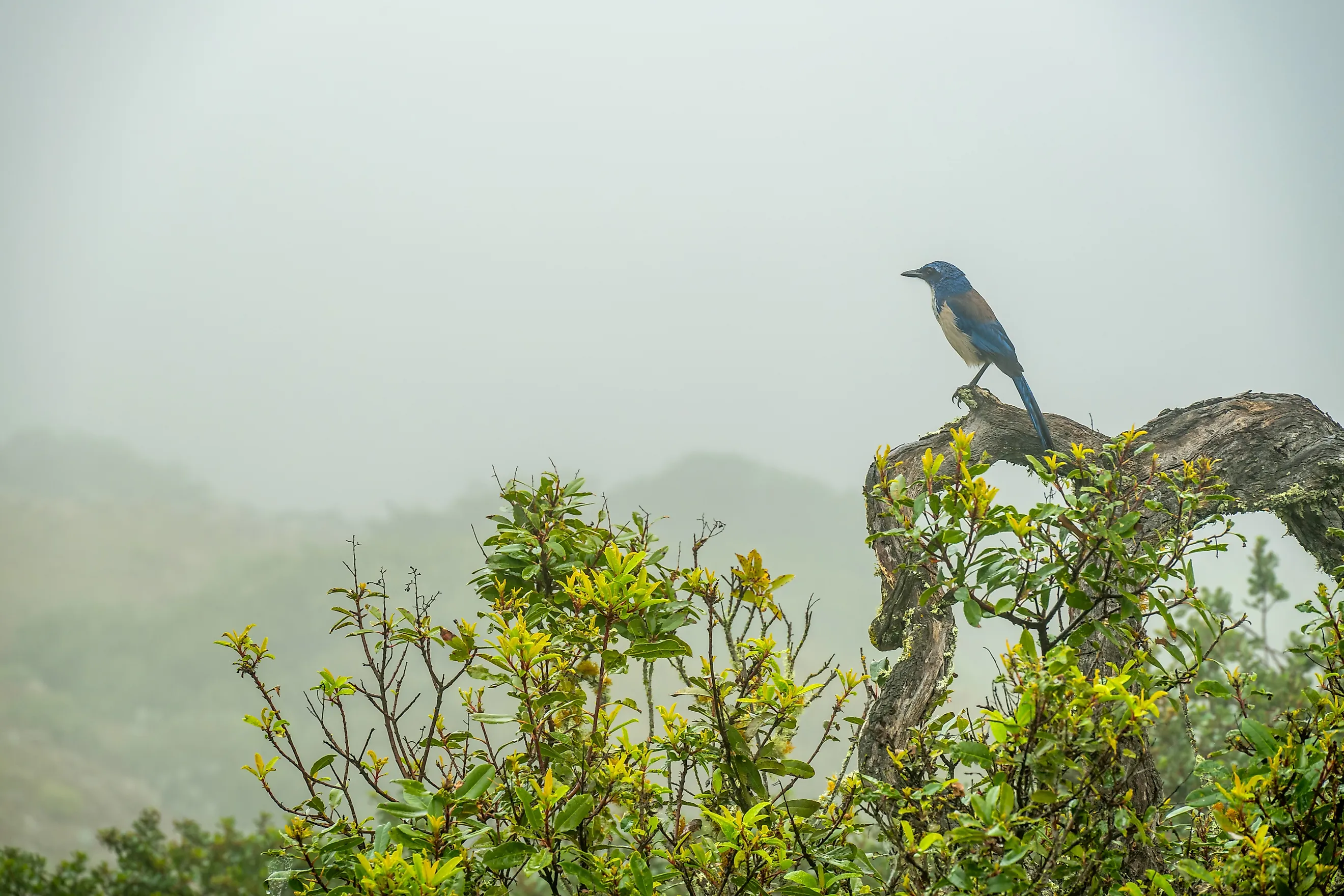
Of the more than 500 bird species that breed in North America, one occurs on a single island: the island scrub-jay. It lives only on Santa Cruz Island, the largest of the islands inside Channel Islands National Park, giving it the smallest breeding range of any bird species on the continent. Larger, darker, and louder than its mainland relative the California scrub-jay, the island scrub-jay likely diverged from that species roughly 150,000 years ago in isolation. A 2012 peer-reviewed study in the journal Ecological Applications, using a more rigorous survey method than earlier counts, revised the population down to around 2,300 birds, far below the previous estimate of over 12,000. That makes it one of the rarest songbirds in the country despite living in plain sight.

Fossil evidence suggests the jay once also lived on neighboring Santa Rosa Island, but there are no confirmed sightings there in more than a century. The National Park Service and The Nature Conservancy jointly manage Santa Cruz Island today, and removing invasive sheep, pigs, and cattle over recent decades has allowed the jay's oak woodland habitat, and the population depending on it, to recover.
Mammoth Cave National Park: A Shrimp That Has Never Seen Daylight

The Kentucky cave shrimp is eyeless, colorless, and found in exactly one place on the planet: the groundwater basins of the Flint-Mammoth cave system beneath Mammoth Cave National Park. Of the ten basins where the species has been documented, eight lie wholly or partly inside the park; the other two sit just upstream. First described in 1901, the shrimp spends its entire life in total darkness in underground streams, feeding on organic sediment washed in by groundwater. It was declared endangered in 1983, and biologists still consider it difficult to survey accurately, but historical counts have put the population in the low hundreds.

The threat isn't habitat loss in the usual sense; it's what flows into that habitat. Because the region sits atop porous limestone, contamination from nearby roads, sewage, and industrial spills can travel underground and surface directly in the shrimp's cave streams, sometimes with little warning. A 1980 truck spill of toxic cyanide salts on the interstate just south of the park is one incident researchers still cite as a cautionary example. The Kentucky cave shrimp has no other range to retreat to if this one is compromised.
Big Bend National Park: A Warbler That Barely Crosses the Border

The Colima warbler breeds widely across the mountains of northeastern Mexico, but within the entire United States, it occurs in exactly one place: the high, oak-and-pine slopes of the Chisos Mountains inside Big Bend National Park. According to the Cornell Lab of Ornithology, this remote corner of West Texas is the only spot in the country where the species has ever been confirmed breeding, and it's been that way since ornithologists first documented the bird in the U.S. in 1928.

Seeing one requires effort: the warblers nest above 6,000 feet on north-facing canyon slopes, reachable only by a multi-mile hike or horseback ride into the park's backcountry along what's now nicknamed the Colima Trail. The bird itself is unassuming, a drab gray-brown warbler with a white eye-ring, easy to overlook next to more colorful relatives. What makes it notable isn't its appearance but its address: among the roughly 60 warbler species that regularly occur in North America, this is the only one confined to a single national park for its entire U.S. range.
Hawaii Volcanoes National Park: Flies That Depend on One Grove of Trees

In a quiet old-growth forest called Kīpukapuaulu, inside Hawaii Volcanoes National Park, a handful of aging māhoe trees support two species of picture-wing fly found nowhere else: Drosophila mimica and Drosophila engyochracea. Hawaii is home to more than 500 endemic species of picture-wing fly, part of one of the most dramatic examples of adaptive radiation on Earth, all descended from a single ancestral species on the islands since ancient times. But these two have narrowed their range down to almost nothing: according to the National Park Service, the māhoe trees at this one grove are their exclusive host plant, the only place their larvae develop.

Park ecologists have tracked both species since the 1990s using sponges soaked in fermenting mushrooms to draw them out for counting. Drosophila mimica is holding on, feeding on the fruit of recovering māhoe trees. Drosophila engyochracea is not: sightings have collapsed since 2007, driven down by introduced predators including yellow jacket wasps and a newly arrived spider that hunts in the trees' bark. If Kīpukapuaulu's māhoe grove disappears, so does this fly, because there is no second grove anywhere else for it to fall back on.
The Smallest Addresses In The National Park System
What connects a blind cave shrimp in Kentucky, a drab warbler in West Texas, and a fish in a single Nevada cavern is how little margin each one has. There's no second population to fall back on if something goes wrong in these specific places, no other park where the story continues if this one doesn't. That's what makes "only national park" different from "rare" or "endangered": it means the boundary of a single park is also, for these five species, the entire boundary of their existence.