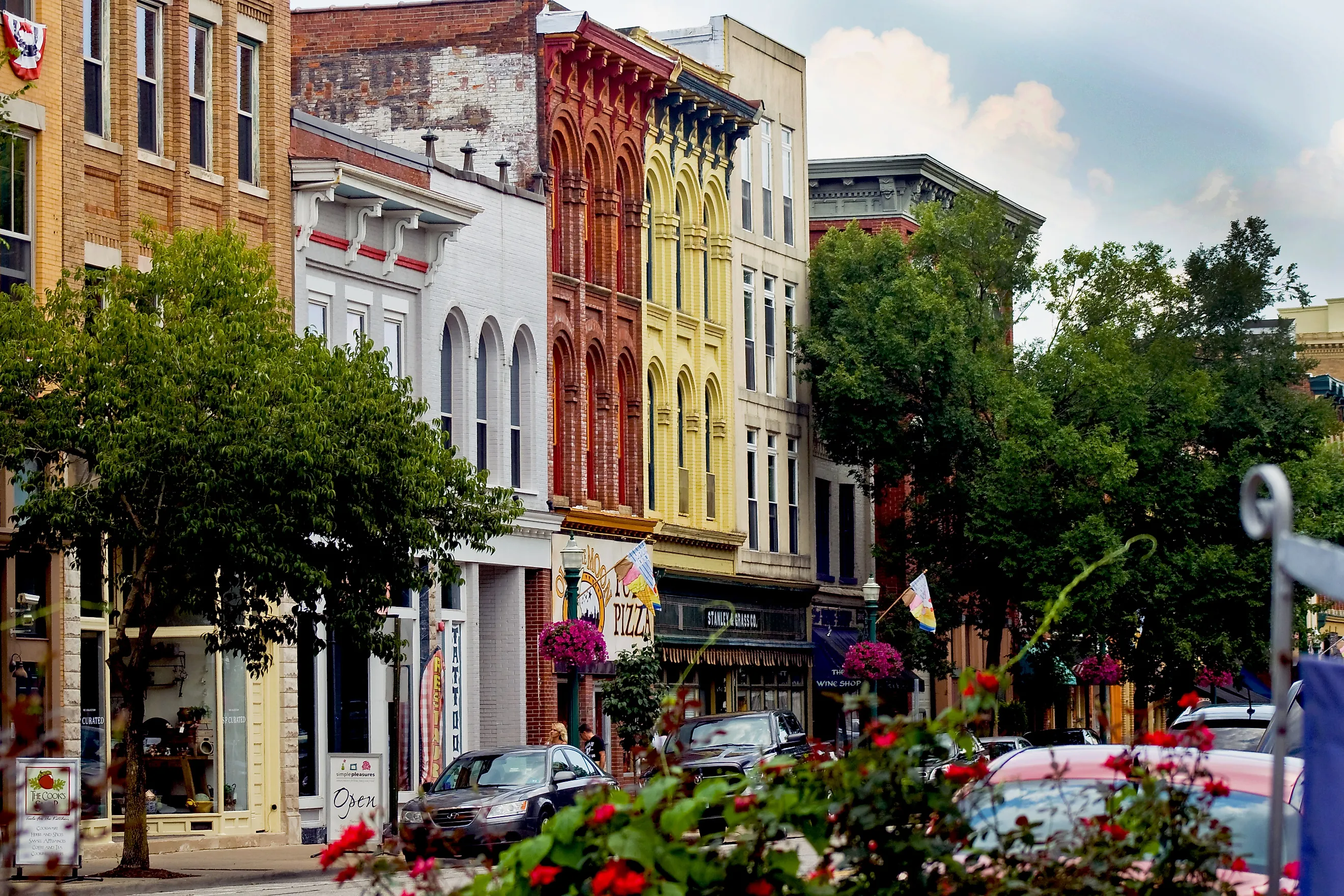
11 Ohio Towns Perfect For A Fresh Start
A fresh start takes a cheap house and somewhere to be on a Friday night. In Tiffin, that means a 1928 movie palace with a live show on the marquee. In Celina, it is a lake big enough for its own lighthouse. In Wapakoneta, it is a flown Gemini capsule under a dome shaped like a moon base. In every one of these eleven Ohio towns, a typical house costs less than $275,000, and not one of them is dull.
Findlay

A move to Findlay does not require giving up a serious job market. Marathon Petroleum is headquartered here, Whirlpool has a major operation in the city, and Blanchard Valley Health System employs people across healthcare. The University of Findlay adds another large workplace. That is a substantial base for a city of about 40,000, especially when homes have recently sold for a median near $220,000.
The city center is useful after working hours too. Main Street has restaurants and locally owned businesses, while Riverside Park follows the Blanchard River with paths and open space. The Mazza Museum is Findlay's most distinctive institution. Its collection focuses on original artwork from children's books, with thousands of pieces connected to illustrators and authors. Community events regularly use the downtown blocks, and recent violent crime has remained below the national rate. Findlay has an unusual combination of corporate jobs, a manageable housing market, and enough nearby activity that Toledo is not necessary for a night out.
Wooster

The Saturday farmers market is a useful introduction to Wooster. It takes place downtown, where restaurants and independent shops line the streets and local foot traffic runs steady. The Wayne Center for the Arts adds classes and performances nearby, while the College of Wooster brings public events and a changing student population into a city of roughly 27,000.
Housing costs more here than in several towns on this list, though the recent median of about $252,000 still falls below the Ohio figure. The employment picture helps explain some of that premium. The college supports hundreds of jobs, and healthcare is a major part of the local economy. Manufacturing and agricultural research add work outside those sectors.
Recent violent crime has been below the national level. Wooster also has dedicated cycling routes that connect parts of the city, making a short ride possible without heading into the countryside first. Much of Wooster's appeal is concentrated in a fairly small area: campus life feeds into downtown, and downtown still functions as somewhere residents actually spend time.
Tiffin

Tiffin is a city of around 18,000 with two universities and houses selling at a recent median near $189,000. That combination does much of the work here. Heidelberg University and Tiffin University bring jobs, sports, performances, and a continual arrival of people who did not grow up locally. Mercy Health-Tiffin Hospital gives residents access to medical care in town, while manufacturers provide another employment route. Recent violent crime has also been comparatively low. The best evening out is often at the Ritz Theatre, an ornate 1928 venue that still stages concerts and live performances. Downtown markets and university events fill some of the gaps between larger shows. Tiffin is small enough that those institutions overlap with everyday life; a campus event, the theatre, and the central business district are not isolated pieces sitting miles apart.
Marietta

About $170,000 was enough to match Marietta's recent median home sale price, one of the widest gaps below the Ohio median among these towns. That lower price does not mean living far from basic services. Memorial Health System is a major employer, Marietta College brings education jobs into the center, and residents have local access to groceries and medical care. Recent violent crime has been especially low compared with national figures.
The more memorable part begins along the water. Marietta occupies the meeting point of the Ohio and Muskingum rivers, with brick streets and older commercial buildings only a short distance from the levee. Ancient earthworks survive inside the city, and the Campus Martius Museum holds exhibits on the settlement established here in the early years of the Northwest Territory. College programs and downtown events keep public life moving through the year. With only about 13,000 residents, Marietta does not need a large entertainment district. The riverfront and historic center are already where people gather.
Ashland

Ashland University's influence reaches well beyond its campus. Concerts, theatre productions, sports, and public programs add regular activity to a city of around 19,000, while the university itself supplies local jobs. University Hospitals Samaritan Medical Center covers healthcare and employs another large group of residents. Manufacturing remains part of the local economy too. The housing side is comparatively easy: recent sales put the median home price near $190,000, and overall crime has run below national levels. Freer Field sits south of the center with meadow and woodland trails that can be used for an ordinary evening walk, not an all-day trip. Brookside Park is another large public space closer to town. Ashland's attractions are not huge tourist draws, but that is part of their usefulness. They are places residents can keep returning to after the novelty of moving has worn off.
Mount Vernon

Local employment in Mount Vernon is unusually anchored for a city of about 17,000. Knox Community Hospital is one of the major workplaces, while Ariel Corporation manufactures gas compressors from its headquarters here. Mount Vernon Nazarene University adds a separate stream of education jobs and brings new students into town every year.
The housing market remains well below the state benchmark, with a recent median sale price of about $228,000. Recent violent-crime figures were also very low. Public Square forms the center of downtown, and First Friday events repeatedly fill the surrounding blocks with people who are there to eat, browse, or catch whatever is happening that evening.
Ariel-Foundation Park is Mount Vernon's most dramatic physical landmark. The roughly 250-acre site occupies former industrial land, and pieces of the old glassworks survive among its lakes and paths. The Rastin Observation Tower rises above it all. The Kokosing Gap Trail also passes close to town, so cycling does not require loading a bike into a car first. In Mount Vernon, the biggest recreation space sits close enough to become part of the weekly routine.
Bellefontaine

The Holland Theatre is not subtle. Its auditorium was designed to resemble a Dutch streetscape at night, complete with building facades beneath a painted sky. It sits in a downtown where old storefronts have reopened as restaurants and small businesses, and public events bring people back into the center. Court Avenue is another curiosity, thanks to its place in the early history of concrete street paving.
Bellefontaine's recent median home price was about $261,000, so it clears the affordability requirement by a smaller margin than most towns here. The tradeoff is a stronger service base than its population of roughly 14,000 might suggest. Mary Rutan Health provides hospital care and employs more than 1,000 people, while manufacturing supports additional jobs around the area. Recent violent and property crime have both been below national figures. The downtown revival matters most on an ordinary weekday, when the center still has businesses worth walking between instead of functioning only as an event backdrop.
Kent

Kent State University changes almost every part of life in Kent. It supplies jobs, fills rentals, supports restaurants, and guarantees that thousands of people arrive without deep local roots. That last point matters in a fresh-start town. Newcomers are normal here. Davey Tree is also headquartered in the city, and healthcare and schools broaden the employment base. Around 28,000 people live in Kent, where recent home sales produced a median price near $252,000 and violent crime remained well below the national rate. Downtown sits beside the Cuyahoga River, with the Portage Hike and Bike Trail passing through the corridor. The Kent State University Museum focuses on fashion and decorative arts, while the May 4 Memorial marks the site and history of the 1970 shootings. Restaurants, university programming, and city festivals keep different parts of the population crossing paths instead of dividing the town into separate campus and non-campus worlds.
Celina

The first thing that changes daily life in Celina is not downtown. It is Grand Lake St. Marys. The shoreline reaches the city itself, and at Lakeshore Park residents can walk beside the water after work. Fishing boats, summer events, and the annual Celina Lake Festival make the lake part of the local calendar as well as the scenery.
The city has only about 11,000 residents. Housing recently sold at a median near $239,000, while recent violent-crime figures were particularly low. Manufacturing remains an important source of income, and county government provides another pool of jobs. Medical services and ordinary shopping are available locally.
The Mercer County Historical Museum is the quieter side of Celina, with collections tied to local and regional history. On the busier summer days, people drift toward the waterfront. That proximity is the key distinction here. A lake view is not something reserved for a subdivision miles outside town. It sits directly beside the community's everyday public space.
Wapakoneta

Wapakoneta has fewer than 10,000 people, yet industrial work remains easy to find in the surrounding employment base. American Trim and General Aluminum are among the manufacturers operating locally, while schools and healthcare provide other options. Houses have recently sold at a median around $253,000. Violent crime has also stayed well below the national rate.
The town's identity comes from a resident who left Earth entirely. Neil Armstrong grew up in Wapakoneta, and the Armstrong Air & Space Museum contains a Gemini VIII spacecraft, spacesuits, lunar material, and exhibits tied to his career. Its distinctive building sits just outside the old downtown, a much more traditional Ohio streetscape of storefronts and civic events. The contrast is unusual: a small manufacturing city with a major space-flight collection sitting a few minutes from Main Street. Community events make regular use of downtown, something more frequent for residents than the museum traffic passing through from Interstate 75.
Defiance

Defiance developed at the meeting of the Maumee and Auglaize rivers, and that geography still determines where people spend time. Pontiac Park occupies the confluence near the site of the 1794 Fort Defiance, while the Andrew L. Tuttle Memorial Museum holds local-history exhibits a short distance away. Independence Dam State Park is a further outdoor option along the Maumee. Housing remains inexpensive, with a recent median sale price near $190,000 for a city of roughly 17,000 residents. Manufacturing is a major source of local work, supplemented by Defiance College and healthcare employers. Recent violent and property crime were both below national rates. Markets and seasonal events use the central streets throughout the year, but the river junction is the detail that matters most. Downtown, historic sites, and access to the water all occupy the same compact part of Defiance instead of being scattered across the county.
Weighing One Against Another
Affordability is the floor here, not the deciding factor. The price and jobs test is met across the whole list, so the choice comes down to the anchor a newcomer wants to live beside. Tiffin holds two campuses inside one small city, and Kent is shaped by a single large university and the people it brings through. In Celina the anchor is the lakefront, while in Marietta and Defiance daily life is organized around a river junction and a walkable historic core. The right pick depends less on the median home price than on which of those anchors a person expects to use every week.