British National Parks You Have Seen On Screen
Hollywood has had a long love affair with the United Kingdom. Whether the country serves as the setting for period dramas and romances or as a scenic backdrop for blockbuster movies, it's a country that offers up countless opportunities for those wanting to explore some of the most memorable scenes to ever hit the big screen.
Many of which were filmed in the country's national parks, like how the lake the Millennium Falcon skims in Star Wars: The Force Awakens is Derwentwater in the Lake District or that Dobby, the house-elf, is buried on a beach in the Pembrokeshire Coast National Park.
Here are seven of the UK’s national parks you’ve almost certainly seen on screen, and what’s there to see today.
Lake District National Park, England

Takodana, the forested planet where the heroes of Star Wars: The Force Awakens (2015) land halfway through the film, is the countryside south of the town of Keswick in Lake District National Park.
The shot of the Millennium Falcon arriving over water was taken above Watendlath Fell in the Borrowdale valley, looking north, with Derwentwater digitally enlarged and joined to its neighbor, Bassenthwaite Lake.
The castle of Maz Kanata, the pirate who keeps a tavern on the planet, was added to the lake by computer, with the fells (the local word for hills) of Catbells and Maiden Moor behind it. None of the actors actually made the trip, and instead a visual effects crew filmed the backgrounds from a helicopter.
So yes, those X-Wing fighters that race in from Walla Crag and across Thirlmere, a reservoir below the Helvellyn ridge, weren't real either.

Forty years earlier, the same valley opened and closed Tommy (1975), the British director Ken Russell's film of the rock opera by The Who. Russell made his home in Borrowdale, and the prologue and the ending were filmed there. The end credits thank the National Trust, the conservation charity, for the use of its Lake District land.
The Lake District is England's largest national park at 912 square miles and was added to the UNESCO World Heritage list in 2017.
Derwentwater, the third largest of its lakes, is the easiest of the Star Wars locations to see. The Keswick Launch calls at seven jetties around the lake, among them Hawes End for the path up Catbells.
Friars Crag, a promontory near the Keswick boat landings, looks down the lake to the Jaws of Borrowdale, the gap between the fells that appears behind Rey when she first steps off the ship.
Northumberland National Park, England

On the night of September 27, 2023, two men with a chainsaw (both since jailed) cut down the tree that Robin Hood: Prince of Thieves (1991) had made famous. The tree stood alone in Northumberland National Park, in a dip known as Sycamore Gap in Hadrian's Wall, the frontier the Romans built across northern England.
In the film, it's here that Kevin Costner's Robin, home from the Crusades, rescues a boy who has climbed the tree to escape the Sheriff of Nottingham's soldiers.
Planted in the late 1800s, the sycamore became known as the Robin Hood Tree, despite being 170 miles from Sherwood Forest. A six-foot section of the trunk is on permanent display at The Sill: National Landscape Discovery Centre, the park's visitor center, two miles from the site, and visitors are encouraged to touch it.

The stump, fenced off beside Milecastle 39, one of the small forts the Romans placed along the wall, has put out new shoots and can be reached via a 15-minute walk from the Steel Rigg parking lot.
In 28 Years Later (2025), Danny Boyle's horror film about a Britain sealed off from the world after a virus outbreak, crews filmed Sycamore Gap without the tree, adding it afterward digitally.
The woodland scenes in which the boy at the center of the story, played by Alfie Williams, hunts with a bow were filmed at Hesleyside, an estate inside the park, where up to 100 cast and crew worked among trees brought down by Storm Arwen, the windstorm that hit northern England in November 2021.
South Downs National Park, England

The Living Daylights (1987), Timothy Dalton's first film as James Bond, opens with a training exercise on the Rock of Gibraltar that turns into a chase and ends with a Land Rover loaded with explosives going off a cliff, with Bond on board.
The road is in Gibraltar, but the plunge was filmed in England at Beachy Head in what is now the South Downs National Park.
Beachy Head is a chalk headland with cliffs 530 feet high on the edge of the seaside town of Eastbourne, on the English Channel coast of Sussex. West of it are the Seven Sisters, a line of white cliffs that ends at the mouth of the River Cuckmere.
They're the first sight of England for Kevin Costner's Robin in Robin Hood: Prince of Thieves. The cliffs also appear in Harry Potter and the Goblet of Fire (2005) and Wicked (2024).

The South Downs is Britain's newest national park, established in 2010, and covers 627 square miles of chalk hills between Eastbourne and the cathedral city of Winchester. The South Downs Way, a 100-mile National Trail (one of Britain's officially designated long-distance paths), links the two and crosses the top of the Seven Sisters.
The base for seeing them is Seven Sisters Country Park at Exceat, a 692-acre reserve of cliffs, river valley, and grassland owned by the park authority, with a visitor center beside the main coast road.
Birling Gap, between the Sisters and Beachy Head, has a cafe run by the National Trust, the conservation charity, and a staircase down to the beach, where the cliffs can be seen from below.
Eryri (Snowdonia) National Park, Wales

When China refused the makers of Lara Croft Tomb Raider: The Cradle of Life (2003) permission to film there, they built a Chinese village in Eryri National Park instead. Eryri is the Welsh name for the Snowdonia mountains of northwest Wales. The set went up on the shore of Llyn Gwynant, a lake below Yr Wyddfa (Snowdon), which at 3,560 feet is the highest mountain in Wales.
It's on this set that Angelina Jolie's Lara Croft, the archaeologist from the Tomb Raider video games, fights her adversary Chen Lo. Thirty members of the Chinese community in the nearby town of Caernarfon were hired as extras, and a local farmer supplied the chickens, the geese, and a mule.

Wonder Woman 1984 (2020), with Gal Gadot in the titular role, came to the same park for the waterfall scene. Swallow Falls, known in Welsh as Rhaeadr Ewynnol, is on the Afon Llugwy (afon is Welsh for river) two miles west of the village of Betws-y-Coed. It was closed to the public while director Patty Jenkins's crew worked there. Visitors can get to the main viewpoint through a turnstile beside the A5 road.
The mountains also appear in HBO's House of the Dragon (2022 to present), the prequel to Game of Thrones. For the second season (2024), the production used Dinorwig Quarry on the edge of the park near the village of Llanberis, once the world's second-largest slate quarry, as the ruined castle of Harrenhal. Sets were also built here for the third season.
Eryri is the largest national park in Wales at 823 square miles, and Llyn Gwynant Campsite, on the lakeshore where the village set stood, offers kayaking and canoeing. The Sherpa'r Wyddfa bus circles the base of Yr Wyddfa, stopping at the start of its main footpaths.
Peak District National Park, England

Peak District National Park was Britain's first national park, and its 555 square miles of moorland and limestone valleys between the cities of Manchester and Sheffield have doubled as both Jane Austen's Derbyshire and a fantasy kingdom.
In Pride and Prejudice (2005), Joe Wright's film of the Austen novel, Keira Knightley's Elizabeth Bennet stands in the wind on Stanage Edge, a four-mile cliff of gritstone, a coarse sandstone, north of the village of Hathersage.
Pemberley, the estate of Elizabeth's suitor Mr. Darcy, is Chatsworth, the home of the Duke and Duchess of Devonshire. Elizabeth's tour of the house starts on the staircase of the Painted Hall and moves to the Sculpture Gallery, where she comes face to face with a bust of Darcy.
The scene was written for a gallery of paintings and changed to use Chatsworth's marbles. The bust, a likeness of Matthew Macfadyen who played Darcy, is still in the house (look for it in the Orangery shop at the end of the visitor route).

The dining room of the inn at Lambton, where Elizabeth stays with her aunt and uncle, was the banqueting room of Haddon Hall. This manor house near the town of Bakewell dates from the 14th century and has belonged to the Manners family for more than 400 years.
The northern section of the park had already served as Westeros in House of the Dragon. In 2021, the first season's crew filmed in the village of Castleton, in Cave Dale, the dry limestone valley below the ruins of Peveril Castle, and at Eldon Hill Quarry, where Prince Daemon Targaryen, played by Matt Smith, fights a pirate army. Cave Dale, with a castle added by computer, appears in episode five as the Vale, a mountain kingdom.
A public footpath runs the length of Cave Dale from the edge of Castleton, and the Castleton Visitor Centre, run by the park authority, is the place to pick up a map. Stanage Edge is a short climb from the roadside parking above Hathersage and is as popular with rock climbers as it is with Austen fans.
North York Moors National Park, England

Hogsmeade Station has two platforms, Victorian-era stone buildings, and a real name, Goathland. That station is in the North York Moors National Park in Yorkshire, and in 2001's Harry Potter and the Philosopher's Stone (released in the United States as the Sorcerer's Stone), it's where the Hogwarts Express delivers the first-year students to school. It is also where Harry says goodbye to Hagrid, the school's gamekeeper, in the final scene.
Little had to be changed for the cameras. Goathland opened in 1865 and is a stop on the North Yorkshire Moors Railway, a 24-mile heritage line between the market town of Pickering and the fishing port of Whitby.
The route was built in the 1830s by George Stephenson, the engineer behind some of Britain's first steam railways, as a tramway worked by horses, and it opened in 1836. It was closed in the 1960s and reopened by volunteers in 1973.

Harry Potter isn't the village's only screen credit. Goathland was Aidensfield in Heartbeat, the long-running police drama set in the 1960s. The railway now bills Goathland as its celebrity station, and the shop on the platform sells Harry Potter gifts.
The park around it covers 554 square miles of moorland, forest, and North Sea coast. The railway is the easiest way to see it without a car. Pickering Station has been restored to its 1930s appearance; Grosmont, the next stop north of Goathland, is where the railway keeps and repairs its locomotives; and the line ends at Whitby, where the ruins of Whitby Abbey overlook the harbor.
Pembrokeshire Coast National Park, Wales
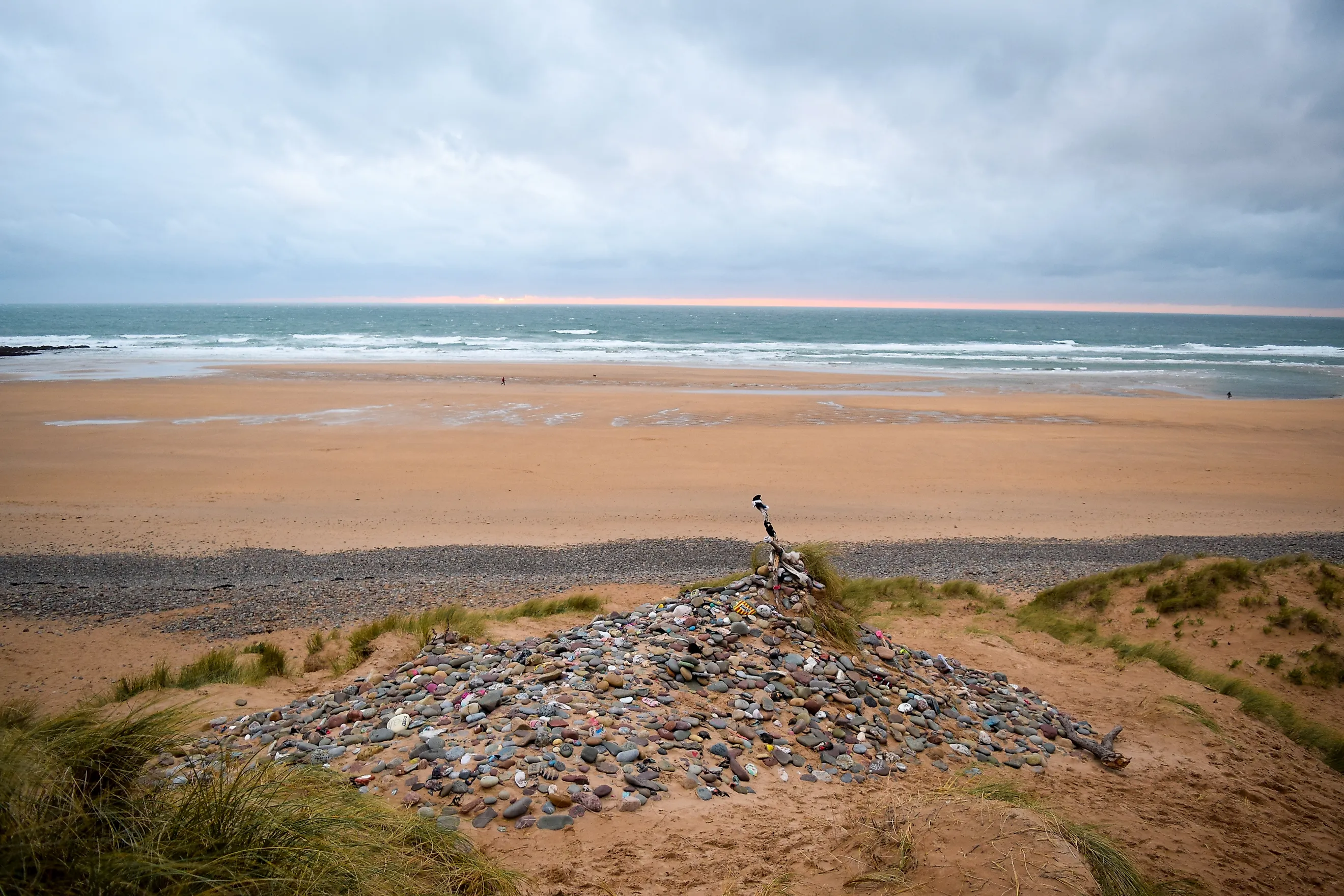
In the dunes behind the beach at Freshwater West, in the Pembrokeshire Coast National Park, a mound of painted pebbles marks the grave of Dobby, the house-elf who dies saving Harry Potter in Harry Potter and the Deathly Hallows: Part 1 (2010).
Dobby is fictional, and nobody's actually buried there but die-hard fans built an actual grave stone there to honor the befallen house elf.
Dobby's death and burial were filmed here, and so were the scenes at Shell Cottage, the seaside refuge that opens Part 2 in 2011. The cottage was a set, weighted with containers of water so that it would not move during filming, and it was removed when the crew left.

Freshwater West has also been a battlefield. In June 2009, Ridley Scott brought more than 600 extras and 150 horses here for the closing battle of Robin Hood (2010), in which a French invasion fleet lands on the English coast and is met on the sand by Russell Crowe's Robin and the king's cavalry. Crowe camped at the beach for several nights instead of being flown back to his hotel in London.
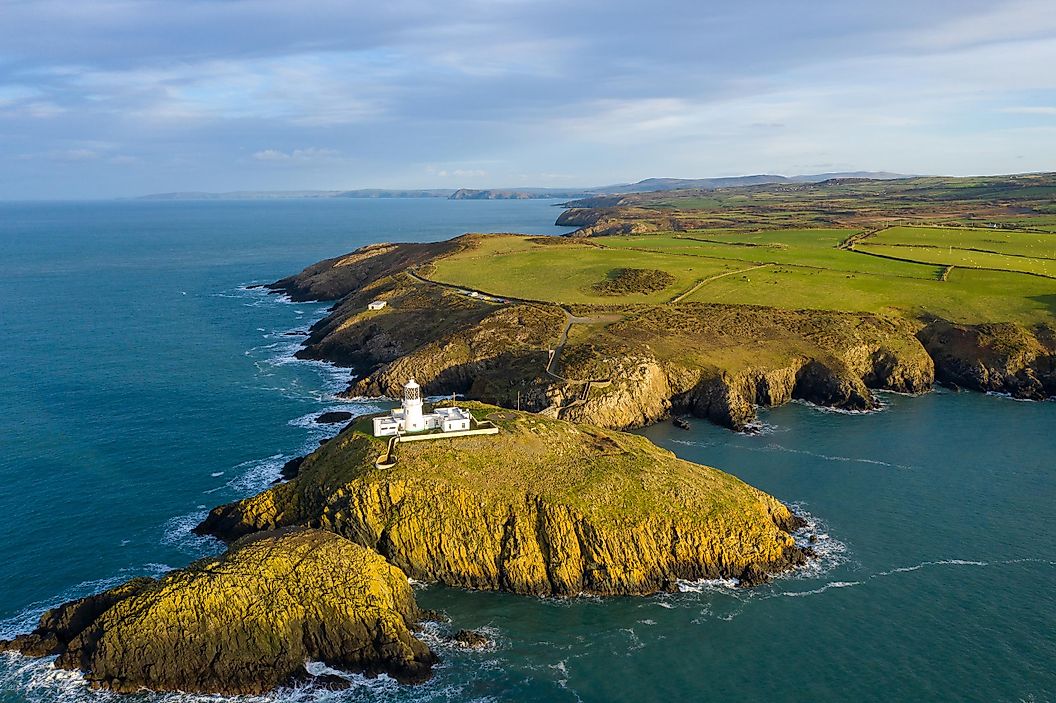
The Pembrokeshire Coast, designated in 1952, covers 240 square miles of coastline. The Pembrokeshire Coast Path, a 186-mile National Trail, stretches from St Dogmaels in the north to Amroth in the south and passes Freshwater West on the way. Gupton Farm, the National Trust's base beside the beach, has a campsite and a surf lodge.
The Sets Are Gone, But Their Impact Remains
Shell Cottage was taken down when filming ended, the Chinese village at Llyn Gwynant was cleared away, and Maz Kanata's castle never existed outside a computer. But what the cameras recorded in each of these seven parks was the parts nobody had to build.
These seven locations are easy to visit, and Britain's national parks have no entrance gates and are free to enter. Most of these locations can be reached by a public footpath, a steam train, or a boat. So, start with a film you know, find the park it borrowed, and go see how much of it you recognize.