5 Most Beautiful Gothic Churches In Maine
Gothic architecture originated in Europe in the mid-12th century and flourished through the 16th century. It experienced a revival of sorts in the 19th century. During this revival, the style crossed the Atlantic Ocean and became popular in the United States, particularly for churches, universities, and civic buildings, thanks to a Victorian-era obsession with castles, cathedrals, and all things medieval. Think St. Patrick’s Cathedral in New York or Washington National Cathedral in D.C.
In Maine, many historic churches were built in the ecclesiastical Gothic Revival style, a 19th-century interpretation of medieval European design. The style ranges from plain wooden chapels to elaborate stone cathedrals adorned with stained glass and pointed arches. The Christ Episcopal Church in Gardiner is the oldest known example of the ecclesiastical Gothic Revival style of architecture in all of New England. For architecture enthusiasts, history buffs, photographers, and anyone with a flair for the dramatic, here are five of the most beautiful Gothic churches in Maine.
St. Peter’s By‑The‑Sea Protestant Episcopal Church, Cape Neddick

Built in 1897, St. Peter’s By-The-Sea is a well-preserved example of Gothic Revival architecture on Maine’s southern coast. The church was the brainchild of Philadelphia natives George and Nannie Conarroe, who summered at the circa-1872 Maine resort, The Cliff House, near Ogunquit. The wealthy couple donated land known as Christian Hill on Bald Head Cliffs so that fishermen at sea could see the cross atop the chapel. The church was designed by Charles C. Burns and built by Edward Blaisdell of York, Maine, to resemble a medieval English country church. The building is roughly cruciform, meaning it is shaped like a cross when viewed from above.
The church is seasonal, open from early June through the second weekend of October each year. It was placed on the National Register of Historic Places in August 1999. The church celebrated its 125th anniversary in 2022. St. Peter’s By‑The‑Sea is about 5 miles from the stunning Cape Neddick Light Station, also known as the “Nubble Lighthouse,” one of the most photographed lighthouses in the world.
Cathedral Of The Immaculate Conception, Portland

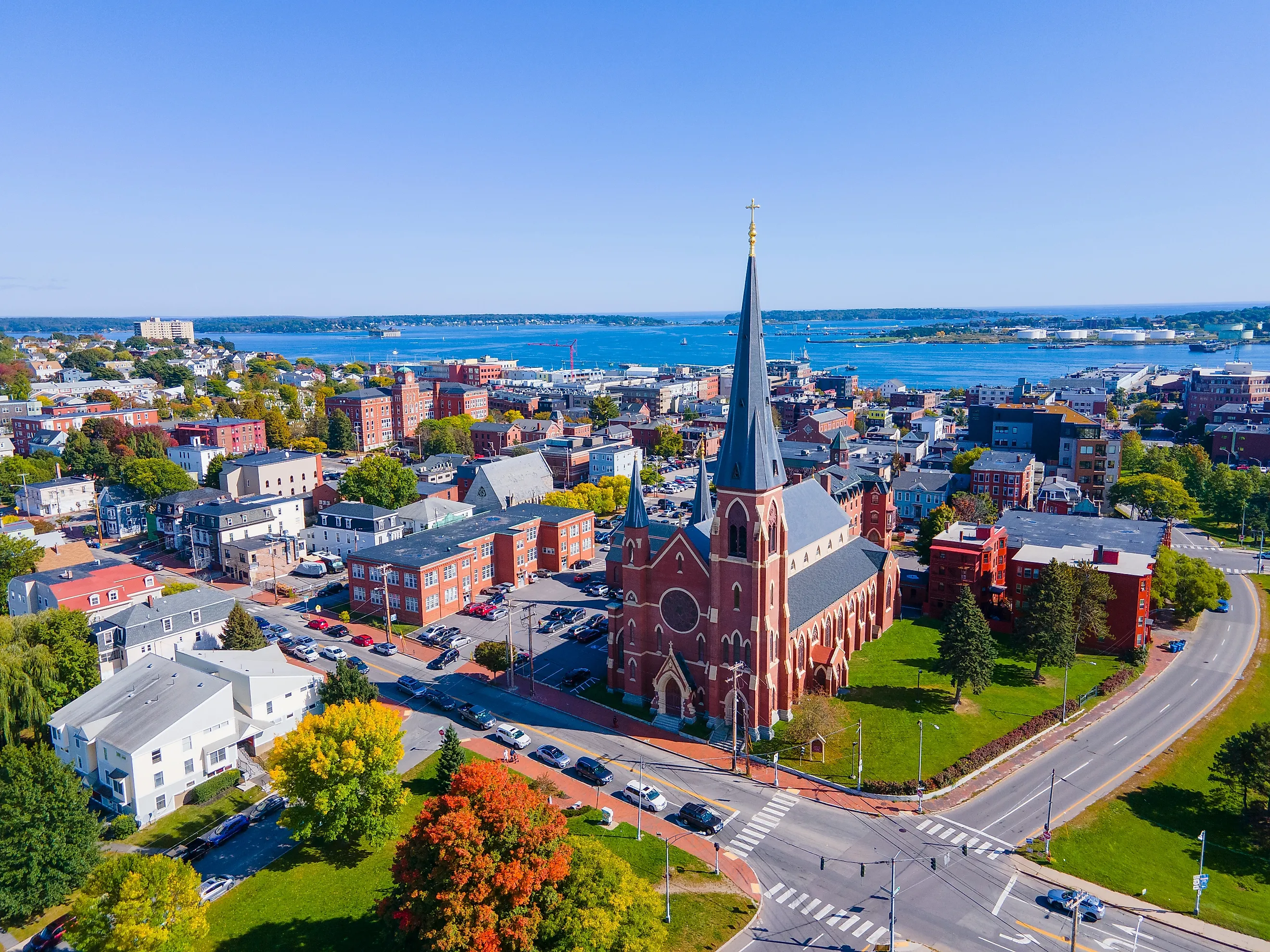
The Cathedral of the Immaculate Conception is an iconic landmark and the seat of the Roman Catholic Diocese of Portland, meaning it’s the central church for Catholics in Maine. It was built by the prolific church architect Patrick C. Keely, who designed nearly 600 churches in the U.S. and Canada, as well as every 19th-century Catholic cathedral in New England. The Neo-Gothic cathedral has undergone several restorations over the years, but today the interior measures 186 feet long and 70 feet wide, with a vaulted ceiling rising 70 feet above the floor. The main aisle is 150 feet long, with seven massive pillars on each side that lift into pointed Gothic arches. The cathedral seats 900.

Several notable works of art are housed in the cathedral, including a marble bas-relief depicting the life of Christ, dating back to 1921, and several paintings by Portland artist Michael Waterman. Tours of the cathedral are available on demand. Despite its rich history and impressive Gothic architecture, the Cathedral of the Immaculate Conception is firmly rooted in the present, regularly livestreaming Masses to the faithful. The Cathedral is listed on both the National Register of Historic Places and the Greater Portland Landmarks.
Christ Episcopal Church, Gardiner

One of Maine’s earlier Gothic Revival Episcopal churches, Christ Episcopal Church dates back to 1820. It was designed by Reverend Samuel Jarvis, a noted American Episcopal clergyman and scholar, and built after a fire destroyed an earlier church at the same location, Christ Church on the Common. In what sounds like something out of medieval times, the original church was deliberately set on fire by a Revolutionary War veteran who claimed a vision ordered him to burn the church down.
As one of the earliest Gothic Revival churches in the state, it was a deliberate move away from the classic meetinghouse style. The rough-cut stone exterior gives the church a fortress-like look, with a Gothic tower and pointed lancet windows, and its height symbolically reaches toward heaven. Of particular interest is the church’s historic bell tower, which houses a 1820 Paul Revere bell, made by Paul Revere & Sons, the famous foundry founded by Paul Revere (and one of the founding fathers of America). The church was placed on the National Register of Historic Places in 1973.
St. Anne’s Episcopal Church, Calais

St. Anne’s Episcopal Church in Calais has been in continuous service since May 11, 1854. It was designed by James Renwick, the renowned architect of St. Patrick’s Cathedral in New York City and the original building housing the Smithsonian Institution in Washington, D.C, and the only known building designed by the prolific architect in Maine. The church is built in the Carpenter Gothic style, which emerged in 19th-century America out of necessity. In places like rural Maine, builders likely lacked the skills or stone to build stone cathedrals, so they used wood instead, adding Gothic elements such as arches, steep gables, and wooden buttresses, resulting in smaller, more hand-crafted Gothic churches.
The church features hallmarks such as pointed-arch windows filled with decorative tracery that give them a lace-like appearance. The front entrance of the church is topped by a four-story clock tower with a four-faced clock and a pointed arch above the doors, while each side of the church features 6 stained-glass bay windows. St. Anne’s seats 150 worshippers, and a new parish hall added in 2006 has become a community hub in Calais, a small community of around 3,100 residents, hosting classes such as yoga, Zumba, veterans groups, and 12-step meetings. In 2010, the clock in the church tower was restored, and today it keeps perfect time.
Basilica of Saints Peter and Paul, Lewiston

The beautiful historic Basilica of Saints Peter and Paul in Lewiston, built between 1905 and 1938, is the largest church in Maine. The massive Gothic Revival basilica measures 316 feet in length and 110 feet in width, with two imposing granite towers flanking the main entrance, each 167 feet tall. The church was designed by Louis-Napoléon Audet, a renowned ecclesiastical architect from Québec who specialized in grand Gothic Revival churches, and was largely built by French-Canadian Catholic immigrants who worked in the town’s textile and shoe mills in the late 19th and early 20th centuries, who needed a place to worship.
The Basilica of Saints Peter and Peter was elevated to Minor Basilica status in October 2004 by the Vatican, in part for its architectural significance. There are only four Major Basilicas in the world, all located in Rome. Every other basilica outside Rome is designated a Minor Basilica. The Lewiston Basilica seats 2,200 worshippers and holds in-person Masses on Saturdays and Sundays, which are also livestreamed.
Maine’s Gothic Treasures
While the world’s famous Gothic churches, such as Notre-Dame de Paris and Westminster Abbey, draw visitors from afar, Mainers and New Englanders don’t need to travel that far to admire stunning Gothic architecture. Maine’s five most beautiful Gothic churches reflect a 19th-century revival of medieval European design that swept across America from the fortress-like stone sanctuaries of Christ Episcopal Church and Basilica of Saints Peter and Paul to the delicate wooden chapel of St. Anne’s Episcopal Church. Contrasted with the rugged Maine coastline, these Gothic churches, with their pointed arches, stained-glass windows, sky-high towers, and spires, are must-see landmarks for anyone fascinated by Maine’s rich history.