7 Prettiest Downtown Strips In Kansas
Wamego still has an actual Yellow Brick Road running through its downtown, lined with Oz-themed murals. Lindsborg's Main Street stretch has a 1887 Farmers State Bank building that now houses City Hall, with Swedish Dala horses for sale a block away. The Chase County Courthouse in Cottonwood Falls has been continuously operating since 1873. The seven Kansas downtowns below each carry their town history on the storefronts of the main strip, whether the anchor is a museum, a 19th-century courthouse, a Swedish-settler shop, or a freight depot from the year the railroad first reached town.
Abilene

Dwight D. Eisenhower grew up in Abilene, and the town's downtown strip carries a heavy share of presidential history. The Eisenhower Presidential Library, Museum, and Boyhood Home complex sits a few blocks south of Buckeye Avenue and draws around 200,000 visitors a year. The Seelye Mansion at 1105 North Buckeye is a 25-room Georgian completed in 1905 by patent-medicine manufacturer A.B. Seelye, who furnished it with pieces he bought at the 1904 St. Louis World's Fair, most of which are still in place. The Abilene & Smoky Valley Railroad runs scenic and dinner rides out of the restored 1887 Rock Island depot behind a 1919 steam engine.
The downtown commercial blocks along Buckeye Avenue and Northwest Third Street are mostly late-19th and early-20th century brick. Amanda's Bakery and Bistro on Buckeye does homemade meals, pastries, and espresso, and the Abilene Downtown Antique Mall just up the block fills more than 7,500 square feet across two floors. Both are inside buildings from the 1880s-1900s commercial-construction era that gives the downtown its current character.
Atchison

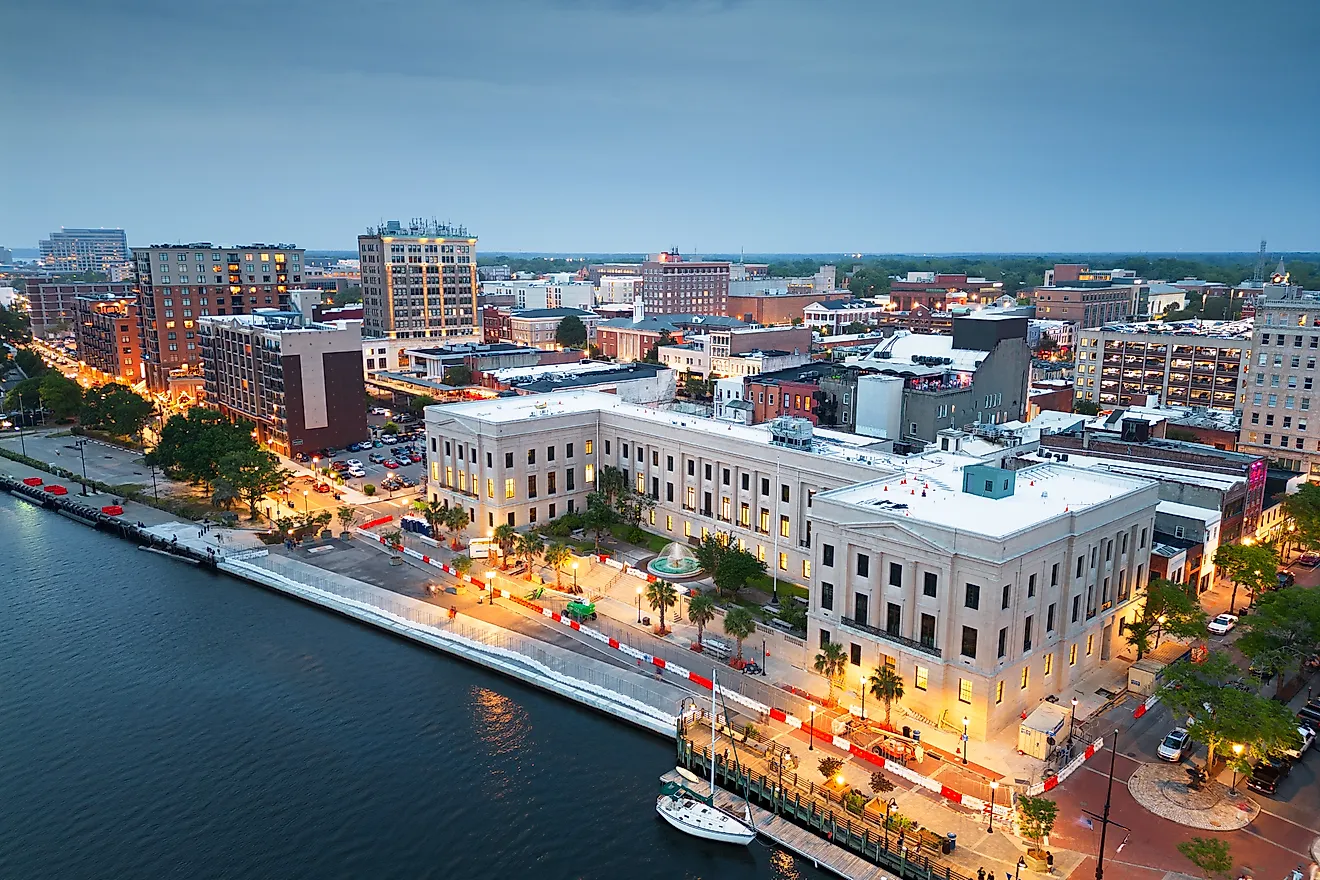
Amelia Earhart was born in Atchison on July 24, 1897, in her maternal grandfather's house on North Terrace Street, which now operates as the Amelia Earhart Birthplace Museum. The Evah C. Cray Historical Home Museum at 805 North Fifth Street, a Victorian mansion completed in 1882 by lumber merchant George Howell, holds another large collection of late-19th-century Atchison interiors. Atchison sits on the west bank of the Missouri River at one of the river's northernmost Kansas reaches, and the town has more than 40 properties on the National Register of Historic Places.
Commercial Street and the surrounding downtown blocks mix Italianate, Richardsonian Romanesque, and Second Empire commercial architecture, most of it dating to Atchison's 1880s-1890s railroad-boom decades. The Sunflower at 504 Commercial does breakfast and coffee; The Berry Best Fudge Company a block over has been making fudge in storefronts on Commercial since 2003. The Atchison Visitor Center occupies the restored 1880 Atchison, Topeka and Santa Fe passenger depot at the foot of Commercial Street.
Cottonwood Falls

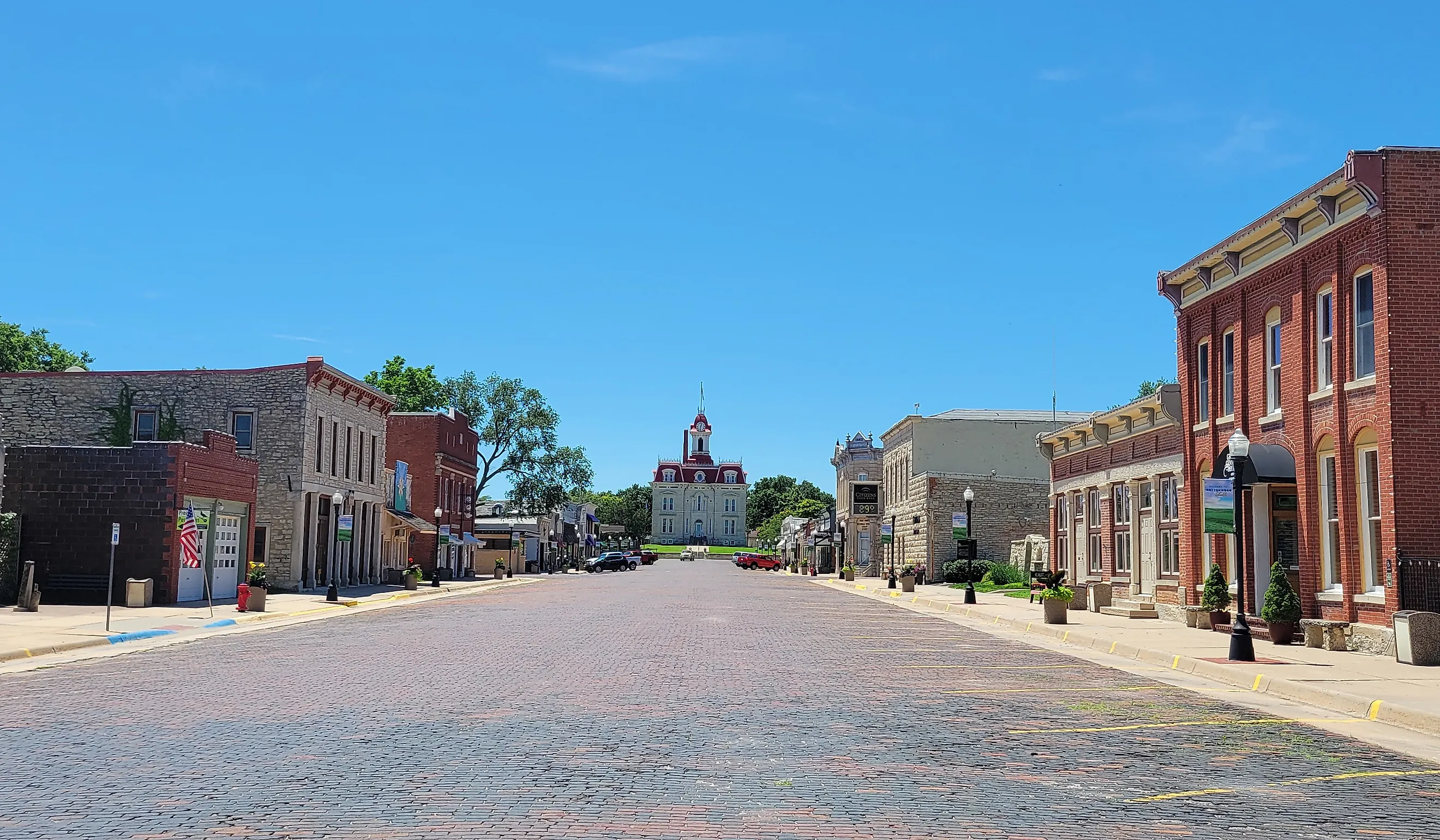
The Chase County Courthouse, anchoring the north end of Cottonwood Falls' Broadway Street, is the oldest continuously operating courthouse in Kansas. The building was designed by John G. Haskell in French Second Empire style and completed in 1873; its mansard roof and clock tower remain the dominant structure on the downtown skyline. Broadway Street's brick-paved blocks run uphill from the Cottonwood River to the courthouse, lined with shops, art galleries, and restaurants in stone and brick storefronts from the same 1870s-1890s building era. The 1879 Stone Schoolhouse on Pearl Street is a one-room school now operated as a museum.
The Chase County Historical Society Museum on Broadway holds Flint Hills agricultural and ranching collections, including material on the cattle-drive trade and the Bluestem hay industry that has been the county's economic mainstay for over a century. Swope City Park, two blocks west of downtown along the Cottonwood River, has tent and RV campsites, walking trails, and gardens.
Fort Scott

Fort Scott National Historic Site, on the north edge of downtown, preserves the 1842-1873 frontier military post that gave the town its name. The fort's twenty original buildings (officers' quarters, barracks, stables, guardhouse, hospital) are restored to their 1842-1853 active-duty appearance, with National Park Service rangers running interpretive programs and reenactments through the summer. The Missouri, Kansas and Texas Railway Freight Depot at the intersection of East Wall Street and Scott Avenue dates to 1870, the year the MKT reached town; its first carload of freight came in on December 3 of that year. The depot is one of the oldest surviving freight buildings on the railroad's original line and remained in service until the 1980s.
Fort Scott's downtown grew rapidly between 1865 and 1888, when the population reached around 14,000 and the town was briefly the fourth-largest in Kansas. Most of the brick buildings on the central commercial blocks date to that period and were constructed using bricks from Fort Scott's local clay pits, a small industry that operated into the early 20th century. The Liberty Theatre on Main Street opened in 1919 and has been fully restored for live performances. A March 11, 2005 fire destroyed several historic buildings in the downtown core, but most of the surviving Victorian-era streetwall is intact.
Hays

The two-block downtown core of Hays is locally known as "The Bricks" for the buff-coloured local brick used in its 19th- and early-20th-century commercial buildings. Fort Hays State University, about a mile south of the downtown core, anchors the town's economy with around 15,000 students through the academic year, and the student population gives The Bricks a steady through-traffic that has supported an unusually dense concentration of restaurants and bars for a town of 21,000.
The Downtown Pavilion on Main Street hosts the Downtown Hays Market every Saturday morning between May and October, drawing produce growers from across western Kansas. The 9th Street Diner is one of the busier breakfast stops on the strip (locally known for its hash browns); The Golden Q operates as both a restaurant and a billiards hall. The Ellis County Historical Society Museum on West 7th Street and the nearby Sternberg Museum of Natural History at Fort Hays State carry the deeper regional history, including the Frontier Cretaceous fossils that have come from the region's Niobrara Chalk beds.
Lindsborg

Lindsborg was founded in 1869 by Swedish Lutheran immigrants from the Värmland and Dalarna regions, and the town has actively preserved the Swedish settler heritage ever since (a tagline of "Little Sweden USA" appears on signs around the downtown core). The Farmers State Bank building at the corner of Main Street and Lincoln, a red-brick structure completed in 1887, now houses City Hall. Main Street between Lincoln and State runs about six blocks of mostly 1880s-1910s commercial frontage, with painted Dala horses (the carved red wooden horses traditional to Sweden's Dalarna province) placed at intervals along the sidewalk.
Hemslojd Inc. on North Main is the largest of the town's Dala-horse workshops, hand-painting most of the horses sold throughout Lindsborg and to mail-order customers worldwide. The Blacksmith Coffeeshop and Roastery a few doors down handles the morning coffee trade. Midsummer's Festival in June and Svensk Hyllningsfest (held biennially in October) are the two largest Swedish-heritage events, drawing visitors from Swedish-American communities across the Midwest.
Wamego

The Oz Museum at 511 Lincoln Avenue, two blocks off Wamego's main downtown strip, holds over 2,000 artifacts from the L. Frank Baum book series (first volume published 1900) and the 1939 MGM film. The actual Yellow Brick Road runs through the surrounding downtown blocks, lined with Oz-themed murals and storefronts that have leaned into the theme. The Columbian Theatre at 521 Lincoln, completed in 1895 in red sandstone, still hosts live performances; the theatre's collection of seven murals originally painted for the 1893 Chicago World's Columbian Exposition (where the building got its name) hangs in the lobby.
Wamego sits about half a mile south of the Kansas River and a section of the Oregon Trail passes through the surrounding farmland. Lincoln Street Lanes, on the downtown strip, is a five-lane bowling alley that has operated under various owners since the 1950s. The Wamego Aquatic Center on Klein Street is the town's main municipal pool. Annual events on the strip include OZtoberFest in early October, which combines a German-style food festival with the standard Oz programming.
What the Main Streets Hold
Each of the seven downtowns above tells a different slice of state history. Abilene anchors on Eisenhower; Atchison on Amelia Earhart and the Missouri River railroad-boom commerce; Cottonwood Falls on Haskell's 1873 Second Empire courthouse; Fort Scott on the frontier-military and 1870 MKT railroad arrival; Hays on Fort Hays State University and the local-brick "Bricks" district; Lindsborg on the 1869 Swedish settlement and its Dala-horse craft; Wamego on the Baum-and-MGM Wizard of Oz industry. The buildings on each strip are mostly late-19th-century brick and stone, the by-product of a roughly thirty-year window between 1865 and 1895 when railroad expansion, commercial growth, and the arrival of locally produced brick combined to give Kansas towns the streetwalls that still define them.