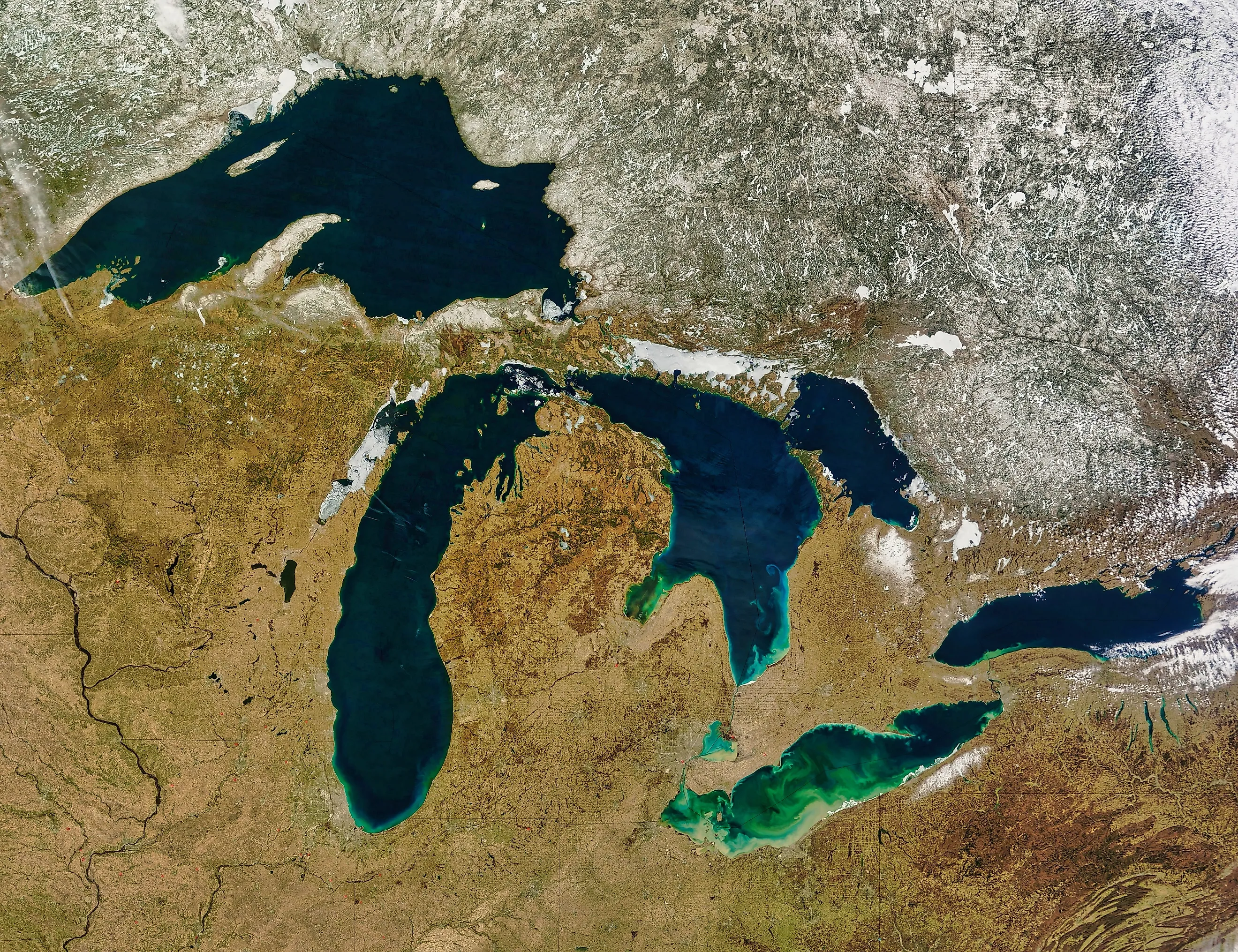
Why The Great Lakes Turn Turquoise From Space
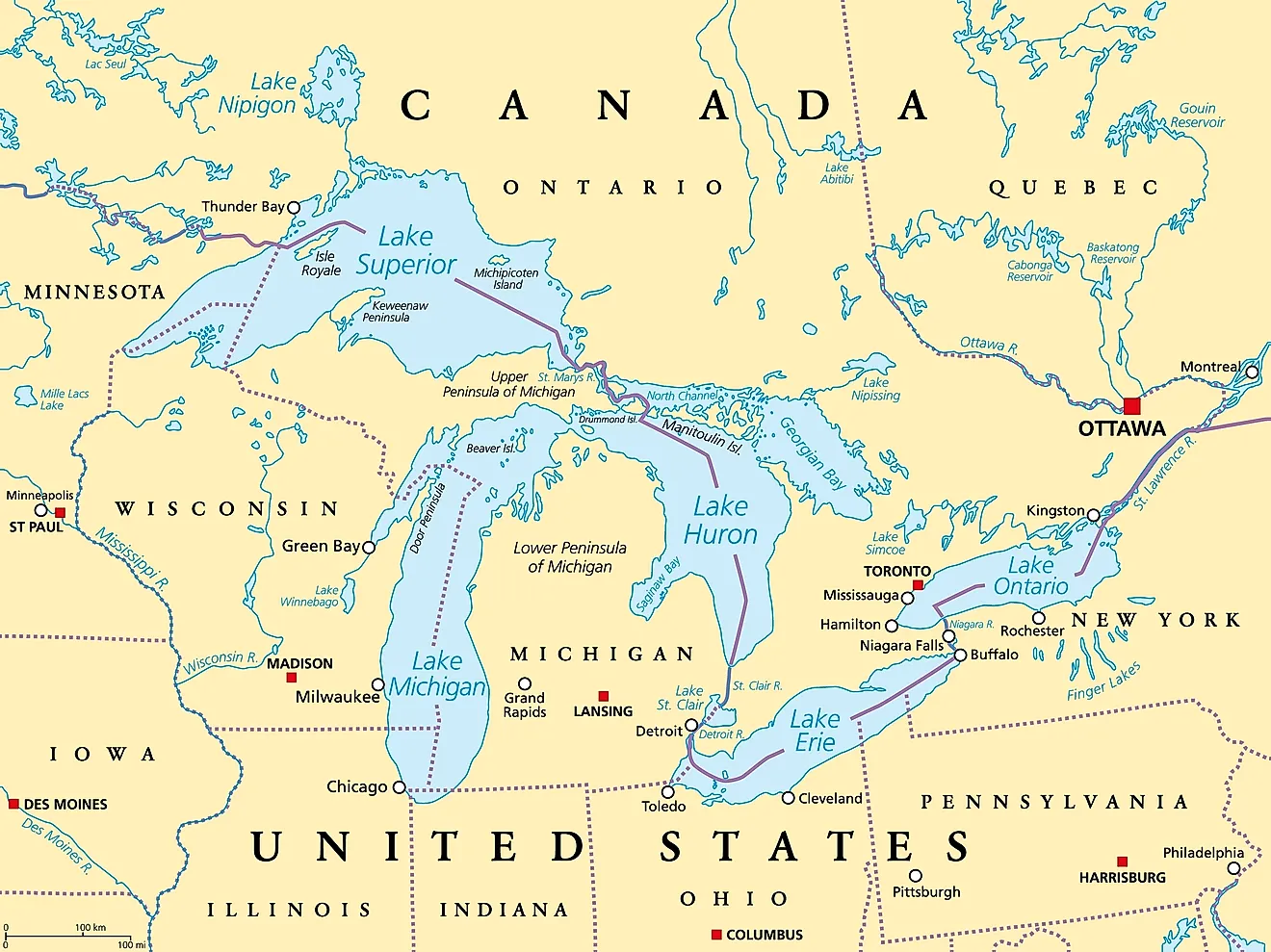
Every summer, satellite images arrive that look like a filing error: vast swirls of milky turquoise, the exact palette of the Bahamas banks, painted across lakes sitting at the latitude of Maine. The color is real, the location is correct, and the explanation is better than either, because the Great Lakes are not reflecting a tropical sky or running a filter. For a few weeks in late summer, parts of Lake Michigan, Huron, and Ontario are literally manufacturing chalk, trillions of microscopic white crystals forming in the open water, and the phenomenon shares its chemistry, its optics, and its name with the process that makes the Caribbean look like the Caribbean. Here is why America's inland seas occasionally dress like the tropics, and what the costume has to do with limestone, sunlight, and an invasive mussel that cleaned the windows.
The Lakes Are Making Chalk

The turquoise has a technical name: a whiting event. Great Lakes water carries a heavy load of dissolved calcium and carbonate, and through most of the year it stays dissolved, invisible as sugar in coffee. Late summer changes the chemistry on two fronts at once. Warm water holds dissolved calcium carbonate less readily than cold water, and the season's booming microscopic plant life, photosynthesizing at full throttle, pulls carbon dioxide out of the water and nudges its pH upward, which pushes the dissolved mineral past its tipping point. The calcium carbonate comes out of solution as a snowfall of calcite crystals, each a few millionths of a meter across, suspended through the sunlit upper water by the billions per gallon.
The result is open water hazed with powdered chalk, and the lake's currents do the artwork, with gyres and eddies dragging the milky water into the loops and plumes that make the satellite images look painted. A whiting is, in the most literal sense, weather made visible: the color is a map of every current running that week.
Why There Is Chalk To Make

The raw material comes from the basement. The lower Great Lakes sit in a basin of limestone and dolomite, the compacted floor of tropical seas that covered the region hundreds of millions of years ago, and the rock still stands in the open along the Niagara Escarpment, the great stone rim that runs through Niagara Falls, the Bruce Peninsula, and the islands of northern Lake Huron. Rain, rivers, and groundwater have been dissolving that ancient seafloor for 10,000 years and delivering it to the lakes as invisible dissolved calcium, a mineral bank account the whitings draw on every summer.
The glaciers opened the account. The same ice sheets that gouged the lake basins ground limestone bedrock into flour across the whole region, salting the soils and sediments with easily dissolved carbonate, which is why the hard water that spots the Midwest's drinking glasses and the turquoise that startles astronauts are the same substance at different concentrations. The lakes turn tropical colors because they are, geologically speaking, recycling an actual tropical sea.
The Bahamas Connection

The tropical resemblance is not a coincidence of palette; it is the same physics. Whitings were named on the Bahama Banks, where warm, calcium-saturated seawater precipitates calcite clouds in exactly the same way, and the famous swimming-pool color of shallow tropical water everywhere comes from the same optical trick: water absorbs red light quickly, and fine suspended particles, calcite crystals, coral dust, glacial flour, scatter the surviving blue and green wavelengths back toward the eye. Micron-scale white particles in sunlit water produce turquoise, whether the particles formed over a reef, under a glacier, or in the middle of Lake Michigan.
It is the same recipe that colors the glacial lakes of the Rockies, where rock flour does the scattering, which puts the Great Lakes in odd but logical company: for a few weeks a year, the water off Wisconsin runs the identical optics as Lake Louise and the banks off Nassau, three different sources of suspended mineral, one shade of impossible blue-green.
The Mussels Cleared The Stage

There is a modern plot twist beneath the postcard. Since the 1990s, invasive zebra and quagga mussels have carpeted the lake bottoms by the trillions, each one a tiny filter pump straining the water around the clock, and collectively they have stripped Lakes Michigan and Huron of much of the floating algae that once tinted them green. The result is water dramatically clearer than it was a generation ago, by some satellite measures now rivaling or exceeding famously pristine Superior, and that clarity is part of the turquoise story: cleaner, brighter water lets sunlight drive the whitings deeper and shows the mineral color with nothing green in the way.
The honest footnote is that the beauty is partly a symptom. The algae the mussels removed was the base of the food web, and the clear turquoise lakes of today support fewer fish than the murkier green lakes of the 1970s did, a transformation scientists describe bluntly as oceanic desertification in fresh water. The lakes photograph like the Caribbean partly because they have been quietly emptied, a desert wearing vacation colors, which does not make the images less beautiful, only more complicated.
Storms Paint It Too

Not every turquoise day waits for summer chemistry. The lakes' other painter is wind: a hard blow across the shallows, especially southern Lake Michigan's sandy basin, stirs fine sand, silt, and old calcite off the bottom and hangs it in the water column, wrapping whole shorelines in bright blue-green bands for days after a gale. Satellite meteorologists see the signature after every major storm, a turquoise outline tracing exactly where the waves worked hardest, the lake bruising in pastel.
One color the turquoise should never be confused with is green. When Lake Erie makes the news each summer, its swirls are chlorophyll, living cyanobacteria blooming on farm runoff, biology rather than mineralogy, and the distinction matters: turquoise water is chalk and physics, generally harmless, while pea-green water is a bloom with a health advisory attached. From orbit, the lakes write both stories in color, and learning to read which is which is half the fun of the imagery.
Beautiful, Complicated
So the turquoise is three stories layered in one image: an ancient tropical seafloor dissolving back into its lakes, summer warmth and sunlight snowing that mineral out as chalk while currents swirl it into art, and a filter-feeding invasion that polished the water clear enough to show it all off, with storm sediment signing the shorelines between events. The lakes turn Caribbean colors for completely un-Caribbean reasons, and the satellites catch them doing it most summers somewhere in the system. It may be the best free show in American remote sensing: five inland seas, one borrowed color, and 400 million years of backstory per pixel.