The Best Beaches On The Great Lakes
The Great Lakes deliver soft, walkable sand and clear, calm water without a grain of salt in sight. These five lakes hold roughly 21% of the world's surface freshwater, and their beaches draw millions of visitors every summer. These eight U.S. beaches were selected for their standout natural features and their protected status within a national lakeshore or state park. Following the shoreline across all five lakes, each one shapes its coast for pure enjoyment.
Sand Point Beach, Pictured Rocks National Lakeshore, Michigan

On the south shore of Lake Superior, Sand Point Beach sits inside Pictured Rocks National Lakeshore, a 73,000-acre park in Michigan's Upper Peninsula that hugs more than 40 miles (64 km) of coastline beneath cliffs rising 50 to 200 feet (15 to 61 m) above the water. Sand Point itself is a low, sandy spit about 4 miles (6.4 km) northeast of Munising, where the shallow, sheltered water of Munising Bay warms faster than anywhere else in the park. Lake Superior rarely climbs out of the upper 50s to upper 60s Fahrenheit (14-20°C) elsewhere, so this is the go-to swimming beach for those who enjoy a semi-cold plunge. Recognized by The Weather Channel and Dr. Beach as one of the Great Lakes' top summer beaches, it is also dog-friendly (on a leash), unlike most of the park's backcountry shoreline. For a bigger dose of scenery, the multicolored sandstone cliffs that give Michigan's Pictured Rocks its name begin just east of Sand Point and are best viewed from a tour boat or kayak, where the mineral streaks in red, orange, and blue-green really shine. Families come for the calm, shallow water, while hikers use it as a launch point for the trail network threading through the dunes and forest behind the beach.
Sleeping Bear Dunes National Lakeshore, Michigan

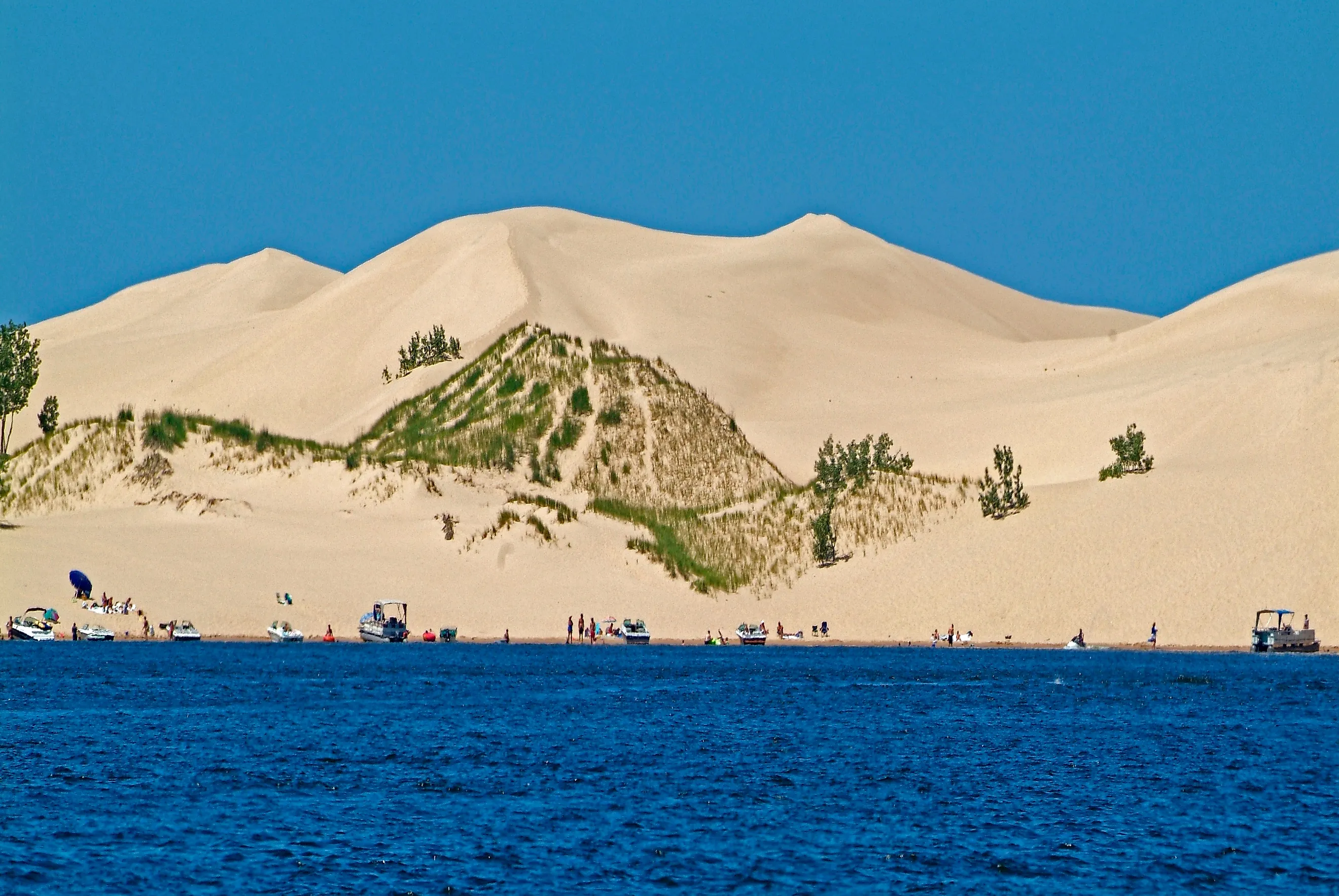
Sleeping Bear Dunes National Lakeshore, on the northeastern shore of Lake Michigan, protects 71,199 acres and roughly 35 miles (56 km) of mainland shoreline between the towns of Frankfort and Leland, plus North and South Manitou Islands. It's home to some of the largest freshwater coastal dunes in the world, with a few towering more than 400 feet (122 m) above the water. You can experience them firsthand at the park's famous Dune Climb. The 7.4-mile (12 km) Pierce Stocking Scenic Drive loops through the dunes and forest with pull-offs overlooking Lake Michigan and the inland Glen Lake, and the beaches along Platte Bay and near Glen Arbor offer some of the clearest, calmest swimming water on the lake's eastern shore. Established in 1970, the park draws around 1.5 million visitors annually and was named "The Most Beautiful Place in America" by Good Morning America in 2011. More than the dunes, the lakeshore preserves an 1871 lighthouse, several former Life-Saving Service stations, and the Port Oneida historic farm district, giving visitors a mix of natural grandeur and 19th-century history alongside the beach itself.
Indiana Dunes National Park, Indiana

Sandwiched between the industrial skyline of Gary and the resort town of Michigan City, Indiana Dunes National Park protects about 15 miles (24 km) of Lake Michigan's southern shore and roughly 15,000 acres of dunes, wetlands, and forest beyond the shore. Designated the United States' 61st national park in 2019, it's one of the most biologically diverse parks in the country, with over 1,100 native plant species. Mount Baldy, a dune near the park's eastern edge, tops out around 125 feet (38 m) and moves inland about 4 feet (1.2 m) a year as wind reshapes it. Swimming is allowed along the entire shoreline. West Beach, near the park's northern entrance, is one of the more popular access points, with lifeguards on duty in summer and a boardwalk trail through the dune ridge behind it. The adjoining Indiana Dunes State Park, a separate 2,182-acre parcel that the national park surrounds on three sides, adds another 3 miles (4.8 km) of beach and its own set of dunes rising nearly 200 feet (60 m). Together the two parks pull in millions of visitors a year, including grateful day-trippers from nearby Chicago.
Kohler-Andrae State Park, Wisconsin

Perched perfectly on Lake Michigan's western shore, Kohler-Andrae State Park combines two formerly separate state parks into 988 acres of beach, dune, forest, and wetland. Its beach runs just over 2 miles (3.2 km) along the lake, backed by the Kohler Dunes State Natural Area. This protected dune ecosystem is home to several threatened plant species and a rare nesting site for the endangered piping plover. The park's signature trail is the Dunes Cordwalk, a wooden boardwalk that threads through the dunes parallel to the shoreline for about 2 miles (3.2 km) one-way, allowing hikers a close look at the unique marram grass and interdunal wetlands without disturbing them. Learn more about it at the Sanderling Nature Center, open May through October, with exhibits on the park's ecology and Great Lakes natural history, plus an observation deck facing the water. Swimming, surfing, and year-round camping across 137 sites round out the offerings, and the water, while clear, stays cold enough that most visitors wade rather than bathe.
Tawas Point State Park, Michigan

Nicknamed the "Cape Cod of the Midwest" for its narrow, curving spit of sand, Tawas Point State Park sits on Lake Huron at the tip of Tawas Bay in eastern Michigan. The 183-acre park is best known for the Tawas Point Lighthouse, whose current tower was built in 1876 and first lit in 1877, which visitors can climb for wide views over the bay and open lake. Because the park occupies a spit rather than a straight shoreline, it offers two very different swimming experiences within a short walk of each other. On the bay side, the water is shallow and noticeably warmer, while the open Lake Huron side is wilder and better suited to strong swimmers. Tawas Point is also considered one of the most important bird migration stopovers on the Lake Huron flyway, with roughly 300 species recorded in and around the park, making it a magnet for birders in spring and fall as well as beachgoers in summer. A modern campground, day-use picnic area, and beach pavilion round out the amenities.
Presque Isle State Park, Pennsylvania

A curved, 3,112-acre sand peninsula jutting into Lake Erie just west of downtown Erie, Presque Isle State Park is home to Pennsylvania's only surf beach and its most-visited state park by a wide margin. The park has eight designated swimming beaches spread along its outer shoreline, each with its own character, plus several additional quiet, unguarded stretches along Mill Road for visitors who'd rather skip the crowds. From the wide sand at Beach 1 near the entrance to the quieter, smoke-free Barracks Beach, visitors can find their own groove. A paved, roughly 13-mile (21 km) road loops the peninsula, and more than 21 miles (34 km) of trails wind through the interior lagoons and woods. The habitat hosts over 339 recorded bird species and is designated as a National Natural Landmark. History buffs should visit the Perry Monument, commemorating Commodore Oliver Hazard Perry's 1813 naval victory on the lake. The Tom Ridge Environmental Center, which opened in 2006, anchors the park's entrance with exhibits on the peninsula's ever-shifting geology to satisfy science-friendly visitors. Because Presque Isle is a recurving sand spit rather than a fixed shoreline, the beaches here are unusually wide and gently sloped compared to much of Lake Erie's coast.
Headlands Beach State Park, Ohio

Roughly 30 miles (48 km) northeast of Cleveland, Headlands Beach State Park protects Ohio's largest natural sand beach, a roughly one-mile (1.6 km) stretch of shoreline along about 35 acres on Lake Erie. Sand dunes are uncommon on this lake, and the adjoining Headlands Dunes State Nature Preserve protects the fragile dune habitat and the handful of plant species that grow there, some of which are more typically found along the Atlantic coast. A separate mile-long paved hike-and-bike trail runs the length of the park, connecting the beach to the nature preserve and to nearby Mentor Marsh State Nature Preserve, one of the largest remaining marshes on Lake Erie's south shore. Popular activities include swimming and sunbathing, beach-glass hunting along the shoreline, and sunset watching, since the park faces almost due north across open water. Take note that there are no lifeguards on duty, so swimmers should keep a close eye on lake conditions, but the sheer size of the sand and the relative lack of crowds compared to Cleveland's urban beaches make it a favorite for a quiet day on Lake Erie.
Fair Haven Beach State Park, New York

On the eastern end of Lake Ontario, Fair Haven Beach State Park covers 1,141 acres of shoreline bluffs, sandy beach, and rolling woodland northeast of the village of Fair Haven. The park's main beach runs about 1,500 feet (457 m) along the lake, including a 600-foot (183 m) guarded swimming area, and sits beside Little Sodus Bay, which offers calmer water for boating and fishing when the open lake gets choppy. Inland, Sterling Pond and Sterling Creek cut through the geological transition between woodland and shoreline, with canoe and kayak rentals available for paddling the pond. The park's glacial bluffs, carved by the same ice-age forces that shaped the Finger Lakes to the south, rise above the beach and give Fair Haven a more dramatic profile than many of Lake Ontario's flatter shorelines. The park has five picnic areas, an 18-hole golf course, and a large campground, making it a popular multi-day stop for visitors exploring New York's Lake Ontario coast.
Chart Your Own Course Along The Great Lakes Shoreline
From the wind-sculpted dunes of Sleeping Bear to the quiet, glass-strewn sand of Headlands Beach, these eight stops make the case that the Great Lakes hold some of the country's most varied and least crowded beach scenery. Each lake brings its own personality to the shoreline, Superior's cold clarity, Michigan's towering dunes, Huron's sheltered bays, Erie's wide sandy spits, and Ontario's glacial bluffs, so no two beaches on this list feel quite the same. Whether the plan is a dune climb in Michigan, a lighthouse tour in the Upper Peninsula, or an afternoon on Pennsylvania's only surf beach, there's a stretch of freshwater coastline here worth building a summer trip around.