The 10 Longest Lakes in Canada
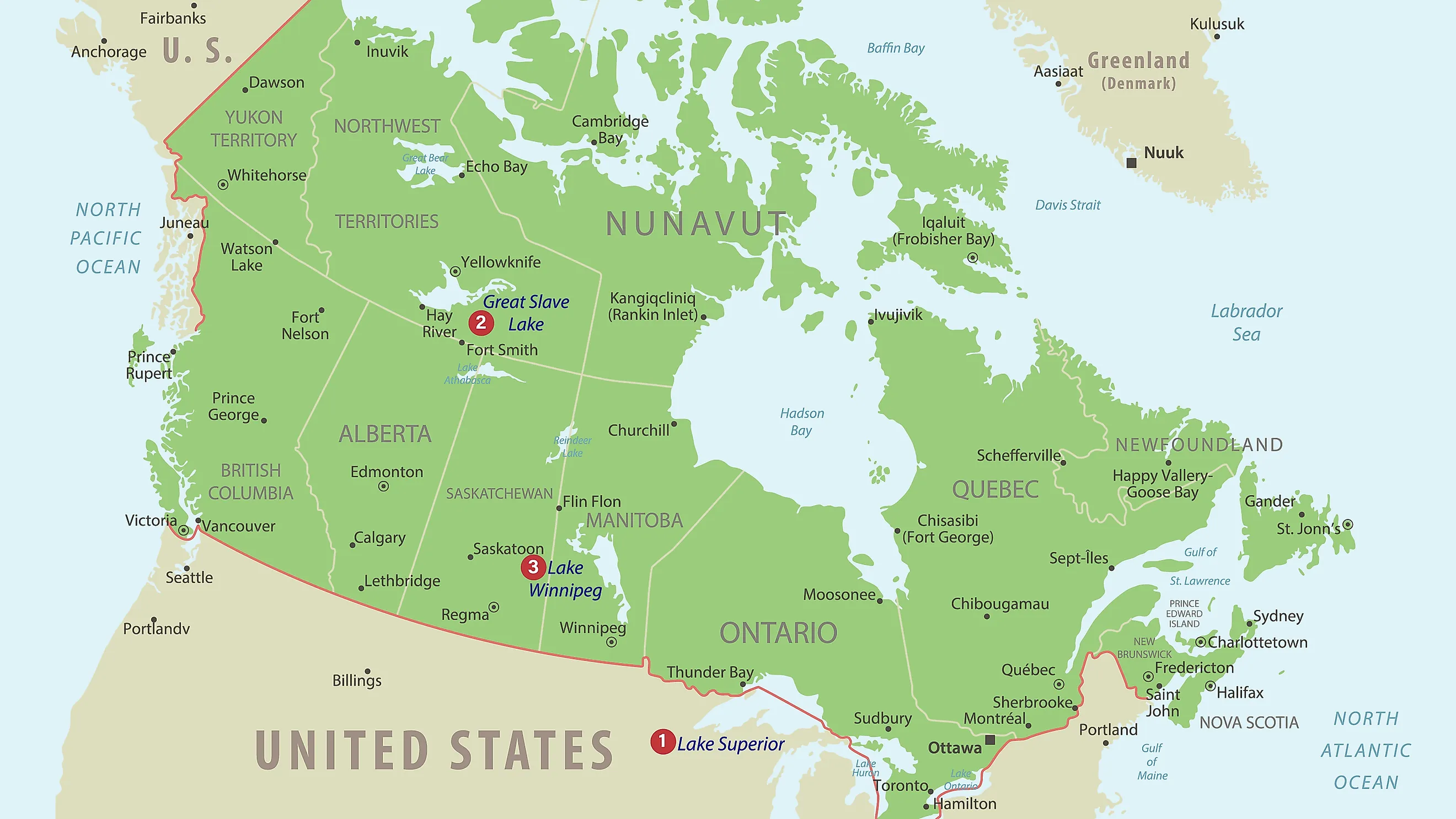
Canada is home to some of the world’s longest lakes, with enormous freshwater bodies stretching across its provinces and territories for hundreds of kilometers. Ranked by maximum length rather than surface area, these lakes reveal another side of Canada’s immense geography. Lake Superior leads the list at 563 kilometers, followed by Great Slave Lake at 469 kilometers and Lake Winnipeg at 425 kilometers. These long lakes are not just impressive on a map; they shape transportation and settlement patterns across the country. Lake Superior supports ports and recreation along Ontario’s north shore and Great Slave Lake anchors Yellowknife and northern winter-road culture. Together, these 10 lakes below show how freshwater helps define the scale of Canada itself.
The 10 Longest Lakes in Canada
| Rank | Lake | Provinces / Territories | Length |
|---|---|---|---|
| 1 | Lake Superior | Ontario | 563 km (350 mi) |
| 2 | Great Slave Lake | Northwest Territories | 469 km (291 mi) |
| 3 | Lake Winnipeg | Manitoba | 425 km (264 mi) |
| 4 | Lake Erie | Ontario | 388 km (241 mi) |
| 5 | Lake Athabasca | Alberta, Saskatchewan | 335 km (208 mi) |
| 6 | Lake Huron | Ontario | 331 km (206 mi) |
| 7 | Great Bear Lake | Northwest Territories | 320 km (200 mi) |
| 8 | Lake Ontario | Ontario | 311 km (193 mi) |
| 9 | Reindeer Lake | Saskatchewan, Manitoba | 245 km (152 mi) |
| 10 | Lake Manitoba | Manitoba | 200 km (125 mi) |
1. Lake Superior - 350 mi (563 km)

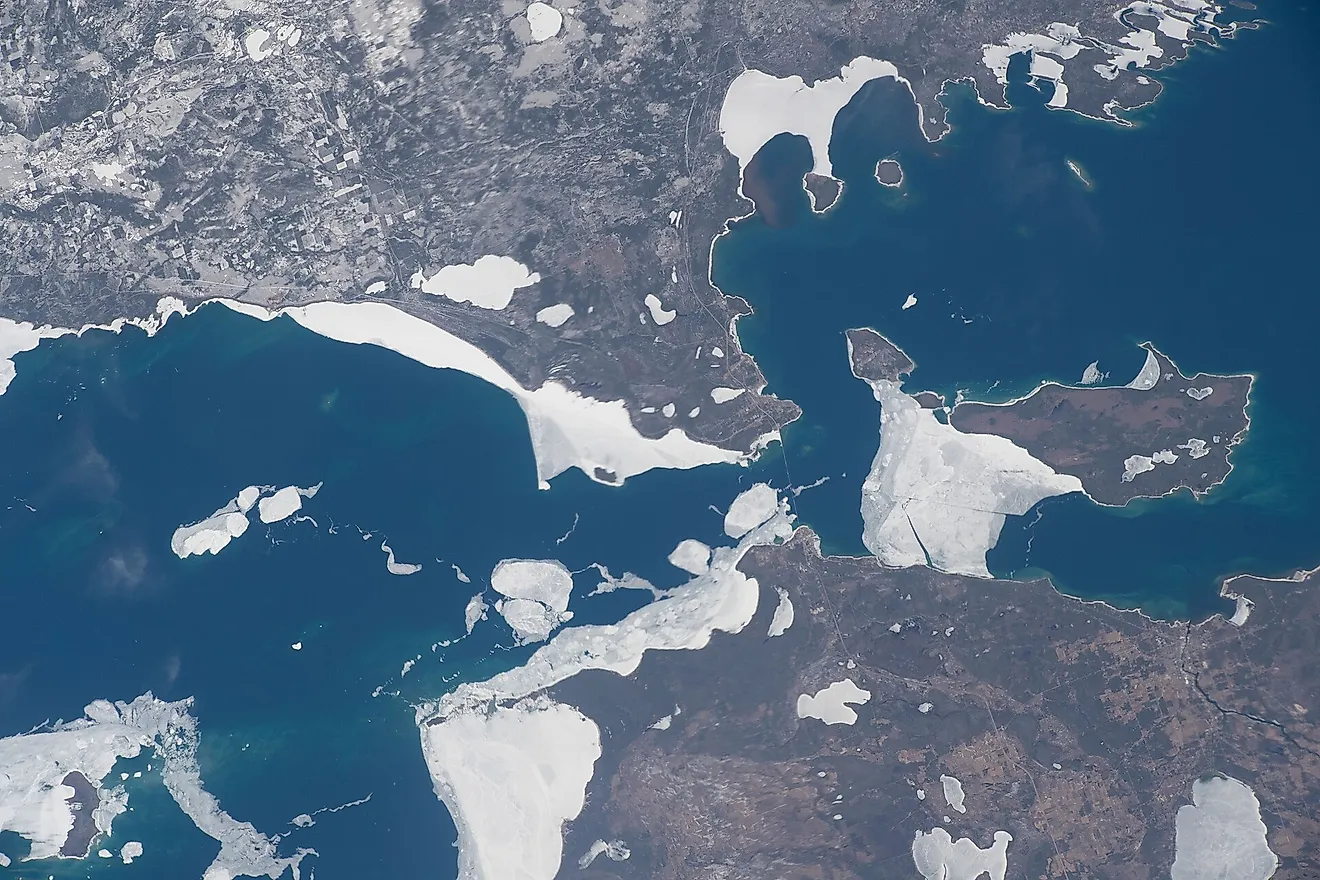
Lake Superior is the largest freshwater lake in the world by surface area and also the longest lake touching Canada. It has a surface area of about 82,100 square kilometers and stretches 563 kilometers from east to west. Shared by Ontario and the American states of Minnesota, Wisconsin, and Michigan, it dominates the geography of the upper Great Lakes and forms a major part of the Canada-US border.
Lake Superior is also the coldest and one of the deepest of the Great Lakes, with famously clear water and a rugged shoreline marked by cliffs, harbors, and forested headlands. Ontario communities along the north shore depend on it for shipping, tourism, and recreation, while the lake’s sheer size creates dramatic weather and wave conditions that can feel almost oceanic. Its scale makes it not only Canada’s longest lake, but one of the country’s most defining natural landmarks.
2. Great Slave Lake - 291 mi (469 km)

Great Slave Lake is the second-longest lake in Canada and one of the most important bodies of water in the North. Located in the Northwest Territories, it reaches 469 kilometers in length and is also the deepest lake in North America, with a maximum depth of about 614 meters. It covers roughly 28,568 square kilometers, making it one of Canada’s largest lakes by area as well.
The lake is closely tied to Yellowknife, the territorial capital, as well as to communities such as Hay River and Łutselk’e. Its long frozen season has historically supported winter travel and ice-road culture, while its cold, clean waters are known for lake trout, whitefish, and northern pike. Despite its remote setting, Great Slave Lake plays an outsized role in northern transportation, fishing, and identity.
3. Lake Winnipeg - 264 mi (425 km)

Lake Winnipeg is Manitoba’s best-known lake and the third-longest in Canada, extending 425 kilometers from north to south. Fed by major rivers including the Red, Saskatchewan, and Winnipeg, it drains northeast into Hudson Bay through the Nelson River. With an area of roughly 24,387 square kilometers, it is also one of the largest freshwater lakes in the world.
The lake is economically and ecologically crucial to Manitoba. It supports major commercial fisheries, especially for walleye and whitefish, and is also important for recreation and hydroelectric systems tied to its inflows and outflows. At the same time, Lake Winnipeg faces serious environmental pressure from nutrient runoff and harmful algae blooms, problems made worse by its shallow average depth and enormous drainage basin.
4. Lake Erie - 241 mi (388 km)

Lake Erie is the fourth-longest lake in Canada, with its major axis extending 388 kilometers. Shared by Ontario and the American states of Michigan, Ohio, Pennsylvania, and New York, it is the shallowest of the Great Lakes and one of the warmest in summer. That shallowness helps support high biological productivity and one of the most valuable freshwater fisheries in North America.
Ontario’s north shore along Lake Erie includes farming districts, beach towns, and important migration habitat for birds. Water enters the lake through the Detroit River from the upper Great Lakes and exits through the Niagara River toward Lake Ontario. While Lake Erie is heavily used for shipping, recreation, and drinking water, it is also well known for periodic algal blooms linked to nutrient runoff from surrounding agricultural lands.
5. Lake Athabasca - 208 mi (335 km)

Straddling northern Alberta and Saskatchewan, Lake Athabasca is the fifth-longest lake in Canada at 335 kilometers. It covers about 7,936 square kilometers and is notable for its position near the edge of the Canadian Shield and the western boreal forest. The lake receives water from the Athabasca River and is part of the vast Mackenzie River drainage system.
Lake Athabasca is also known for the Peace-Athabasca Delta nearby, one of the largest inland freshwater deltas in the world and a globally important wetland complex. The lake supports fishing, northern communities, and wildlife habitat, while its remote setting gives it an outsized importance in the environmental geography of western Canada. Its combination of size, length, and ecological value makes it one of the country’s standout inland lakes.
6. Lake Huron - 206 mi (331 km)

Lake Huron is 331 kilometers long and ranks sixth among Canada’s longest lakes. Bordered by Ontario and the U.S. state of Michigan, it is the second-largest Great Lake by surface area and is famous for its long shoreline, broad open water, and countless islands. Georgian Bay and Manitoulin Island help make its Canadian side especially distinctive.
Lake Huron is central to tourism, boating, sport fishing, and beach culture in Ontario. Its shoreline includes resort towns, national and provincial parks, and major recreation destinations. Manitoulin Island, located within the lake, is the world’s largest freshwater island and adds another layer to Huron’s already unusual geography.
7. Great Bear Lake - 200 mi (320 km)

Great Bear Lake is the largest lake located entirely within Canada and the seventh-longest in the country, at roughly 320 kilometers. Found in the Northwest Territories near the Arctic Circle, it has a surface area of 31,328 square kilometers and is one of the largest lakes in North America. Its five main arms give it an irregular, sprawling shape unlike the more oval form of many southern lakes.
The lake is known for its remarkable water clarity, sparse human settlement, and deep cultural importance to the Sahtu Dene. Délı̨nę, the main community on its shore, has long depended on the lake. Great Bear Lake is frozen for much of the year and remains one of the least disturbed large lake ecosystems in the country, which adds to its reputation as one of Canada’s most pristine northern waters.
8. Lake Ontario - 193 mi (311 km)

Lake Ontario is the eighth-longest lake in Canada, stretching 311 kilometers along its major axis. It is the smallest of the Great Lakes by surface area, but it remains one of the most historically and economically important because of its connection to the St. Lawrence River and the Atlantic trade corridor. The lake is shared by Ontario and New York State.
On the Canadian side, Lake Ontario anchors the country’s most densely populated corridor, including Toronto, Hamilton, and many smaller waterfront communities. It supports shipping, industry, recreation, and drinking water for millions of people. Despite its relatively modest size compared with Superior or Huron, its long east-west form and central role in settlement make it one of Canada’s most consequential lakes.
9. Reindeer Lake - 152 mi (245 km)

Reindeer Lake lies mostly in northeastern Saskatchewan, with part of it extending into northwestern Manitoba. It ranks ninth among Canada’s longest lakes at 245 kilometers, though some Canadian references list a slightly shorter maximum length of 233 kilometers. Either way, it clearly belongs among the country’s ten longest lakes. Its highly irregular shoreline and many islands help explain the variation between sources.
Reindeer Lake is an important fishing and wilderness lake in western Canada, known for northern pike, lake trout, and remote lodges. Communities such as Southend, Brochet, and Kinoosao are tied closely to the lake. Its combination of length, jagged shoreline, and relative remoteness makes it one of the more striking large lakes outside the Great Lakes system.
10. Lake Manitoba - 125 mi (200 km)

Lake Manitoba rounds out the list. Britannica describes it as more than 125 miles, or more than 200 kilometers, long. Older sources sometimes give a figure closer to 191 kilometers, but standard modern summaries usually place it just over 200 kilometers, which keeps it in tenth place among Canada’s longest lakes.
Located in south-central Manitoba, the lake is broad, shallow, and historically important to Indigenous travel, settlement, and the fur trade. Today it remains significant for commercial fishing, wildlife habitat, and flood management in the prairie lake system. Compared with the dramatic depths of Great Slave or Superior, Lake Manitoba stands out instead for its shallow character and long, low-lying shoreline.
Implications Of The Length Of A Lake
There are many ways to describe lakes physically, including area, depth, volume, shoreline, and length. Looking at lakes by maximum length rather than area produces a somewhat different ranking. Great Bear Lake, for example, is much larger in area than Lake Athabasca or Lake Ontario, yet it is shorter than both by standard maximum-length measurements. That contrast shows how area and shape are not the same thing.
Length can matter in practical ways too. Long lakes often influence wind fetch, wave action, settlement patterns, and transportation routes. In Canada, these lakes support ports, fishing grounds, recreation hubs, wildlife habitat, and entire regional identities. Ranked this way, they show that Canada’s freshwater geography is not only vast in area, but also stretched across extraordinary distances.