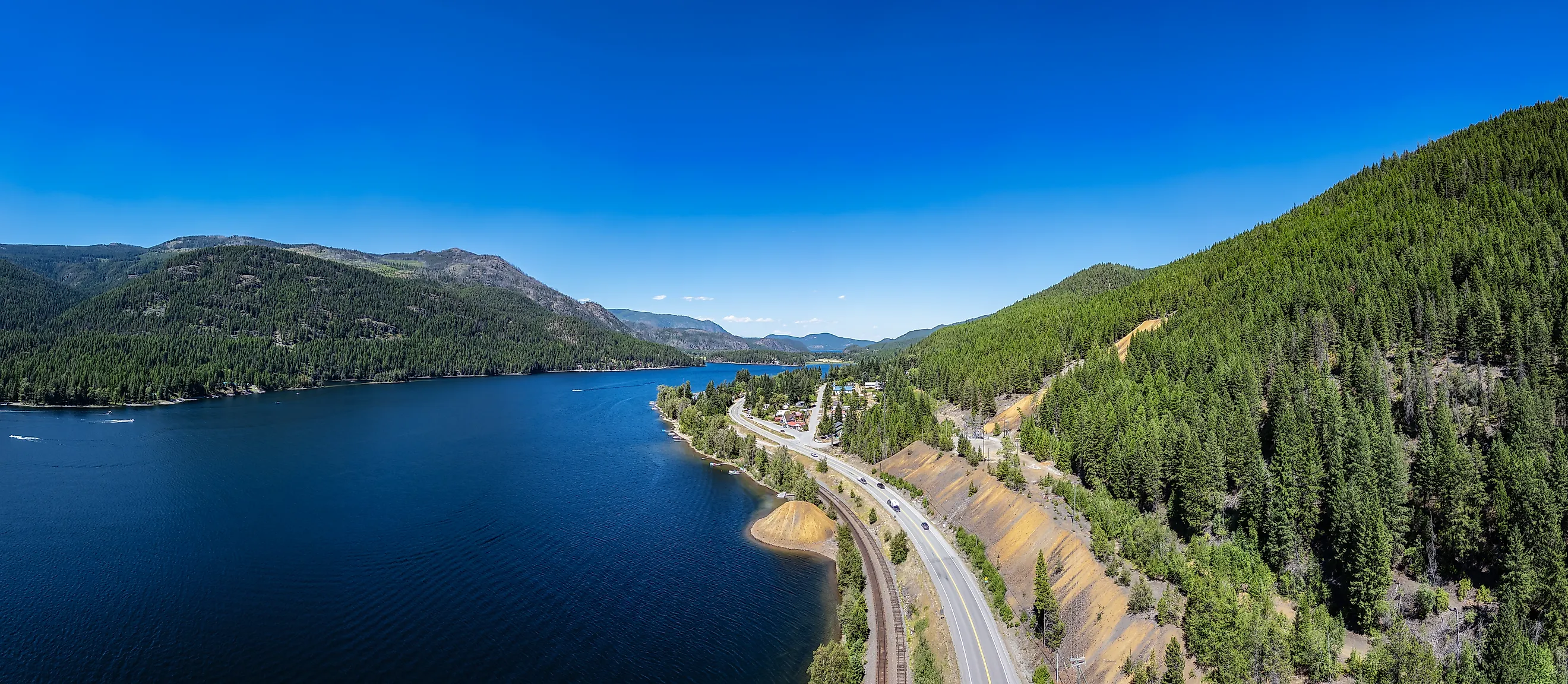
The Biggest Lakes in British Columbia
British Columbia holds more than 20,000 lakes, and a handful of them are big enough to swallow a small country's worth of shoreline. Some were carved by retreating glaciers over thousands of years. Others appeared in a single generation, when engineers threw dams across major rivers and let the water climb the valley walls. The five largest each cover more than 150 square miles, and together they tell the story of how water shapes this province, through ice, salmon, hydroelectric power, and the communities that have lived along their shores for centuries. Counting down from the biggest, here are the five largest lakes in British Columbia.
1. Williston Lake

No lake in British Columbia comes close to Williston. It sprawls across 680 square miles (1,761 square kilometers), and it did not exist before 1968. That was the year the W.A.C. Bennett Dam sealed off the Peace River, and the rising water backed up into the Rocky Mountain Trench to fill three long arms, the Peace, Parsnip, and Finlay Reaches. The result is the seventh-largest reservoir on Earth by volume. It was named for Ray Gillis Williston, the provincial Lands Minister who championed the dam.
The lake sits at 671 meters (2,201 feet) above sea level and drains toward the Arctic Ocean by way of the Mackenzie River system. Its creation flooded the traditional territory of the Tsay Keh Dene First Nation, a loss the community still marks today. For visitors, the draw now is the fishing: rainbow trout, lake trout, kokanee, and northern pike all swim these waters, and provincial parks like Muscovite Lakes dot the shore.
2. Nechako Reservoir

Sixteen years before Williston, the same idea played out farther west. In 1952, the Kenney Dam plugged the Nechako River, not to send power to a distant city, but to feed a single industry. The diverted water drops through a tunnel in the Coast Mountains to the Kemano generating station, which exists to run the aluminum smelter at Kitimat. The reservoir that formed behind the dam covers 344 square miles and reaches depths near 1,000 feet.
The water sits high, around 853 meters (2,799 feet), and swings up to 20 feet through the year as power demand rises and falls. Building it came at a steep human cost: the flooding relocated more than 75 families and drowned the traditional lands and gravesites of the Cheslatta Carrier Nation, whose shores these had been for generations. Tweedsmuir North and Entiako Provincial Parks now border the water.
3. Atlin Lake

Here the dams give way to something older. Atlin is the largest natural lake in British Columbia, 299 square miles (775 square kilometers) of cold, clear water in the far northwestern corner of the province. Its name comes from the Tlingit "A'a Tlein," meaning "big lake," and it more than earns it. The lake reaches nearly 290 meters deep, and its northern reaches cross into Yukon.
Atlin is also a source of the Yukon River, draining north through the Atlin River into Tagish Lake and onward toward the Bering Sea. Most people who live here settled along the eastern shore, near the historic gold-rush town of Atlin, while the southern end lies protected inside Atlin Provincial Park. Mining and hunting still shape daily life in the district.
4. Babine Lake
Babine is the long one. At 153 kilometers (95 miles) in length, it is the longest natural lake in British Columbia, a thin ribbon of water northeast of Burns Lake in the center of the province. Counting its islands, it covers 495 square kilometers (191 square miles), which also makes it the second-largest natural lake after Atlin. It sits at 711 meters (2,333 feet) above sea level and drains northwest into the Babine River, the single most important sockeye salmon tributary of the Skeena.
That salmon run is the heart of the lake's story. The Lake Babine Nation built fishing weirs here for generations, and the annual sockeye harvest fed both the community and, from the 1820s, the Hudson's Bay Company, which hauled tens of thousands of salmon over the Babine Portage to Fort St. James. The lake also holds a rare, oversized strain of rainbow trout that feeds on salmon fry and grows to trophy size, drawing anglers from across the region.
5. Kootenay Lake

Down in the province's southeastern corner, Kootenay Lake is the narrow, fjord-like fifth, 407 square kilometers (157 square miles) hemmed in by mountains. It runs about 104 kilometers long and just 3 to 5 kilometers wide, part of the Kootenay River system and held at its current level by the Corra Linn Dam. It sits at 532 meters (1,745 feet) above sea level.
Glaciers ground out this trench over tens of thousands of years, and the water has served as a travel and trading route for the region's Indigenous peoples far longer than any road. Roughly 20,000 people live along its shores today. Rainbow trout, bull trout, and brook trout fill the lake, and the free Kootenay Lake ferry still shuttles between Kootenay Bay and Balfour, carrying travelers across the water much as boats always have.
How British Columbia's Lakes Compare to the Rest of Canada
British Columbia has thousands of lakes, but on the national scale its giants are mid-sized. Canada holds somewhere between 880,000 and two million lakes, more than any other country on Earth, and roughly 14 percent of all the world's lakes larger than 500 square kilometers sit within its borders. Against that backdrop, Williston's 1,761 square kilometers is modest.
The truly enormous Canadian lakes lie north and east of the province. Great Bear Lake, in the Northwest Territories, spreads across about 31,153 square kilometers, making it the largest lake entirely inside Canada and the eighth-largest on Earth. Great Slave Lake, its neighbor, covers roughly 27,200 square kilometers and plunges to 614 meters, the deepest water in North America. Lake Superior, shared with the United States, is the largest freshwater lake in the world by surface area. Great Bear alone is close to 18 times the size of Williston.
What sets British Columbia apart is not the scale of any single lake but the sheer number and character of them. Where the North and the Prairies hold a few vast, shield-bound inland seas, British Columbia is threaded with long, narrow, glacier-cut fjord lakes wedged between mountain ranges. Many are strikingly deep for their size. Quesnel Lake, southeast of the five largest, reaches 511 meters and is often described as the deepest fjord lake in the world. It is depth, clarity, and abundance, rather than raw surface area, that define the province's water.
The Biggest Lakes in British Columbia
Two of the five largest are natural and three are the work of dams, but all of them prove the same point: in British Columbia, water is never a small thing. Whether it took ten thousand years of ice or a single decade of concrete, each of these lakes reshaped the land around it and the lives lived along its edge. Only five BC lakes clear 400 square kilometers; the province's other well-known large lakes, listed below them, fall some distance behind.
| Rank | Lake | Area (including islands) | Altitude | Type |
|---|---|---|---|---|
| 1 | Williston Lake | 1,761 km2 (680 sq mi) | 671 m (2,201 ft) | Reservoir |
| 2 | Nechako Reservoir | 890 km2 (344 sq mi) | 853 m (2,799 ft) | Reservoir |
| 3 | Atlin Lake | 775 km2 (299 sq mi) | 668 m (2,192 ft) | Natural |
| 4 | Babine Lake | 495 km2 (191 sq mi) | 711 m (2,333 ft) | Natural |
| 5 | Kootenay Lake | 407 km2 (157 sq mi) | 532 m (1,745 ft) | Natural |
Beyond the five that top 400 square kilometers, several other large lakes anchor their own regions of the province. Exact surface areas below this point vary between sources and do not support a precise ranking, but the most prominent include:
| Lake | Approx. area | Region | Notable for |
|---|---|---|---|
| Okanagan Lake | ~351 km2 (135 sq mi) | Okanagan Valley | Fjord lake; Ogopogo legend |
| Quesnel Lake | ~263 km2 (102 sq mi) | Cariboo | Deepest fjord lake in the world (511 m) |
| Shuswap Lake | ~310 km2 (120 sq mi) | Columbia-Shuswap | Sockeye salmon runs; houseboating |
| Stuart Lake | ~358 km2 (139 sq mi) | Northern Interior | Historic Fort St. James on its shore |