How Many Lakes Are There in Canada vs the United States?
No matter how you count or measure them, Canada has significantly more lakes than the United States. This is proven through a broad spectrum of data, as there is no single global standard to determine what constitutes a lake. Regardless, the pattern with the data we have is evident when you compare the two countries and their bodies of water.
Canada

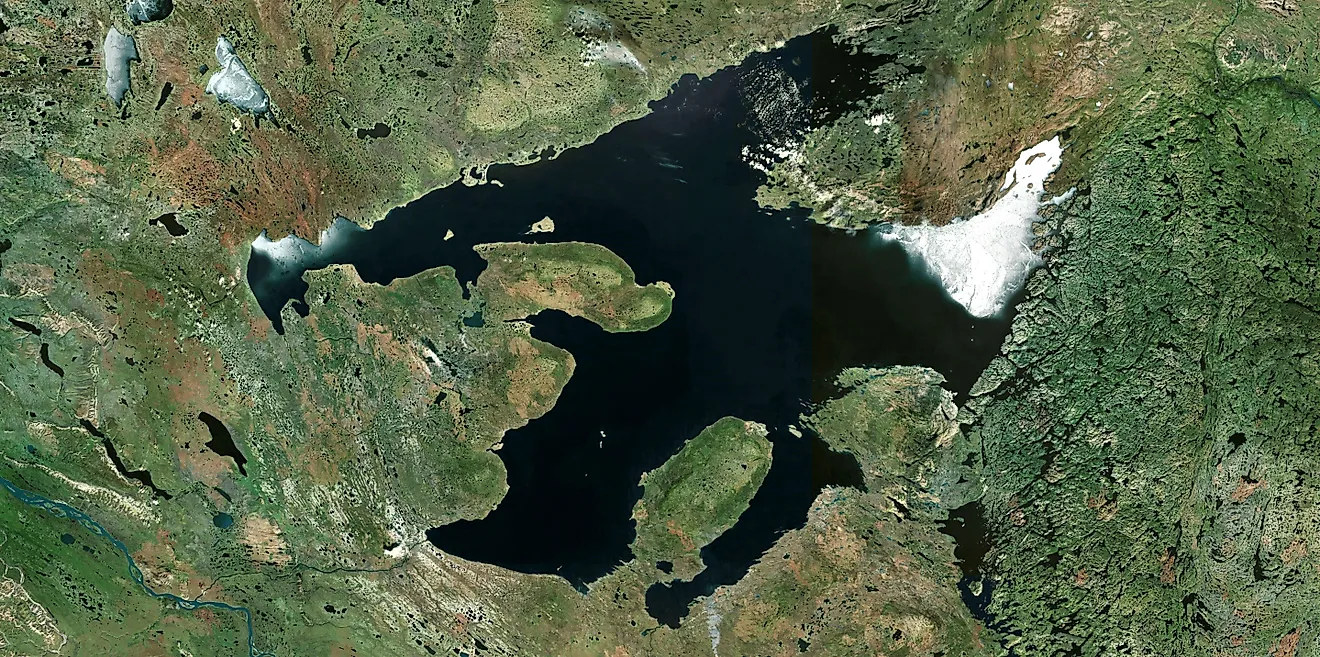
When studying Canadian lakes, scientific sources estimate that there are around 2 million lakes, including small lakes. For context, the combined water of these lakes and rivers is enough to flood the entire county to a depth of over 6.5 ft (2 m).
Using a stricter cutoff and only counting lakes greater than or equal to 0.03 mi² (lakes ≥ 0.1 km²), a recent analysis from the HydroLAKES database shows that Canada has roughly 879,800 lakes. According to this data, a large portion of these lakes is located in the Northern Hemisphere, with Canada accounting for a significant portion, alongside countries such as Scandinavia, Russia, and Alaska.

But what if we're measuring them with an even stricter cutoff? The highest cutoff that has been used is the one used by the Atlas of Canada, which only counts lakes larger than 1.16 mi² (3 km²). And even under that scrutiny, the Atlas of Canada counts a total of 31,752 lakes, with 560 of them larger than approximately 39 square miles (100 square kilometers).
United States

When comparing the number of lakes from the United States to Canada, you can already see a wide gap when measuring a lake at the ≥ 0.03 mi² (0.1 km²) threshold. According to World Population Review, the United States has a recorded population of 102,500.
And even with that clear number, the United States could arguably have fewer lakes than that if we're to compare naturally formed lakes. In 2012, the U.S. Environmental Protection Agency (EPA) conducted a national lakes assessment, which examined 111,119 lakes that were over 1 hectare (~2.5 acres) in size and at least 3.3 feet (1 m) deep, and found something interesting. About 58,700 of these lakes were entirely natural, while over 53,000 were man-made reservoirs.

It's here that the precise number of lakes is less distinct, as other studies have offered vastly different numbers and used different measurement standards. For example, a separate research claims there are approximately 480,000 lakes in the Lower 48 alone. However, it likely contains many of the man-made reservoirs, which are small in size, and also excludes lakes in Alaska and the Great Lakes. As a result, the number from that study isn't directly comparable to the scientific figure that the EPA used when measuring lakes.
Broadly speaking, both scientific studies for Canada's lakes and the EPA have used the scientific cutoff of lakes ≥ 0.03 mi² (lakes ≥ 0.1 km²). When you stick to that common scientific cutoff, the data make it clear: In the United States, about 111,119 lakes meet that threshold. Meanwhile, Canada has 879,800 lakes meeting that threshold. Canada has about 8-9 times more lakes than the U.S., and by some estimates, more lakes than the rest of the world combined. And while in Canada's case, many of those lakes are located further north, the abundance of lakes throughout the country ensures that people can visit numerous lakes in their surrounding area. In fact, despite other countries having far fewer lakes, there is a good chance that, depending on where you live, you might be near a lake.