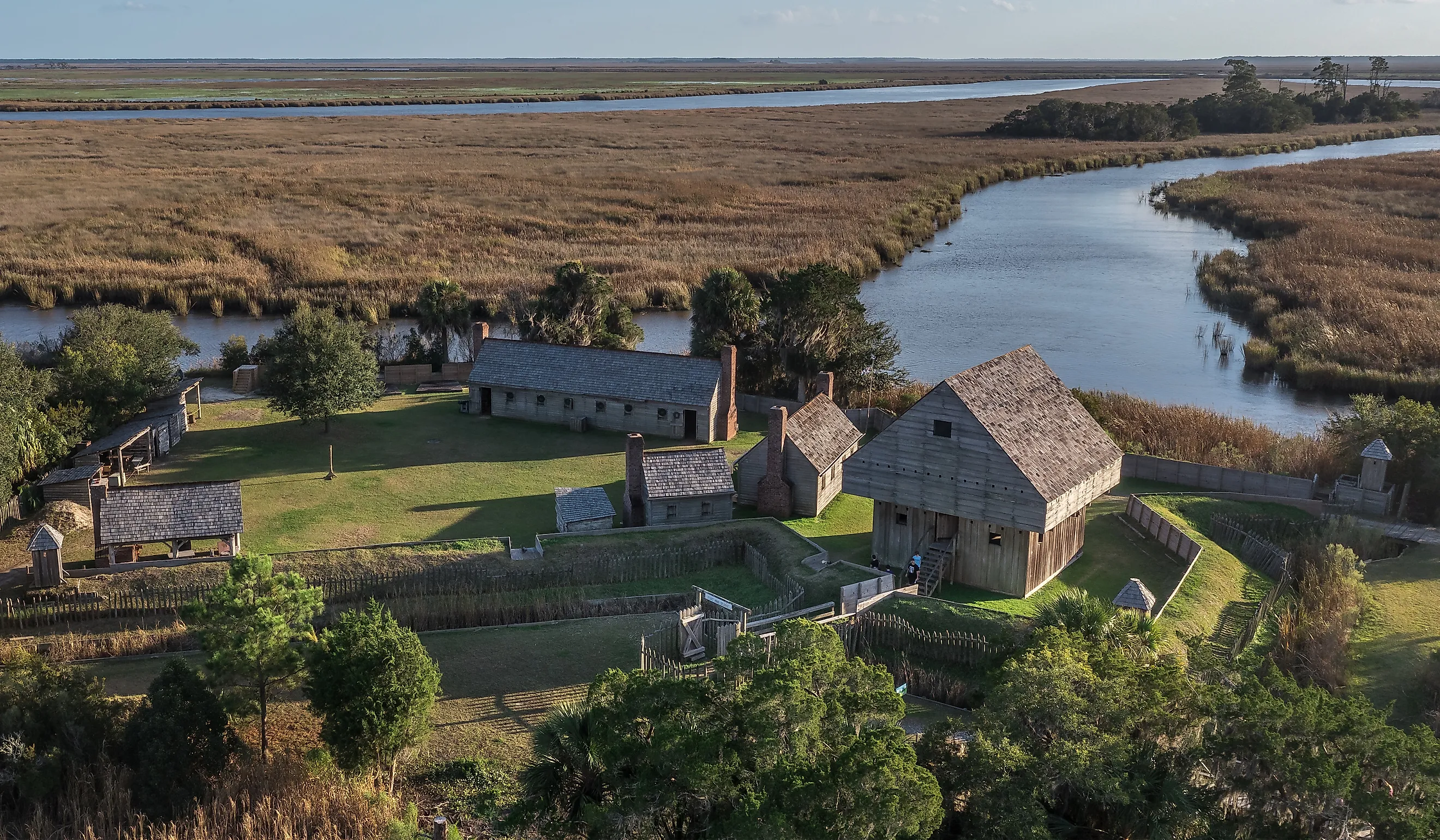
7 Must-See Historic Forts In Georgia
Georgia's waterways were a crucial point of defense against Spanish and British forces. Later they became a strategic point of contention for Union and Confederate interests. The state's many historic forts helped secure inland waterways for more than 200 years. While many forts in Georgia no longer stand and their original locations are unverifiable, a handful still exist. Old Fort Jackson is the oldest standing fort in Georgia. Fort King George has been reconstructed to resemble the fort as it stood in 1721. This guide covers seven forts from Georgia's past that welcome visitors to explore their history today.
Fort Pulaski

Fort Pulaski is part of the Fort Pulaski National Monument on Cockspur Island. The fort was built between 1829 and 1847 and placed close to the mouth of the Savannah River to prevent upriver access to Savannah, which is roughly 15 miles away. The fort is named after General Casimir Pulaski, a Polish Revolutionary War hero who was mortally wounded at the Siege of Savannah in 1779. Fort Pulaski is considered one of the most impressive harbor defense structures of the Civil War era.
Its seven-and-a-half-foot brick fortified walls were the primary defense against overseas enemies until 1862, when Union forces took advantage of new rifled artillery to breach its defenses, with 30 hours of mortars and cannons bombarding the fort. After the southeast wall was breached, Confederate Colonel Charles H. Olmstead surrendered to the Union. The fort was then used to hold Confederate prisoners and as a storage area for ammunition.
Fort Pulaski was later abandoned by 1885 and established as a National Monument by President Calvin Coolidge in October 1924. Guided tours of the fort are offered by the National Park Service. The fort has been preserved to allow continuous access to its history. Upon arrival, guests are greeted with a replica of a 13-inch Seacoast Mortar. Each tour lasts between 45 minutes and one hour, throughout each day of the week.
Old Fort Jackson

Old Fort Jackson is located on the eastern end of Savannah, on the banks of the Savannah River. Construction began in 1808, making Old Fort Jackson the oldest standing brick fortification in Georgia. The fort was manned during the War of 1812 and the Civil War, in which Confederate forces used it as a headquarters of the Savannah River defenses. After the city's surrender in December 1864, Union troops garrisoned Old Fort Jackson.
Costumed historical interpreters provide multi-era military programming, including daily historical weapons demonstrations. A 9-inch Dahlgren cannon is one of the largest pre-Civil War-era artillery pieces in the United States that still functions. Daily cannon firing programs take place between 11 am and 2 pm throughout the year. Casemate exhibits on display at the fort include weaponry, tools used at the fort, and artifacts. These exhibits allow visitors to gain insight into the history of the fort, those who served there, and its role in Savannah's defense.
Fort McAllister

Fort McAllister is an example of the best-preserved Confederate earthwork fortification. It is located on the banks of the Ogeechee River within Fort McAllister State Park. The fort was built in 1861 at Genesis Point on the plantation of Lieutenant Colonel Joseph Longworth McAllister. The fort provided protection from the US Navy for the southern flank of Savannah, which is 15 miles north, during the Civil War. The earthworks were attacked seven times by Union ironclads but did not fall until 1864, ending General William T. Sherman's "March to the Sea." Fort McAllister also defended the rice plantations of the lower Ogeechee River Basin, as well as the Savannah, Albany, and Gulf Railroad Bridge, which was a key transportation link located further upstream.
Visitors to Fort McAllister State Park can view the grounds with cannons, a furnace, bombproof barracks, and palisades. The Fort McAllister Museum houses Civil War artifacts, a video of the battle, and a gift shop.
Fort Frederica
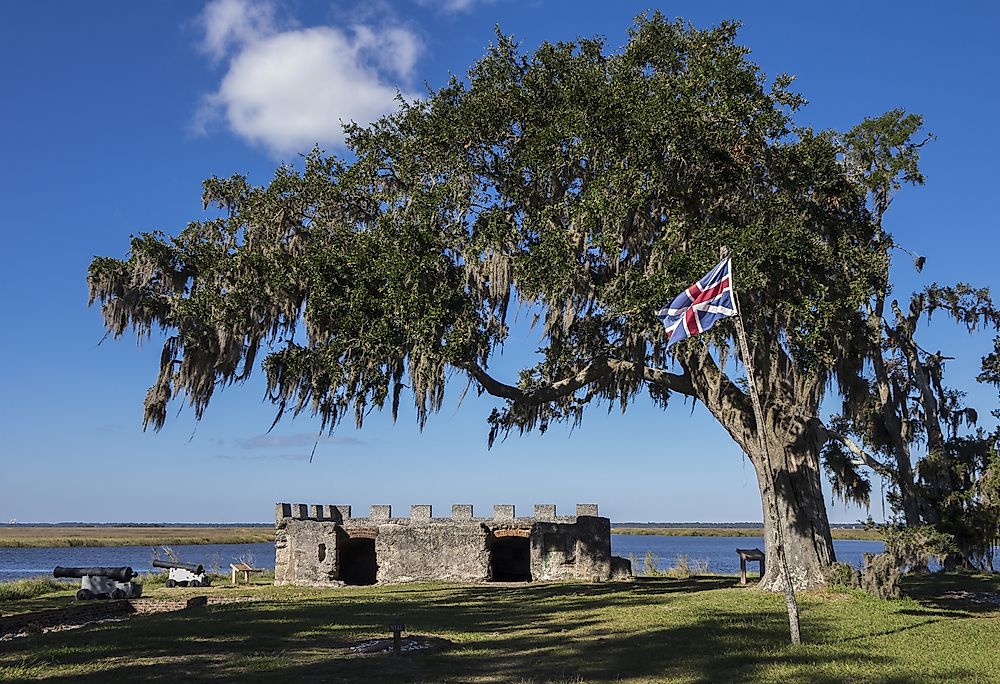
Fort Frederica was established by James Oglethorpe in 1736 in an effort to protect British colonies from the Spanish in Florida. In the early 1700s, Georgia was the epicenter of a centuries-old conflict between Spain and Britain. The fort and the town were built by 44 men, 72 women, and children. By the 1740s, Frederica was a busy village of roughly 500 citizens. Colonists from England and Scotland plus Germanic states later arrived at Frederica. In 1742, during the Battle of Bloody Marsh, Fort Frederica's troops defeated the Spanish, solidifying Georgia as a British Colony. However, the lessening military threat to Georgia's coast saw Fort Frederica's regiment disbanded in 1749.
The archaeological remnants of Frederica are protected by the National Park Service in what is now the Fort Frederica National Monument. The National Monument consists of 300 acres of archaeological sites and remnants of the original structures. Through a visitor center, museum, and educational programs, visitors can learn about the colonial era and the lives of the inhabitants of Fort Frederica.
Fort King George
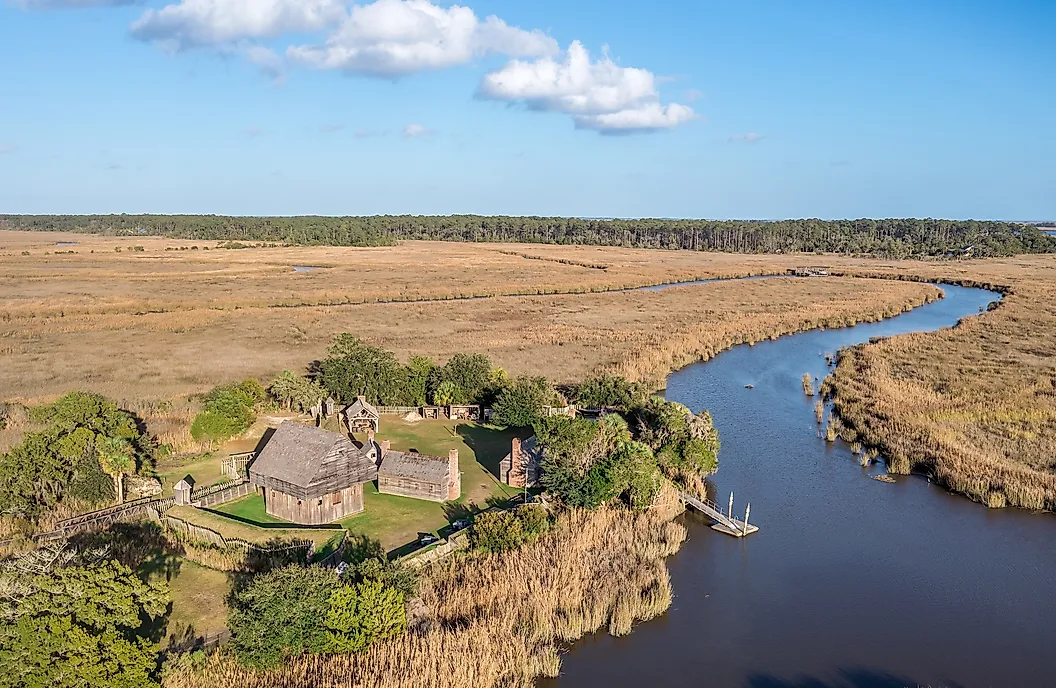
Fort King George was built in 1721 by Colonel John Barnwell of South Carolina, under British Royal orders. Fort King George is located in Darien, near the mouth of the Altamaha River. It initially operated as the southernmost outpost of British North America, and later became the stronghold for the southeast region. Fort King George is a small cypress blockhouse, measuring 23 square feet, with three floors and a lookout in the gable from which the guard could overlook the Inland Waterway and St. Simon's Island. Additionally, there were officers' quarters and barracks, with the entire premises surrounded on all but the river side by a moat and palisades. The fort was destroyed by fire in 1726, but was rebuilt a year later, when it was guarded until 1732.
Using old records and drawings, Fort King George has been authentically reconstructed and offers public tours. Structures available to the public include a blockhouse, officers' quarters, barracks, a guardhouse, a moat, and palisades. A museum and film cover the Guale Indians, Fort King George, the Scots of Darien, and 19th-century sawmilling when Darien became a major seaport.
Fort Gaines

A more inland stockade, Fort Gaines was established in 1816 by the order of General Edmund P. Gaines, commander of a large district who used Fort Gaines as his headquarters. The fort comprised two blockhouses, was 100 feet square, and was enclosed by a stockade measuring eight feet high. In 1817, when Indians were active in the area, settlers took refuge in the fort, which was garrisoned by Federal troops serving under General John Dill. The fort was reinforced by Georgia militia during the First Seminole War of 1817-1818, although it was never threatened or at risk of an attack. By 1836, the original fort had rotted away, and a second fort was constructed for the Creek War of 1836. A third fort was also constructed at Fort Gaines by Confederate troops in 1863.
Although the original Fort Gaines is no longer standing, a one-third scale replica of a blockhouse from the 1816 fort stands on the bluff at Fort Gaines within Frontier Village Historic Site. The reproduction of the blockhouse and the 1863 Confederate fort are open during daylight hours. The 1863 Confederate fort is particularly noteworthy as one of its cannons has remained in the same place for over 140 years after the end of the Civil War.
Fort Screven

Fort Screven is located on Tybee Island at the mouth of the Savannah River, as an integral part of the nation's coastal defense system. The fort is named after Revolutionary War hero General James Screven. Although the creation of the fort was approved by the Georgia Legislature in 1786, the fort was not formally established until 1898, almost a century later. It remained in continuous use through the Spanish-American War, World War I, and World War II. It primarily served as a Coast Artillery fort, then as an infantry post, and finally as a school for deep-sea diving.
Battery Garland, on the north end of Tybee Island, once mounted a single 12-inch gun with a range of eight miles. The room that once stored over six hundred-pound projectiles and two hundred-pound bags of gunpowder now operates as the Tybee Island Museum. The museum displays exhibits that narrate over 400 years of Tybee Island's history. Admission to the museum also grants visitors access to the Tybee Island Lighthouse, Georgia's oldest and tallest active lighthouse.
Georgia's Coastal Forts
These historic forts in Georgia have withstood various conflicts spanning the Revolutionary War through the end of World War II. Each fort played a role during periods of active conflict and the prevention of upstream access to major ports like Savannah. Today, they are great tourist destinations, but more importantly, priceless facets of regional history. At one point, they defended Georgia against Spanish, British, and Civil War-era threats. Now, they defend the memory of battles from a forgotten age.