12 Most Hospitable Towns In Pennsylvania
Lititz sheltered 250 wounded Revolutionary War soldiers in its church in 1777. Easton has been running the same farmers market since 1752. Media made "Everybody's Hometown" its official motto and actually means it. Pennsylvania's communities have a habit of taking hospitality seriously, and they have had a long time to practice. What keeps people coming back are things like a free concert series filling a hillside amphitheater every summer since 1975, or a downtown street that closes every Wednesday so neighbors can eat outside together. Here are twelve towns that do it well.
Lititz

Once voted "the Coolest Small Town in America," Lititz's hospitality tradition stretches back to 1777, when the town cared for more than 250 wounded Revolutionary War soldiers in its church. The town's signature stop is Julius Sturgis Pretzel Bakery, the oldest commercial pretzel bakery in the United States, which started in the 1860s. The same family recipe is still in use, and guided tours walk visitors through the original brick ovens, the history behind the twist, and a hands-on pretzel-making session. Down the street, the Wilbur Chocolate Retail Store is another downtown fixture from the 1880s. Wilbur Buds, their signature chocolate pieces, actually predate Hershey's Kisses, and the store offers tastings of dark chocolate almond clusters, milk fudge made on-site, and other in-house specialties.
Two minutes down is Lititz Springs Park, a 7-acre spring-fed green space where the limestone creek meanders through picnic pavilions, duck ponds, and an amphitheater. February is when the park and neighboring streets host the Fire & Ice Festival. The ten-day community event delivers master-carved ice sculptures, fire acrobatics, a Maker's Market at the historic Linden Hall gymnasium, and live performances.
New Hope

Named "the number one small town for arts and culture in the United States" by Travel + Leisure, New Hope has built its identity around openness, to artists, to outsiders, to anyone who shows up curious on the Delaware River banks. The Delaware Canal State Park towpath cuts right through the heart of downtown, part of a 60-mile historic corridor connecting Easton to Bristol. The restored Locktender's House at the New Hope access point explains how the canal locks once operated, and the flat, shaded path draws hikers, cyclists, and anyone who just needs a long walk along the river. From there, the town pulls you toward Bucks County Playhouse, a theater seating roughly 440 standing on the remnants of a 19th-century grist mill. Names including Grace Kelly, Robert Redford, and Liza Minnelli have performed on its stage in its more than 75-year history.
Nature lovers can head four miles south on River Road to Bowman's Hill Wildflower Preserve, an accredited botanical museum protecting 134 acres. It is dedicated to native plants, and 4.5 miles of trails through Pidcock Creek Valley pass ponds, meadows, and mature hardwood forest. More than 700 Pennsylvania native species, including Virginia bluebells and trillium in spring and butterfly weed and coneflowers through summer, draw visitors throughout the season. The town's welcoming spirit gets a public face every September at the New Hope Arts and Crafts Festival. The two-day outdoor celebration brings together local and regional artists showing painting, sculpture, ceramics, and photography.
Lewisburg

Lewisburg serves up more than expected in arts, food, and community life. Its 9.5-mile Buffalo Valley Rail Trail covers the distance between Lewisburg and Mifflinburg through pastoral farmland. Interpretive signs along the way detail regional history, and two breweries sit right on the route for anyone who yearns for a stop. Back in downtown, the Lewisburg Farmers Market draws a steady Wednesday crowd with fresh produce, baked goods, smoked meats, and jarred preserves.
The arts anchor of the town is the Campus Theatre, a single-screen cinema in Art Deco style that opened in January 1941. Designed by architect David Supowitz and renovated in 2011, it screens a rotating mix of classics, independent features, and first-run films, with affordable tickets and real butter on the popcorn. The walls still carry the original etched glass doors and 16-foot murals. Come September, the town gathers for the International Festival. The free afternoon event features vendors and cultural organizations representing global culture.
Gettysburg

No Pennsylvania town carries as much collective American memory as Gettysburg. The Gettysburg National Military Park Museum and Visitor Center is the right starting point. Its 22,000-square-foot museum holds artifacts from the battle alongside interactive exhibits and short films, followed by the Gettysburg Cyclorama that surrounds you during a light and sound show. The battlefield itself spans over 6,000 acres of open parkland, featuring 40 miles of roads and more than 1,000 monuments. For the civilian side of the story, the Shriver House Museum takes people on guided 40-minute tours of this 1860s dwelling, where Confederate sharpshooters took up positions during the action. Costumed guides lead visitors through rooms meticulously restored to their 1860s appearance, including the basement saloon and the attic where soldiers took position, with original bullet holes still visible in the walls.
Each summer, the One Hundred Nights of Taps allows the community to pay respects to the fallen. Volunteer buglers from across the country sound the 24-note call at dusk over the graves. If not visiting in the season, stop by the Gettysburg National Cemetery, the final resting place for Union soldiers killed during the battle. Abraham Lincoln delivered the Gettysburg Address here, and the cemetery's semicircular rows of graves, marked state sections, and Soldiers' National Monument keep the scale of the loss impossible to abstract.
Jim Thorpe

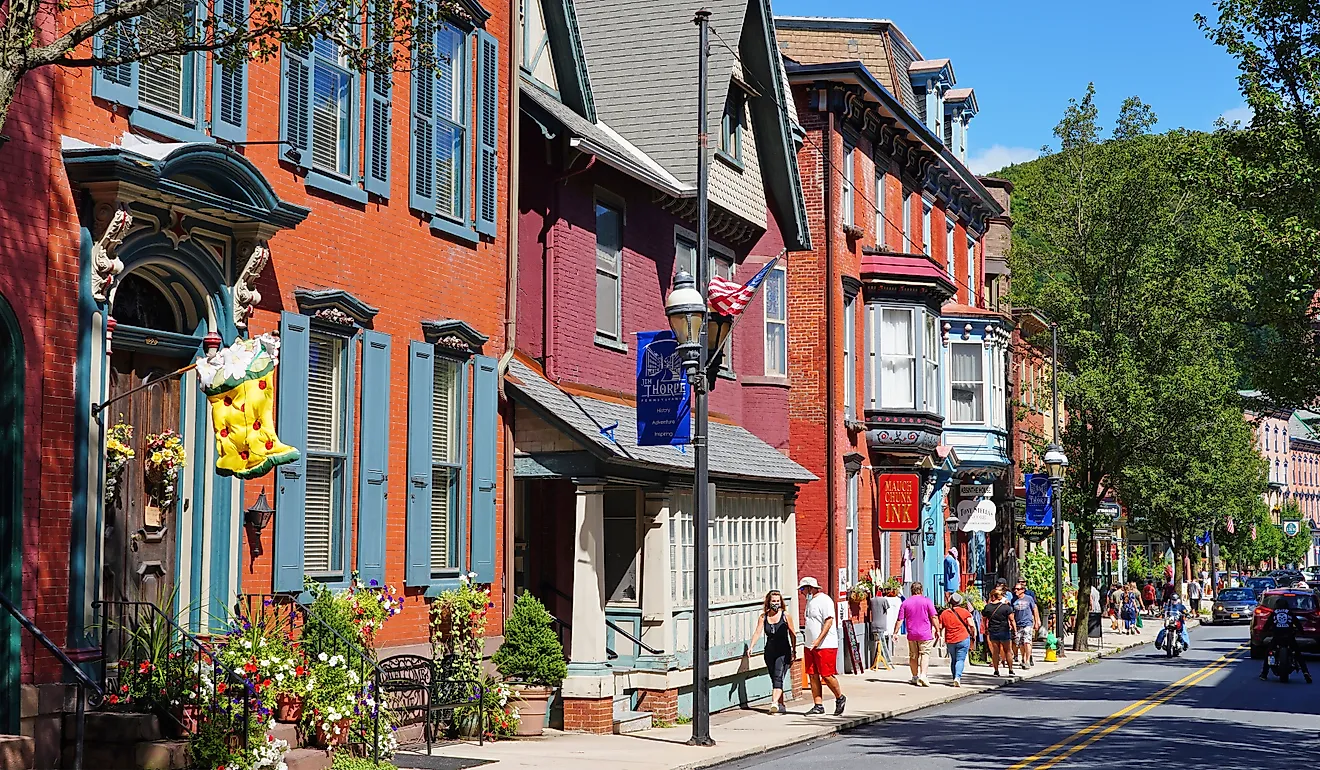
Jim Thorpe does its fair share to keep its nickname, the "Little Switzerland of America." The Lehigh Gorge Scenic Railway runs vintage diesel trains on roughly 70-minute round trips through Lehigh Gorge State Park along the former Lehigh Valley Railroad route. The gorge walls rise on both sides, the river runs below, and narration threads coal and railroad history together for the whole ride. From the train station, the town's architectural showcase begins its climb up the hill with the Asa Packer Mansion, an 1861 Italianate villa kept fully preserved inside. Almost nothing has moved since the 19th century, and the chandelier in the main hall was reproduced for the film Gone with the Wind.
Live performances run through the 1881 Mauch Chunk Opera House. One of America's oldest vaudeville theaters, it now seats around 450 and books national touring acts alongside comedy, theater, and local performers, with acoustics that make every seat feel close. The town is at its photogenic peak during the Fall Foliage Festival. The gorge turns, and the streets fill with train rides, artisan vendors, ghost tours, and the kind of all-in autumn energy that has made Jim Thorpe a perennial destination for foliage chasers across the Northeast in October.
Bellefonte

Bellefonte, known as the "Victorian Jewel of Pennsylvania," lines Spring Creek with one of the state's most intact collections of Victorian architecture. Talleyrand Park, with its willow trees, gazebo, paved loop popular with walkers and runners, and the creek flowing through it, makes it one of the most photographed parks in Central Pennsylvania. Adjacent to the park, the Gamble Mill dates its foundations to 1786. It now operates as a restaurant and inn along the Riverwalk, with a speakeasy-style cocktail bar in the lower level called The Republic and an upstairs farm-to-table restaurant.
After a ten-minute walk, the Bellefonte Art Museum for Centre County mounts rotating exhibits by regional artists alongside one of the few Underground Railroad installations in the area. December is all about the signature Bellefonte Victorian Christmas. Now in its 45th year, the event includes a Victorian Brass Band, horse-drawn carriage rides, a Music Crawl through historic churches, a Winter Market in Talleyrand Park, and train rides courtesy of the Bellefonte Historical Railroad Society.
Ligonier

Ligonier has earned national attention from The Washington Post and Country Living magazine as one of America's standout small destinations. The real draw is Fort Ligonier, an 8-acre reconstructed British fortification. Its museum holds the archaeological finds that informed the reconstruction of the fort to within inches of its original footprint. A young George Washington visited the fort, and the Washington Gallery inside explores that chapter in detail. The three-day Fort Ligonier Days festival commemorates the Battle of Fort Ligonier in October with battle reenactments, a parade down Main Street, juried crafts, live music, and fireworks.
The town also basks in the Ligonier Country Market from mid-May through September, drawing 130-plus vendors selling heirloom produce, handmade crafts, and local honey to what is reliably described as one of Western Pennsylvania's oldest and largest open-air markets. Ligonier brings the fun, too, best seen at Idlewild & SoakZone. Spread across wooded hillsides in the Laurel Highlands, the park mixes classic rides, Story Book Forest, live children's shows, and a full water park, making it a multigenerational tradition for families across Western Pennsylvania.
Easton

Easton traces its history to 1752 and still gathers around Centre Square, where the Declaration of Independence was publicly read in 1776. That same square is also home to the Easton Farmers' Market, in business since 1752, running Saturday mornings May through November with fresh produce, cheese, baked goods, honey, and flowers from local farms. About a kilometer from the square, the Karl Stirner Arts Trail takes people on a 1.75-mile paved trail curving beside the Bushkill Creek, linking the historic Simon Silk Mill to the base of Lafayette College's campus. There are also more than 15 permanent outdoor sculptures and murals along the route, including a gate built by sculptor Karl Stirner himself.
Families love Centre Square's Crayola Experience. The 65,000-square-foot interactive space includes 25 hands-on exhibits where visitors can name and wrap their own crayon color, melt wax into artwork, and watch the crayon-making process live. The square stays active long after market season, prominently with the Easton Winter Village. During the holidays, ice skating, wooden vendor huts, and seasonal lights make downtown one of the Lehigh Valley's biggest winter gathering spots.
Media

Media's unofficial motto is "Everybody's Hometown," earned through decades of deliberate inclusion and a walkable downtown that genuinely pulls people in. State Street is the spine of it all, a tree-lined stretch where independent restaurants spill onto the sidewalk May through September for Dining Under the Stars. The borough closes the street to traffic on Wednesdays, and the whole thing turns into an open-air block party that regulars have been returning to for years. A vintage trolley still runs down the center of State Street, one of the last in Pennsylvania. Nearby, the Tyler Arboretum spans 650-plus acres of meadows, wetlands, and woodlands with hiking paths totaling 17 miles. It also has champion trees, historic buildings, and over 500 rhododendrons in its Wister Collection. The Fragrant Garden was once visited by Helen Keller and was designed as a garden for the blind.
The arts in Media have a home at the restored Media Theatre, which consistently runs musicals, plays, and concerts throughout the year on its State Street stage. Community life spills beyond downtown each summer during the Rose Tree Summer Festival, a long-running outdoor concert series that has filled the park's hillside amphitheater with free performances since 1975. Running five nights a week from mid-June through mid-August, the festival brings Broadway, classical music, country, pop, and children's shows to one of Delaware County's biggest seasonal gathering traditions.
Bedford

Bedford sits roughly halfway between Harrisburg and Pittsburgh and has been receiving travelers since the colonial era. Old Bedford Village is a living history museum built around nearly 40 authentic 18th- and 19th-century structures relocated from across Bedford County. Costumed interpreters demonstrate candlemaking, tinsmithing, and blacksmithing. The Fort Bedford Museum chronicles the original 1758 French and Indian War-era fort that gave the town its name, with exhibits on regional military, Indigenous, and canal history.
On downtown's edge, Jean Bonnet Tavern has been a favorite detour since the 1760s. Travelers now stop for crab dip, prime rib, burgers, and Pennsylvania craft beer inside low-ceilinged stone dining rooms lit by fireplaces and exposed wooden beams. October 2026 also marks the 62nd Bedford Fall Foliage Festival (October 3-4 and 10-11), filling downtown with hundreds of craft vendors, two music stages, children's activities, and an antique car parade against the backdrop of the Allegheny Mountains at peak color.
Hershey

Hershey grew from Milton S. Hershey's chocolate factory into a full company town, where schools, public gardens, and Hershey Kiss-shaped streetlights still reflect the town's unusual origins. The Hershey Gardens have grown into 23 acres with 12 themed areas including a rose garden, a Japanese garden, and a children's garden with chocolate-themed plants. The year-round indoor Butterfly Atrium hosts 600-plus tropical butterflies representing 25 to 30 species at any point.
The Hershey Story Museum traces Milton Hershey's life, his unlikely path through early failed candy ventures into global chocolate success, and the model community he built around the factory. There is also a paid Chocolate Lab add-on where visitors pour and decorate their own bars. Live events are the beat of the Giant Center, a 10,500-seat arena that is home ice for the Hershey Bears American Hockey League team, a perennial contender and one of the most decorated franchises in minor league hockey. Between Bears games, the venue keeps a roster of Broadway, comedy, concerts, and touring productions.
State College

State College is regularly highlighted as one of the most energized college-town atmospheres in the country. The arts anchor on campus is the Palmer Museum of Art, the largest art museum between Pittsburgh and Philadelphia. The 73,000 square feet of interlocking sandstone pavilions hold 15 galleries with skylights that pull in natural light across works by Warhol, Wyeth, and Haring. Hiking Mount Nittany, the mountain that overlooks the valley and gave Penn State its mascot, offers several miles of trails with a roughly 600-foot climb to ridge-top views of Beaver Stadium, the campus, and farmland stretching to the horizon.
Back on level ground, the Penn State Berkey Creamery produces 100-plus flavors of ice cream on-site using milk from the university's dairy herd. The student-operated facility has roots in Penn State's dairy program dating to 1865 and draws a loyal line year-round. Every July since the 1960s, the town hosts the Central Pennsylvania Festival of the Arts. The multi-day event brings over 125,000 people downtown and onto campus for a nationally ranked sidewalk art sale, theatre and music performances, and a children's festival.
Twelve Towns That Show Up For Visitors
Pennsylvania makes a strong case for being one of the more underrated destinations in the United States. The most hospitable towns in Pennsylvania don't rely on a single landmark to earn their reputation. Gettysburg draws visitors into its history through free nightly bugle ceremonies every summer, while Media became the first Fair Trade Town in America in 2006. Across these twelve towns, hospitality shows up in the details: a festival in its sixth decade, a free museum on a college campus, and a downtown that closes its main street every Wednesday so neighbors can eat together outside.