6 Must-See Historic Forts In Florida
Florida is better known for beaches than battlements, but its coastline is studded with old forts that once decided who controlled these waters. The Spanish built the first ones to guard La Florida from pirates and British raids. After the War of 1812, the United States added a chain of brick Third System fortresses along the coast. Most never lost a battle and many never fired a shot in anger, yet they are still standing. Today these six forts pair ocean and Gulf views with cannon smoke and centuries-old stone. You can walk the same gun decks and corridors that soldiers did hundreds of years ago.
Castillo de San Marcos

The Castillo de San Marcos is the oldest masonry fort still standing in the continental United States, and it has the scars to prove it. It guards the western shore of Matanzas Bay in St. Augustine, where the Spanish Empire had already watched wooden forts rot, burn, and blow away. So in 1672 the Spanish crown started building in coquina, a local shellstone that could take a beating. It paid off in 1702, when an English siege torched St. Augustine but could not crack the fort. England later won it by treaty, then America did the same, yet no one ever took it by force. Decommissioned and named a national monument in 1924, the Castillo is now St. Augustine's crown jewel, with a courtyard, soldier barracks, a gun deck over the bay, and weekend cannon firings by costumed reenactors.
Fort Matanzas

Fourteen miles south of the Castillo, Fort Matanzas is the smaller sibling that guarded St. Augustine's back door. The Spanish built it in coquina in 1742 on Rattlesnake Island to watch the Matanzas Inlet, where enemy ships could otherwise slip in from the south. "Matanzas" means "slaughters" in Spanish, after the 1565 killing of French Huguenots nearby, though the fort itself never saw a real battle. It worked mostly by deterrence, firing warning shots at scouting boats. Like the Castillo, it passed to Britain and then to the United States in 1821, and restoration began in the 1920s. The 300-acre monument spans Anastasia and Rattlesnake Islands, and a free NPS ferry is the only way out to the fort, where you can climb to a view of the river and the Atlantic.
Fort Pickens

It took more than 21 million bricks to raise Fort Pickens on the western end of Santa Rosa Island near Pensacola Beach. Built from 1829 to 1834 and named for Revolutionary War general Andrew Pickens, the five-sided fort was a centerpiece of the Third System, the coastal-defense push that followed the War of 1812. Along with Forts McRee and Barrancas, it protected Pensacola Bay and its Navy Yard. During the Civil War, it was one of just four Southern forts the Confederacy never captured. Later it held Apache prisoners, including the famous Chiricahua leader Geronimo, from 1886 to 1888. Pickens stayed active until 1947 and joined the Gulf Islands National Seashore in 1971, and today its arched ruins, underground bunkers, and surrounding trails are open to explore.
Fort Clinch

Fernandina Beach residents helped the U.S. Army Corps of Engineers build Fort Clinch on the northern tip of Amelia Island, another Third System fort begun after the War of 1812. Construction started in 1847, but only about two-thirds was ever finished. The fort changed hands without a fight more than once, with Confederate troops grabbing it in 1861 and Union forces taking it back in 1862. It was dusted off again for the Spanish-American War of 1898 and served as a surveillance post in World War II. The roughly 2,000-acre Fort Clinch State Park, created in 1935, sits where the St. Marys and Amelia Rivers meet Cumberland Sound. Inside, the barracks, prison, and gun deck are furnished like the 1860s, and a smooth-bore cannon still points out over the water.
Fort Zachary Taylor

Down in Key West, Fort Zachary Taylor sits in the southernmost state park in the continental United States. Its Third System job was to guard Florida's southern tip and Key West Harbor, and construction began in 1845 under conditions so remote that supplies sometimes came from as far as Germany. Named for President Zachary Taylor, the fort was finished in 1866, just after the Civil War it had quietly served through under Federal control. It was cut down to a single story in 1889 ahead of the Spanish-American War. The fort opened to the public in 1985 and now holds the country's largest collection of Civil War cannons, along with winding brick corridors and tiered gun ports. When you are done, Fort Zachary Taylor Beach is right there for a swim or a snorkel.
Fort Jefferson

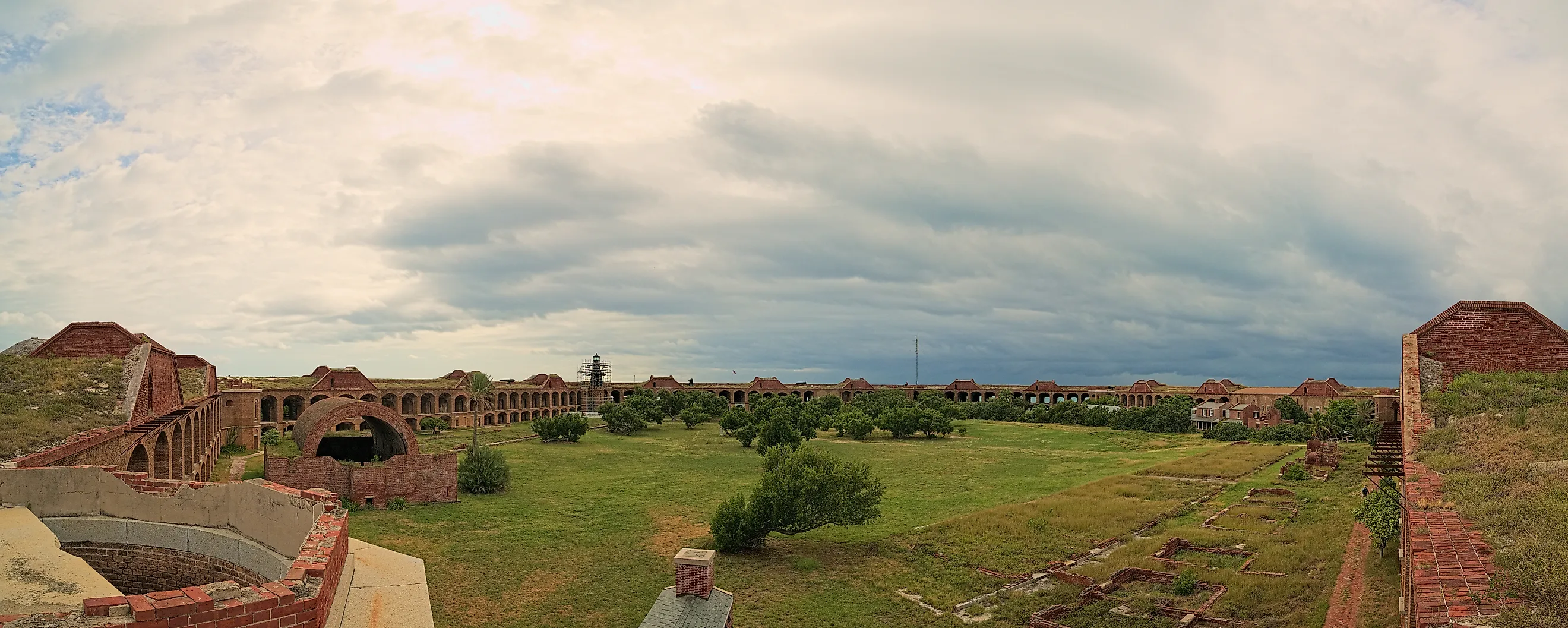
The most remote of them all, Fort Jefferson sits on Garden Key in the Dry Tortugas, 70 miles west of Key West and reachable only by ferry, seaplane, or private boat. It never saw combat, but as a "Guardian of the Gulf" it was built to control the Dry Tortugas harbor and hold out through a year-long siege. That made it enormous, a hexagon of more than 16 million bricks covering most of a 16-acre island, with three gun levels. Work ran from 1846 to 1889 and was never actually finished. During the Civil War it doubled as a prison, most famously for Dr. Samuel Mudd, jailed for setting the broken leg of President Abraham Lincoln's assassin. Today it anchors Dry Tortugas National Park, named like the fort for a president, Thomas Jefferson.
Florida Beyond the History Books
No textbook or documentary quite matches standing inside one of these forts. You can run a hand over the Castillo's coquina, climb Fort Clinch's ramparts for the same view a sentry once had, and feel how much history soaked into the stone even where no battle was ever fought. Six forts, four centuries, and one very well-defended coastline.