The Widest Tree In America
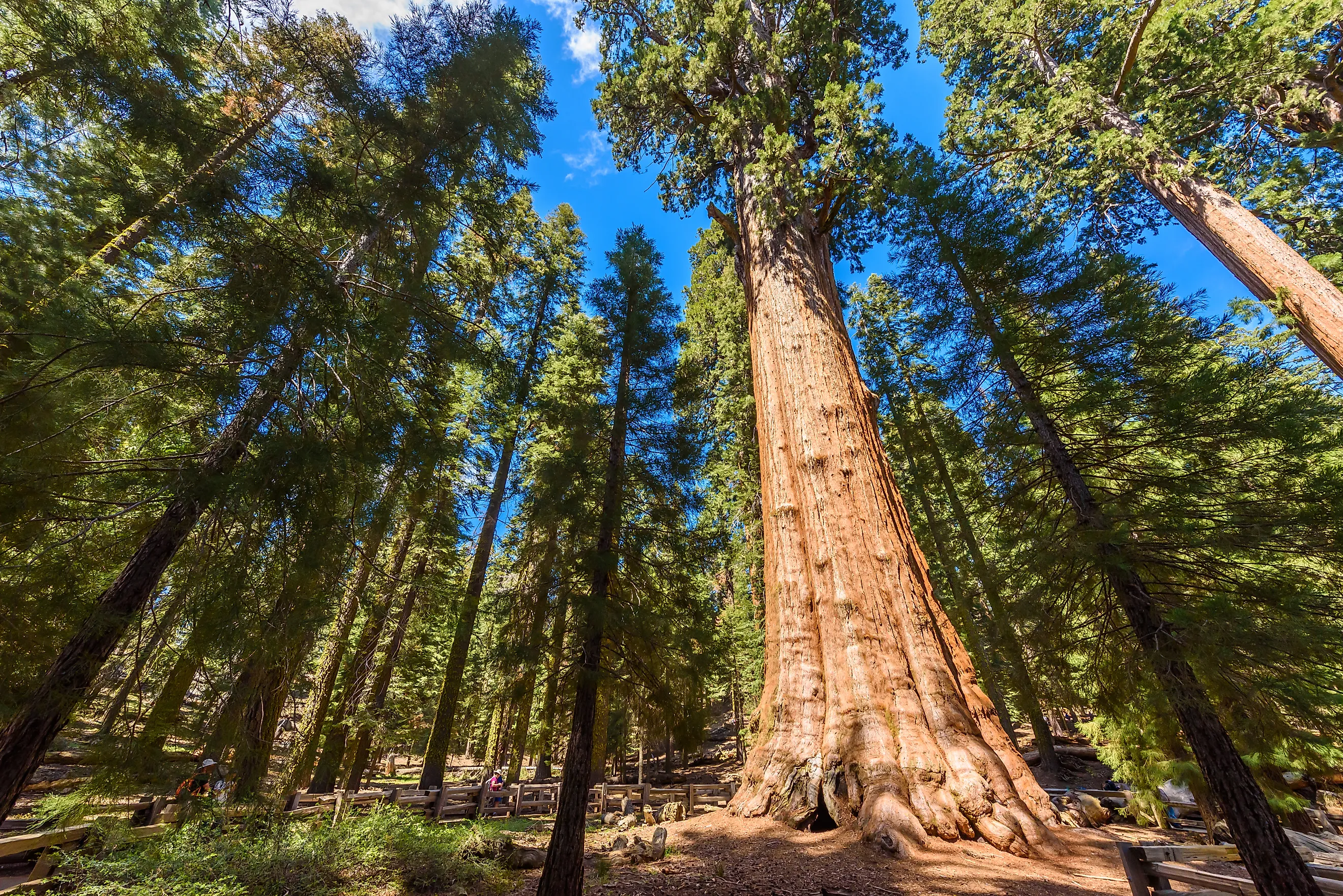
The most voluminous tree in the United States, and one of its widest and tallest, is California's General Sherman tree.
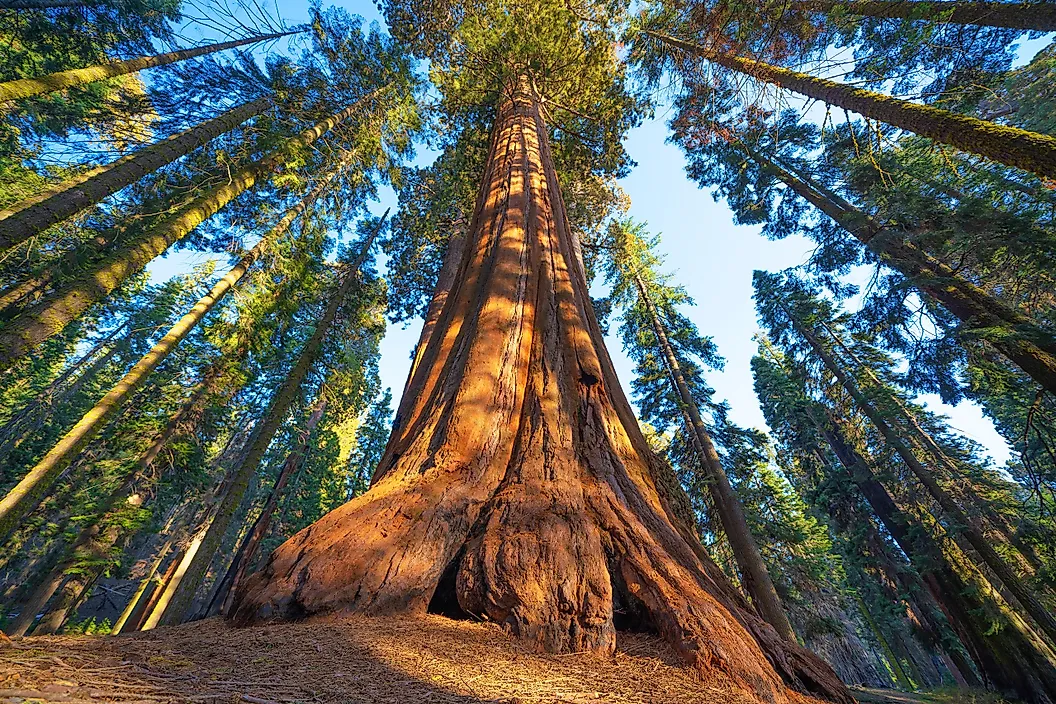
Standing prominently on the western slopes of the Sierra Nevada, within Sequoia National Park, this giant sequoia (Sequoiadendron giganteum) has a base circumference of 102.6 feet and a maximum base diameter of 36.5 feet. Combined with its neck-cranking height of 274.9 feet, that girth gives the General Sherman the largest volume of any tree in the world at an estimated 52,500 cubic feet.
The stoutest tree in the Americas, meanwhile, is Mexico's Tule Tree, with a circumference of 119 feet and a diameter of 38 feet.
Tree huggers unite, and we'll need a lot of you joined together for these suckers, as we learn more about General Sherman, Tule, and other massive trees across America and beyond.
General Sherman's Mind-Melting Facts

General Sherman is a cone-bearing tree and one of Planet Earth's three redwood species with many world-leading accolades.
Named after Civil War (Union Army) general, William Tecumseh Sherman, this show-stopper of Sequoia National Park started, like all giant sequoias, as a seed no larger than an oat flake. Over time, we're talking Biblical scales between 2,200 to 2,700 years, General Sherman grew to a height of 274.9 feet.
While other sequoias reach higher above the canopy, as do their Californian cousin trees, the coast redwoods (the tallest trees in the world), General Sherman's girth is what puts it in the record books.
At ground level, General Sherman has a maximum diameter of 36.5 feet and a total circumference of 102.6 feet. To put that in perspective, it would take about 17 six-foot-tall tree huggers linked with outstretched arms to wrap around its trunk.
Sixty feet up, it still has a diameter of 17.5 feet, and even at 180 feet, its diameter is greater than most champion trees at their maximum of 14 feet. For base measurements alone, the National Park Service puts the General Grant tree in nearby Kings Canyon ahead of it, at 107.6 feet around and 40.3 feet across.
Such a tall and portly trunk amounts to a total estimated volume of 52,500 cubic feet, or roughly the amount of wood needed to build 120 average-sized homes. This makes General Sherman the largest tree, by volume, in the world.
With all of that volume comes a tree-mendous amount of weight. The trunk alone weighs almost 1,400 tons, or 2.8 million pounds, equivalent to 15 blue whales!
As you might suspect, a tree this wide, tall, and voluminous guzzles a lot of water, estimating 500 to 800 gallons per day in the summer. That's about 15 bathtubs.
Visiting the General Sherman Tree

Though federally protected under the purview of Sequoia National Park, the General Sherman tree is actually highly accessible to the public. It is situated right off the Generals Highway, just around the bend from the Lodgepole Visitor Center.
The closest major city is Fresno, roughly two hours, or 80 miles, west of the park. Upon arrival, exit onto Wolverton Road, which leads to the parking lot for General Sherman's easy, half-mile paved path.
From there, additional trails lead deeper into the Giant Forest grove. However, because there are a few stairs on the main trail, another small parking lot with a wheelchair-accessible path can be utilized just off of Generals Highway.
Threats to Giant Sequoias
One of the nuances neglected from climate change discussions is the essential role of forest fires. For instance, giant sequoias are a fire dependent species, adapted with thick, insulating bark to withstand moderate fires and relying on those cyclical flames to release their seeds and clear competing underbrush.
Thus, after prolonged fire suppression, authorities began performing prescribed burns in the Giant Forest in recent decades. The accumulated tinder from the unnatural (if well meaning) suppression of forest fires, combined with the rising temperatures and drought driven by climate change, has resulted in extreme fires capable of damaging or destroying sequoias and other redwoods.
The National Park Service estimates that the 2020 Castle Fire and the 2021 KNP Complex and Windy fires killed 13 to 19 percent of the world's large giant sequoias — those with trunks four feet in diameter or more — or roughly 8,400 to 11,900 trees.
With the encroaching threat of severe burns, firefighters have instigated creative measures to spare these beloved trees. In September 2021, during the midst of a lightning-caused forest fire, the base of General Sherman's trunk was wrapped in aluminum foil to prevent past fire scars (that it was able to withstand, unaided) from reigniting.
Following major wildfires, it is also necessary to actively restore sequoia groves through re-planting initiatives, as they cannot resprout in the same way as coastal redwoods.
Other World-Leading Wide Trees

Now that we've been thoroughly introduced to the most voluminous tree in America, it's time to meet the widest tree in the Americas. El Árbol del Tule, "the Tule Tree," or "Ahuehuete" in the native Nahuatl language, stands at the center of Santa María del Tule — a town in the Mexican state of Oaxaca, just outside of the city of Oaxaca.
This Montezuma cypress,Taxodium mucronatum, slightly out-shines General Sherman with a circumference of 119 feet and a maximum diameter of 38 feet. With that said, because it is nowhere near as tall as the giant sequoia in question, Tule's total volume pales in comparison (i.e. 24,675 cubic feet).
For the widest tree in the world that honor belonged to South Africa's Glencoe Baobab.
Baobab (Adansonia) trees are icons of Sub-Saharan Africa and Australia, with the African baobab (Adansonia digitata), aka "the Tree of Life," being particularly stout. Located in the Limpopo Province, Glencoe's trunk measured 154 feet around and 52.2 feet across before it split in two in November 2009 and was later de-listed as a national Champion Tree.
That left its provincial neighbor, the Sagole Baobab, as South Africa's stoutest, a title it already held for overall size index owing to its greater height.
Ooh Baby, It's A Wide World
Turning one's head skyward to the tallest trees on the planet is certainly a spiritual experience, but seeing how wide ancient species can get, such as the giant sequoias of California, is no less marvelous. The amount of wood, water, and time that fostered the General Sherman tree truly boggles the mind.
However, despite its resilience, unprecedented threats loom for the largest tree in the United States because forest fires are a double-edged sword — both essential and potentially devastating to giant sequoias — nuanced discussions and multi-pronged management strategies are required to ensure the survival of this multi-millennia-old species.