The National Forests Where Elk Spend The Winter
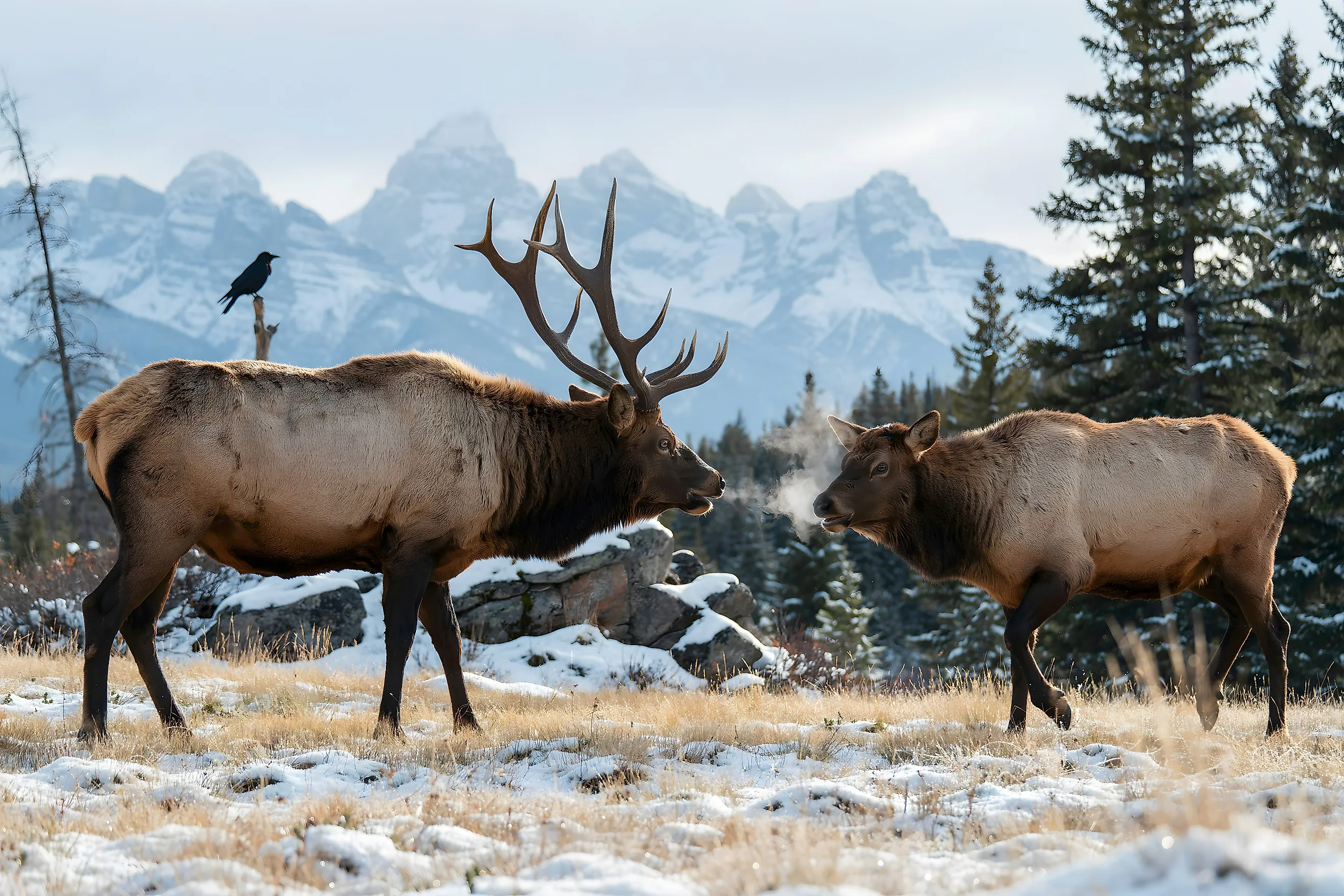
While not all elk populations move throughout the year, some migrate as temperatures drop and food becomes scarce. This is the main difference between "resident" elk, which inhabit the same ranges throughout the year, and "migratory" elk, which move between distinct summer and winter ranges. Each migratory herd has its own movement patterns depending on habitat use and climate, but most head to lower elevations in the winter, where there is less snow, better access to food and shelter, and a chance to conserve energy. Their high-summer habitat, by contrast, can pose numerous obstacles in colder months, such as limited food, increased predation risk, and greater energy expenditure.
These winter homes are chosen based on average snow depth, food availability, and general topography, with abundant forage, shallow snow, and warmer, south-facing slopes often favored. National forests managed by the US Forest Service often provide ample, safe habitats for elk and many other wildlife species because the Forest Service works with state agencies and non-governmental organizations to preserve land and meet the needs of wildlife like elk.
Bridger-Teton National Forest

The Bridger-Teton National Forest in western Wyoming is part of a major migration corridor for the Jackson Elk Herd, the largest migratory elk herd in the United States. This critical region is part of the journey taken by thousands of elk as they follow ancient routes between their seasonal ranges. The 3.4-million-acre forest is part of the Greater Yellowstone Ecosystem, one of the last largely intact temperate ecosystems in the world.

The Jackson herd numbered about 10,000 elk in the Wyoming Game and Fish Department's 2026 trend count. Most of these elk summer in Grand Teton National Park, southern Yellowstone National Park, the Teton Wilderness, and the Gros Ventre drainage, and many cross the forest on their way down to the valley floor of Jackson Hole as snow deepens in late fall. Some stay on Bridger-Teton land through the winter, and the forest is winter range for other herds as well. Wyoming runs supplemental feeding at 21 elk feedgrounds in the western part of the state, and seven of them are on Bridger-Teton land, including the Dell Creek and Forest Park feedgrounds.
Custer Gallatin National Forest

The Custer Gallatin National Forest in southern Montana is the winter destination for much of Yellowstone's largest elk herd. The Northern Yellowstone herd spends the summer on higher ground throughout the park, then moves to a lower winter range in the foothills and valley bottoms along the Yellowstone, Lamar, and Gardner rivers, where temperatures are more moderate, and snowfall is lighter than in the park's interior. According to the National Park Service, the majority of this herd now migrates beyond the park boundary onto the Custer Gallatin and nearby private land.

That winter range has grown over the decades. In the two decades after the late 1970s, the herd's winter range north of the park more than doubled as elk pushed farther into Montana's Paradise Valley. In April 2025, a Montana Fish, Wildlife and Parks helicopter survey counted 7,226 elk in the herd, with 6,124 of them outside the park, the highest tally in several years. The forest is a member of the Northern Yellowstone Cooperative Wildlife Working Group, which counts and tracks the herd together with the park, the state, and the US Geological Survey.
Shoshone National Forest

Shoshone National Forest is named after the Shoshoni people, who have lived on the land for thousands of years, and is America's first national forest, established in 1891 as part of the Yellowstone Park Timberland Reserve. This forest in northwestern Wyoming spans about 2.4 million acres, including more than 1.4 million acres of designated wilderness, and is part of the roughly 20-million-acre Greater Yellowstone Ecosystem. It is home to unique ecosystems and wildlife, including a substantial elk population.

Shoshone's eastern foothills and river valleys are key winter range for elk that summer inside Yellowstone National Park. The Cody herd, which numbers 6,000 to 7,000 elk, spends summer on the park's Thorofare Plateau and winters on Shoshone land and private land along the eastern slope of the Absaroka Range, with core winter areas along the North and South Forks of the Shoshone River. Along the route between the two ranges, some of these elk climb nearly 3,000 vertical feet over Needle Mountain. Farther north, the partially migratory Clarks Fork herd winters in Sunlight Basin and the Absaroka foothills west of Cody, where elk returning from Yellowstone mix with residents that stay in the area year-round.
White River National Forest

White River National Forest in Colorado has a large elk population. Colorado is one of the country's heavy hitters in elk habitat. Colorado is home to the largest elk population in the United States, with more than a quarter of a million individuals. This 2.3-million-acre national forest is one of the most visited in the country, and while this is largely due to the ski resorts within its boundaries, the wildlife is also a major draw. This forest is also home to a massive migratory elk herd, one of the largest in the country.

The forest's lower slopes and valleys provide winter range for elk across the region. In the Eagle-Holy Cross Ranger District, the Forest Service closes the Hardscrabble area to motorized use from December 1 to April 15 to protect wintering wildlife, and state roadless-area assessments identify parts of the forest, such as Assignation Ridge, as elk winter range and winter concentration areas. Winter remains the hardest season for these animals. During the severe winter of 2022-2023, the White River herd and the neighboring Bears Ears herd each lost roughly a third of their elk, according to Colorado Parks and Wildlife. Mild winters since then have helped the herd recover, and CPW classified more than 20,000 elk in it for the second year in a row.
Salmon-Challis National Forest

The Salmon-Challis National Forest in east-central Idaho spans 4.3 million acres, and the Forest Service says its habitat supports one of the largest herds of Rocky Mountain elk found on any national forest in the country. Part of the forest lies within the Frank Church-River of No Return Wilderness, where the main Salmon River and its Middle Fork have cut deep canyons through the mountains. The Forest Service notes that the Salmon River Canyon is deeper than the Grand Canyon.

Those canyons matter most in winter. Along the river breaks of the main Salmon and the Middle Fork, the hotter, drier, south-facing slopes support ponderosa pine stands that constitute a major portion of the available big-game winter range in the wilderness. When snow piles up in the high country, elk move down onto these sunnier slopes. Idaho Fish and Game manages the elk that use this country as part of its Middle Fork Elk Zone, which takes in the drainages of the Middle Fork of the Salmon River.
Winter Habitats for Migratory Elk
While certain national forests are home to resident elk all year round, others are a summer or winter home for migratory elk who move to greener pastures when the weather changes during the shoulder seasons. In particular, elevation plays a major role in the migration patterns of these large mammals. Visitors to national forests looking to spot elk should consider the migration patterns of the herds in these areas before planning a trip.