The State Parks With The Tallest Trees
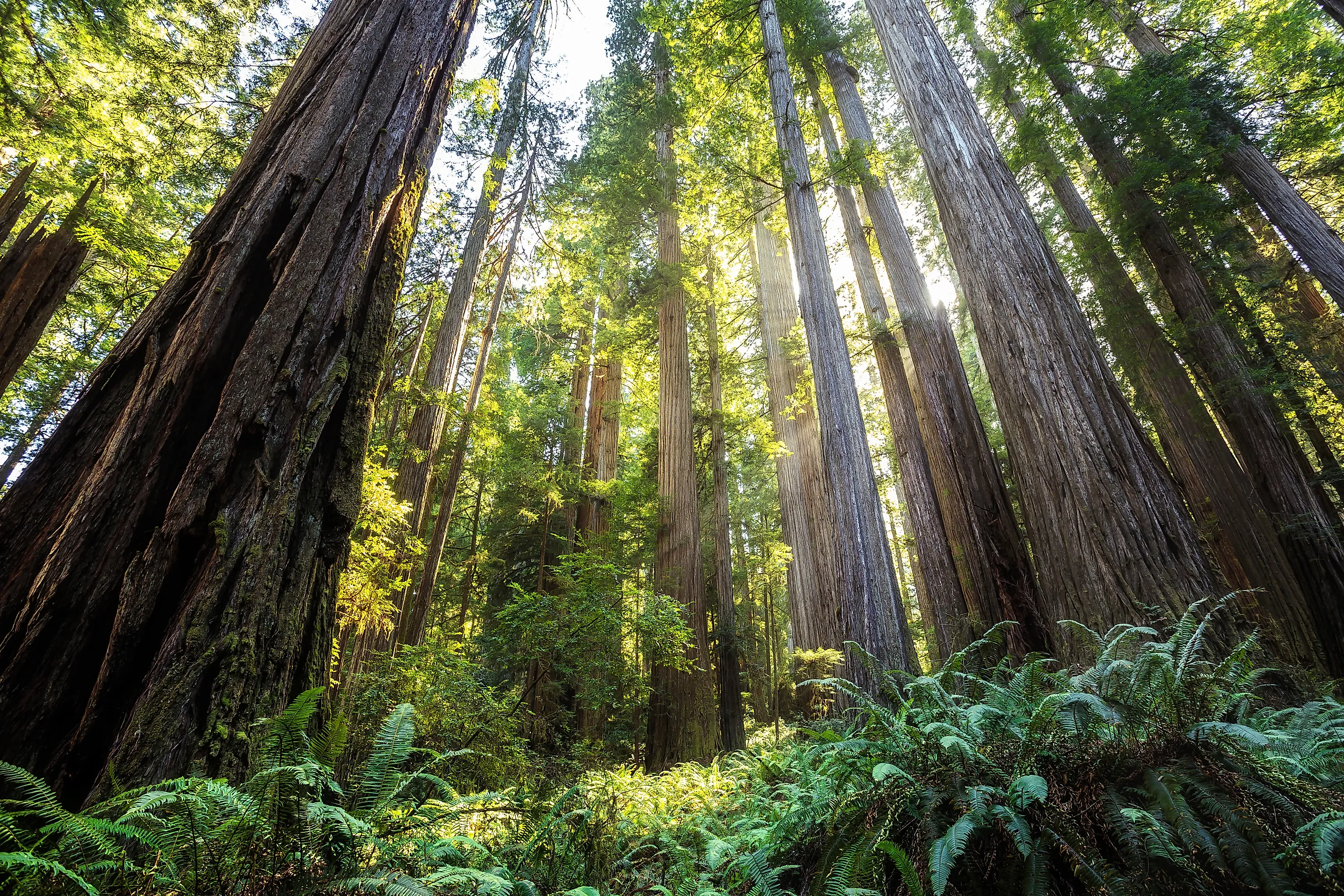
Capable of growing well in excess of 300 feet, coast redwoods (Sequoia sempervirens) are the tallest trees in the world. These russet giants are found exclusively along the fog belt of the Pacific Coast, and are protected by a litany of California state parks spanning the Oregon border down to Big Sur.
Easy-to-access groves throughout Redwoods National and State Parks, Humboldt Redwoods State Park, and Big Basin Redwoods State Park foster low-impact explorations. Dozens of additional state parks do their part to preserve coastal redwood ecosystems, but in terms of the tallest trees, the attention is owed to the following big hitters.
The planet's tallest surviving tree is a 380.8-foot coastal redwood called Hyperion. It grows within Redwoods National and State Parks, but its precise location is kept secret so as to protect this 600 to 800-year-old world record holder.
Some of these individual state parks adopt a similar strategy, while others enshrine their local champion. In any case, the true magic of these misty, high-canopy places is walking (or driving) amongst contiguous groves of redwoods.
Jedediah Smith Redwoods State Park

Jedediah Smith Redwoods State Park is one of three state parks comprising Redwoods National and State Parks. This, the northernmost unit, spans 10,000 acres around the watershed of Smith River and Mill Creek, just east of Crescent City, and protects approximately seven percent of all remaining old-growth redwoods.
Named in honor of a ground-breaking American explorer, Jedediah Smith Redwoods State Park encourages exploration in the form of light walks through looped groves, extensive point-to-point hikes, overnight camping in the park's namesake campground, under the watchful branches of these nourishing giants, and scenic drives along unpaved roads or even straight through U.S. Route 199.
The park's quintessence, the 44-acre Stout Grove, contains trees exceeding 300 feet, including the platformed but unsigned, 325-foot Stout Tree.
Del Norte Coast Redwoods State Park

Picking right up from the south side of Jedediah Smith Redwoods State Park, Del Norte Coast Redwoods State Park carries the mantle as tall-tree protector within Redwoods National and State Parks. This 6,400-acre swath spans eight ruggedly-handsome miles of the Pacific Coast, and is approximately 50 percent old-growth coast redwood.
Paralleled by the Redwood Highway (101) and the California Coastal Trail (CCT), while also networked by winding dirt roads, there are a variety of ways to appreciate this primeval forest. A visit could entail a moment of admiration from a scenic roadside turnout, or the steep descent (and subsequent ascent) on the four mile (round-trip) Damnation Creek Trail.
The latter reveals Del Norte Coast's rocky shoreline, slamming waves, and full-blast sun at the end of the switchback trail through the redwoods. In addition to redwoods, Del Norte Coast provides important feeding and breeding grounds for a variety of salmon.
Prairie Creek Redwoods State Park

Dropping down to Prairie Creek Redwoods State Park, less than 50 miles north of Eureka, tree-hugging hikers will love the 75 miles of soothing, trunk-lined trails, including a continuation of the CCT.
With over 10,000 densely-packed acres, this third state park of the Redwood National Park collective constitutes the second-largest contiguous old-growth redwood forest in the world. The king of these woods is the 1,500-year-old, aptly-named Big Tree. Standing 286 feet, with a diameter of 23.7 feet and circumference of 74.5 feet, this signed, platformed, co-operative photo-op of a tree can be reached right off of the Newton B. Drury Scenic Parkway — a scenic-route spur of the Redwood Highway.
Impressive as Prairie Creek's old-growth redwoods undoubtedly are, Fern Canyon, with its 50-foot fern-lined walls is another of the park's focal points.
Humboldt Redwoods State Park

Though outside the banner of Redwoods National and State Parks, Humboldt Redwoods State Park is every bit impressive, arguably more so. Within its 53,000 acres, the 10,000-acre Rockefeller Forest takes the crown as the largest remaining intact old-growth redwood forest in the world.
Amazingly, this park contains the second, fourth, sixth, and eighth tallest trees, but is famous for three particular attractions: Founders Tree, the Dyerville Giant, and the Avenue of the Giants. At 346.1 feet, Founders Tree is the tallest standing tree within the park. Heck, its first branch doesn't even sprout until 190 feet off the ground!
The Dyerville Giant was the local champion until it came crashing to the ground in 1991, at the ripe old age of approximately 2,000 years. Yet, there it lies, right along the Founders Grove nature trail: 362-feet long and 17 feet in diameter. Laid on its side, passersby get an even greater appreciation for its dimensions.

Finally, the 32-mile scenic drive known as the Avenue of the Giants skirts beside the Redwood Highway, tracing the course of the big-tree-fostering South Fork Eel River. Heading north to south, the first stop is Founders Grove, followed by the Humboldt Redwood State Park Visitor Center, the Shrine Drive-Thru Tree, and multiple hikable groves.
Big Basin Redwoods State Park

South of San Francisco, within the Santa Cruz Mountains, Big Basin Redwoods State Park sports a 328.1-foot coastal redwood called Headwall Tree. Like Hyperion, its exact location is kept under wraps.
Founded in 1902, Big Basin is going through a period of transition and regrowth following the 2020 forest fire that burned through 97 percent of its 18,000 acres. The fire-resistant, fire-dependent redwoods survived, but all of Big Basin's historical structures were destroyed, along with much of its undergrowth.
Six years on, plant-life is blossoming amidst the charred foundation, animals are returning, and the mountain-redwood-ocean trifecta still wows. The park is open for business, though with limited amenities, so check ahead before committing to travel plans.
Bonus: Calaveras Big Trees State Park

This last tall-tree state park takes us into the western slopes of the Sierra Nevada. Calaveras Big Trees State Park's 6,498 acres (spread across a North and South Grove) introduces a fresh species of redwood: the giant sequoias (Sequoiadendron giganteum). These stout-trunked trees are the largest on earth in terms of their volume and mass, and are some of the longest living trees (upwards of 3,200 years), but they don't quite reach the heights of their coastal redwood cousins.
With that said, giant sequoias are still some of the tallest trees found in any of America's state parks. For instance, Calaveras Big Trees State Park's champion tree, Louis Agassiz, stands 250 feet tall with a whopping diameter of 25 feet! Another of Calaveras' paradigm-shattering attractions is the Discovery Tree.
Though it was tragically cut down in the 1850s, the loss of this giant sequoia catalyzed the redwood conservation movement. Today, the helipad-sized stump has a wooden staircase leading up it, helping North Grove visitors to appreciate the scale of these trees from yet another perspective.
Redwoods For Good
Following the logging boom of the 19th and 20th centuries, just five percent of the world's redwoods remain. Of those, 95 percent grow along California's coast. The combined units of Redwoods National and State Parks offer a multifaceted visitation experience, but nearby Humboldt Redwoods State Park, the Bay Area's Big Basin Redwoods State Park, and Calaveras Big Trees State Park of the distant Sierras, are head-turning, neck-tilting destinations unto themselves.
There are plenty of other protected spaces throughout northern California and southern Oregon in which to see redwoods, but in regard to state parks, these five host the tallest of tall trees.