The Forests Growing On Old Lava Flows
A lava flow can erase a forest in a matter of hours. Given enough time, however, a forest can return and eventually make the volcanic landscape almost disappear. Across the western US, trees grow on lava that once covered the ground as molten rock. Some flows now support mature forests, while vegetation is still working its way into cracks in younger basalt. Fresh lava provides almost no soil, and its jagged surface can be difficult for seeds to reach and roots to penetrate. Lichens, mosses, and hardy plants begin altering the rock. Organic material accumulates, pockets of soil develop, and larger plants eventually gain a foothold.
Some examples are found on public lands managed by the US Forest Service, where recreation exists alongside timber production, grazing, and wildlife habitat. Beneath the trees may lie a landscape created by an eruption that once looked anything but forested.
Where Lava Preserved a Forest

One of the strangest places to see the relationship between trees and lava is Lava Cast Forest, part of Deschutes National Forest in Oregon.
The trees growing today are not the same trees that were overtaken by the lava flow. Instead, the landscape preserves evidence of the older forest buried beneath molten rock. According to the US Forest Service, Lava Cast Forest formed when lava moved through an old-growth forest and cooled around the trees, creating casts of trunks that once stood there.
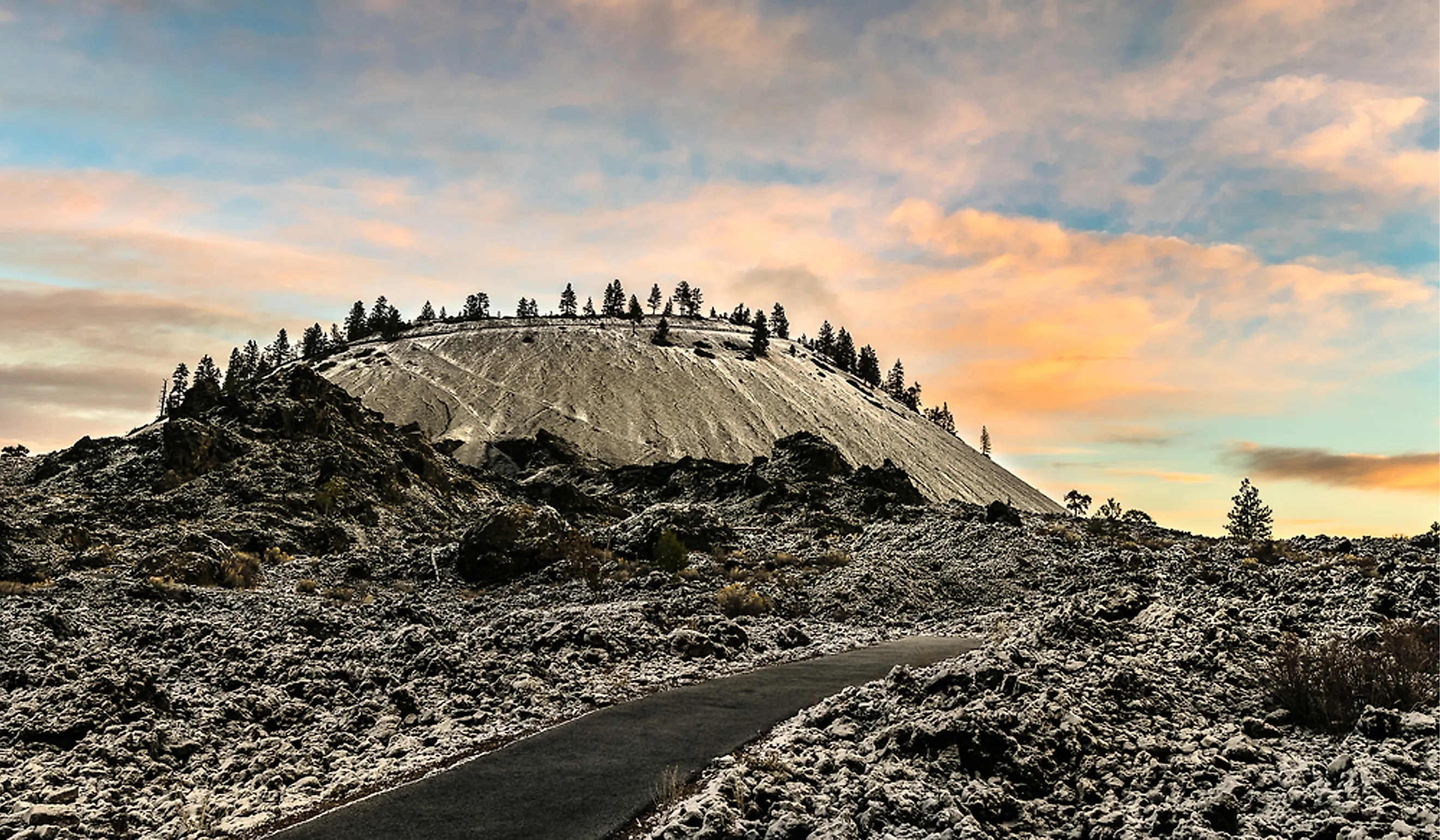
The one-mile Lava Cast Forest Trail passes numerous tree casts left behind by trees that vanished thousands of years ago. The lava came from nearby Lava Butte, a cinder cone that rises about 500 feet above its surrounding lava flow. The Forest Service dates the eruption to roughly 7,000 years ago.
When Forests Grow Over Lava

Lava Cast Forest is part of the larger volcanic landscape surrounding Newberry Volcano in central Oregon. The area contains cinder cones, lava flows, and caves.
Newberry National Volcanic Monument was established in 1990 and is managed by the US Forest Service within Deschutes National Forest.
Lava River Cave formed during an eruption from Newberry Volcano about 80,000 years ago. Visitors can enter the mile-long lava tube through a forested landscape that gives little indication of the volcanic passage beneath the ground.
Elsewhere, younger lava flows remain much more obvious. Lava Butte's roughly 9-square-mile flow creates a dark, rocky contrast with the surrounding forest.
Together, these sites show how differently volcanic landscapes can appear as they age. Fresh or relatively young flows can remain dark and exposed, while older volcanic terrain may become increasingly difficult to distinguish from the surrounding forest. In central Oregon, lava, trees, caves, and soil development exist at different stages of the same long process.
A Forest Starting Over

Some forests growing on volcanic landscapes are old enough that their relationship with lava is easy to overlook. Mount St. Helens offers the opposite experience.
The volcano's 1980 eruption dramatically altered the surrounding landscape, knocking down or killing forests across a broad area and covering parts of the ground with volcanic material. Yet the ecological story did not end with the eruption.
USGS researchers describe the recovery of Mount St. Helens as an ongoing process shaped by surviving plants and animals, new vegetation, erosion, and the changing volcanic landscape. The eruption created a vast natural laboratory in which scientists could observe how ecosystems rebuild after a major disturbance.
The volcano's relationship with lava extends beyond 1980. Two basalt flows erupted about 1,700 years ago and traveled roughly 10 miles from the summit. One contains the Ape Cave lava tube.
Today, much of the surrounding landscape is green again. Plants have returned, animals have recolonized the area, and new ecosystems continue developing around terrain reshaped by volcanic activity.
Where Lava Is Still Bare

Not every volcanic landscape has had enough time to become completely forested.
Craters of the Moon in Idaho provides a dramatic contrast between dark lava fields and the vegetation of the Snake River Plain. The volcanic field contains more than 60 recognizable lava flows created during eight eruptive episodes over approximately the past 15,000 years. The most recent eruptions occurred about 2,000 years ago.
Some vegetation has established itself in cracks and sheltered areas, but large portions of the volcanic field remain dominated by exposed rock. The surrounding forests and woodlands make the contrast even more noticeable, with vegetation sometimes ending abruptly at the edge of a lava flow.
Cracks, collapsed lava tubes, and sheltered pockets also create different conditions for plants. Small changes in moisture, temperature, and accumulated sediment can determine where vegetation takes hold first.
How Lava Shapes Where Trees Grow

The relationship between trees and lava is not always as simple as barren rock slowly becoming forest.
In parts of the western United States, old lava flows create sharply different habitats from the forests growing nearby. The Forest Service's Mayfield Research Natural Area in northeastern California includes distinctive vegetation associated with basalt flows, where trees are generally absent or scattered, even though forests grow in surrounding areas.
Lava can create a landscape full of fractures, ridges, and sinkholes. Soil may be thin in some places and deeper in others, while water can drain quickly through cracks or collect in protected depressions.
The result can be a patchwork rather than a uniform forest. A ponderosa pine may find enough soil to establish itself on one section of a flow while shrubs and grasses dominate only a short distance away.
Even after the lava is no longer geologically young, its physical structure can continue influencing the plants that grow on it. The age of a lava flow alone does not determine whether it will support a dense forest. Its surface and ability to retain soil can continue shaping vegetation long after the eruption itself.
When the Forest Hides the Lava

One of the strangest things about old lava flows is how effectively forests can conceal them.
A visitor hiking through a mature pine forest may be walking across an ancient eruption without realizing it. Fallen needles and decomposing wood gradually build soil, tree roots work their way into fractures, and weather breaks apart exposed rock.
Forest Service research in central Oregon documents forests and plant communities growing among lava flows, pumice deposits, and cinder cones. In the Deschutes National Forest, ponderosa pine and other conifers grow across landscapes shaped by repeated volcanic activity.
The lava never disappears completely. It can continue influencing drainage, soil depth, and the shape of the land. After thousands of years, however, the forest may become the landscape's most obvious feature, hiding the eruption beneath it.
The Forest Is Only the Latest Chapter

Forests can seem permanent, but lava flows reveal how temporary they can be.
An eruption can destroy a forest in hours. At Lava Cast Forest, the flow even preserved evidence of the trees it buried. Then, over thousands of years, new vegetation returned and another forest grew across the same volcanic landscape.
The same cycle appears at different stages throughout the West. At Craters of the Moon, much of the lava remains exposed. Around Mount St. Helens, ecosystems continue recovering from a modern eruption. Elsewhere, older flows support mature forests that give little indication of the molten rock beneath them.
Trees grow, die, and are replaced over centuries. Lava can remain for thousands or millions of years.
A forest may look like the end of the story. On an old lava flow, it may simply be the newest chapter.



.jpg)