10 Greastest Inventions Made By The Soviet Union
- Soviet scientist Vladimir Demikhov created the world’s first implantable total artificial heart.
- The Soviets launched the world's first space station, Salyut 1, in 1971.
- The first mobile phone device was invented by Soviet engineer Leonid Ivanovich Kupriyanovich.
The Soviet Union spent seven decades trying to out-invent the West, and on a surprising number of fronts, it did. The space race produced the headline achievements, the first satellite, the first person in orbit, the first space station, but Soviet scientists were also quietly building heart-lung machines and artificial hearts decades before the West got there, and even coded one of the best-selling video games of all time. Some of these inventions changed the world. Others were brilliant dead ends the system never bothered to mass-produce. Here are ten that left a mark, counting up to the one almost nobody expects to find on a list of Soviet achievements.
10. The Autojektor

Long before open-heart surgery was possible, a Soviet physician kept a severed dog's head alive with a machine. Sergei Brukhonenko built the autojektor in the 1920s, the first device to circulate and oxygenate blood outside a living body, and used it in a series of unsettling canine experiments that proved life could be sustained mechanically. His work was decades ahead of its time and pointed directly toward the cardiopulmonary bypass machine, the technology that makes modern heart surgery possible. The demonstrations were disturbing enough to inspire a 1940 documentary; the science behind them saved millions of lives.
9. The Ilizarov Apparatus

Working in a remote Siberian clinic in the 1950s, orthopedic surgeon Gavriil Ilizarov noticed something nobody had exploited: pull a broken bone apart slowly enough, and the body grows new bone to fill the gap. The external cage he designed to do it, a ring of steel wires and rods bolted around the limb, could save legs that would otherwise have been amputated and even lengthen them. His method gained fame after he treated Soviet high jumper Valery Brumel in 1968 and Italian journalist Carlo Mauri in 1980, and surgeons worldwide adopted it. The Ilizarov apparatus is still bolted onto patients today.
8. The First Human Anthrax Vaccine

Louis Pasteur developed an anthrax vaccine for livestock in the 1880s, but the first vaccine for people came out of the Soviet Union in the 1930s. It was a live-spore formula, and the West considered it too risky for human use, developing safer inactivated versions in the 1950s and 60s instead. Risky or not, it was a genuine first in the fight against a disease that still kills, and a marker of how far Soviet microbiology had come. Anthrax outbreaks remain rare today, and people in high-risk jobs are still vaccinated against it.
7. The Artificial Heart

The name most people attach to the artificial heart is Dr. Barney Clark, the first human to receive a permanent one, in 1982. But the idea was proven in a Moscow lab 45 years earlier. In 1937, Soviet scientist Vladimir Demikhov implanted the world's first total artificial heart into a dog, which survived a few hours on the device. It was brief, but it settled the fundamental question of whether a machine could stand in for the heart at all. Every artificial heart since traces back to that experiment.
6. Multistage Rocket Theory

Stacking one rocket atop another is an old trick; a sixteenth-century Bavarian fireworks maker named Johann Schmidlap was doing it to send pyrotechnics higher. What the Soviets contributed was the math that turned the idea into spaceflight. In his 1929 work "The Space Rocket Trains," the visionary theorist Konstantin Tsiolkovsky worked out rigorously why a single rocket can never reach orbital velocity, and why a staged one, dropping dead weight as it climbs, can. Every rocket that has ever reached space, and by extension every GPS signal and weather satellite, runs on the principle he formalized. The R-7 that launched Sputnik in 1957 was the first practical proof.
5. Sputnik 1

It was a polished metal ball the size of a beach ball, trailing four antennas and doing nothing but beeping, and it terrified half the planet. When the Soviets launched Sputnik 1 on October 4, 1957, the first human-made object to orbit Earth, it opened the space age and handed the USSR an enormous propaganda victory. Its designers, led by chief engineer Sergei Korolev, deliberately fitted it with a transmitter any amateur radio operator could pick up, so the whole world could confirm the achievement for itself. A month later, Sputnik 2 carried the dog Laika, the first living creature in orbit. The Americans, caught flat-footed, would not answer until 1958.
4. Vostok 1

On April 12, 1961, a 27-year-old Soviet pilot named Yuri Gagarin became the first human being to leave the planet. His Vostok 1 capsule made a single orbit of Earth and came down over Kazakhstan, with Gagarin ejecting and parachuting to the ground separately, a detail the Soviets kept quiet for years because the rules of the day required a pilot to land inside the craft. Developed in a sprint against America's Project Mercury, Vostok 1 beat the first American into orbit by ten months and made Gagarin the most famous man alive overnight.
3. The Space Rover

Forty years before NASA's Curiosity became a household name on Mars, the Soviets were already driving a robot around the Moon by remote control. Lunokhod 1 touched down on November 17, 1970, the first wheeled vehicle to operate on another world, a bathtub-shaped, solar-powered rover steered by a five-person team back on Earth. Built in about a year after the first Lunokhod was lost in a 1969 launch failure, it was scheduled to last three lunar days and ran for eleven, roving the surface and sending back thousands of images. It proved that exploring other worlds did not require sending people at all.
2. Salyut 1

Every space station that followed, including Mir and the International Space Station, descends from a cylinder the Soviets launched on April 19, 1971. Salyut 1 was the world's first space station, and it was built and flown in barely a year. The story turned tragic: the first crew failed to dock, and the second, from Soyuz 11, lived aboard for a record 23 days but died during reentry when their capsule depressurized. It was a devastating loss, but Salyut 1 had proven humans could live and work in orbit, the foundation of every long-duration mission since.
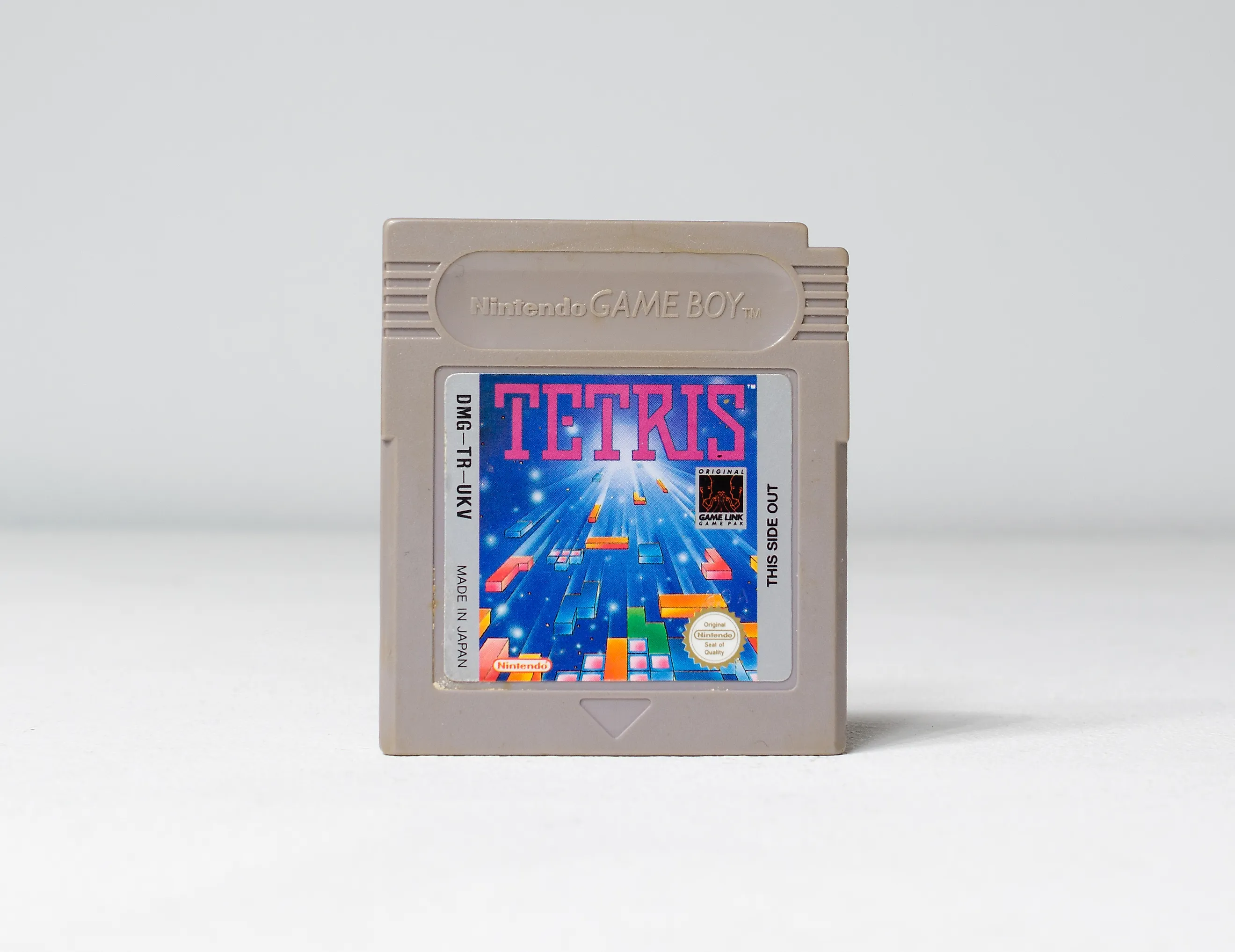
1. Tetris

The most-played creation on this list was not a rocket or a machine but a game, dreamed up on a computer so primitive it could only draw with text. In June 1984, an engineer named Alexey Pajitnov built Tetris in his spare time at the Dorodnitsyn Computing Centre of the Soviet Academy of Sciences in Moscow, running it on an Elektronika 60 and building the falling blocks out of keyboard characters. He named it from the Greek "tetra," for the four segments in every piece, and tennis, his favorite sport. Copied floppy disk by floppy disk, it spread across the USSR and then slipped past the Iron Curtain, setting off one of the strangest licensing battles in tech history, because under the Soviet system Pajitnov did not own his own invention; the state did. The rights ran through a Soviet agency for a decade before finally returning to him in 1995. Today Tetris has sold more than 520 million copies across dozens of platforms and ranks among the best-selling video games ever made, which means the most globally beloved thing the Soviet Union ever produced may be a puzzle its creator was not initially paid for.
Ten Inventions, One Superpower
Taken together, these ten reveal a country that was often first and not always second-guessed enough. Soviet science reached the future early in cardiac medicine and orbital flight, sometimes decades ahead of anyone else, and along the way produced a puzzle game the whole planet still plays. What it lacked was the West's knack for turning a breakthrough into a product on every shelf. The artificial heart, the space station, and the rover reshaped the world; Tetris conquered it, even as the state that produced it collected the early profits. Brilliant invention and complicated ownership, side by side, may be the most Soviet legacy of all.