7 Oldest Founded Towns To Visit In Massachusetts
Massachusetts keeps its earliest chapters in public view. A beach town like Rockport carries place-names that predate English maps, while Plymouth still draws crowds to a boulder whose fame outgrew its proof. Inland, communities such as Dedham and Agawam reveal how quickly settlements turned into working systems with mills and property lines negotiated with Native nations.
Even later-founded ports like Newburyport show how rebellion and shipbuilding traveled beyond Boston’s spotlight. What makes these places truly compelling is the way ordinary streets preserve competing stories of arrival, survival, trade, faith, and folklore. The towns ahead offer a timeline you can walk: wharves and commons, centuries-old houses, and local legends layered over the same ground generation after generation.
Rockport

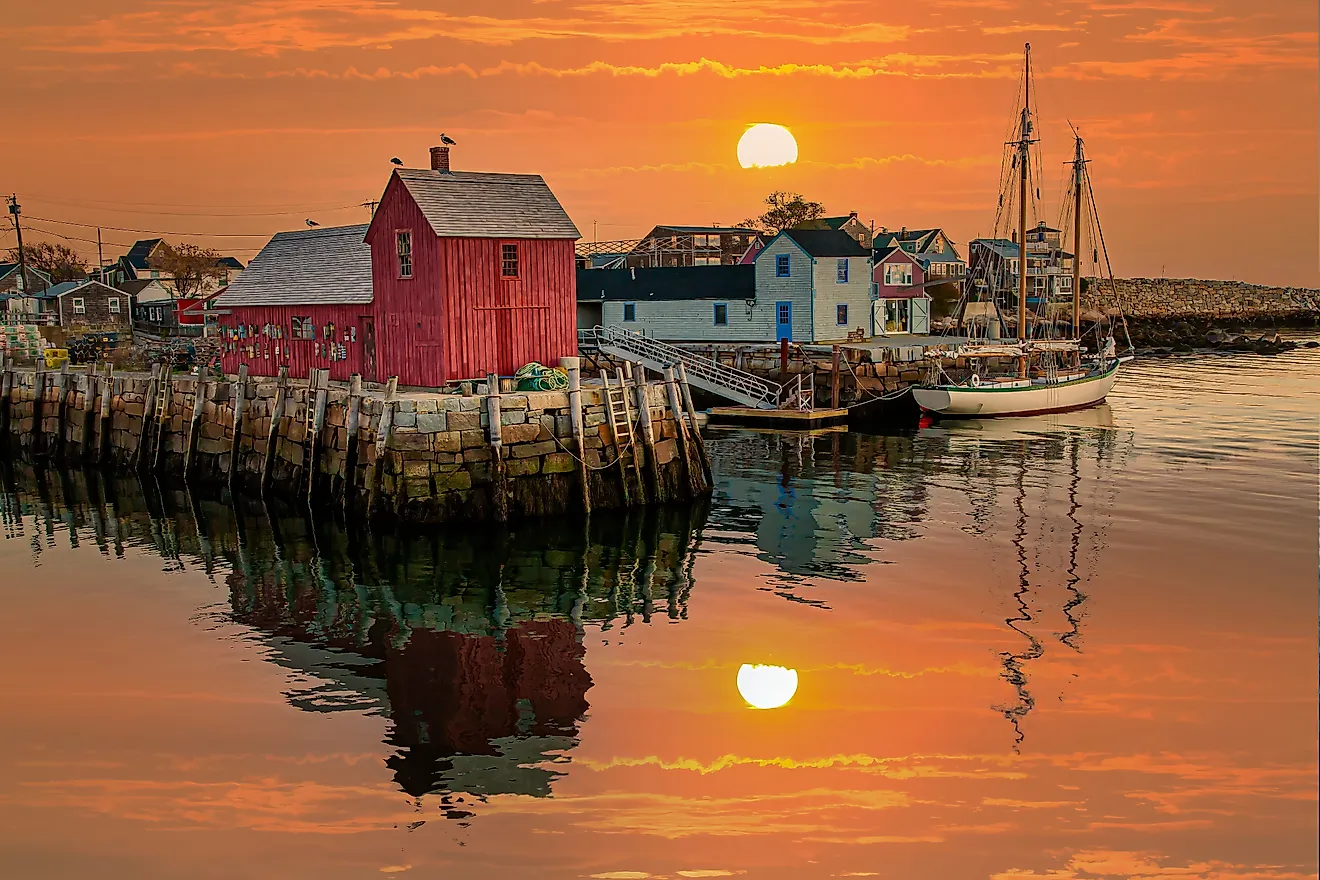
Rockport is a coastal town bordered by the Atlantic Ocean on three sides. Its extensive history predates the arrival of Europeans in the early 17th century. The Agawam tribe inhabited the region for centuries, establishing a permanent settlement in what is now modern-day Rockport. Originally named Aux De Isles by Samuel de Champlain in 1605, permanent European settlement did not occur until 1623. Rather than engaging in conflict with the indigenous tribes, most Europeans maintained amicable relations with the Agawam, and both groups collaborated to foster mutual prosperity. While it remains a vibrant historic town, it also offers a contemporary and engaging environment for visitors. The local seafood is notably exquisite and is served along the pristine coastline. Visitors can enjoy activities such as scuba diving, whale watching, cycling, and hiking through Rockport's rural wilderness areas.
Boston

Boston is among the most recognized cities on this list; however, this does not imply that it lacks surprises for visitors. Notably, Boston is the location of Fenway Park and Harvard University. Furthermore, it hosts several exceptional Revolutionary War-era buildings and battlegrounds.
The history of Boston predates European settlement, with the native Massachusets tribe inhabiting the area. The Charles River played a significant role in native life, with tribes establishing semi-permanent settlements along its banks. Boston also played a crucial role during the Revolution, being the site of Paul Revere's ride and the Boston Tea Party.
Visitors are advised to dedicate a minimum of 3-5 days to exploring this city. With its historical monuments, extensive and picturesque college campuses, and modern infrastructure, there is a wealth of experiences to undertake.
Plymouth

Plymouth is among the most ancient settlements in Massachusetts. Its name is derived from the port town of southwest England, the origin of many of the earliest European settlers. However, prior to European contact, the region near Plymouth was inhabited by the Wampanoag Tribe. Unfortunately, this tribe endured a series of plagues that decimated approximately 95% of its population prior to European arrival.
Plymouth became one of the earliest English settlements in the United States, established in 1620. The location known as Plymouth Rock is traditionally regarded as the landing site of the Pilgrims, although this is not verified as an historical fact.
Despite questions regarding the accuracy of this claim, Plymouth Rock continues to attract over one million visitors annually. Visitors are also encouraged to explore the National Monument of the Forefathers and the Pilgrim Hall Museum. After touring these historic sites, visitors are advised to visit the seashore to experience the area's natural beauty.
Agawam

Agawam gets its name from one of the original tribes in the area. The name is thought to mean "place of unloading" or "fish curing place." However, the name was given to honor the first people who resided in the region.
A fur trader named William Pynchon purchased much of the land from the native tribe in 1636. However, the town was not officially incorporated until 1855, when it was called Agawam.
Provin Mountain is one of Agawam's most notable sites and part of the western boundary. It's the perfect place to hike and experience historic sites. It's part of the Metacomet-Monadnock Trail, a lovely wilderness trail stretching for 114 miles.
Dover

Dover is part of Norfolk County, 15 miles outside downtown Boston. Dover's one of Massachusetts's quietest, safest, and richest towns, with a vibrant history that adds to its overall charm. The Benjamin Caryl House and the Dover Demon are two of the city's most renowned tourist attractions.
While the earliest settlers were said to have arrived from Europe in 1640, they didn't gain notoriety until the mid-1700s. Benjamin Caryl was one of the first official ministers in the town and built the notable house mentioned above. It's still standing today and was home to his family and descendants for several generations.
Dover has its own local legend for any mystery or cryptid lovers out there. The Dover Demon was first reportedly seen in 1977 by two young people who saw the demon while driving and crawling through a local farm. If you're up for an adventure, keep your eyes open.
Dedham

Dedham is a small, picturesque town in Norfolk County. The neighborhoods are small and quiet, with a lot of surrounding natural beauty to enjoy. However, it's also a prosperous neighborhood with a bustling economy.
Settlers arrived in Dedham around 1635 after an order decreed settlers push further inland due to overcrowding. After settling, residents established several trades, including one of the first mills in the area.
While the nature trails are a must-see for any visitors, also ensure you see the Fairbanks House Museum. The log house was built in 1636 and housed one of the first European families to settle there. If you love history, you'll love this majestic old house.
Newburyport

Newburyport is located in northeastern Massachusetts in Essex County. While settlers resided in Newburyport before its official founding, it wasn't officially established until 1764. Newburyport is home to the first tea rebellion in the U.S., even though Boston often overshadows it.
Newburyport was an important city during and before the Revolutionary War. It's best known for its shipbuilding capacities and was one of the top producers of clipper ships.
You'll find several of the oldest, still operational places of business in Newburyport. Newburyport's Five Cent Savings Bank is the oldest bank in the nation that's still in operation. If you're planning a trip, stop by and see this old, beautiful building.
Bonus Entry: Attleboro

Attleboro is a prominent town in southeast Massachusetts in Bristol County. It's commonly known as the Jewelry Capital of the World due to its thriving industry. While it doesn't still produce large quantities of jewelry, it retains its roots in the industry with several family-owned jewelry businesses.
Attleboro was established in 1694, although it was settled in 1634. Wamsutta, a leader of the Wampanoag people, wrote the original land grant permitting European use of the land. The L.G. Balfour Company was one of the first jewelry manufacturers in the city, which aided in its prominence.
Oak Hill is the highest point in the town and an excellent spot for hiking. Capron City Zoo is also an ideal spot for a day trip and the perfect place to visit with children.
Massachusetts has some of the most diverse and amusing small towns that offer visitors an enchanting peak into the past. From Harvard's campus to some of the oldest-built chapels in the U.S., Massachusetts is an idyllic spot for anyone hoping to dive into the nation's founding. However, Massachusetts also gives visitors a fantastic immersion into the natural wonders of the northeast. The coasts, mountains, rivers, and forests still paint the landscape, giving the state a pristine and quiet appearance.