The Most Charming River Towns In Kansas
Every town on this list exists because of a river. Settlers built at the spots where the water could be crossed or shipped along. Atchison went up on a Missouri River landing that Lewis and Clark had used in 1804. Marysville grew around a Big Blue ferry that carried wagon trains west toward Oregon and California. Leavenworth started beside a fort built to guard river trade on the Santa Fe Trail. Even the Pony Express changed horses at these crossings before the water routes gave way to rails. Trace any of these seven Kansas towns back far enough and you land at a riverbank.
Atchison

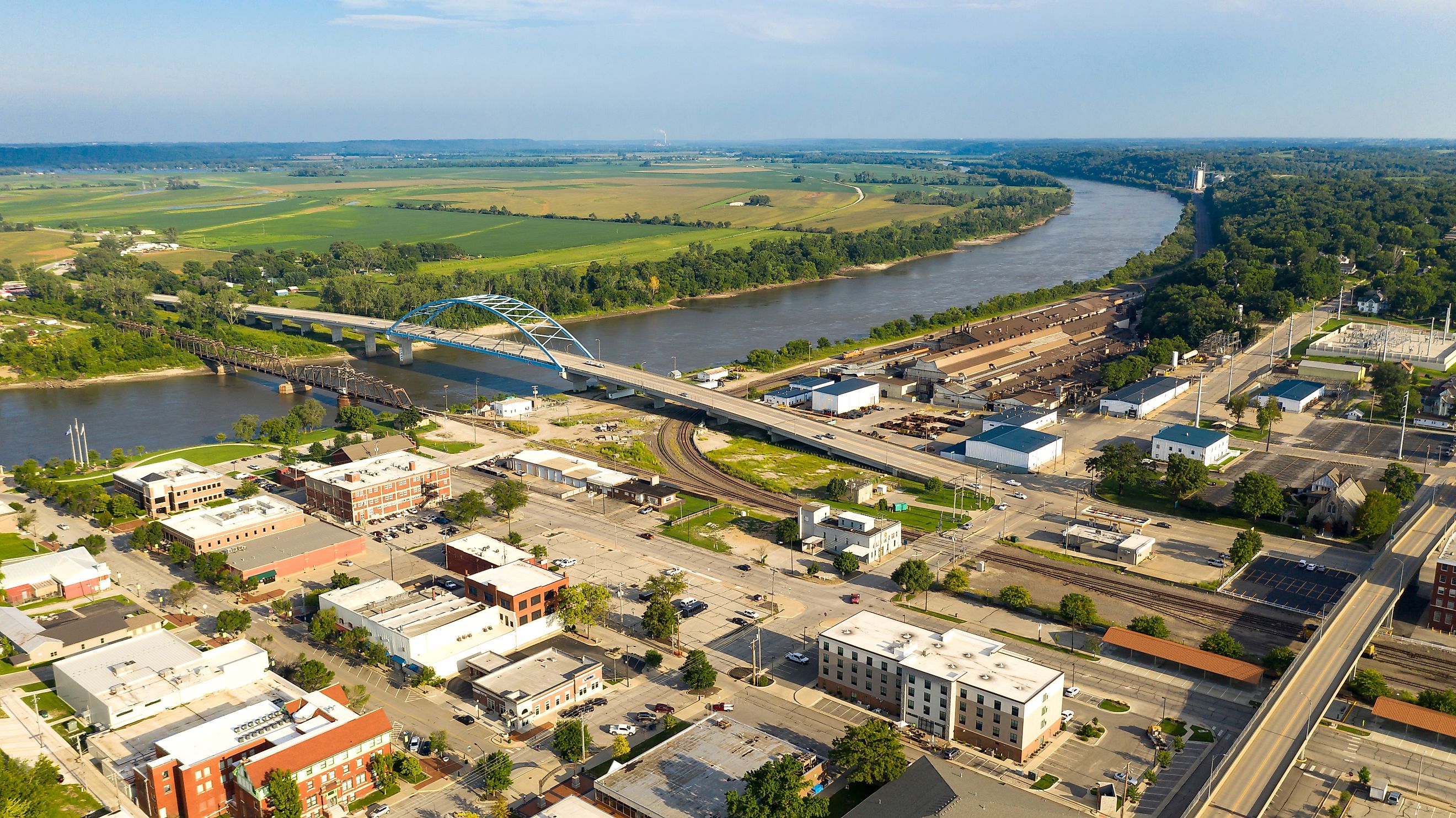
The town of Atchison was founded in 1854 on the bluffs of the west bank of the Missouri River, half a century after Lewis and Clark camped there in 1804. Its most famous daughter, Amelia Earhart, was born here in 1897 in her grandparents' North Terrace home. Now the Amelia Earhart Birthplace Museum, the house is maintained by the Ninety-Nines, the international organization of women pilots where Earhart herself served as the first president. Her childhood bedroom still looks out over the river below.
The story continues at the Amelia Earhart Hangar Museum, recently opened at Amelia Earhart Memorial Airport three miles west of downtown. Its centerpiece is Muriel, the world's last remaining Lockheed Electra 10-E, an identical plane to the one that Earhart was flying when she disappeared in 1937. The restored aircraft is surrounded by interactive exhibits, including a virtual reality flight recreating her 1932 solo crossing of the Atlantic.
Down at the water, Riverfront Park features a riverwalk with monuments marking the Lewis and Clark expedition that camped here. There's a keelboat-themed playground for the kids, and a reconstructed Kanza Earthlodge based on the dwellings of the Kanza people, the tribe that gave Kansas its name. The park is also the best place to photograph the Amelia Earhart Memorial Bridge, the steel arch that spans the Missouri here.
Leavenworth

Fort Leavenworth was established on the west bank of the Missouri River in 1827 to protect trade on the Santa Fe Trail. The town that developed next to it was incorporated in 1854 and was the first to be established in Kansas Territory, hence its nickname, "the First City of Kansas." The Frontier Army Museum features historic wagons and military artifacts, and the Buffalo Soldier Monument honors the African American troops of the 10th Cavalry Regiment, formed here in 1866.
Back in Leavenworth, the C.W. Parker Carousel Museum celebrates the man known as the "Carnival King." Charles Parker built his amusement ride factory in Leavenworth in 1911, making hundreds of carousels for carnivals and amusement parks worldwide. Take a $1.50 spin on a fully restored Parker carousel built in 1913, one of the oldest surviving carousels in the United States.
The museum is located a block from Leavenworth Landing Park, a quarter-mile landscaped walkway along the Missouri that's decorated with sculptures recalling the riverboat, railroad, and wagon escort eras. Next door, the Riverfront Community Center occupies the former Union Depot, completed in 1888 when Leavenworth was a regional railway hub.
Wamego

Located on the north bank of the Kansas River, Wamego has become the go-to destination for all things connected to The Wizard of Oz. The OZ Museum has you enter through a recreation of Auntie Em's farmhouse before stepping into galleries filled with artifacts and mementos. Highlights include props and production notes from the 1939 film, to items from the Broadway musical Wicked. Outside, a painted Yellow Brick Road leads two blocks to the Emerald City Playground, passing several Toto statues along the way.
A few doors from the museum, the Columbian Theatre displays artwork salvaged from the 1893 World's Columbian Exposition in Chicago, the fair whose White City is credited with inspiring Oz author L. Frank Baum's Emerald City. Wine lovers can continue the theme at the Oz Winery with vintages named Squished Witch and Drunken Munchkin. Hungry? Order some Auntie Em's Nachos at Toto's Tacoz, while OZtoberFest features costume contests and live music to the downtown core each fall.
Wamego City Park is home to the town's other landmark: the Schonhoff Dutch Mill. Built in 1879 by Dutch immigrant John Schonhoff on his farm north of town, the 40-foot stone tower was dismantled in 1924 and hauled into Wamego by 35 horse-drawn wagons, where it was rebuilt in the park.
Marysville

Marysville's humble origin story kicked off with the opening of a simple trading post on the Big Blue River in 1852 at the spot where a ferry carried wagon trains heading west. Today, Historic Trails Park marks the point where eight historic routes converged, including the Oregon Trail, the Mormon Trail, and the Pony Express route. A full-size ferry replica built from local cottonwood gives a sense of what the often-difficult crossing was like for wagon trains.
The Pony Express is undoubtedly the town's biggest claim to fame and is celebrated at the Pony Express Barn and Museum. Set in a livery stable built in 1859 that served as Home Station No. 1 on the mail route from St. Joseph, Missouri, to Sacramento, California, it's the last remaining original home station from the route. Displays include wagons, a stagecoach, and artifacts from the service's 18-month run from 1860 to 1861.
The Blue River Rail Trail is the place to go to enjoy Marysville's waterfront. The trail follows the Big Blue for nearly 12 miles north to the Nebraska border, where it connects with the Homestead Trail and, eventually, Lincoln, Nebraska. Watch for the town's famous black squirrels along the way. Marysville's official mascot, these rare rodents are protected by the town and are celebrated with a collection of five-foot fiberglass squirrel sculptures.
Independence

Riverside Park has been the pride of Independence since 1914, when 50 acres of land along the Verdigris River were donated to the city. Planned by the same landscape architect who laid out Kansas City's park and boulevard system, highlights include a carousel added in 1950, a miniature train from 1953, and Santa Fe steam locomotive No. 1050, built in 1898.
The Ralph Mitchell Zoo is the star attraction here. Opened in 1925, its most famous feature, Monkey Island, made its debut in 1932 and was the birthplace of Miss Able, the rhesus monkey that flew to space aboard a Jupiter rocket in 1959, one of the first primates to survive the trip.
In summer, families cool off next door at the Riverside Beach Family Aquatic Center with its three pools, lazy river, and water slides. Five miles northwest of town, Elk City State Park adds a reservoir, a swim beach, and the Table Mound Hiking Trail to the mix of fun things to do in Independence.
Arkansas City

The Walnut River joins the Arkansas River four miles north of the Oklahoma border after both have snaked around Arkansas City (aka, "Ark City"). This confluence has attracted people for centuries, with evidence of Etzanoa, an ancestral Wichita settlement that flourished from 1450 to 1700, discovered along the lower Walnut. Etzanoa Conservancy runs tours of the site from the Cherokee Strip Land Rush Museum.
Here you'll also learn about the Cherokee Strip Land Rush of 1893 when settlers massed at Arkansas City before racing south to claim six million acres of former Cherokee Outlet land. Founded in 1966, the museum displays tools, clothing, and documents from the period, along with the Bland School, a one-room schoolhouse, and the Bill Baird Pioneer Farm and Garden. Its collection even includes an early copy of the Declaration of Independence.
Downstream on the Arkansas River, the Chaplin Nature Center protects prairie, floodplain forest, and a long river sandbar within its trail network. Operated by the Wichita Audubon Society, the preserve has recorded 225 bird species and is free to visit. Time a trip for the last full weekend of October and you can join Arkalalah, the fall festival held since 1928 with a carnival, marching bands, and a Saturday parade.
Humboldt

Humboldt occupies the east bank of the Neosho River in southeast Kansas and was founded in 1857. Raided twice by Confederate forces in 1861, a 12-site driving tour covers its Civil War history. Neosho River Park is the best place to go to appreciate the waterway itself, with fishing access and views of the Neosho River Bridge, an arched concrete span built in 1926.
Humboldt's downtown square is a must-visit for its restored buildings. A relatively recent initiative, these now preserved buildings from the 1850s now house local businesses like Union Works Brewing Co., Bijou Confectionary, and Octagon City Coffee Co., all worthy of a visit. Neosho Valley Woodworks is another interesting restoration initiative and features a workshop and woodworking museum. It runs belt-driven antique machinery inside the former Odd Fellows Lodge, constructed in 1866 and the town's first brick structure built after the Civil War.
Cyclists and walkers can follow the Southwind Rail Trail, a 6.5-mile crushed limestone path along a former rail corridor north to Iola, where it meets the 51-mile Prairie Spirit Trail. BaseCamp Humboldt, a 21-acre campground with cabins and a bike park, is situated near the trailhead.
Kansas' Most Charming River Towns
From the Missouri River bluffs in Atchison to the place where two rivers meet near Arkansas City, these seven towns show just how much Kansas history happened along the state's riverbanks. Rivers influenced where ferries crossed, where the Pony Express changed horses, and the routes settlers took. Pick one for a weekend visit, or see them all. If you do, you'll see how much of Kansas history happened at the water's edge.