The Most Beautiful Desert Towns In California
The beauty of a California desert town comes from two things at once. There is the raw landscape, the badlands and dunes and abrupt mountains that ring these places. And there is what people have built inside it, whether a dark-sky reserve or an open-air sculpture park. Spread across three of the four deserts in the United States, the towns below pair the two as well as anywhere in the state. These are some of California's most beautiful desert towns.
Borrego Springs

Borrego Springs sits on the floor of Borrego Valley on the western edge of the Sonoran Desert in southern California. This small village of around 3,500 residents has no traffic lights, no big-box stores, and is the only town in California completely surrounded by a state park.
The town is full of pueblo-style architecture that blends into the desert badlands around it. Borrego Springs runs a serious art scene for its size, and the downtown is full of galleries and home to the Borrego Art Institute, which offers classes and workshops across a range of disciplines. Its most striking feature is artist Ricardo Breceda's collection of scrap-metal sculptures, which line the roads and rise out of the playas at Galleta Meadows. More than 130 sculptures are scattered across the Borrego Springs area, and you can pick up a detailed map of their locations from the Anza-Borrego Desert Natural History Association. The town's setting in the middle of Anza-Borrego Desert State Park delivers a wealth of outdoor activities. Miles of hiking, biking, and equestrian trails cross the desert, and the Santa Rosa Mountains to the northeast offer higher-elevation escapes from the heat on the desert floor. Spring fills the desert with wildflower blooms, and beginning in early February, birdwatchers arrive to spot Swainson's hawks as they migrate north from Central and South America.
Borrego Springs is the world's second and California's first designated International Dark Sky Community. The region's hot, dry climate produces remarkably clear night skies. Combined with the town's commitment to limiting light pollution, that clarity makes for rare stargazing. On a moonless night, thousands of stars are visible, and the town's nonprofit Borrego Springs Dark Sky Coalition runs astronomy programs throughout the year.
Palm Springs

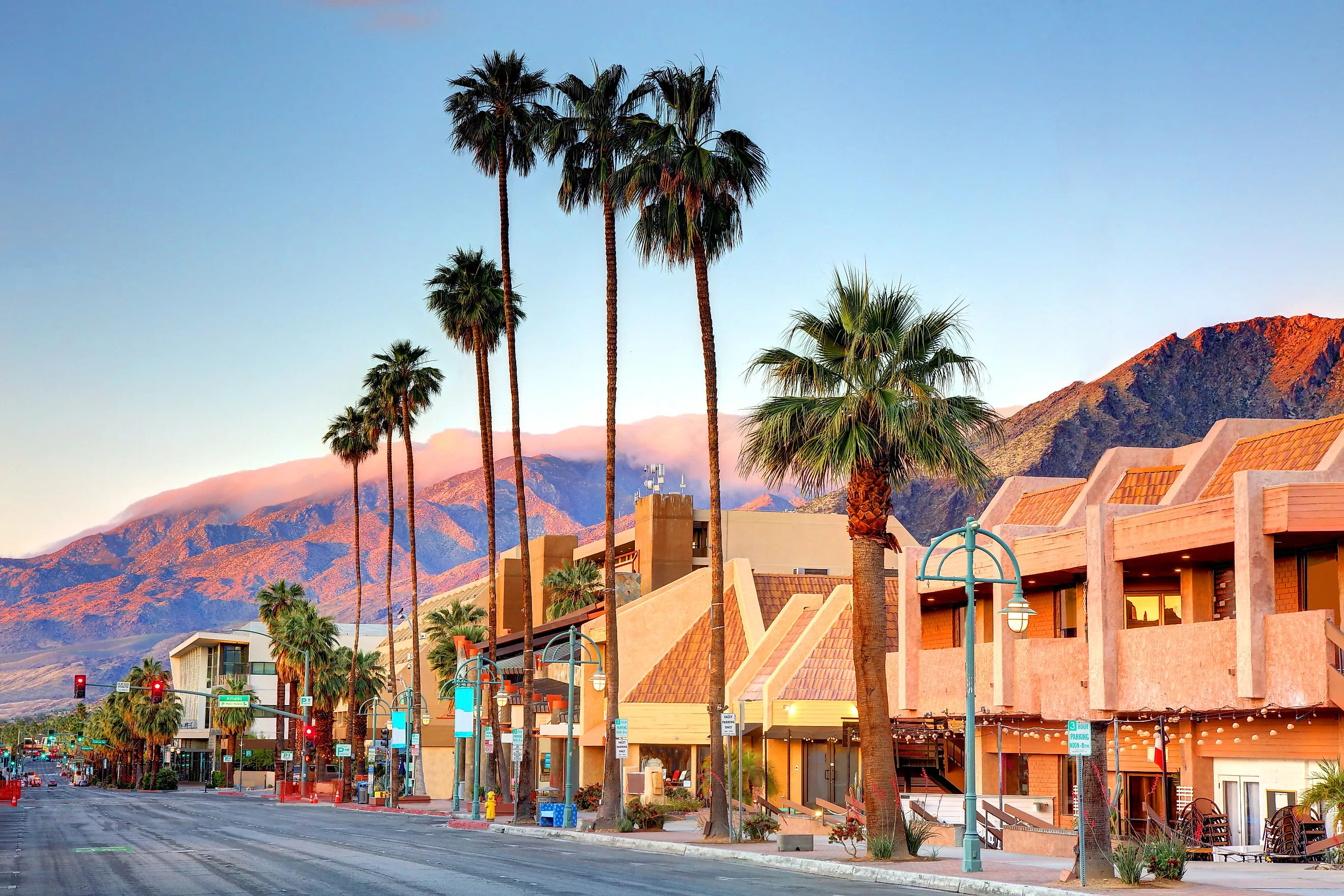
Forty miles north of Borrego Springs, Palm Springs answers with a different kind of desert beauty: mid-century modern architecture, palm-lined streets, and busy resorts. Sitting beneath the imposing pinnacles of the San Jacinto Mountains in the Colorado Desert's Coachella Valley, the city has no shortage of natural beauty within easy reach, but the art scene and eye-catching design are just as striking.
Much like Borrego Springs, Palm Springs has a highly regarded art scene. The city is home to several renowned galleries. The M Modern Gallery houses surrealist paintings by the artist SHAG, and the Backstreet Art District's artist-owned establishments feature everything from hand-blown glass sculpture to contemporary painting. The Palm Springs Art Museum is well worth a visit too. With an extensive modern and contemporary collection and a rotation of temporary exhibitions, there is always something new to see. If architecture is more your speed, Palm Springs has one of the country's largest concentrations of preserved mid-century modern structures. Through the 20th century, architects like Albert Frey and Richard Neutra left their marks on the city, shaping a style known as "desert modernism," notable for clean lines, open floor plans, and walls of windows and sliding glass doors.
The city also offers several ways to enjoy the Colorado Desert firsthand. Right behind the art museum, experienced hikers can take the Cactus to Clouds Trail to the summit of Mount San Jacinto, one of the most topographically prominent peaks in the country. Be warned: the trail has one of the steepest ascents of any day hike in the country, climbing over 10,000 feet in twenty miles. You can also enjoy the views from the mountains by taking the Palm Springs Aerial Tramway, the largest rotating tram car in the world, along the cliffs of Chino Canyon. Wildlife lovers will want to explore the Coachella Valley Preserve's 20,000 acres of blown-sand desert and palm oases, which shelter rare and endangered species like the desert pupfish and the Coachella Valley fringe-toed lizard. After a day in the desert, you can soak in one of the mineral hot springs found across the greater Palm Springs area.
Desert Hot Springs

Two aquifers built this town, one hot and one cold, running side by side beneath the desert along the Mission Creek Fault. Homesteader Cabot Yerxa struck both while digging wells in the 1910s, and the hot mineral water gave Desert Hot Springs its name and its livelihood. The town sits at the northern edge of the Coachella Valley, up against the San Bernardino Mountains, and the water is still the reason to come.
You can soak in that mineral water for a fraction of a Palm Springs spa bill at longtime bathhouses like Sam's Family Spa, in operation since 1971, where the pools draw straight from the geothermal source. The town holds one of the densest concentrations of small mineral-water spas and hotels in the country, many of them modest family-run properties rather than luxury resorts.
The town's other landmark is Cabot's Pueblo Museum, a four-story adobe that Yerxa built by hand starting in 1941 from salvaged lumber, telephone poles, and scrap he hauled out of the desert. The Pueblo Revival structure holds 35 rooms and remains standing decades later, a testament to his self-taught engineering. Inside, the museum displays his collection of Native American and Alaska Native artifacts alongside work by contemporary desert artists. The hillside setting also delivers wide views across the valley toward the San Jacinto Mountains and the wind farms spinning at the pass.
Twentynine Palms

Travel northeast from Palm Springs into the high-desert community of Twentynine Palms. Located in the Mojave Desert, this town is one of the gateways to Joshua Tree National Park, but it offers far more than proximity to the park. Twentynine Palms has grown into one of the more eclectic desert communities in recent years, with galleries, boutique shopping, and a wide array of restaurants and breweries.
The sparse Mojave landscape has long been a muse for the artists and craftspeople who call it home. The work of local creatives turns up at galleries like The Glass Outhouse and the 29 Palms Art Gallery, and in the public pieces that line the streets as part of the city-commissioned Oasis of Murals project. If you feel the muse calling, the 29 Palms Creative Center offers pottery and fused-glass classes to the community.
You should also experience the desert firsthand and explore the 800,000-acre Joshua Tree National Park. Drive Park Boulevard to see the famous rock formations and the spiky Joshua trees the park is named for. Catch a sunrise at the Cholla Cactus Garden or a sunset from Keys View as the low sun turns the desert to orange and red. Once the sun goes down, a different beauty takes over as the sky fills with stars. Joshua Tree is a designated International Dark Sky Park, and the night sky draws stargazers and photographers year-round. The park hosts a night-sky festival each fall, and visitors can attend astronomy talks and stargazing events at the Sky's the Limit Nature Center and Observatory.
Pioneertown

About half an hour from Twentynine Palms, Pioneertown is the most unusual town on this list. This village in the Morongo Basin region of the Mojave Desert looks like it was plucked straight from a Western film, and that is entirely by design. It was established in 1946 by actor Dick Curtis, who dreamed of building a "living, breathing film set." The 1880s-themed town has appeared in dozens of films and TV shows, and while it is now seldom used for its original purpose, the Old West setting still stands amid the desert.
You get a taste of the high desert before you even reach the town limits, on the winding four-mile road up from Yucca Valley. The state-designated scenic drive passes through protected wilderness before the welcome sign comes into view. Mane Street is Pioneertown's commercial hub. Several of the Wild West buildings house working businesses, including the Pioneertown General Store and Pappy and Harriet's Pioneertown Palace. Perhaps the most notable is the Red Dog Saloon, which has hosted intimate shows by global stars like Paul McCartney and Leon Russell. On the western horizon, the Sawtooth Mountains rise above the desert floor, and the Pioneertown Mountains Preserve protects the surrounding geology. Hiking trails wind through the network of volcanic mesas and granite formations, home to bighorn sheep and several species of migratory songbirds.
Joshua Tree

The town of Joshua Tree shares its name with the spiky yuccas that grow across the surrounding Mojave, and it sits at the meeting point of two deserts: the high Mojave and the lower Colorado. That overlap gives the area an unusual mix of plant life and terrain, from granite monoliths to open scrub, and it has drawn a steady community of artists and musicians who trade city rents for high-desert light.
The clearest expression of that scene is the Noah Purifoy Outdoor Desert Art Museum, north of town. The artist built the open-air site over roughly ten acres between 1989 and his death in 2004, assembling more than 100 large-scale sculptures from found materials like scrap metal, bicycle parts, and old appliances. Many pieces are built to be walked into, and the desert weather is slowly reshaping them, which was the point. Back along the main highway, small galleries, vintage shops, and roadside cafes carry the same do-it-yourself spirit.
Most visitors still come for the park at the town's doorstep, where the boulders draw rock climbers from around the world and the dark skies pull stargazers on clear nights. Spring brings wildflowers to the washes, and fall cools the evenings enough for comfortable camping. Between the trailheads and the galleries, Joshua Tree rewards a slow day as much as a hard hike.
Lone Pine

In Lone Pine, you get two deserts for the price of one. Located in the Owens Valley between the Inyo Mountains and the Sierra Nevada, this tiny town sits right at the overlap of the Mojave Desert and the Great Basin Desert. Lone Pine's most obvious draw is its wide range of outdoor recreation, but there is plenty of small-town character within the town limits as well.
As you walk down the main street, many of the buildings look like they were lifted from a Western movie set, with clapboard exteriors and awnings shading the sidewalk. Lone Pine was a hub for Western filmmaking during the silent era, but the Wild West heritage is more than a Hollywood facsimile. The surrounding hills are dotted with Old West ghost towns, including Cerro Gordo in the Inyo Mountains, one of the best-preserved in the state. The town also has more modern landmarks, including the post-and-beam Oyler House, designed in the mid-20th century by Richard Neutra.
When it comes to natural beauty, you are spoiled for choice in Lone Pine. At the base of the towering Sierra peaks, the Alabama Hills have served as the backdrop for many Hollywood films, thanks to their distinctive rounded boulders, arches, and eroded hills of orange rock. In springtime, Mojave asters and scarlet milkvetch add splashes of color. East of the Inyo Mountains, Death Valley National Park, the largest national park outside Alaska, covers over three million acres of diverse terrain. Here you will find the lowest point in North America at Badwater Basin, the massive volcanic Ubehebe Crater, and the windswept Telescope Peak, which offers panoramic views of the park from 11,049 feet.
Lee Vining

This high-desert community has a landscape that looks lifted from the American Southwest, but its elevation brings enough winter snow to make it one of only two ice-climbing destinations in California. Lee Vining is tiny, home to about 200 residents (217 at the 2020 census), but its small main street and the scenery within easy reach make it well worth a stop.
The eastern slopes of the Sierra rise above the cluster of shops and restaurants at the core of town. Restaurants like Nicely's, with its towering neon sign and old-school look, seem lifted straight from the 1950s. One of the town's quirkier features is the Upside Down House, built as a roadside attraction in 1956 and relocated to the grounds of the Old Schoolhouse Museum around the turn of the millennium.
The real beauty of Lee Vining is in its surroundings. The town sits on the southwestern shore of one of the oldest lakes in North America. The 65-square-mile Mono Lake is over a million years old and provides a temporary home for up to two million birds each year. Its alkaline water mixes with freshwater springs to build otherworldly tufa towers, calcium-carbonate spires that rise from the surface. Visitors can also walk the deserted streets of a genuine California gold-mining town at Bodie State Historic Park. Several structures survive in this eerie remnant of the Gold Rush; at its peak the town held close to 2,000 buildings and 8,000 residents. For a completely different kind of scenery, drive Route 120 over the Sierra at Tioga Pass, where the landscape shifts into a diverse mountain ecosystem as you enter Yosemite National Park, one of the most visited outdoor destinations in the country.
Beauty Beyond the Barren
The desert is a hard sell for many travelers, but the deserts of California may surprise you with their range of topography and climate. There are vast stretches of barren scrubland, but also towering mountains, distinctive rock formations, and some of the clearest night skies in the country. If you want to give the desert a go, these towns are good places to begin. Between their tight-knit communities of artists, their resorts, and their architecture built to complement the terrain, these desert towns are every bit as striking as the landscapes around them.