The Cheapest Beautiful Towns To Live In Utah
Price sits in Utah's coal country, where a brick bungalow still trades hands for about $225,000. Logan's typical home value stays near $410,000 beneath the peaks of the Bear River Mountains. Cedar City's summer Shakespeare festival fills theaters a short drive from Zion's red rock. Every town on this list stays well below Utah's typical home value. Regional hospitals and colleges give these towns their own working economies. Places like Vernal and Brigham City show that cheap and scenic share one address.
Price

The ZHVI for Price sits at approximately $225,000, an exceptionally affordable entry point. Its housing stock runs to solidly built mid-century brick bungalows and early 1900s miner cottages, centered around a highly walkable grid rather than large subdivisions of modern suburban builds. Renters see similar savings, with market trends showing average monthly rents around $900 for typical multi-bedroom homes, while the overall BestPlaces cost-of-living index is low at 82.
Living here positions residents directly within the Castle Valley, surrounded by stark, gray-shale badlands and high desert plateaus that form a dramatic, uncrowded backdrop for daily life. This location offers immediate access to the northern edge of the San Rafael Swell and the Book Cliffs, making it a good choice for those prioritizing proximity to the region's public lands.
The tradeoff for this affordability is distance. Price is a 120-mile drive from Salt Lake City, meaning residents rely heavily on the local economy. Fortunately, it operates as the regional hub for Carbon County. Castleview Hospital (CommonSpirit Health) is a major local employer, and Utah State University Eastern provides a steady economic baseline. The campus also houses the Prehistoric Museum, where articulated dinosaur skeletons excavated from the Cleveland-Lloyd Quarry display the town's deep paleontological roots.
Logan

Logan's character is defined by water and elevation. The town sits at the base of the Bear River Mountains, where the Logan River exits Logan Canyon and cuts directly through the city grid. Residents are a short drive away from fly fishing, limestone rock climbing, and the Beaver Mountain Ski Area.
Usually, a town with this level of immediate alpine access prices out median earners. But Logan maintains a typical home value of roughly $410,000. Rent averages $1,250 to $1,400 for apartments, keeping the market accessible for younger professionals and families, while the overall cost-of-living index stands at 95.
The primary economic engine keeping the town viable is Utah State University, a land-grant research institution that dominates the local labor market and sustains a vibrant downtown. Instead of empty storefronts, Logan's Center Street features an operational 1923 theater, independent bookstores, and high-density residential lofts. The architecture leans heavily on pioneer-era masonry; the Logan Tabernacle, constructed from local quartzite, dominates the skyline without looking like a generic municipal building.
Because Logan operates as the base for the entire Cache Valley, livability metrics are strong. Cache Valley Hospital provides regional medical care, and the Cache Valley Transit District operates a zero-fare bus system that connects the residential neighborhoods directly to the university and commercial centers.
Tooele

Located just 35 minutes west of downtown Salt Lake City, Tooele sits in an adjacent valley beneath the 10,000-foot peaks of the Deseret Peak Wilderness. Residents get the visual impact of a major mountain range and immediate access to hiking and off-highway vehicle trails, without Salt Lake County prices.
The typical home value in Tooele hovers around $415,000. While higher than Price or Logan, it remains significantly cheaper than nearly any suburb on the eastern side of the Oquirrh Mountains, keeping its cost of living index at 96. Larger lots define the market here; it is still entirely possible to buy a multi-bedroom modern stucco house with a yard for the price of a small condo in Salt Lake City. Rentals are available with a three-bedroom unit averaging about $1,400 per month.
The town's industrial and military history is plain to see. Tooele City Hall incorporates modern glass and steel into the older brick commercial blocks lining Main Street. While many residents commute into the Salt Lake Valley for tech and corporate roles, local employment is centered on the Tooele Army Depot, which stores conventional munitions and remains one of the region's largest employers, alongside growing manufacturing and distribution centers that take advantage of the Interstate 80 corridor.
Cedar City

The open-air Engelstad Shakespeare Theatre draws thousands of attendees every summer to watch live productions under the night sky, operating as a core component of Cedar City's cultural infrastructure alongside Southern Utah University. The university provides a stable base of state employment for the town of around 40,000 residents, while Intermountain Cedar City Hospital and a local regional airport supply essential services that eliminate the need for long highway trips to Salt Lake City or Las Vegas.
This strong institutional baseline comes without the extreme real estate inflation seen in other parts of southern Utah. Zillow indices show a typical mid-2026 home value of $375,000, which often buys early-20th-century Craftsman houses along residential avenues shaded by mature cottonwoods. The overall cost-of-living index tracks at 92, and local rents average $1,300 a month. Living here places residents directly where the Great Basin meets the Markagunt Plateau, creating immediate views of the alpine stands in Dixie National Forest to the east and the red sandstone walls of the Kolob Canyons section of Zion National Park to the south.
Vernal

The Uinta Mountains rise directly to the north of Vernal, creating a massive east-west barrier that funnels weather and runoff toward the Green River and the fossil quarries of Dinosaur National Monument. A typical home value here is $295,645, which can buy a multi-acre property or a large brick house near the commercial center. Renters pay approximately $1,331 per month, and the overall cost-of-living index is 87.
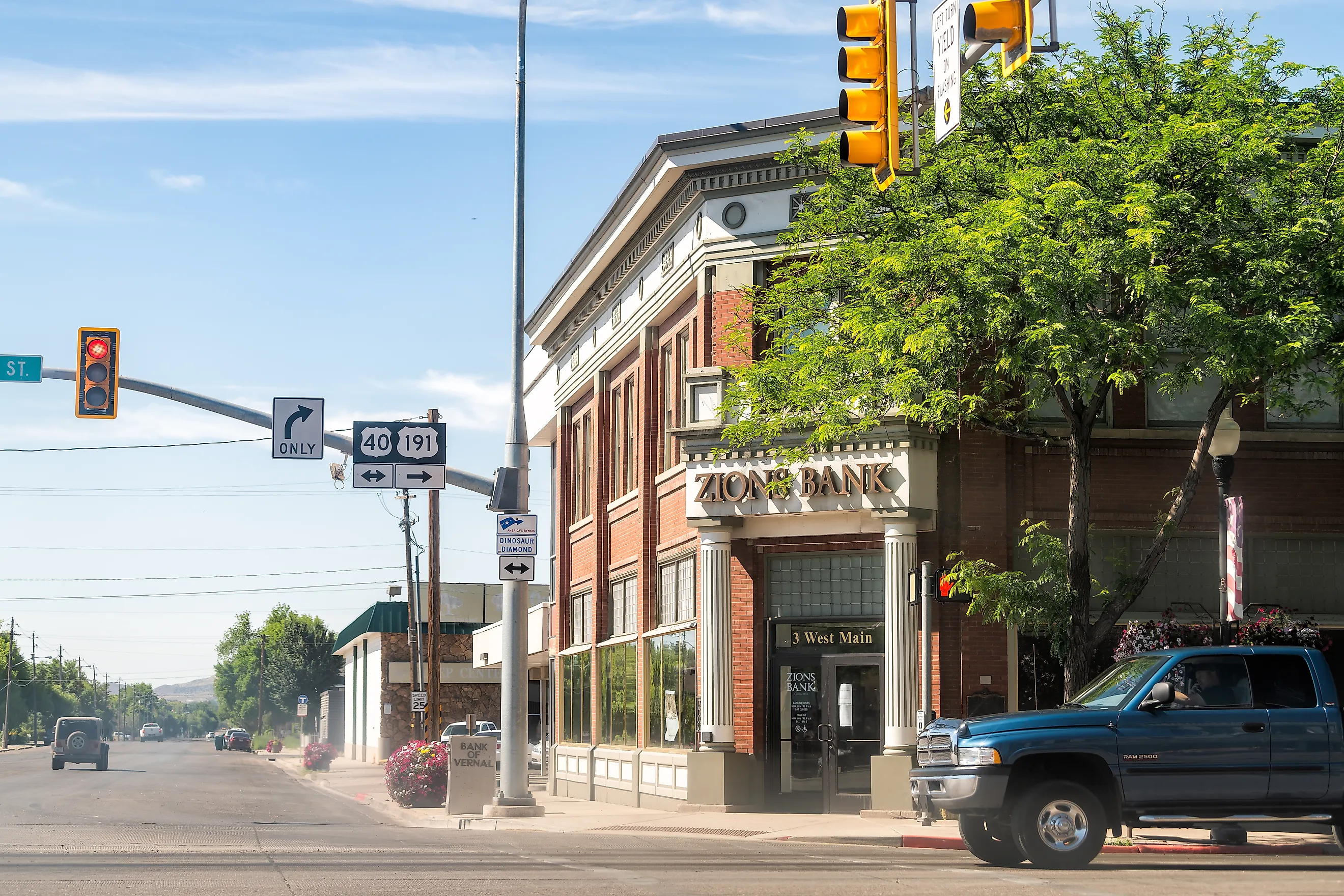
The town's layout reflects its role as a regional staple. The Zions Bank building occupies the intersection of Main Street and Vernal Avenue, with an early-1900s masonry facade and heavy bronze doors. Oil and gas extraction provides high-wage employment across the Uintah Basin, supported by the Uintah Basin Technical College and Ashley Regional Medical Center.
Ephraim

The Snow College Noyes Building, built in the late 19th century from white limestone quarried from the surrounding hills, features tall arched windows and a central bell tower. The two-year college provides steady employment and a regular rotation of nursing and fine arts students in the commercial district. The Wasatch Plateau rises to the east, with timber and grazing land for local agriculture.
The typical home value lands at $340,000, which often includes a half-acre lot with a renovated early-20th-century farmhouse or a newer build on the outskirts. The overall cost-of-living index is 89, and average rents hover at $1,100, providing a lower-cost alternative to the urban counties to the north.
Richfield

Fishlake National Forest blankets the high elevations of the Pahvant Range directly west of the city, dropping steeply to the edge of the residential grid, where single-level masonry homes occupy quarter-acre lots. Securing a property against this mountain backdrop typically requires an investment of $335,783, according to mid-2026 Zillow data, keeping housing well below the state average. At the same time, the overall cost-of-living index sits at 88.4. Renters find similar affordability, with typical local leases ranging between $1,100 and $1,200 a month.
Daily life in the valley relies on strong regional infrastructure rather than long commutes. Sevier Valley Hospital serves as a critical healthcare hub, providing emergency care and surgeries across a vast area of central Utah. At the same time, the Snow College Richfield campus offers agricultural and technical training programs. In the center of the municipal grid, the historic Sevier County Courthouse holds the town's civic services behind red brick, a domed cupola, and classical columns.
Brigham City

The Brigham City Arch spans Main Street with a neon sign strung between two stone pillars, marking the entrance to a commercial grid laid out in the 1850s. Home values are typically $416,063, offering buyers deep backyard plots with established peach and cherry trees. The cost-of-living index is 93, and rentals average $1,123.
The Bear River Migratory Bird Refuge occupies the wetlands to the west, where massive flocks of waterfowl pass through the valley. At the same time, the steep ridges of the Wellsville Mountains block the eastern horizon. Brigham City Community Hospital, part of Intermountain Health, and the nearby Northrop Grumman provide significant employment in the medical and aerospace sectors.
Fillmore

The Territorial Statehouse State Park Museum is the one finished wing of a much larger capitol, built from red sandstone with high-arched windows. Its architect planned four wings around a central Moorish dome, but funding ran out and only this south wing was completed. Chalk Creek flows out from the adjacent Fishlake National Forest, cutting directly through the agricultural parcels surrounding the main grid and supplying local irrigation.
Intermountain Fillmore Community Hospital provides immediate medical access, and Interstate 15 allows freight and local transit to bypass the heavy snowfall areas to the north. The typical home value is $310,000, enough to buy a modest brick home on a substantial plot of land. The cost of living index is 86, and rents are roughly $1,000 per month.
Nephi

Mount Nebo, the highest peak in the Wasatch Range, dominates the eastern skyline above Salt Creek Canyon, holding visible snowpack well into the summer months. Below these ridges, the local economy runs on steady institutional employment rather than tourism, supported by the Nebo School District and the Central Valley Medical Center, which together employ hundreds of residents across the medical and educational sectors.
Living within view of the peak remains highly accessible compared to the urban counties directly north. Buyers encounter a typical home value of $365,000, which generally buys new construction on the edges of the historic grid or updated 1950s homes on wide avenues. The overall cost of living index is 90, with average rents around $1,150 per month. At the same time, the historic Juab County Courthouse stands on the central commercial street, with its heavy stone facade and prominent clock tower.
Where Utah Stays Affordable
In most of Utah, a low home price marks a town on the way down. The towns on this list are the exception. Colleges and regional hospitals supply steady paychecks in Ephraim, Richfield, and Nephi. Commuters settle in Tooele to trade a longer drive for a bigger yard. The mountains and public lands beside each town were never priced into the local market. That gap between the scenery and the sticker price is what earns them a spot here.