The 9 Can't-Miss Towns In Kansas
A can't-miss Kansas town is usually one that committed hard to a single idea. Dodge City bet everything on its outlaw past and never once let the legend cool. Wilson staked its whole identity on Czech heritage down to a giant painted egg. Lucas decided a prairie village could be a folk-art capital and made the case in concrete. Nicodemus chose to guard a piece of American history that exists nowhere else in the West. That refusal to blend in is what turns these nine small towns into real destinations.
Dodge City

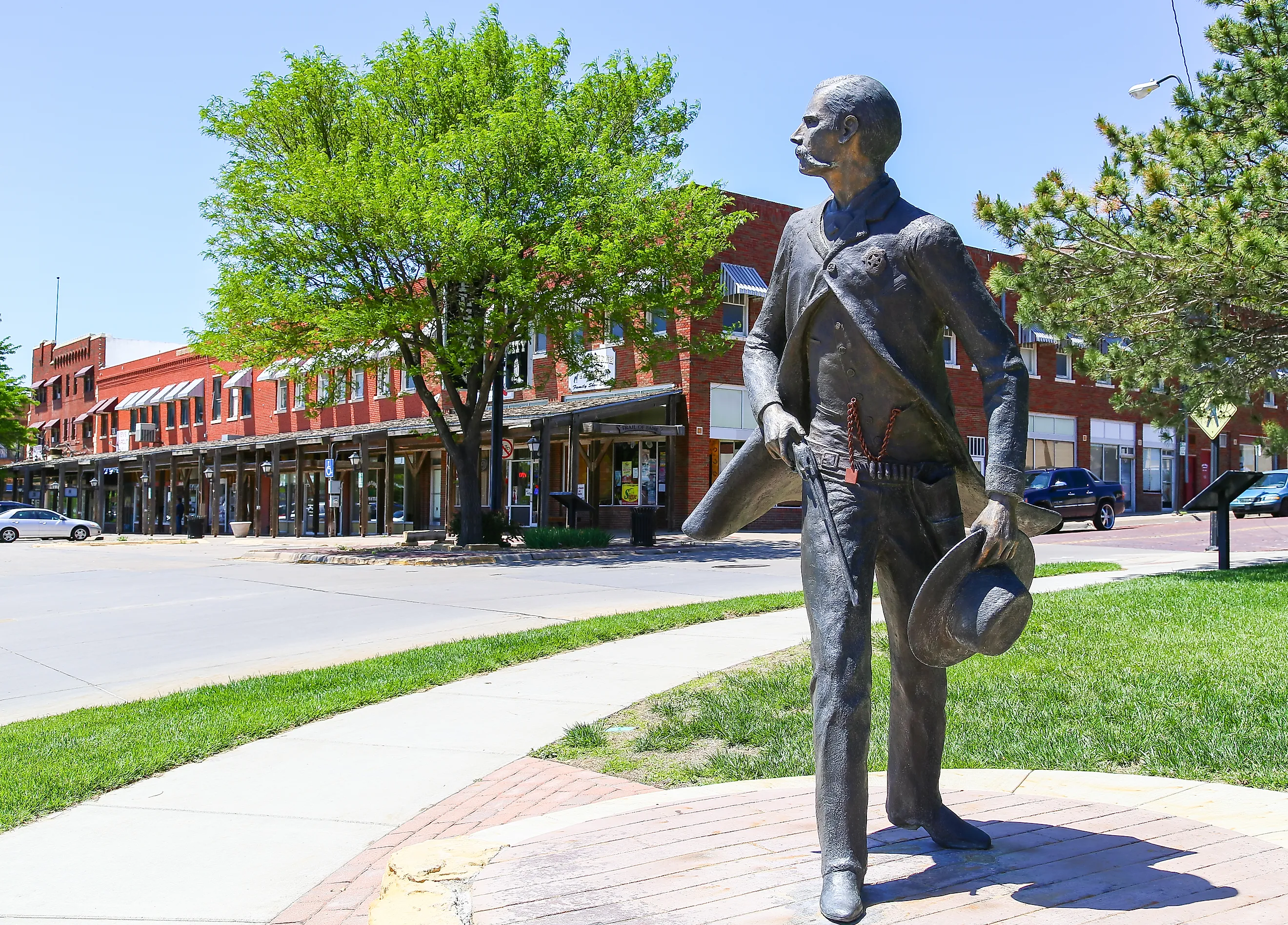
Cattle drives and railroads built Dodge City into the roughest of the Kansas cow towns, and the place has traded on that reputation ever since. Today it pairs the frontier legend with a working agricultural economy that keeps the feedlots and packing plants busy.
Boot Hill Museum sits at the center of the historic district, with restored buildings, period exhibits, and outdoor displays that recreate a late 19th-century cattle town. The Gunfighters Wax Museum occupies the second floor of the Kansas Teachers' Hall of Fame next door, where life-size figures stand in for Wyatt Earp, Jesse James, and other names tied to the town's Wild West years. Murals, interpretive markers, and old commercial architecture fill the nearby streets.
The Carnegie Center for the Arts takes a quieter approach, rotating exhibits by regional and national artists through a restored Carnegie library. Families head instead to Long Branch Lagoon, a Western-themed water park with more than 27,000 square feet of slides, pools, and a 720-foot lazy river.
Past the edge of town, ranchland and crop fields run to the horizon. Dodge City draws its character from that mix of frontier legend, open prairie, and its present-day job as a regional hub for southwest Kansas.
Council Grove

Wagon trains bound for Santa Fe once stocked up at Council Grove, the last dependable timber and water stop before the long haul southwest. Traces of that trail history still line the streets, the buildings, and the Neosho River corridor that runs through town.
Limestone walls and storefronts give the downtown its look, built from the local stone that early settlers had close at hand. The town served as a gathering point for traders, travelers, and settlers headed onto the plains.
A self-guided route through 25 historic sites connects the buildings and locations tied to the Santa Fe Trail and the town's founding. Kaw Mission State Historic Site preserves a territorial-era building and tells the story of the Kanza Nation, whose homeland once covered much of the state. Interpretive markers and preserved structures across town put that history within a short walk of one another.
The Neosho Riverwalk traces the water through town, linking green spaces, overlooks, and a community amphitheater that hosts seasonal events. Council Grove Reservoir, just beyond the edge of town, adds boating, fishing, camping, and wildlife watching.
The surrounding Flint Hills shift color through the year, green in late spring and gold by late summer. Tall grasses bend in the wind, wildflowers open along the roadsides, and limestone breaks through the pasture. History and landscape sit close together here, which is most of Council Grove's appeal.
Baldwin City

Wooded hills and rolling farmland ring Baldwin City, marking the seam where the eastern Kansas forests give way to open prairie. Baker University, the oldest university in the state, gives the tree-lined downtown a college-town pace.
Art carries real weight in local life. The Lumberyard Arts Center rotates exhibits, performances, and workshops by regional artists through the year. The annual Maple Leaf Festival each October fills downtown with quilts, crafts, and crowds that come in from across the region.
Farming still shapes the country around town. Family farms and agritourism spots, including The Light Center, open their gates for seasonal events and locally grown produce. Back roads wind past fields, woodlots, and old farmsteads that change with each season.
Baldwin City works best as a place where art and agriculture share the same few square miles, and where a Saturday can hold a gallery opening and a farm stand without much of a drive between them.
Wilson

Czech immigrants came to Wilson in the 1870s to work the new Kansas Pacific rail line, and their descendants have run the town's identity ever since. Kansas made it official in 1967, naming Wilson the Czech Capital of Kansas.
The World's Largest Czech Egg stands twenty feet tall under a gazebo near the tracks, hand-painted by a local artist in a traditional kraslice design. The After Harvest Czech Festival takes over the streets each summer with polka music, dancing, kolaches, and one of the larger small-town parades in the state.
The Midland Railroad Hotel is the town's best-known building, a 28-room hotel that opened in 1899 and still takes overnight guests. Wilson State Park spreads along the lake just north of town, with hiking, fishing, boating, and camping among the limestone bluffs of the Smoky Hills.
Wilson keeps its Czech roots front and center, close enough to the Smoky Hills that the two feel like one visit.
Nicodemus

Formerly enslaved families from Kentucky and Tennessee founded Nicodemus in 1877, chasing the promise of land and self-governance on the western Kansas plains. It remains the oldest and only surviving Black settlement west of the Mississippi established during Reconstruction, and today the entire community, home to roughly a dozen residents, is a National Historic Site.
Five original buildings survive, among them Township Hall, two churches, and the District No. 1 schoolhouse. Together they trace the work of settlers who tried to build new lives through farming, faith, and community after the railroad bypassed the town and its population thinned.
The prairie around the site does much of the storytelling. Local roads and walking areas open onto the wide horizons, crop fields, and grasslands that the first homesteaders faced. The quiet of the High Plains makes plain the determination that settling this country demanded.
Descendants and park staff still gather each summer for the Homecoming Emancipation Celebration, held nearly every year since 1878. Nicodemus offers a different kind of Kansas stop, one built less on attractions than on perseverance and the families who saw it through.
Hays

Fort Hays put Hays on the map, first as a rough military post guarding the railroad and the cattle trails, then as the town that grew up around it. Restored buildings, museums, and the open High Plains still tie the place to its frontier start.
Fort Hays State Historic Site holds the military chapter, with restored buildings, exhibits, and walking paths under mature trees. The Sternberg Museum of Natural History reaches much further back, showing off Cretaceous fossils and the famous fish-within-a-fish specimen pulled from the chalk beds of western Kansas.
Downtown runs to brick storefronts, locally owned shops, and murals. The Historic Chestnut Street District keeps the scale of an early commercial strip while serving as the town's spot for restaurants, galleries, and events.
Volga German settlers shaped this stretch of Kansas in the late 1800s, and their influence still shows up in local festivals, church architecture, and food traditions like bierocks. West of town, the Smoky Hills roll toward the horizon in layered rock and open pasture. Hays makes a solid base for western Kansas, equal parts history, culture, and wide country.
Lucas

A town of about 400 people on the central Kansas prairie, Lucas bills itself as the grassroots art capital of Kansas, and the claim holds up on a walk down its streets. Murals cover the buildings, sculptures crowd the sidewalks, and handmade oddities fill corners a visitor might otherwise skip past.
The Garden of Eden is the reason most people come. Civil War veteran Samuel P. Dinsmoor began building it around 1907, ringing his limestone log-cabin home with concrete sculptures that spell out his politics and his reading of the Bible. A block away, Bowl Plaza carries the tradition into a public restroom covered inside and out with mosaic made from donated tile, glass, and found objects.
Lucas leans hard into the unexpected. The World's Largest Collection of the World's Smallest Versions of the World's Largest Things, assembled by artist Erika Nelson, shrinks the giant roadside attractions of America down to handmade miniatures she built after visiting the originals.
Bottle trees, metalwork, and painted structures keep turning up across the community, and the open prairie behind them makes the colors read even sharper against the sky. For all the creative energy, Lucas stays small and unhurried, its galleries and yard art tended by residents who take clear pride in the work.
Abilene

The last great cow town on the Chisholm Trail, Abilene boomed on cattle drives and railroads in the 1860s and kept the wide brick-and-limestone streets to prove it. A generation later it raised the boy who would command the Allied armies in Europe and win the White House.
The Dwight D. Eisenhower Presidential Library and Museum anchors the east side of town, its landscaped grounds and memorial chapel surrounding the modest boyhood home of the 34th president. The complex draws visitors from across the country to the town where Ike grew up.
Downtown keeps a well-maintained run of brick buildings filled with local shops and restaurants. Little Ike Park adds a sculpture of Eisenhower as a boy and a formal garden at the center of town. The compact grid rewards walking.
The Abilene & Smoky Valley Railroad runs excursion trains through the countryside to nearby Enterprise, a reminder of how the rails turned prairie settlements into shipping towns. Beyond the last streets, central Kansas farmland opens under a sky that changes by the hour. Between the cattle history, the presidential legacy, and the tidy downtown, Abilene gives visitors plenty to fill a day.
Cottonwood Falls

Deep in the Flint Hills, Cottonwood Falls sits amid tallgrass prairie that rolls unbroken to the horizon. Cattle graze the open pastures, limestone breaks from the hillsides, and old stone fences mark boundaries laid down generations ago.
The Chase County Courthouse closes the south end of Broadway and remains the oldest working courthouse in Kansas, built from native limestone in 1873 and still hearing cases in its original rooms. Its red mansard roof is visible from much of the county, and a three-story walnut spiral staircase winds up through the interior. Downtown keeps the scale of an earlier era, its stone buildings holding cafés, galleries, and small shops along a walkable main street.
The Tallgrass Prairie National Preserve opens the country up just north of town. Trails cross native grassland where a bison herd has roamed since 2009, and wildflowers turn over with the seasons. Nearby Chase State Fishing Lake adds fishing, hiking, and quiet prairie views.
Ranching, conservation, and generations of stewardship set the pace in Cottonwood Falls, and the town feels bound to the country around it.
Kansas Beyond the Highway
These nine towns reward the traveler who leaves the interstate. Dodge City trades on its cowboy past, Wilson on its Czech heritage, and Lucas on a folk-art tradition unlike anything else in the state. Council Grove and Cottonwood Falls hold the Flint Hills, Abilene keeps a president's memory, and Nicodemus preserves a chapter of American history that survives nowhere else in the West. Different as they are, they share a habit of asking visitors to slow down and stay awhile.