American Towns That Quadruple in Size Every Summer
Show up in Ocean City, Maryland on a July Saturday and you are one of roughly 300,000 people on a ten-mile strip of sand. Come back in February and you could walk that same beach for an hour and pass a dozen locals. These places live two lives a year. A small year-round town runs the water, the schools, and the plow routes all winter. Then summer lands and the same streets carry a crowd many times larger. The reason is almost always the same. Each of these towns sits on a barrier island, a sand spit, or a car-free island where the beach and the open water are the whole draw.
Ocean City, Maryland

About 6,800 people live in Ocean City year-round. On a summer weekend that number tops 300,000, which makes it the second most populated place in Maryland behind Baltimore. The whole town is a barrier island roughly ten miles long and only a few blocks wide, hemmed by the Atlantic on one side and Isle of Wight Bay on the other. That shape is why the surge feels so intense. Everyone lands in the same narrow band of hotels, boardwalk, and beach. The three-mile boardwalk is the spine of it, and you can bike the full length before the crowds wake up if you start around sunrise. By midday the sand fills in and the water fills up with swimmers, anglers, and charter boats headed out for white marlin.
Provincetown, Massachusetts

Provincetown sits right at the curled tip of Cape Cod, as far out into the Atlantic as the land goes. About 3,700 people live there through the winter. In July and August that climbs toward 60,000, and on a big weekend the ferry from Boston sells out days ahead. Commercial Street carries most of the foot traffic, packed with galleries and raw bars, but the reason to haul your bike out here is behind the town. The Province Lands section of Cape Cod National Seashore runs a paved trail through some of the best dunes on the East Coast. Ride out to Race Point in the morning and you get open beach, seals offshore, and a view of nothing but water bending around the Cape.
Nantucket, Massachusetts

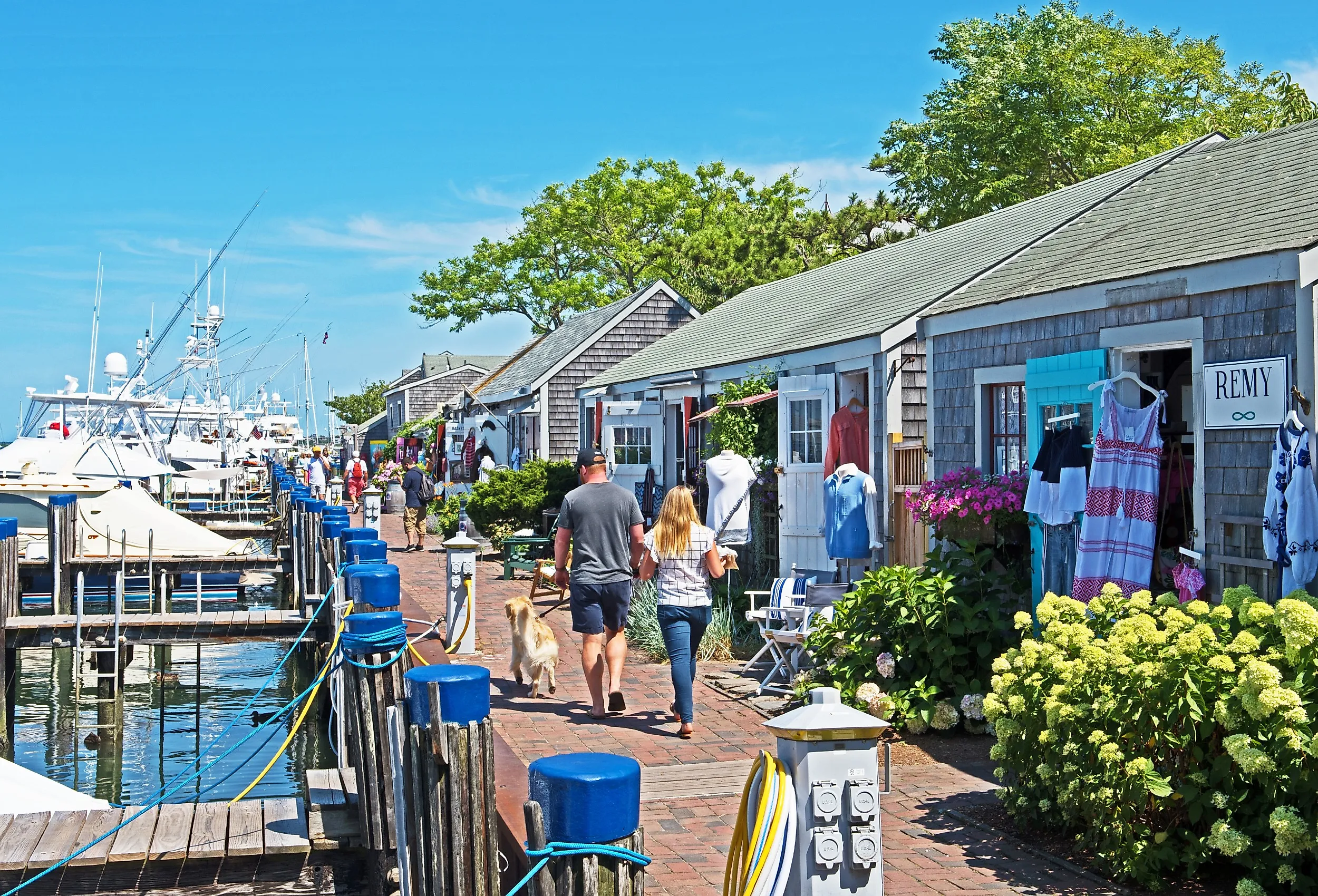
Nantucket sits 26 miles out in the Atlantic, far enough that everything arrives by ferry or small plane. The 2020 census counted 14,255 residents. In July and August the island holds around 80,000 people at the peak, and even an average summer day now runs above 40,000. Sitting that far offshore turns every crowd into a logistics problem, since workers, groceries, and cars all move through the same two ferry lines. The payoff for the trip is the riding. Nantucket has more than 30 miles of paved bike paths, and you can pedal from town out to Madaket for the sunset or over to Siasconset through the moors without touching a highway. Rent a bike near the wharf and skip the car-reservation scramble entirely.
New Shoreham, Rhode Island

Block Island is the whole town of New Shoreham, and about 1,400 people live there year-round. On a peak day between the Fourth of July and Labor Day, that jumps to 15,000 or 20,000 visitors coming off the ferries into Old Harbor and New Harbor. What keeps the island from paving over for that crowd is a deliberate choice. More than 40 percent of Block Island is protected open space, so the growth has to fit inside the same small footprint locals use all year. That protection is also the best part of visiting. The Clay Head Trail runs along the bluffs on the northeast shore and connects to a maze of walking paths through the interior called the Greenway. Hike out to the Mohegan Bluffs and climb down the stairs to the beach at the bottom for the clearest water on the island.
Mackinac Island, Michigan

Mackinac Island bans cars, so the summer crowd arrives by ferry and gets around on foot, bike, or horse-drawn carriage. Around 500 people live on the island through the winter. On a busy summer day it hosts as many as 15,000 visitors, and the season pulls in more than a million people between May and October. The no-car rule is the whole character of the place, and it makes the surge feel different from the coastal towns. There is no traffic, just a lot more bikes and horses. The best move is the loop road, M-185, which runs 8.2 miles right along the Lake Huron shoreline and is the only state highway in the country with no motor vehicles. You can ride the full circle in about an hour, past limestone arches and quiet gravel beaches most of the day-trippers never reach.
Cape May, New Jersey

Cape May sits at the very southern tip of New Jersey, where the Atlantic meets Delaware Bay. Fewer than 3,000 people live there year-round, and summer can push the daytime crowd to around 50,000. It has been a resort since the 1800s, which is why the streets are lined with the largest collection of Victorian houses in the country. The town's location does more than draw beachgoers, though. Cape May sits on one of the biggest bird migration routes on the continent, and Cape May Point State Park is where serious birders come every fall. Walk the trails around the lighthouse pond in spring or fall and you can spot hawks, warblers, and shorebirds funneling down the peninsula by the thousand.
Avalon, New Jersey

Avalon takes the northern half of a barrier island called Seven Mile Beach. Only about 1,200 people live there year-round, and the summer population runs past 30,000 at the peak. That is one of the steepest seasonal jumps on the whole Jersey Shore, and it comes straight from the housing mix of a few permanent homes surrounded by thousands of summer places. What sets Avalon apart from the rest of the shore is its dunes. The town protects one of the tallest and widest dune systems on the East Coast, and a boardwalk trail runs right through it. Walk the dune path early and you get songbirds in the thickets and a clear look at how the island holds itself together against the ocean.
Stone Harbor, New Jersey

Stone Harbor shares that same Seven Mile Beach island, just south of Avalon. Around 900 people live there in winter, and the summer number climbs above 23,000. The two towns run into each other, but Stone Harbor leans harder into its wild edge. The southern end of town is the Stone Harbor Point preserve, a stretch of undeveloped beach and dune where terns and black skimmers nest through the summer. A little inland, the Wetlands Institute sits on 6,000 acres of salt marsh and runs trails and a bay overlook. Paddle the back bays here at high tide and you move through egrets, ospreys, and diamondback terrapins instead of crowds.
Why The Same Kind Of Town Keeps Showing Up
Line these eight towns up and the pattern is hard to miss. Every one is a barrier island, a sand spit, or an island you can only reach by boat. That geography is the whole engine. The beach, the dunes, and the open water are exactly what pull the summer crowd, and the narrow strip of land is exactly what caps how many people can fit. A place like Ocean City can host 300,000 people because the beach runs for miles, and it stays a small town in January because there is nowhere to sprawl. The best way to see any of them is to work with that shape instead of against it. Get on a bike or a trail early, point yourself toward the water, and you will find the quiet edge of a town that looks packed from the boardwalk.