Where Coral Snakes And Copperheads Overlap
These two share a region and almost nothing else. The copperhead is a pit viper with hinged fangs that strikes and releases. The coral snake is the only native elapid in North America, related to cobras and mambas, with short fixed fangs that have to chew to deliver a dose. The venom numbers explain why that distinction matters more than the range map: a copperhead's average bite delivers about a third of a lethal dose, and a coral snake's delivers roughly double. They share a dozen states and almost nothing else.
The Shared Ground Is The Coastal Plain

Two of the three American coral snake species occupy ground the copperhead also holds. The eastern coral snake runs from southern North Carolina through South Carolina, Georgia and Florida, west across Alabama and Mississippi into Louisiana. The Texas coral snake covers Texas, Louisiana and Arkansas. Copperheads occur across all of that and far beyond it.
The third species does not overlap at all. The Sonoran coral snake lives in central and southeastern Arizona and southwestern New Mexico, well west of any copperhead.
The Copperhead Range Swallows It
As with the cottonmouth comparison, the two ranges are nowhere near the same size.
Copperheads reach north to New York and west into Nebraska, across the whole eastern half of the country. Coral snakes are confined to the southern coastal plain and Texas, with a strong preference for sandy, well-drained soil they can burrow into.
So anywhere there is a coral snake there is a copperhead, and across most of the copperhead's range there is no coral snake to worry about.
One Is A Cobra Relative

The taxonomy is not trivia here, because it determines everything about how a bite behaves. Copperheads are Viperidae, the pit vipers, with long hinged fangs that fold back and swing forward in a fast strike. Coral snakes are Elapidae, the family containing cobras, mambas and kraits, with short fixed fangs at the front of the mouth.
Elapids generally have to hold on and work the jaw to envenomate, which is why coral snake fang punctures often look like scratches and are easily missed entirely.
The Venom Yields Tell The Real Story

Put the two sets of figures side by side and the asymmetry is stark. An eastern copperhead yields about 26 milligrams of venom on average, with a lethal dose estimated at 85 to 100. An eastern coral snake yields 10 to 12 milligrams, against a lethal dose of 4 to 6.
The copperhead carries a fraction of what would be required. The coral snake carries roughly twice what is required, in a much smaller package, which is the entire difference between a painful bite and a medical emergency.
Copperheads Bite Vastly More People

Frequency runs in exactly the opposite direction to severity, which is the reassuring half of this.
Around 5,000 venomous snakebites occur annually in the United States. Copperheads account for roughly half of all treated bites. Coral snakes account for fewer than 100 cases, between 0.3 and 0.6 percent of the total.
Across a seventeen-year study of coral snake bites, Florida and Texas accounted for 90.5 percent of them, and 7 percent were dry bites with no venom delivered.
The Antivenom Situation Is Genuinely Awkward

This is the part most comparisons leave out, and it is the strongest argument for treating the two species differently.
Production of North American Coral Snake Antivenin was discontinued, creating a national shortage of the only product approved by the Food and Drug Administration for the purpose. The agency has repeatedly extended the expiration dates of existing lots to keep stock usable.
The shortage changed clinical practice. Where every suspected bite was once treated empirically, many centers adopted a wait-and-see approach, holding antivenom until systemic symptoms appear. The difficulty is that the antivenom cannot reverse neurological damage once it has started.
Symptoms Can Take Eighteen Hours

The delay is the specific danger with the coral snake, and it has no equivalent in a copperhead bite.
Clinical signs are typically delayed, usually appearing within an hour but documented up to 18 hours after envenomation. A person bitten can feel fine for most of a day and then develop descending paralysis.
Untreated, respiratory failure is the main cause of death. A copperhead bite announces itself immediately with pain and swelling, which is unpleasant and considerably more useful.
You Will See The Copperhead First

Behavior separates the two as cleanly as taxonomy does, and it explains the bite statistics exactly.
Copperheads are ambush predators that take up position and wait, relying on camouflage and freezing rather than fleeing. Most bites happen because somebody stepped on or near one they never saw.
Coral snakes are secretive and spend much of their time under leaf litter, logs and loose soil. They are rarely encountered above ground, and most bites involve someone picking one up.
The Rhyme Works Here And Nowhere Else

Within the overlap zone the mimics complicate things further, and the familiar rule has a hard geographic limit.
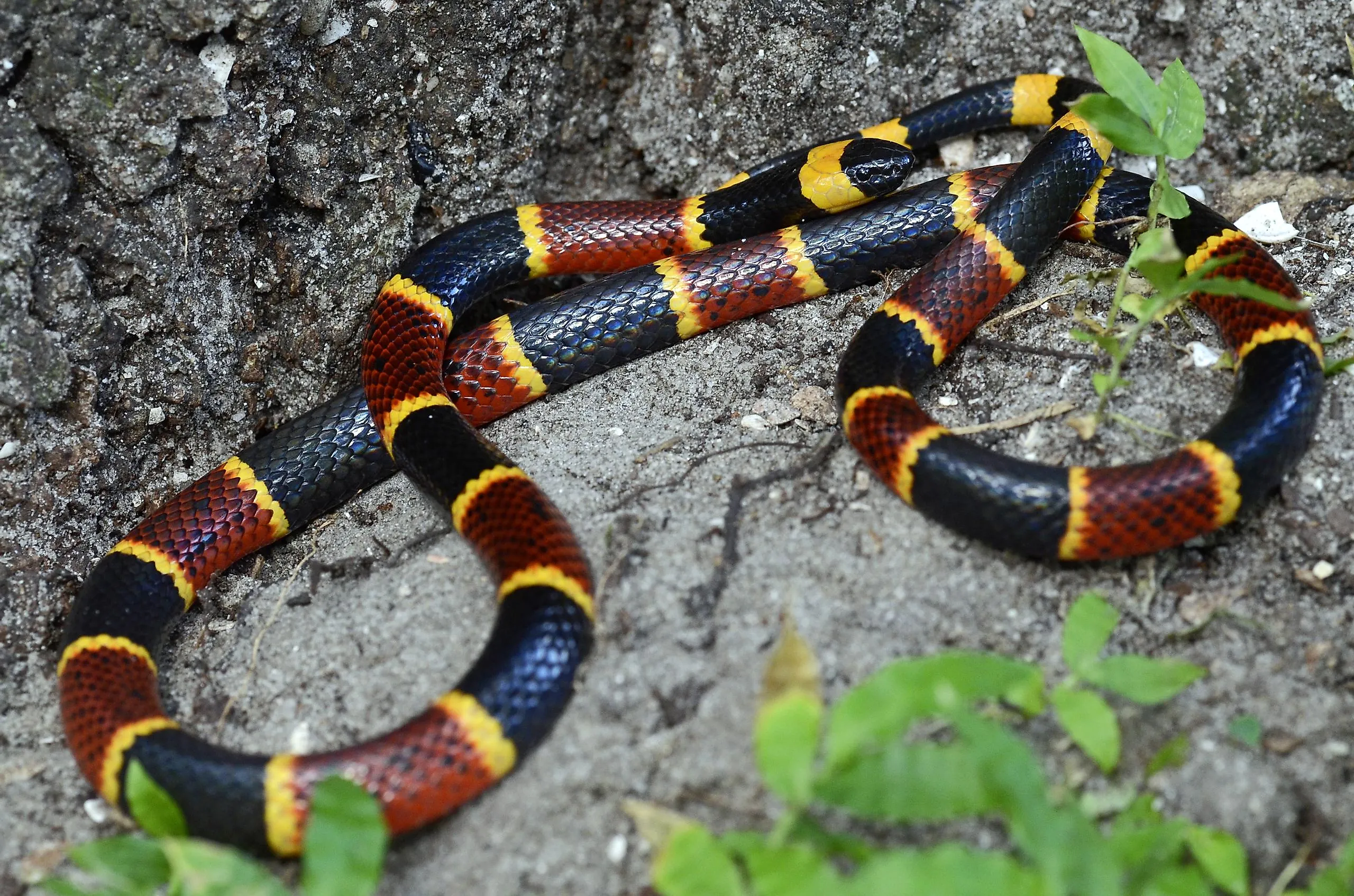
On an American coral snake the red and yellow bands touch and encircle the body completely. On the scarlet kingsnake and the scarlet snake, red touches black. The rhyme about red and yellow works across the United States and fails in Central and South America, where the banding patterns do not follow the rule.
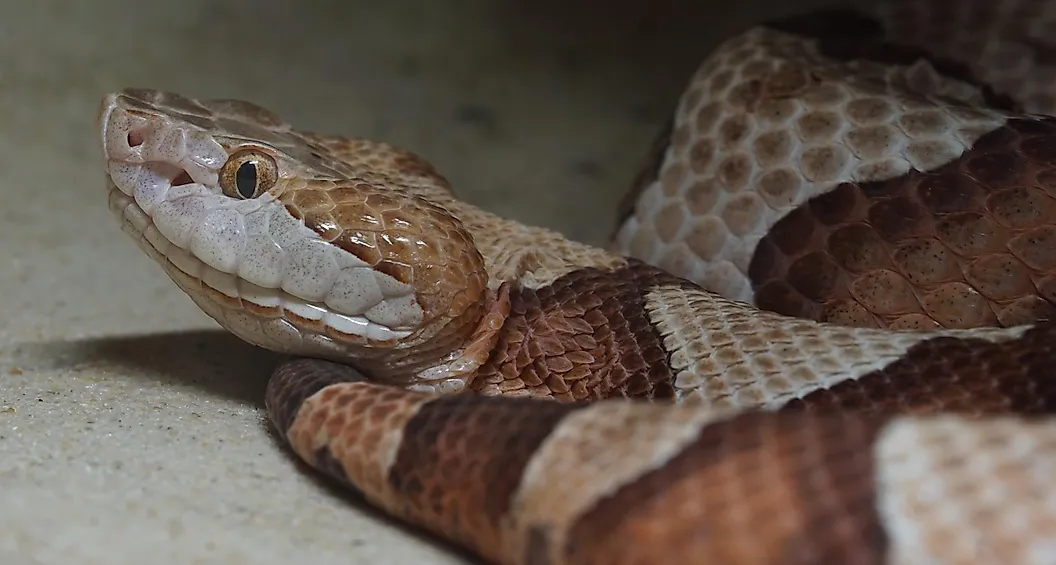
The more reliable tell is the head. Coral snakes have a black snout, round pupils and no facial pit. Copperheads have the heat-sensing pit, vertical pupils and an unmistakable coppery head.
The Short Answer

Coral snakes and copperheads overlap across the southern coastal plain from the Carolinas to Louisiana and through Texas and Arkansas, with the copperhead range extending far north and west of anywhere a coral snake occurs.
Where they meet, the copperhead is the one you will almost certainly encounter and the coral snake is the one that matters more if you do. One delivers a third of a lethal dose and announces itself immediately. The other delivers double, takes up to 18 hours to show, and the antivenom for it has not been in production for years.