9 Most Walkable Town Centers In New England
The narrow streets of New England's historic downtowns make them ideal places for walking. Fewer cars, historic buildings, and unique shops are a recipe for vibrant small towns full of life, whether it's attending Schooner Festival in Gloucester, Massachusetts, or enjoying the Festival of Fools in Burlington, Vermont. The waterfront communities embrace the sea, like Rockland's Maine Lobster Festival or Newport's Oyster and Chowder Festival. Further inland, the Maine MILL in Lewiston, Maine, showcases industrial-age ingenuity. In Brattleboro, Vermont, many bookstores make tracking down that rare and hard to find book title a little bit easier. But what these walkakble small town centers all have in common is New England charm.
Rockland, Maine

The deep water harbor of Rockland, Maine supports a fleet of local fishing boats. In the 19th-century, the small town earned the nickname "Rockland by the smell" owing to the stink of the fish processing plants. Since the 1990s, the fortunes of this New England fishing village have changed course, growing into a destination with a vibrant, walkable town center. Today you can find fresh local seafood like oysters, lobster, and scallops at Jess's Market on Main Street.
A short walk up Main Street leads to Harbor Park at the center of town where annual festivals like the North Atlantic Blues Fest host live music to the waterfront. The main stage of the Rockland Maine Lobster Festival is also in Harbor Park, though the Big Parade runs down Main Street. And the Rockland Farmers Market can be found here on Thursdays from May through October.
Visual arts has become a big part of Rockland's community in recent years. Two blocks up Main Street on Winter Street, the Center for Maine Contemporary Art showcases Maine's contemporary artists with exhibitions and programming. Another block up on Museum Street, the Farnsworth Art Museum celebrates artworks by great American artists, with extra interest paid to Maine's legendary creatives. The rotating exhibitions highlight the 16,000 works in the museum's permanent collection and exhibitions developed in partnership with other arts organizations.
Further along on Main Street, small independent shops like Arctic Tern Books, a first-run bookstore, line the street. Across the street from the bookstore, Main Street Markets stocks locally produced foods, pantry items, sandwiches, and prepared foods.
Lewiston, Maine

A19th-century canal cuts through downtown Lewiston, Maine. Beginning in 1850, the canal system helped power the textile mills. Today, the Maine Museum of Innovation Learning and Labor sits at the center of this walkable downtown, celebrating industrial technology. The museum has salvaged more than 10,000 artifacts from the industrial era, including looms and silkscreens. The new building opened in June of 2026 with 22,000 square feet of exhibition space. Alongside the museum is the Historic Auburn Riverwalk Iron Bridge. The bridge connects Lewiston to the Auburn Riveralk, a converted rail trail that runs on the Auburn side of hte Androscoggin River.
From the museum head up Chestnut Street crossing the canal on the Wiseman Bridge to find Lisbon Street, the main downtown strip. Many of the shops along Lisbon Street serve the Somali immigrant community, like the Global Halal Market with imported spices and bulk foods. Between 2001 and 2003, hundreds of asylum seekers were settled in the Lewiston area. Two decades later, the legacy left by this immigrant group is delicious food, like Haime Restuarant on Lisbon Street, and the The Heritage Restuarant on the corner of Lisbon and Chestnut, both with menus focused on Somali and East African dishes.
Lewiston also has a thriving visual arts community with galleries along Lisbon Street. Munka Studio is a shared gallery and production space with members presenting exhibitions. Further down Lisbon Street, the LA Arts Gallery presents 6 exhibits a year showcasing local artists. The organization also hosts the monthly Art Walk LA. Held on the final Friday of each month, the event turns storefronts into galleries and performance spaces.
Portsmouth, New Hampshire

The fast current of the Piscataqua River prevents the harbor in Portsmouth, New Hampshire from freezing in winter. The open water made Portsmouth an important maritime town, beginning in 1800 with the first U.S. Navy shipbuilding facility. The sailing ship legacy is celebrated in the annual Sail Portsmouth Maritime Festival featuring a parade of tall ships that pass right by the center of this walkable downtown. The best place to view the ships is the sidewalk on the Memorial Bridge linking the center of town with Maine across the river.
The Memorial Bridge serves as a gateway to Portsmouth. Just off the bridge on Daniel Street, the historic Warner House, a red brick structure from 1718, now serves as a museum showcasing the 200 years of history lived by the occupants of the home. Continuing along the street toward Market Square are numerous small shops like the Portsmouth Book Nook, an independent community bookstore for adults and children. The store hosts book clubs and a monthly reading challenge to encourage raders to choose books outside of their comfort zone.
Market Square is a historic shopping district dating to the mid-1700s. The annual Market Square Day celebrates the revitalization of the square with local and regional musicians, a 10K race, and a vehicle-free day throughout downtown Portsmouth. The festival also has 150 vendors offering food, arts, and crafts. Other times, the lively square is home to many small shops like, G. Willikers Books & Toys, a shop specailizing in all things kids, including picturebook author reading events.
Gloucester, Massachusetts

Founded in 1623, Gloucester's seaport is one of America's oldest. Cod fishing became a major industry in the 19th century, with as many as 400 vessels calling Gloucester home by the 1880s. Today, commercial fishing boats still operate out of the harbor, but on a much smaller scale as fish stocks have declined. Visitors can still experience the thrill of historic sailing vessels on the 1926 Schooner Adventure, departing right from the center of this walkabkle town. Maritime Heritage Charters operates the Schooner Ardelle, a modern schooner, on excursions around the harbor.
The annual Gloucester Schooner Festival sees schooners in three classes race out of the habor into the waters off Cape Ann. During the festival, the Maritime Gloucester museum is open displaying model ships and sailing history, and there is music, food, and schooner tours.
One block inland from the Habor Loop, the lively Main Street is filled with small shops. Heading west on Main Street, Dogtown Books has new and used books, vintage objects, and gift items. Next door, Main Street Arts & Antiques has a curated collection of treasures, from a well-stocked glassware display to collectibles like old cameras and vinyl records.
Also on Main Street, The Cut Live is a restaurant, bar, and live performance venue hosting more than 150 events each year. The lineup includes a mix of bands, storytelling, and standup comedians.
Provincetown, Massachusetts

Walking is the best way to navigate the tiny seaside Provincetown, Massachusetts. Commercial Street runs the length of town and is the focal point of the town's many parades, like the Carnival summer celebration. The annual parade includes music, costumes, floats and awards prizes like "Most Queer" and "Most Environmentally Sustainable."
Many visitors begin their journey at MacMillan Pier. Buses and ferries arrive here from Boston, and the large wharf has parking. Along the pier, artists' Trap Sheds spotlight local artists and artisans. Part gallery, part shop, these sheds offer a central point to view numerous local artists. Visitors can also book whale watching tours with the Dolphin Fleet of Provincetown. On the 3 to 4-hour long cruises, Humpbacks, Finbacks, and Right Whales can be spotted.
Commercial Street is densely packed with art galleries, gift shops, and seafood restaurants. The Lobster Pot, known for its bright red neon lobster sign, has a dining room overlooking the harbor and serves dishes like a clam bake, lobster bisque, lobster roll, and Portuguese soup. Continue down the street for the Provincetown Art Association and Museum with exhibitions in 6 gallery spaces and 3 sculpture gardens.
Head the opposite direction to catch the Tea Party at Boatslip. The 4pm cocktail hour features strong drinks, a DJ, and dancing. At the end of Commercial Street, the beach at Pilgrim's First Landing Park has views of the sunset over Cape Cod Bay. The adventorous can scramble over the Provincetown Causeway, a 1.25 mile stone dike, providing access to the secluded Long Point Beach. Additional walking leads to the Long Point Light Station. High tides do crest over the stones stranding wayward hikers.
Newport, Rhode Island

Gilded Age cottages line the shores of Newport, Rhode Island. These iconic mansions like the Breakers and Marble House offer tours of the interiors, but visitors can catch glimspers of their grandiose exteriors by hiking along the Cliff Walk. The 3.5 path perches above the Atlantic Ocean on stone cliffs passing under the nose of the magnificent mansions.
The Cliff Walk can be accessed at different points along the path. The simplest walking route to the center of town is along Memorial Boulevard, though wandering the side streets reveals hidden manor houses often otherwise overlooked. Just off Memorial Boulevard on Thames Street, the Sailing Museum & National Sailing Hall of Fame showcases the best of this nautical sport. Rotating exhibits focus on the fundamentals of the sport like the physical and psychological challenges, skills, and competition. The Hall of Fame includes an annual induction of new members for achievements in Olympics, history, and coaching.
Memorial Boulevard becomes America's Cup Avenue, to honor the storied sailing race. Heading north, Bannister's Wharf and the adjacent Bowen's Wharf are the center of this walkable town. Here the unique shops and restaurants line the narrow pier, like Newport Mansions Store on Bannister's Wharf stocked with home decor, artwork, fashion, jewlery and more, inspired by the Gilded Age manors sitting on the cliffs. These two wharves also host outdoor festivals, like the annual Newport Oyster & Chowder Festival featuring champagne and bivalves, or the Bowen’s Wharf Seafood Festival, an autumn tradition where visitors sample fish tacos, lobster rolls, chowder, clams, and more.
New London, Connecticut

More than 1,100 whaling voyages departed from New London, Connecticut during the 18th and 19th century, making it the second busiest whaling port in the world. In the 1830s, the profits from whaling made many in New England wealthy, and four similar Greek Revival homes on Huntington Street became known as Whale Oil Row. Today, these historic buildings are used as commercial office space in the center of this walkabkle town.
Just down Huntington Street, the Garde Arts Center stands at the corner of State Street. The Garde Theater building was built in 1926 as a vaudeville theater and early cinema. The historic theater became the center of Southeastern Connecticut's performing arts in 1985 with the creation of a nonprofit organization to restore and operate the facility. Today the historic theater hosts musicals, opera, dance, concerts, and films.
Continuing down State Street, Sarge's Comics & Games has toys, board games, manga, and other collectibles. On the building's exterior wall facing Eugene O'Neill Drive, there is a 175-foot long, 35-foot tall mural depicting 3 sperm whales. The Wyland Whaling Wall 41 is one of a series of murals painted by environmental artist Robert Wyland. The painting is similar to a mural that once was displayed in Dallas, Texas until it was painted over in the spring of 2026 to promote the FIFA World Cup.
At the end of State Street, a statue depicts a child-age Eugene O'Neill sitting on a rock writing. The bronze statue commemorates the writer's centennial birth. At the statue, the New London Waterfront Walk begins, continuing south along the river with views of the harbor.
Brattleboro, Vermont

A 19th-century postmaster produced one of the first adhesive stamps in Brattleboro, Vermont. Printing was a big part of the Brattleboro economy when Postmaster Frederick Palmer commissioned a stamp in the 1840s. He hoped to save time collecting five cent fees, but Palmer's Brattleboro Stamp only served as a private experiment. He produced several hundred before calling things off, just a few years before the Post Office officially issued stamps. The printing and publishing industry remained an important part of Brattleboro's history attracting writers like Rudyard Kipling, author of The Jungle Book.
Bookstores flourish in this walkable town center. Main Street is home to Antidote Books, Brattleboro Books, and Lost Time Books, as well as the comic books store Ray Gun Comics. Intersecting Main Street, Elliot Street has two more shops, Everyone's Books and Book Lovers. These shops are stocked with new, used, rare, and out of print books. Walking around this downtown feels a bit like a treasure hunt browsing the shelves of aging books.
On the west end of Elliot Street, Kipling's Tavern is named in honor of the novelist. A restaurant or bar has occupied the space since 1926, but the current iteration opened just a few years ago with a modern burger menu and craft cocktails. For less bookish pursuits, check out the Brattleboro Museum & Art Center. Founded in 1972, the organization converted a historic train station into a thriving gallery with rotating exhibits.
Burlington, Vermont

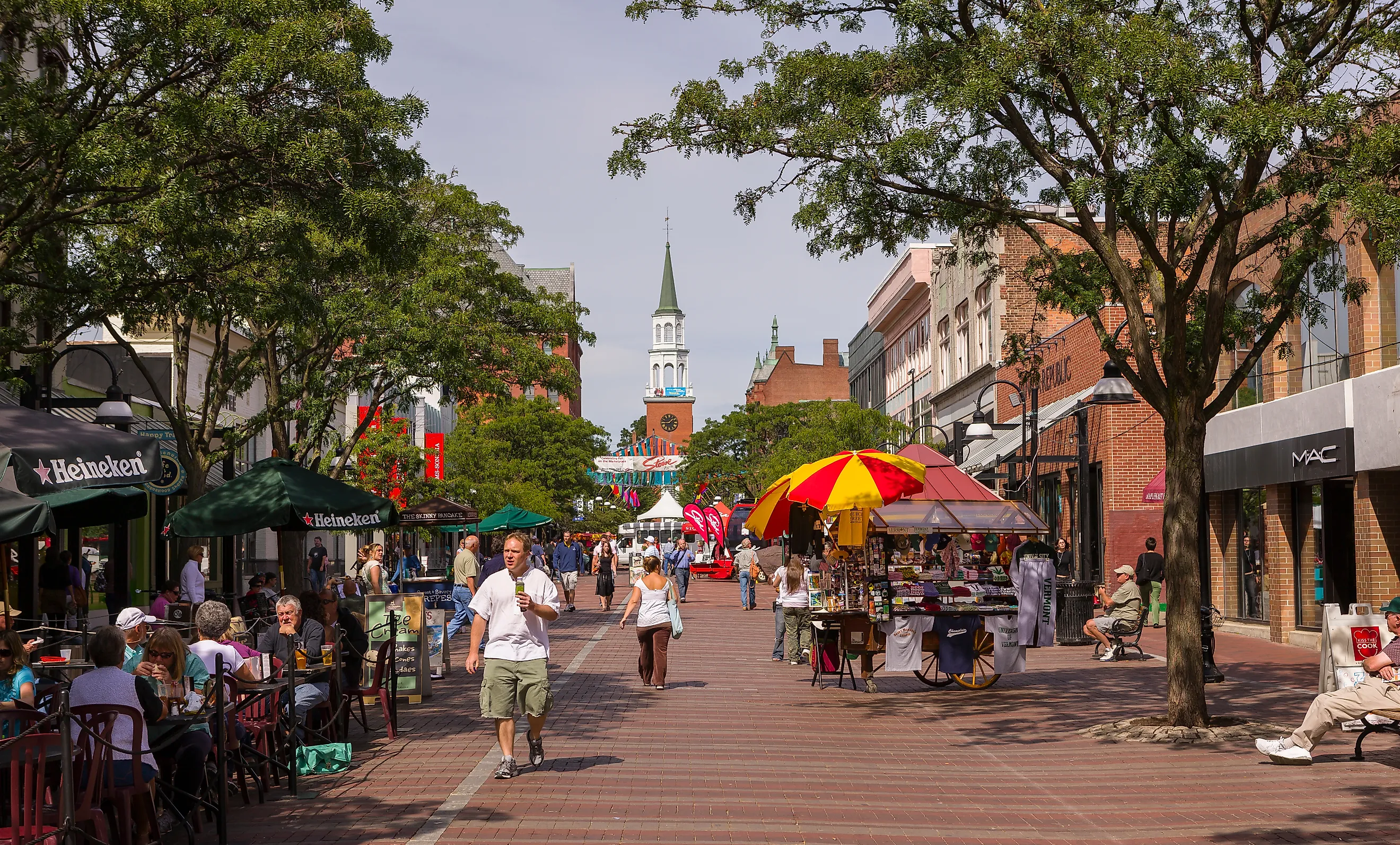
Sitting on the shore of Lake Champlain, Burlington, Vermont once had a 30-foot deep ravine running through the city. The natural formation was created by the flow of Winooski River, since naturally routed elsewhere. In the 19th century, rail tracks ran through the ravine. When the rails were relocated, the space was used as a sewer and then finally filled in. The last vestiges of the natural ravine can be seen in the dip on King Street between Church Street and Winooski Avenue. A block over, City Hall Park sits at the center of this walkable downtown.
City Hall Park hosts events like the Burlington City Arts Festival of Fools. The annual family-friendly festival highlights street performers, street theater, and music, along with a vendor marketplace along Church Street.
Across from City Hally Park, the Burlington City Arts Center is a 3-level exhibition space supporting community arts. The center hosts classes, concerts, films, art markets, and hosts studio hours for working artists. Further down Church Street, Frog Hollow Vermont State Craft Center fosters craft education and builds community around the craftwork in Vermont. The center spotlights the works of the Fog Hollow Craft Association members and hosts educational events.
Shops line Church Street, like Vermont Flannel, a New England chain dedicated to flannel apparel and accessories, and further up Church Street, Crow Books, a first-run bookstore. At the corner of Church and Cherry Street, Ben & Jerry's current Burlington shop. The location of the first location of this iconic ice cream chain opened in 1978 a few blocks away on the corner of Paul Street and College Street. A plaque marks the spot.
Walking In New England's Vibrant Town Center
Walking around New England's small towns is a great way to experience community, culture, and simply have a good time. Whether you need to stock up on flannel shirts in Burlington or looking for collectibles at Sarge's Comics in New London, the shops in these vibrant downtowns offer unique choices. Museums like the Maine Center for Contemporary Art in Rockland showcase the creative energy of New England, while festivals like Provincetown's Carnival highlight the whimsy and connection of close-knit community. One thing is certain, walking through these downtowns helps make them feel alive and full of life.