8 Germany Towns With Unforgettable Main Streets
Germany's main streets are memorable for their distinctive architecture and scenic surroundings. In Bavaria and North Rhine-Westphalia, half-timbered buildings and flower window boxes create a storybook feel. Elsewhere, streets open to the Bavarian Alps or to wooded landscapes near Gengenbach. Frescoes, maypoles, and other traditions give these streets much of their character. Every square and façade adds to a streetscape that is rooted in local life.
Rothenburg ob der Tauber

Rothenburg ob der Tauber is a classic storybook setting with half-timbered structures from the 14th century and window boxes overflowing with trailing flowers. The medieval town is famous for the Plönlein, a much-photographed intersection with a colorful yellow half-timbered house, a tower, and a fountain. Along Bavaria's Romantic Road, the walkable village is one of the best-preserved walled towns in Germany. Visitors can walk the medieval ramparts for views of the Tauber River and the valley below.
The cobblestone streets are lined with shops selling regional specialties like schneeballen, alongside the famous Käthe Wohlfahrt Christmas Village. St. Jakobskirche (St. James Church) holds the Altar of the Holy Blood, an ornate wood-carved altarpiece by Tilman Riemenschneider that was completed around 1505. The Medieval Crime and Punishment Museum explores centuries of law enforcement and criminal justice practices through documents and devices.
Hohenschwangau

Another idyllic street near Germany's Romantic Road, Alpseestraße leads through the village of Hohenschwangau, within the municipality of Schwangau. This walkable street features traditional Bavarian buildings and classic maypoles on the way to Lake Alpsee, a clear mountain lake often dotted with swans. Backed by the Bavarian Alps, the 19th-century Neuschwanstein Castle is visible from many angles along this street. Horse-drawn carriages wait curbside to transport visitors to and from the castle through the surrounding spruce and pine forest.
Hohenschwangau's main street combines its scenery and small-town atmosphere with outdoor recreation and King Ludwig II's other castle. The bright yellow Neo-Gothic Hohenschwangau Castle was a childhood home of Ludwig II, where he spent extended time during his father Maximilian II's reign. The Marienbrücke Bridge, about 150 feet long, spans the Pöllat Gorge roughly 300 feet below. The bridge serves as a vantage point for castle and valley views and as an access point to hiking paths that lead toward the Austrian border.
Bacharach

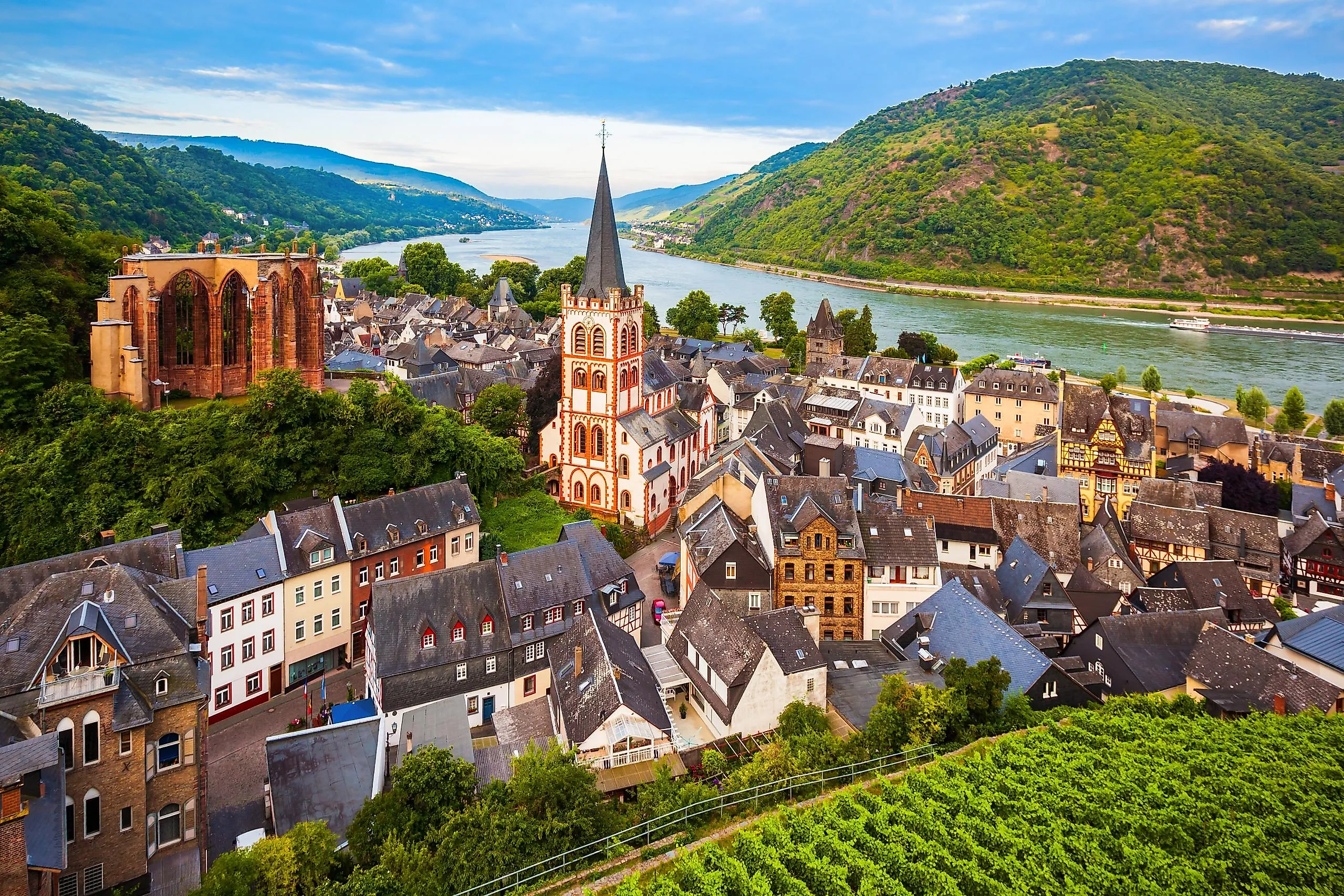
Bacharach, in Rhineland-Palatinate along the Rhine River, is noted for its historic half-timbered architecture framed by colorful window boxes along Oberstraße. Running through town, this street leads to the Rhine as it passes by wine cafés and the four-gabled, half-timbered Altes Haus, which dates to 1568. The old city walls, constructed in the 1300s, have walkable sections and tower views, including the Liebesturm (Love Tower) and the Marktturm (Market Tower).
Historic landmarks and relaxing spots are located near Oberstraße. The 12th-century Stahleck Castle, once the seat of the Counts Palatine of the Rhine, overlooks the main street and now operates as a youth hostel that is open to visitors. Wernerkapelle (Werner Chapel) is a Gothic ruin near St. Peter's Church. The banks of the Rhine offer quiet spots with benches alongside active docking areas for Rhine River cruise boats.
Gengenbach

Gengenbach's Engelgasse (Angel Alley) is lined with half-timbered architecture and overflowing window boxes. This narrow road winds through the old town and is often described as a "fairytale" street for its cobblestones and residential atmosphere. The 18th-century Rathaus (town hall) is a striking focal point with its pink exterior and 24 windows. During the Christmas season, the façade becomes the world's largest Advent calendar. Each night, a light reveals a new scene in one of the windows.
Gengenbach's location in Baden-Württemberg's Black Forest makes it convenient for hiking trails and museums. The Gengenbach-Mattenhof is a scenic five-mile loop trail that passes through forests, vineyards, and farmland. The Narrenmuseum Niggelturm, a carnival museum, preserves local traditions through costumes and masks from regional festivals, including Gengenbach's annual Alemannic carnival.
Quedlinburg

Quedlinburg's Marktstraße leads to the Marktplatz, a public square in continuous use since the Middle Ages. Ice cream shops, restaurants, and small stores line the path. Along the way, well-preserved examples of the area's more than 1,000 traditional half-timbered structures come into view, part of the architectural heritage that earned Quedlinburg's old town its UNESCO World Heritage designation in 1994. This street has convenient access to the Fachwerkmuseum im Ständerbau, dedicated to the art of fachwerk, or half-timbered construction. At the square, the Quedlinburg Roland, a more than nine-foot-tall sandstone statue of a knight, stands as a prime focal point.
Historic landmarks and the natural beauty of the Harz Mountains are accessible from points around town. The Schlossberg (Castle Hill) is home to Quedlinburg Castle and the nearby Romanesque Collegiate Church of St. Servatius. The castle hosts a museum that chronicles the region's history. The Selke Valley Railway, a historic narrow-gauge steam railway, travels by cliffs and forests as it connects Quedlinburg to towns like Eisfelder Talmühle and Alexisbad.
Monschau

Monschau's scenic Eschbachstraße runs along the Rur River as it travels toward the Old Town. The river flows directly through town, lined on either side by timber-framed buildings and spanned by stone and wooden bridges. Small cafés and bakeries dot this route. The street offers views of Monschau Castle, originally built in the 13th century and expanded and rebuilt in the 17th century.
German cultural and culinary heritage are easy to find throughout the streets of Monschau. Rotes Haus (Red House) tells the town's textile-making history through the 18th-century home of a former merchant; Monschau cloth was considered the highest quality in the region. The Historic Mustard Mill has been hand-producing mustard since 1882. The Wilderness Trail takes hikers through forests and meadows in nearby Eifel National Park.
Oberammergau

Oberammergau's wide main street is lined with cafés and traditional woodcarving shops. Bavarian houses with stucco fronts and colorful window boxes are the main draw along the walkable street. Many of these buildings carry elaborate exterior frescoes (a regional tradition known as Lüftlmalerei) depicting fairytales and biblical scenes. Combining the artistry of the village with the surrounding Ammergau Alps, the Laber-Oberammergau ski area offers downhill trails in winter and hiking paths in summer.
Oberammergau is small, but its tiny streets fill with festivities during the once-a-decade presentation of the Passion Play. In 1633, at the height of the plague, villagers pledged to perform the play if they were spared from the disease. The first performance was held in 1634, and the play has been staged in years ending in zero since 1680, with a few interruptions for postponement, cancellation, or wartime suspension.
Cochem

Cochem, set along the Moselle River, is best known for the Moselpromenade, a lively riverfront walkway lined with cafés, colorful houses, and views of Reichsburg Castle above town. Just inland, the Marktplatz is at the heart of the historic center, where cobblestone lanes, half-timbered buildings, wine taverns, and local shops give the old town much of its appeal. Bernstraße adds to the scene as one of Cochem's main shopping streets, with easy access to both the market square and the promenade.
The Eifel and Hunsrück Mountains form the backdrop to Cochem's lively streetscape. A striking presence overlooking town, Reichsburg Castle was originally built around 1000 AD and rebuilt in the 19th century after being destroyed by French troops in 1689. Cochem's Historic Mustard Mill museum, separate from the better-known mill in Monschau, chronicles the German tradition of gourmet mustard. The Pinnerkreuz (Pinner's Cross) is a lookout point atop Pinnerberg Mountain. It can be reached by the Cochem chairlift or by hiking trail and offers wide views of the Mosel Valley.
Unforgettable Main Streets in Germany
Germany's main streets blend centuries of history with nearby natural attractions while maintaining a small-town atmosphere. Narrow lanes and avenues lead to vineyard-covered hills in the Rhine and Moselle River regions. In other areas, streets serve as gateways to the Ammergau Alps and the Harz Mountains. Museums, public art, and culinary traditions enrich the roadway. Together, these main streets create a welcoming character that balances cultural depth with scenic surroundings.