2026's 8 Most Scenic Germany Towns
Germany's most memorable small towns often owe as much to their surroundings as to their architecture. Medieval roofs rise above vineyard covered river valleys in the west, half timbered houses crowd beneath castle hills in the center, and church towers appear against snow capped Alpine peaks in the south. The eight towns on this list are all small, but no two offer quite the same view. Some are best seen from a mountain lookout or castle terrace, while others reward a slow walk beside a river or through streets that have changed remarkably little over the centuries. Together, they show how Germany's scenery shifts between the forests and river valleys of the west and the lakes and mountains along its southern edge.
Monschau

The Rur River twists through the center of Monschau, leaving remarkably little space between the water, steep wooded hillsides, and rows of slate roofed houses. Start beside the river in the old town, where timber framed façades rise directly above the Rur and narrow lanes disappear between them. The Rotes Haus stands out with its red exterior. Wealthy cloth manufacturer Johann Heinrich Scheibler built the combined residence and business premises during the 1760s, and its preserved interiors recall the industry that once brought prosperity to this secluded Eifel town.
Climb toward Monschau Castle for a different perspective, looking back across the roofs compressed into the valley below. Those who want to follow the river farther can cycle the RurUfer-Radweg, which runs directly through the old town and Rur Valley. The route is one of three premium Eifel cycling trails that cross the municipality, allowing the scenery to continue well beyond Monschau's historic center.
Cochem

Few views capture the Moselle Valley as completely as Cochem, where the river curves beneath steep vineyard slopes and Reichsburg Cochem rises on a rocky hill about 330 feet above town. Visitors can walk uphill from the medieval center to tour the castle's rooms and courtyards, then descend toward the Marktplatz, where a Baroque town hall, St. Martin's Fountain, and half timbered houses roofed in dark Moselle slate surround the square. Sections of Cochem's medieval defenses also survive among the narrow streets, including the Endert Gate, which dates to 1332.
For the broadest panorama, take the chairlift up Pinnerberg to Pinnerkreuz. The lookout opens across the Moselle Valley toward Cochem and Reichsburg on the opposite hillside. Hikers can continue along the Moselsteig, where steep paths climb through the slopes above town and repeatedly reveal the castle between vineyards and trees.
Quedlinburg

In Quedlinburg, the scenery is architectural. More than 2,000 half timbered houses spanning roughly eight centuries fill an exceptionally well preserved medieval town plan at the northern edge of the Harz Mountains. The UNESCO listed old town is best appreciated from Schlossberg, the sandstone rise crowned by the Romanesque Collegiate Church of St. Servatius. King Henry I was buried here in 936, and visitors can still enter the church and treasury before walking through the monastery gardens on the plateau for a view across Quedlinburg's uneven sea of steep roofs, gables, and church towers.
Back below, Marktplatz presents a closer view of the townscape. Half timbered buildings frame a square laid out around 1150, with the vine covered town hall and twin towers of St. Benedikti along its northern side. For another panorama, climb the Market Church tower, where the view reaches from the old town and Schlossberg toward Münzenberg and the Harz foothills.
Rothenburg ob der Tauber

The stone walls of Rothenburg ob der Tauber still wrap around its medieval center, creating a skyline of tiled roofs, church spires, defensive towers, and timber framed houses above the Tauber Valley. The most photographed corner is Plönlein, where a narrow yellow half timbered house stands between two diverging cobbled streets. One slopes toward the Siebers Tower, while the other leads toward the Kobolzeller Gate, producing the layered medieval view that has become synonymous with Rothenburg.
Walking the town walls reveals a broader perspective. Visitors can follow much of the fortification above the old center, passing defensive towers while looking across rooftops toward the surrounding Franconian countryside. At the western edge of town, the Burggarten occupies the site of Rothenburg's former imperial castle and opens toward the Tauber Valley. A path descends from this side of town toward the river, where the medieval Double Bridge provides a striking view back toward Rothenburg's walls and towers high above the valley.
Meersburg

Meersburg climbs steeply from the shore of Lake Constance, with vineyards, castle towers, and rows of colorful houses stacked above the waterfront. The town's defining landmark is the Meersburg Castle, whose origins reach back to the early Middle Ages. Its elevated terraces provide views across the lake toward the Swiss shore and, on clear days, the distant Alps. Inside, visitors can explore furnished rooms, defensive spaces, and the chambers associated with German poet Annette von Droste-Hülshoff.
Just uphill, the Baroque New Palace offers another of Meersburg's finest viewpoints. Its garden terrace overlooks the lower town, harbor, and broad expanse of Lake Constance, turning the palace grounds into as much a scenic stop as a historical one. The landscape becomes more rural around the Fürstenhäusle, Droste-Hülshoff's former vineyard retreat above town, where vines descend toward the lake. Back at water level, the lakefront promenade provides the opposite perspective. Castle walls and vineyard slopes rise behind the harbor while ferries cross toward Constance on the far shore.
Füssen
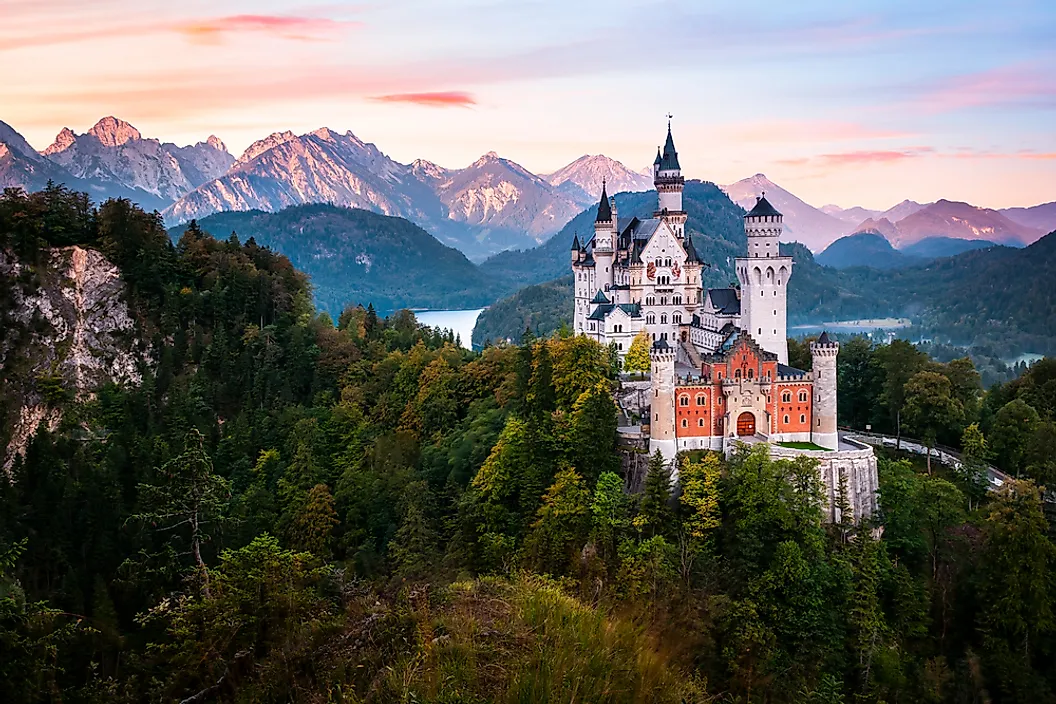
At the southern end of Germany's Romantic Road, Füssen sits where the turquoise Lech River leaves the Alps and enters a landscape of lakes and forested foothills. Above the old town, the late Gothic Hohes Schloss is immediately recognizable by its illusionistic painted façades. Visitors can walk through its courtyard and climb sections of the complex for views across Füssen's red roofs toward the mountains. Below it, St. Mang's Abbey occupies another prominent position beside the Lech and now houses the Museum of Füssen.
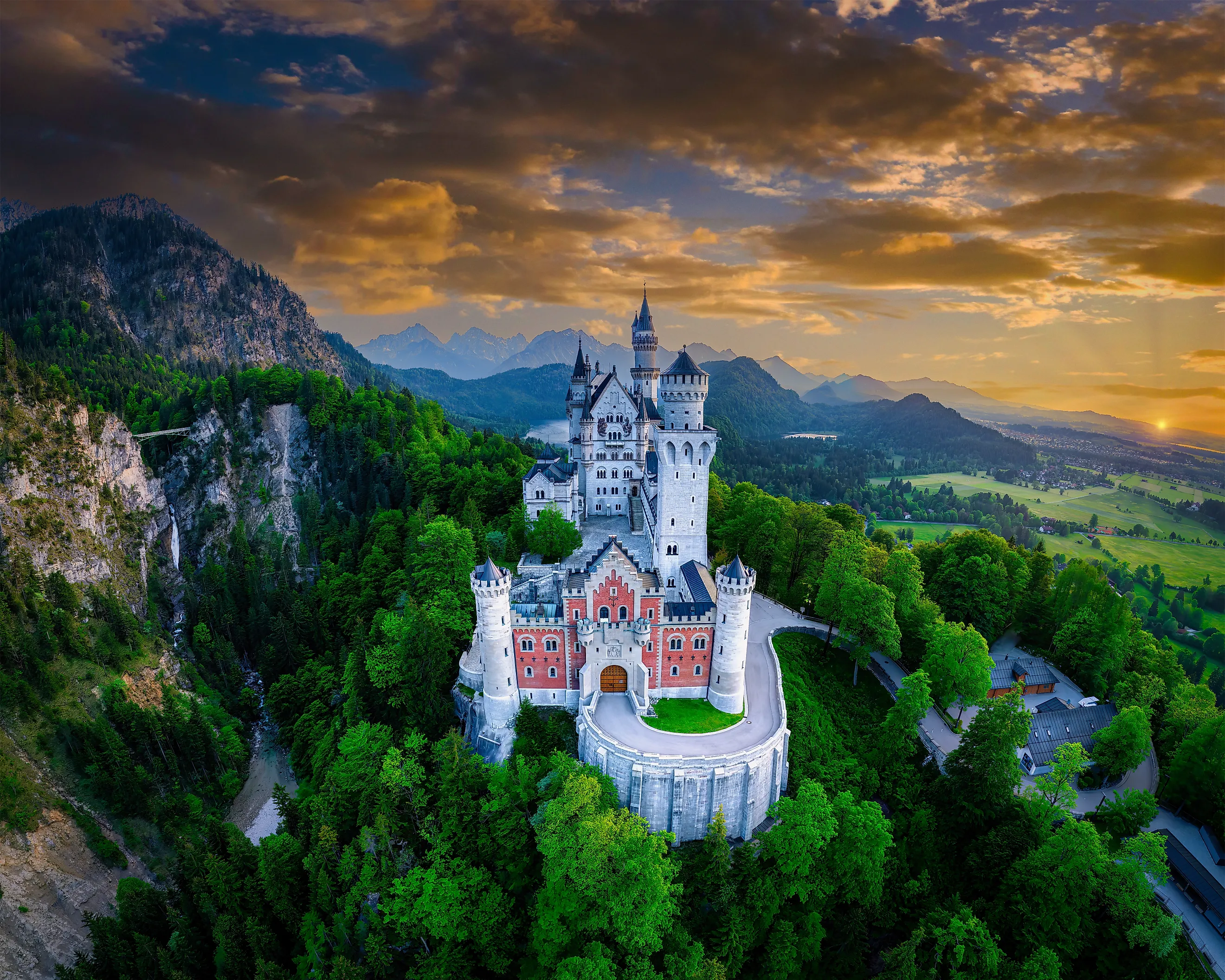
A short walk upstream reaches Lechfall, where the river pours over a broad stepped weir before squeezing into a narrow rocky gorge. The Maxsteg footbridge crosses directly above the rushing water and provides one of the area's most dramatic close range views. For a wider Alpine panorama, summer boat trips on Forggensee look back toward Füssen and the mountain skyline, with Neuschwanstein and Hohenschwangau visible from parts of the lake. The combination of river, lakes, mountains, and elevated historic buildings makes Füssen scenic from almost every direction.
Garmisch-Partenkirchen

Mountains dominate almost every view in Garmisch-Partenkirchen, where the Wetterstein range rises abruptly behind neighborhoods and church towers. One of the most dramatic landscapes lies just outside the center at Partnach Gorge. A narrow path follows the Partnach River through a ravine where rock walls rise as much as 260 feet overhead, with waterfalls spilling beside tunnels cut into the stone. The gorge changes noticeably with the seasons, with rushing meltwater in warmer months giving way to curtains of ice during winter.
The town also provides access to the Zugspitze, Germany's highest mountain at 9,718 feet. Cable cars carry visitors to the summit area for views across hundreds of Alpine peaks in Germany, Austria, Switzerland, and Italy when conditions are clear. The AlpspiX viewing platform offers another high altitude perspective from two steel walkways projecting beyond the mountainside. Back in town, Ludwigstraße provides a distinctly Bavarian foreground for those peaks, with painted façades and historic houses lining the old heart of Partenkirchen.
Berchtesgaden

Few German towns occupy a setting as dramatic as Berchtesgaden, which sits in an Alpine basin beneath the Watzmann massif near the Austrian border. The surrounding mountains become especially imposing at Königssee, a long, narrow lake enclosed by steep rock faces. Electric passenger boats cross its emerald water toward St. Bartholomä, whose red domes stand on a small peninsula beneath the Watzmann East Face. During the journey, boat crews traditionally demonstrate the lake's famous echo with a trumpet or flugelhorn.
For an aerial perspective, the Jennerbahn climbs from the Königssee valley toward Jenner Mountain. From the upper station, trails lead to viewpoints overlooking the lake far below and the Watzmann across the valley. Much of the surrounding landscape belongs to Berchtesgaden National Park, Germany's only Alpine national park, where more than 150 miles of trails and Alpine routes cross forests, high meadows, and mountain terrain. Back in Berchtesgaden, the historic market square provides a gentler final view, with pastel façades, the collegiate church, and mountains rising behind the rooftops.
Germany's Small Towns, Across River Valleys And The Alps
Germany's most scenic small towns show how dramatically the country's landscapes change over relatively short distances. Monschau and Cochem fit tightly into western river valleys, while Quedlinburg and Rothenburg ob der Tauber preserve medieval skylines that are best appreciated from surrounding hills and walls. Farther south, Lake Constance gives Meersburg its vineyard covered waterfront, and the scenery becomes progressively more mountainous through Füssen, Garmisch-Partenkirchen, and Berchtesgaden. In each town, the strongest views extend beyond a single landmark. Rivers, lakes, vineyards, forests, historic roofs, and mountain ridges combine to create places worth exploring from more than one perspective.