8 Prettiest Main Streetscapes In The Finger Lakes
New York's Finger Lakes region is a landscape cut by glaciers, which ground 11 river valleys into deep troughs before the last of the ice left the state about 11,000 years ago. Today, villages cluster at the ends of these lakes, and many of the region's main streets stop right at the water. Genesee Street in Skaneateles drops to Clift Park, where a white gazebo looks out over 16 miles of lake. Trinity Episcopal Church in Seneca Falls stands so close to Van Cleef Lake that the water holds the tower's reflection. These, along with a handful of others, are the prettiest main streetscapes in the Finger Lakes.
Skaneateles

Genesee Street doubles as US Route 20. It slopes downhill; the storefronts stop, and Skaneateles Lake fills the view. Clift Park sits at the bottom of that slope, with a white gazebo looking out over 16 miles of water. A pier extends from the lawn, and benches, restrooms and a public swimming area sit along the shore behind it.
Across the street, the Sherwood Inn dates to 1807, and its porch overlooks the north shore. Its dining rooms are open morning through evening, seven days a week. Mid Lakes Navigation runs a narrated sightseeing boat daily from the village dock. Walk east for the architecture. Gothic, Victorian and Greek Revival houses stand along East Genesee inside the Skaneateles Historic District.
Seneca Falls

West on Route 20, a working canal cuts through the middle of Seneca Falls. Trinity Episcopal Church, finished in 1886, stands at the edge of Van Cleef Lake. Blue limestone from a nearby quarry accounts for the gray of the walls, and some 20 stained glass windows fill the interior with color, some of them from Tiffany Studios. Locally, it's regarded as the most photographed church in New York.
A few doors east, the restored Wesleyan Chapel and the visitor rooms of Women's Rights National Historical Park are open to the public year-round. South of the water, the Frank J. Ludovico Sculpture Trail runs 0.9 miles along the canal from a trailhead off Bridge Street, with benches and outdoor sculpture along the route.
Geneva

Eleven miles on, Geneva's prettiest block is on Linden Street. The narrow lane of brick facades closes to cars on warm weekends and fills with cafe tables instead. The same 19th century brick runs along Seneca, Exchange and Castle streets. On Linden, stone columns with scrolled tops stand in the front wall of the old Farmers and Merchants Bank, under a wide triangle of stone. Around the corner on Seneca Street, the 1894 auditorium of the Smith Opera House stays in constant use.
On South Main Street, Federal row houses built between 1808 and 1820 stand along one side. These homes are painted in enough colors to earn the local name Rainbow Row. They face Pulteney Park with Seneca Lake behind them. Below Rainbow Row, the lawns, benches and walking paths of Geneva Lakefront Community Park reach to the shoreline.
Canandaigua

Sixteen miles west, Canandaigua's Main Street climbs one long slope. The Ontario County Courthouse stands at the top of the hill, a pale brick block behind four tall white columns. A gilded Goddess of Justice tops its dome, in view from most of downtown. Farther north on Main Street, the Granger Homestead is a Federal mansion on 12 acres of lawn and Victorian gardens. Three barns behind it hold the largest carriage collection in western New York, and guides run hourly tours Wednesday through Sunday.
A short drive east, Sonnenberg Gardens and Mansion State Historic Park surrounds an 1887 Queen Anne summer house with 50 acres of Italian, Colonial and Japanese garden rooms, planted between 1902 and 1920. At its south end, Main Street reaches Canandaigua Lake. Kershaw Park covers nine acres of shoreline path, sand beach, gazebo and pavilions along the north shore. The replica paddlewheel steamboat Canandaigua Lady sails from Steamboat Landing between May and October.
Naples

Route 21 runs 22 miles south into a valley with grapevines lining the hillsides above both shoulders of the road, and a Main Street at the bottom. The village of Naples raised its brick Memorial Town Hall on Main Street in 1872 to honor local Civil War veterans, and a dance floor and stage still occupy the upper story. Artizanns sells the work of more than 200 regional artists, Wednesday through Sunday.
Grape harvest is the center of the local calendar. Hazlitt Red Cat Cellars pours glasses in the former Widmer Wine Cellars complex just off Main, and the Naples Grape Festival takes place on the Memorial Town Hall grounds each September. Vine Street leaves Main and dead ends half a mile later at Grimes Glen County Park. A shale gorge and a waterfall of roughly 60 feet lie at the end of a creek walk.
Penn Yan

Twenty-three miles east on Route 364, Penn Yan's Main Street is packed with sights worth seeing. Buildings from 1820 through 1929 stand shoulder to shoulder. Plain, flat brick from the early years sits beside the turrets, porches and steep mansard roofs of the later buildings. The National Register added the whole downtown in 1985. The Chronicle Building on East Main carries Gothic brick detail, and the mansard tower of the old Knapp Hotel still marks the head of the street.
At the corner of Main and Seneca, the Birkett Mills has ground buckwheat since 1797, and its current mill went up on that corner in 1824. A 28 foot pancake griddle hangs on the wall, a 10 ton souvenir of the record setting flapjack cooked in 1987. The Keuka Candy Emporium sells nostalgic sweets from vintage barrels inside the historic Lown's Building. From a trailhead on Cherry Street, the Keuka Outlet Trail runs seven miles to Dresden past Seneca Mills Falls. Red Jacket Park sits on Keuka Lake itself.
Hammondsport

South along Keuka Lake is Hammondsport, home to a true village green with storefronts on all four sides. The National Register listing here covers nearly the whole village rather than just a single block. The Park Inn has run as a country inn and restaurant since 1861, and its windows face the green. A few doors along Shethar Street, Gottlieb Frey put up a 600 seat opera house in 1901; today it's home to Opera House Antiques.
Patina keeps a shopfront on the same block, open daily. Free concerts fill Pulteney Park on Thursday evenings through the summer, lawn chairs and all. Shethar Street slopes down toward the water and ends at Depot Park, where a swimming beach and picnic tables sit right at the edge of Keuka Lake. Just outside the village on Route 54, the Glenn H. Curtiss Museum opens every day from May through October.
Corning

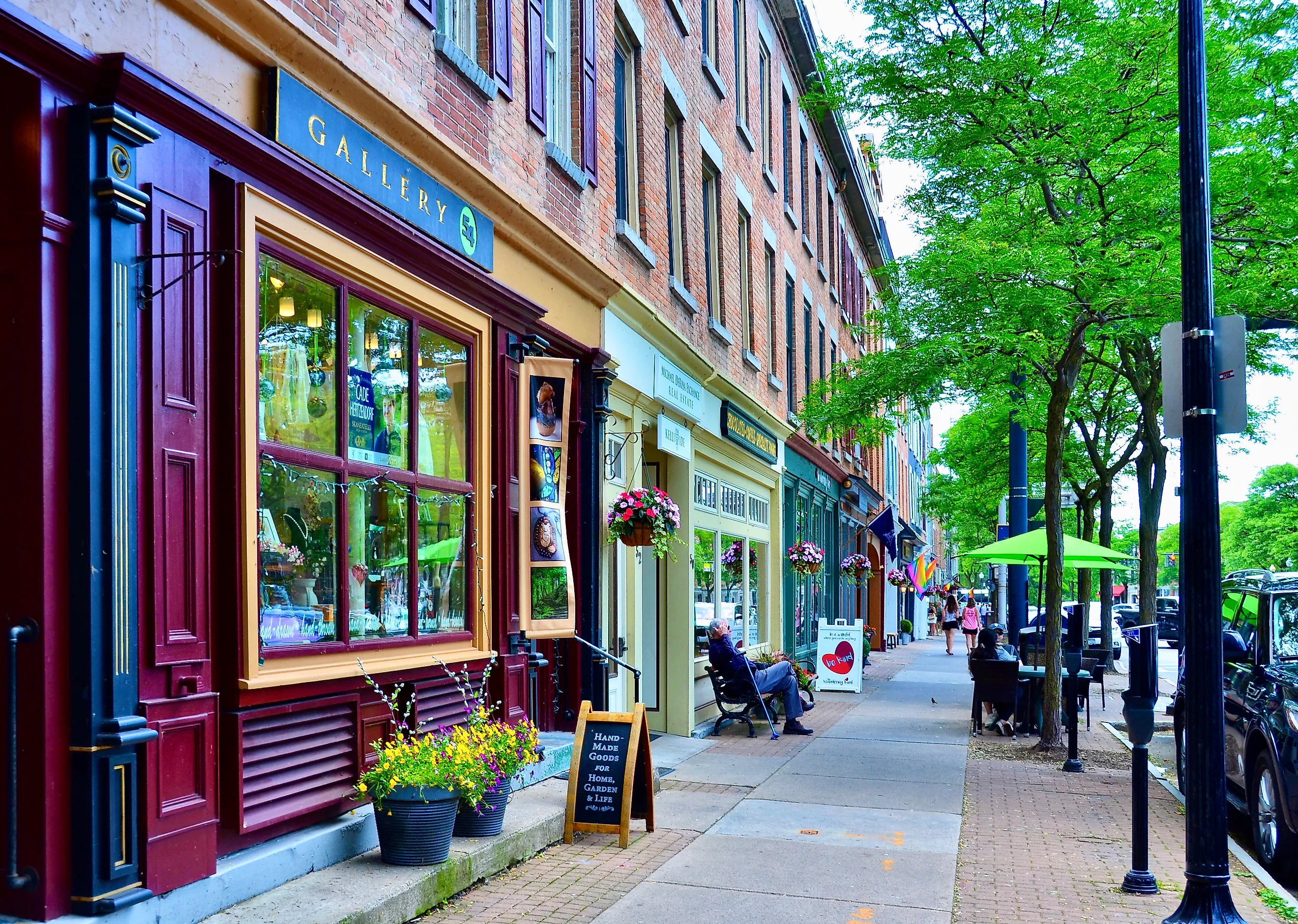
Twenty-nine miles southeast, by way of Route 54 and Interstate 86, Corning has one of the best restored streetscapes in the region. Five blocks of Market Street run from Bridge Street to Wall Street. Late 19th century commercial buildings stand along both curbs, many of them trimmed with molded clay ornament made within Corning. A restoration program launched after the 1972 flood brought those facades back, and the National Register listed the district in 1974. The Brown's Cigar Store building went up in the late 1870s and the First Bank Building in 1882.
Brick paving, honey locust trees and wrought iron tables fill Centerway Square beneath an 1883 clock tower, 50 feet of Antrim stone housing a 1,400 pound bell. The 1893 Old City Hall now holds the Rockwell Museum, a Smithsonian Affiliate open daily, nine to five. From there the 1921 Centerway Walking Bridge crosses 710 feet of the Chemung River to Riverfront Centennial Park, where sycamores shade a fountain and a pavilion at the water's edge.
Where The Street Runs Out Of Land
These eight streets all sit in close relationship with the landscape around them. Many follow valleys and shorelines first shaped by the region's glacial geography, ending near lakes, rivers, or parks that remain in view today. Genesee Street reaches Clift Park above Skaneateles Lake. Shethar Street slopes toward Depot Park in Hammondsport. Main Street in Canandaigua finishes near nine acres of shoreline at Kershaw Park.
The buildings came later and mostly stayed. Penn Yan and Hammondsport gained historic districts that preserved whole stretches of downtown, and Geneva's Federal row houses have stood since the early 1800s. The position of the water shaped much of the setting. What sits between the shoreline and the storefronts is the source of these streets' distinct look.