8 Of The Most Captivating Small Towns In England
England's small towns are where the country keeps some of its most interesting details. Some keep cobbled lanes that still climb past smugglers' inns, or old market squares trading since the Middle Ages. Others are medieval ports now stranded miles inland after the sea receded, or castles you'll recognize from the movies. Each of these captivating small towns is fun to explore. For a change of pace and scenery from England's busier tourist destinations, these small towns are worth getting to know.
Rye, East Sussex

Mermaid Street runs downhill in one long cobbled sweep, its half-timbered houses leading to the Mermaid Inn. Rebuilt in 1420 above cellars dating from 1156, the inn served in the mid-1700s as a base for the Hawkhurst Gang, smugglers who moved contraband brandy, tea, and silk through the town's cellars and passages. Rye has kept intact most of the medieval street plan these baddies would have known, making walking here an eye-opening experience.
Rye was one of England's Cinque Ports, the confederation of coastal towns that supplied ships for the crown's defense, and the Ypres Tower is a well-preserved reminder of that role. Built in 1249 as a coastal defense, it also served as a prison, a courthouse, and a mortuary, and now forms one half of Rye Castle Museum. You'll also want to check out the Landgate, built in 1329 and the last of the town's four original gateways still standing.

St Mary's Church is worth the climb for its clock alone. The turret mechanism was installed in 1561 and is among the oldest such church clocks in the country that still does its job, its 18-foot pendulum swinging in full view inside the north transept. The gilded figures on the exterior face, known as the Quarter Boys because they strike the quarters rather than the hours, were added in 1760. The views over Romney Marsh toward the English Channel add to the experience.
The view also takes in Rye Harbour Nature Reserve. It covers part of the same rare shingle "desert" as Dungeness to the east, and its saltmarsh and saline lagoons are home to more than 4,355 species of plants and animals. You can learn more about them at the Rye Harbour Discovery Centre, which has ten self-guided trails, five bird hides, and the Lime Kiln Cafe looking out over the reserve.
Chipping Campden, Gloucestershire

One curving High Street of honey-colored Cotswold limestone makes up almost all of Chipping Campden. It's a captivating street view that has been added to since the 14th century but never spoiled.
Standing on its own island in the middle of it all is the Market Hall, given to the town in 1627 by London cloth dealer Sir Baptist Hicks so that traders could work under cover. The lucrative Cotswolds wool trade paid for everything here. Grevel House, built in the 14th century for the merchant William Grevel, is the oldest house in town.

Grevel's memorial brass inside St. James' Church describes him as the flower of the wool merchants of all England. The church was rebuilt in the 15th century in Perpendicular Gothic style with wool money, though parts of it are Norman work from 1180. Framed against the nearby row of almshouses (also paid for by Hicks) built in 1612, it makes for one of the best street views in the Cotswolds.
In 1902, the designer Charles Robert Ashbee moved his Guild of Handicraft from London's East End into the Old Silk Mill on Sheep Street, bringing some 50 craftsmen and their families with him. The Guild folded in 1908, but Hart Gold and Silversmiths, run by descendants of one of the original guild members, still works from the same first-floor workshop and welcomes visitors. Court Barn Museum covers the wider Arts and Crafts story, which Chipping Campden played a part in.
Skipton, North Yorkshire

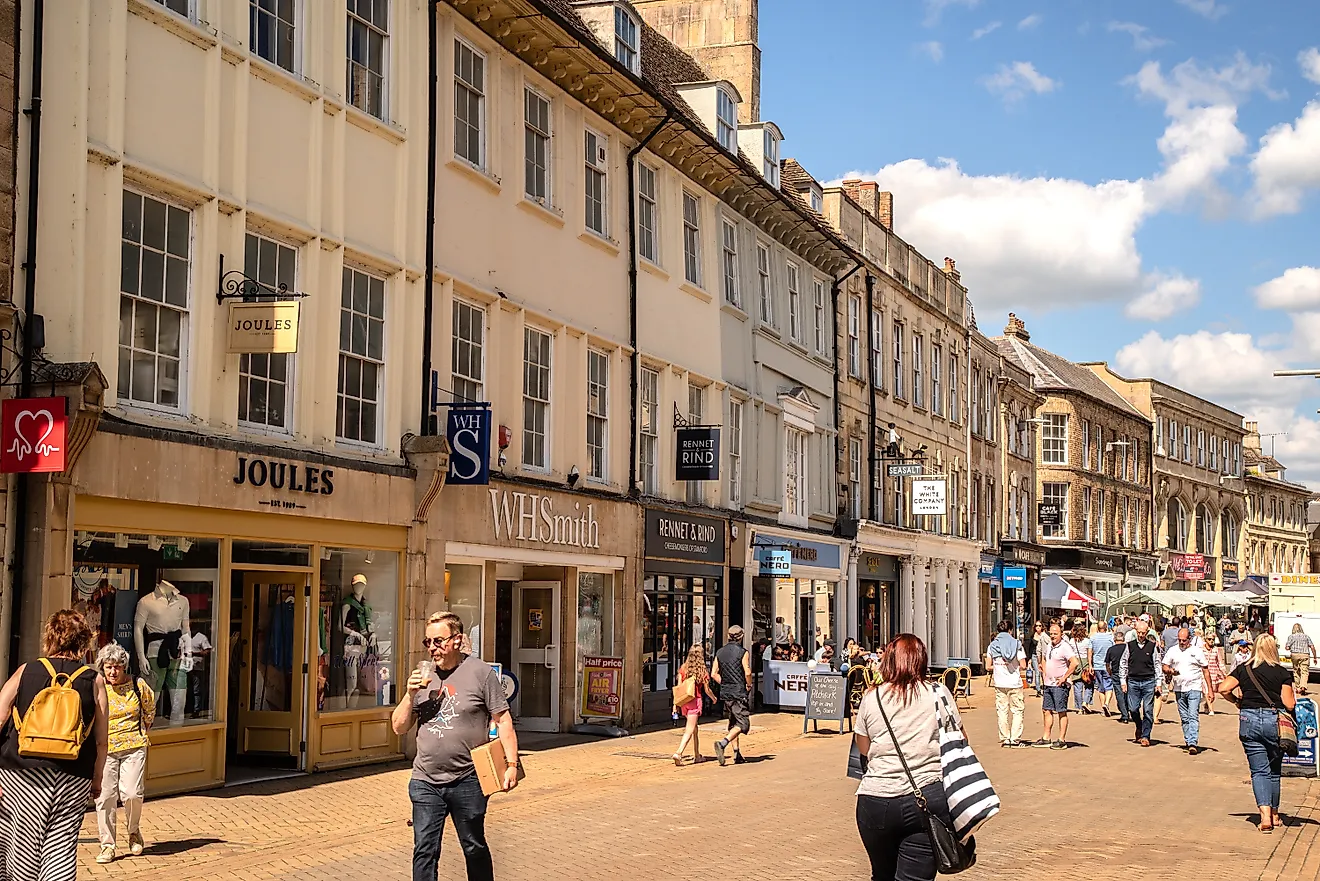
Market stalls line Skipton High Street four days a week under a charter granted by King John in 1204 for trade in sheep and woolen goods. The medieval layout that grew around the town's importance as a place of trade is still very much in evidence, with narrow alleyways called "ginnels" running between what were once long, thin plots of land that open onto courtyards behind.
At the head of the High Street stands Skipton Castle, one of the most complete medieval castles in England, and still fully roofed after more than 900 years. The seat of the Clifford family from 1310, it was the last royalist stronghold in northern England during the Civil War, surrendering in December 1645 after a three-year siege.

A lovely, shady trail circles the entire castle, offering superb views of this imposing fortress from several angles along the way. Craven Museum inside Skipton Town Hall on the High Street is a must-visit. Free to enter, it keeps more than 60,000 objects in its collection, including a rare First Folio of Shakespeare's plays, printed in 1623.
The Leeds and Liverpool Canal is another nice feature of this pretty Yorkshire town. Cut through the middle of the town in the 18th century, canal boat trips leave from the town wharf.
Southwold, Suffolk

Set in the middle of a residential street a few blocks back from the beach, the Southwold Lighthouse looks a tad out of place. First lit in 1890, the 102-foot tower replaced three lights on Orford Ness that were being undercut by erosion. It still guides shipping along the Suffolk coast.
The cannons on nearby Gun Hill are another curiosity. Six 18-pounders face out to sea, commemorating the Battle of Sole Bay, fought offshore in 1672 between an Anglo-French fleet and the Dutch. The battle was so close to Southwold Beach that townspeople were able to watch it from the clifftops and even cared for wounded sailors who washed ashore.

You can't visit Southwold without hoisting a pint (or two) of Adnams. Brewing here since 1872, the brewery and its Copper House Distillery are behind Victorian frontages on East Green, a short walk from the flagship store just off High Street. Brewery and distillery tours are available. Look out for Southwold Jack, the company's logo, based upon the 15th-century painted figure in St Edmund's Church that strikes a bell to mark the start of services.
Jutting out from the town's beach, Southwold Pier is home to the Under the Pier Show, a room of unique handmade coin-operated machines built by the engineer and cartoonist Tim Hunkin, who also made the pier's water clock. At the base of the pier, you'll spot a large mural of author George Orwell, who moved into his parents' Southwold home in 1921. Top off your day with a takeout from The Little Fish & Chip Shop (part of the Sole Bay Fish Company), a gelato from Harris & James, and a nap on sandy Southwold Beach.
Sandwich, Kent

Sandwich is another handsome English town that has managed to keep its medieval shape pretty much intact. It's here you'll find the longest unbroken stretch of timber-framed buildings in England, among them the Sandwich Weavers building, named for the Flemish Protestant refugees whom Elizabeth I gave written permission to settle here in the 1560s.
The Guildhall, built in 1579, is still used for civic business and contains the Sandwich Guildhall Museum, where the town's copy of Magna Carta, dated 1300, is displayed alongside a Charter of the Forest. Both had been cataloged, shelved, and forgotten before being rediscovered in the town archives in 2014. The Sandwich Local History Society runs guided walking tours, and a self-guided town trail map can be picked up at the museum.

Traffic still crosses the River Stour through the arch of the Barbican, the checkered flint tollgate beside the town's only road bridge, while Fisher Gate on the quay, built in 1384, is the last medieval town gate surviving in its original form.
The earth rampart known as the Bulwark, raised in 1385 against French raids, now makes a circular walk around the old town.
Lyme Regis, Dorset

The Cobb curves out from the shore at Lyme Regis and has done so, in one form or another, since at least 1328, when a document recorded storm damage to it. The Portland stone wall people refer to as the Cobb today was rebuilt in 1820. It's something of a cultural icon, too. Jane Austen used it in Persuasion, and John Fowles, who lived in the town for decades, made it the setting for the opening of The French Lieutenant's Woman.
Lyme Regis also has a deep connection to our understanding of fossils and prehistoric marine reptiles. Mary Anning was born here in 1799 and spent her life working the cliffs on either side of town, finding the first ichthyosaur skeleton to reach scientific attention when she was just 12, and the first complete plesiosaur in 1824.

You can learn more about her story (and dinos) at the Lyme Regis Museum, built on the site of her home and fossil shop, and a bronze statue of Anning can be seen on the seafront.
Fossils are still being found in and around Lyme Regis. Church Cliffs and Black Ven to the east release ammonites and belemnites onto the beach after winter storms, and at the western end of Monmouth Beach, reachable only at low tide, the Ammonite Pavement is a limestone ledge crowded with fossil ammonites pressed flat into the rock. Dinosaurland Fossil Museum has thousands of local specimens on display.
Alnwick, Northumberland

Alnwick Castle has been the ancestral home of the Percy family for more than 700 years, and Visit Northumberland describes it as the second largest inhabited castle in England after Windsor. It's instantly recognizable to Harry Potter fans, as it was on its lawns that the broomstick lessons in the first two films were shot, and it appeared as Brancaster Castle in Downton Abbey.
Next door, The Alnwick Garden has several unique water features, including the stone weirs of the Grand Cascade. You can walk up both sides of this mesmerizing cascade, stopping to enjoy its sights and sounds at strategically placed benches along the way.

Laid out above the cascade, the large Ornamental Garden invites exploration and relaxation, too, as does the Rose Garden with its many thousands of shrub roses and climbers. Be sure to book a tour of the Poison Garden, which can only be entered with a guide.
Wandering old town Alnwick is another must-do. Enter through the arch of Bondgate Tower, the only substantial survivor of the medieval town walls, and you reach the cobbled Market Place, where sellers set up on Thursdays and Saturdays.
Keswick, Cumbria

Located in the north of England's fabled Lake District, Keswick is an idyllic spot to get to know this beautiful corner of Cumbria. The Keswick Launch offers fun cruises on Derwentwater, just a 10-minute walk from the town's market square. It's an especially handy way for hikers to reach the far shore before walking back to Keswick.
Built in 1813 with an unusual one-handed clock, Moot Hall overlooks the pedestrian-friendly Main Street and Market Square and makes for a great keepsake photo of the town. And for culture vultures, Theatre by the Lake stages numerous performances a year, along with the Words by the Water literature festival each March.

Keswick Museum in Fitz Park is free to enter and keeps the Musical Stones of Skiddaw, a 19th-century instrument of tuned hornfels rock that is still played. And just a mile and a half east of town, the 38 stones of Castlerigg Stone Circle, believed to have been erected a thousand years before Stonehenge, stand on an open plateau set against the mountains of the Skiddaw, Blencathra, and the Helvellyn ranges. Access is free.
England At Its Most Captivating
Each of these eight English towns has something distinct to offer curious travelers looking for an alternative to the UK's usual tourist haunts. Whether it's the near-complete medieval ports of Rye and Sandwich that no longer stand overlooking the sea, the architecture Chipping Campden's wool trade paid for, or the castles of Alnwick and Skipton, they're each worth spending a day or two exploring.