8 Of The Friendliest Towns In Wales
In Wales, some of the smallest towns have the biggest hearts. Llangollen's motto promises that Wales welcomes the world, and the town backs it with close to 100 community groups. In Crickhowell, more than 100 volunteer walk leaders put on the walking festival every March. Narberth fits comedy nights, wool shows, and a monthly farmers market into one room at the Queen's Hall. Down on the Conwy quay, four families still rake mussels by hand, a trade passed between them for more than 150 years. These eight towns are among the friendliest in Wales.
Conwy

Conwy sits inside a medieval wall almost a mile long, with 21 towers still standing, and is part of the UNESCO World Heritage Site inscribed in 1986. Edward I built Conwy Castle between 1283 and 1287, and its eight towers look out over the estuary. Plas Mawr on the High Street is Britain's best-preserved Elizabethan townhouse, built for Robert Wynn between 1576 and 1585. The Royal Cambrian Academy displays Welsh contemporary art around the corner on Crown Lane. Down on the quay, four families still rake Conwy mussels by hand from the estuary beds, a trade passed down for more than 150 years. The boats are small enough for one person, so the raking happens in full view of anyone walking the waterfront, and the walled town behind it is compact enough to cross on foot in a few minutes.
Llangollen

Llangollen's motto reads "Where Wales welcomes the World," and they mean it: every July the International Musical Eisteddfod brings choirs and dancers from more than 100 nations into a town of about 3,500 people. It became one of only three Cittaslow towns in the UK in 2013, an accreditation that counts community life as an asset, and the town has close to 100 volunteer groups. For a place this size that is an unusual amount of organised goodwill, and it shows most during festival week, when Llangollen takes in several times its own population without losing its temper. The Llangollen Railway leaves the middle of town for 10 miles up the Dee valley behind steam. The Llangollen Wharf sends narrowboats along the canal pulled behind a heavy horse. Up Hill Street, Plas Newydd was home to the Ladies of Llangollen from 1780 to 1829, its rooms lined with carved oak that the two of them collected from churches.
Machynlleth

Machynlleth has held a market charter since Edward I granted one in 1291. Owain Glyndwr held his parliament here in 1404, and the Senedd-dy on Heol Maengwyn has a free exhibition about him under a 1912 mural of the Battle of Hyddgen. The town sits in the middle of the Dyfi Biosphere, the only UNESCO biosphere reserve in Wales. Machynlleth celebrates the arts as well. MOMA Machynlleth fills seven galleries in a converted Wesleyan chapel with modern Welsh art and holds concerts in the Tabernacle next door. Y Plas, the old Londonderry mansion, stands in parkland at the edge of town that is open to everyone every day of the week. Free access is something of a local habit: the Glyndwr exhibition costs nothing, and the parkland gates stay open to residents and visitors on the same terms.
Aberystwyth

Aberystwyth has a seafront tradition that nobody can fully explain. Walk to the far end of the promenade and kick the bar, a habit that has several competing origin stories. Nobody will stop you joining in, which is rather the point of it; the ritual belongs to anyone who walks the promenade to the end. The Cliff Railway has been hauling people up the steep face of Constitution Hill since 1896, and the camera obscura at the top throws a view of a thousand square miles onto a table. The Vale of Rheidol Railway steams 12 miles inland to Devil's Bridge from a station in the middle of town, running since 1902. The farmers market sets up at the top of town by the Market Hall twice a month, and the ruins of Edward I's castle sit free and open on the headland.
Narberth

Narberth is a town of about 2,000 people whose high street is almost entirely independent shops. The Golden Sheaf Gallery sells contemporary art, sculpture, and jewelry over two floors of a Georgian building on the High Street, and Oriel Q shows contemporary work on Market Street. The Queen's Hall hosts comedy nights, wool shows, tribute bands, and a monthly farmers market in the same room, which is what a small town's social life looks like when everybody books the same building. The Narberth Food Festival fills the Town Moor every September, and the town was shortlisted for a Great British High Street award for the strength of its main street.
Tenby

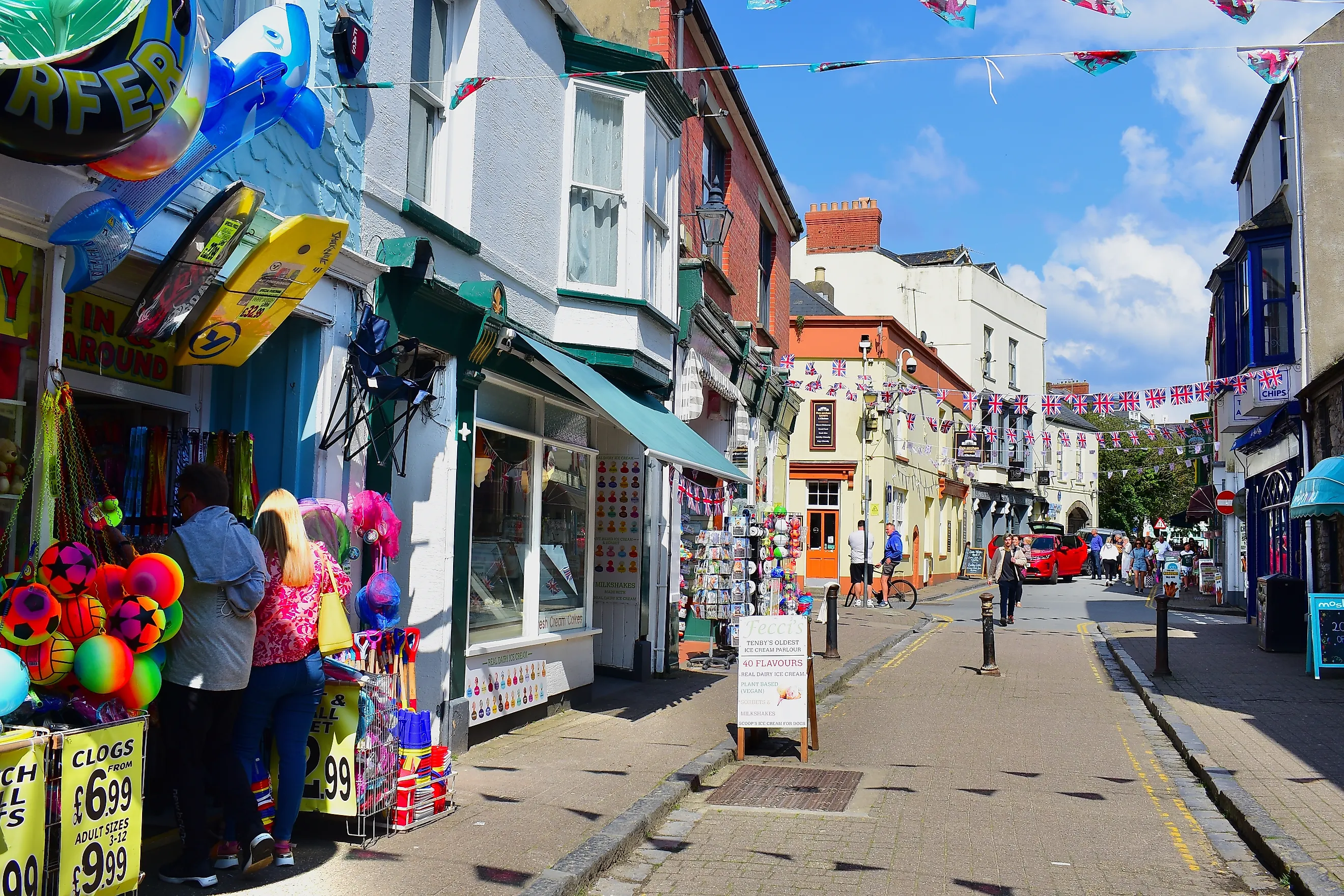
Tenby still sits inside its medieval walls, first built in 1245 and rebuilt in 1457. The Five Arches, a rounded stone gatehouse, is the way into town. Tenby Museum and Art Gallery, founded in 1878 as a voluntary organisation for the benefit of the town, stands above the harbour on Castle Hill. It is the oldest independent museum in Wales and is still a community charity, with volunteers on the front desk. It has multiple galleries on the town's geology, maritime trade, pirates, and art. The National Trust runs the Tudor Merchant's House on Quay Hill as a merchant family would have in the late 1400s. It's complete with a trading room at street level, and the kitchen, hall, chamber, and bed chamber are stacked on the floors above. From the harbour, boats crewed by local skippers run the 20-minute crossing to Caldey Island between April and October.
Crickhowell

Crickhowell stands in the Usk valley between Brecon and Abergavenny, inside Bannau Brycheiniog National Park, with independent shops filling the Georgian buildings along its High Street. Book-ish took Independent Bookshop of the Year at the British Book Awards in 2024, its second win after 2020. It has a cafe down Silver Lane and a loft upstairs where author evenings and book clubs meet. CRiC, the information centre on Beaufort Street, is run as a registered charity by a small staff team and volunteers, and the gallery above it changes its show of Welsh artists and makers every eight weeks. A volunteer committee based there hosts the Crickhowell Walking Festival every March, drawing on more than 100 walk leaders. Crickhowell Castle is a ruin in the recreation ground in the middle of town; today it's down to two joined towers and the base of a gatehouse. Nearby there's also the 4.5 mile circuit up to Crug Hywel, the Iron Age fort that gave the town its name.
Abergavenny

The Abergavenny Food Festival spreads across 11 venues on the third weekend of September, from the castle grounds to the theatre, and it is put together each year with help from local volunteers. The Victorian market hall on Cross Street runs a market almost every day, with a flea market on Wednesdays, a monthly farmers' market, and a craft market on second Sundays. Abergavenny Museum sits inside the castle walls in a Regency hunting lodge built on the Norman motte. St Mary's Priory Church on Monk Street has the Jesse figure, a 15th-century sleeping king carved from a single piece of oak, and the only wooden one of its kind left anywhere.
Finding a Welcome Across Wales
If you really want to get to know Wales, aim for the smaller towns rather than the big-name castles. From the Conwy estuary through the Dyfi Biosphere and the Pembrokeshire coast to the Usk valley, these towns are kept going by volunteer committees, charity-run desks, and families who have worked the same water for generations. Whether you're after a festival weekend, a morning at a market, or an afternoon in a gallery, these eight towns are the friendliest places in Wales to arrive as a stranger.