8 Must-See Historic Towns in New England
New England did not invent American history, but it staged most of it. The first shots of the Revolution rang out at a wooden footbridge in Concord. Twenty people executed in Salem in 1692 changed how the country thinks about due process. Pilgrims first stepped ashore at Provincetown weeks before they ever saw Plymouth Rock. The eight historic towns below each guard a specific piece of that story. Walk into any of them and the past is still right there on the sidewalk.
Concord, Massachusetts

Concord sits 20 miles west of Boston and started the American Revolution on April 19, 1775, when colonial militia faced down British regulars at Old North Bridge. Daniel Chester French (who later sculpted the seated Abraham Lincoln at the Lincoln Memorial) carved the Minute Man statue that has guarded the bridge since 1875. The original Nipmuc name for this spot was Musketaquid, meaning "grassy plain by the river."
Sleepy Hollow Cemetery on Bedford Street holds Authors Ridge, where Louisa May Alcott, Nathaniel Hawthorne, Henry David Thoreau, and Ralph Waldo Emerson are all buried within steps of each other. Alcott's family home Orchard House, where she wrote Little Women, opens for tours year-round. Concord's Colonial Inn, originally built in 1716 and operating as an inn since 1889, still serves dinner in rooms Thoreau's family once owned.
Northampton, Massachusetts

Northampton sits in the Pioneer Valley along the Connecticut River, and its history runs deeper than its modern reputation as a college town suggests. The Algonquian-speaking Nonotuck people lived here for centuries before English settlement in 1654. The town was attacked during King Philip's War in 1675-1678 and again during Queen Anne's War, 1702-1713. By the mid-19th century, Northampton had become a key Underground Railroad hub. Sojourner Truth lived here, as did Black abolitionist David Ruggles. Frederick Douglass visited often.
The David Ruggles Center for History and Education on Florence Street tells the story of the Northampton Association of Education and Industry, the utopian community where Truth, Ruggles, and Douglass all spent time. The Calvin Coolidge Presidential Library and Museum at Forbes Library is the only presidential library housed inside a public library; Coolidge served as Northampton's mayor before he was president.
Old Saybrook, Connecticut

Old Saybrook was founded in 1635 at the mouth of the Connecticut River by John Winthrop the Younger, on land long inhabited by the Nehantic and Pequot peoples. The original Saybrook Fort, built that same year, gave the English colonies their first defended toehold on the Connecticut. Yale College, before it moved to New Haven in 1716, actually held its first classes in Old Saybrook from 1701 to 1707.
Fort Saybrook Monument Park preserves the fort site with interpretive panels and walking paths overlooking the river mouth. The General William Hart House on Main Street, built in 1767 by a wealthy West Indies trader, is open for guided tours that emphasize Hart's Revolutionary-era network of merchant ships. Ferry Landing State Park offers shoreline access along the river, with views of Saybrook Point and the Long Island Sound entrance.
Salem, Massachusetts

Salem carries the weight of one of American history's most studied miscarriages of justice. Between February 1692 and May 1693, special courts convicted 30 people of witchcraft. Nineteen were hanged and one man, Giles Corey, was pressed to death with stones. The Salem Witch Trials Memorial on Charter Street, dedicated in 1992 on the 300th anniversary, lists the 20 names alongside the Charter Street Cemetery where several judges from the trials are buried.
The Peabody Essex Museum on East India Square holds the oldest continuously operating museum in the country (founded 1799). Its collection covers maritime history, American art, and significant Asian and Native American holdings. The Salem Maritime National Historic Site preserves nine acres of waterfront and includes a full-scale replica of the 1797 tall ship Friendship. Each October, the citywide Haunted Happenings festival turns downtown into a month-long Halloween destination.
Provincetown, Massachusetts

The Pilgrims actually landed in Provincetown first. The Mayflower dropped anchor in Provincetown Harbor on November 11, 1620 (Old Style), and the Pilgrims signed the Mayflower Compact aboard the ship before continuing on to Plymouth. The 252-foot Pilgrim Monument, completed in 1910 and the tallest all-granite structure in the United States, marks the first landing. The attached Provincetown Museum tells the story alongside the town's later identity as a Portuguese fishing port and one of America's oldest art colonies.
The Provincetown Art Association and Museum, founded in 1914, holds over 3,000 works documenting the artists who summered here from the late 19th century onward. Province Lands Bike Trail loops through the Cape Cod National Seashore's dunes and pitch-pine forest. Provincetown has been a haven for the LGBTQ+ community since the early 20th century, and rainbow-flagged Commercial Street still anchors that legacy.
Mystic, Connecticut

Mystic was a major American shipbuilding center between 1784 and 1919, when roughly 600 vessels were launched from yards along the Mystic River. The Mystic Seaport Museum preserves that legacy across 19 acres of waterfront. Its centerpiece is the Charles W. Morgan, the last surviving wooden whaling ship in the world. Launched in 1841 from New Bedford, she made 37 voyages over 80 years and is now a National Historic Landmark.
The Mystic River Bascule Bridge, completed in 1922 and still operating with its original counterweight system, lifts to let boats pass roughly every 40 minutes. Mystic Aquarium on Coogan Boulevard hosts beluga whales, African penguins, Steller sea lions, and one of only six Steller sea lion habitats in the country. The historic downtown along Main Street still holds the kind of independent bookstores and seafood shacks that hand-built shipping towns left behind.
Newport, Rhode Island

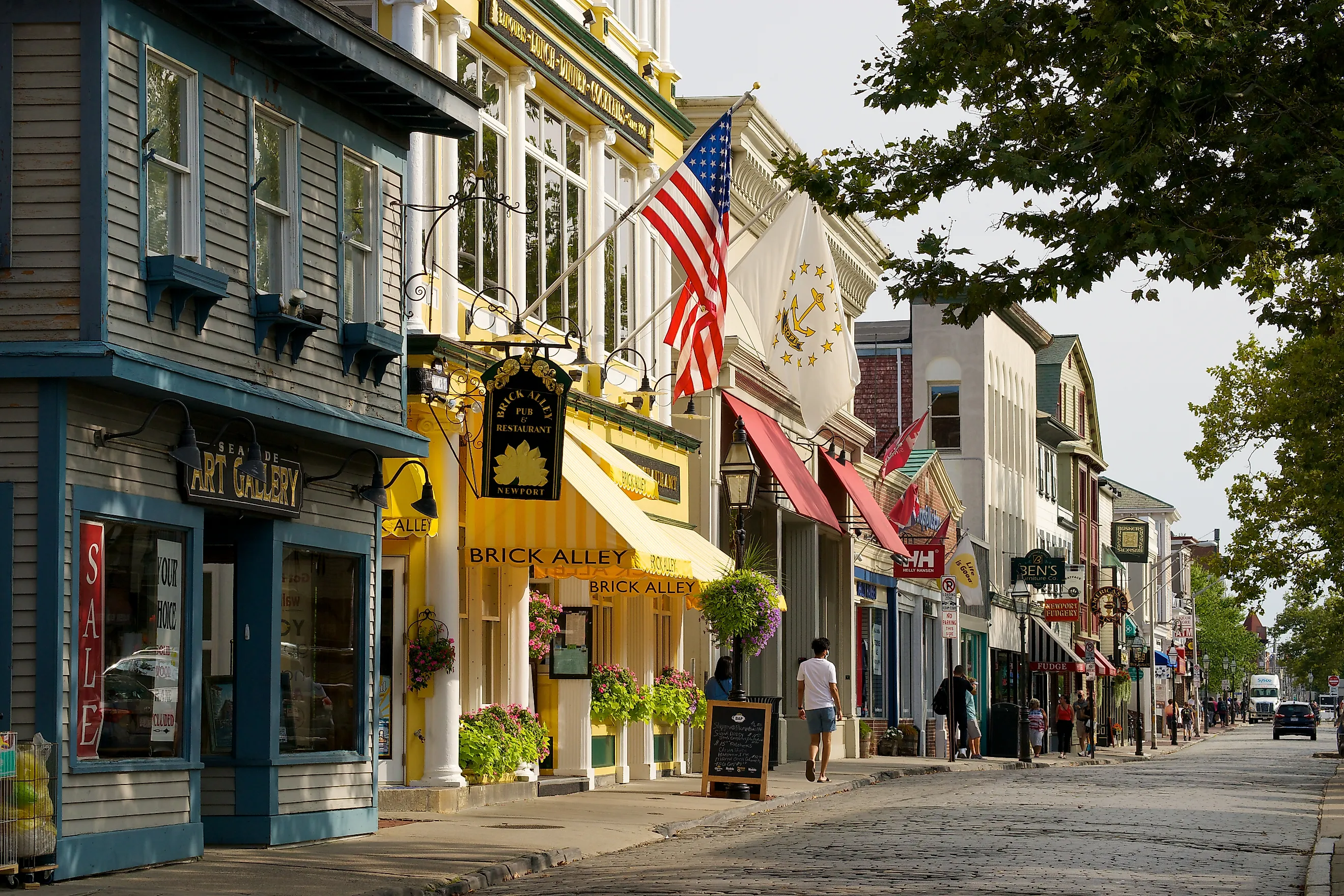
Newport sits on Aquidneck Island and runs on Gilded Age wealth and centuries of seafaring. The Breakers, the 70-room summer "cottage" Cornelius Vanderbilt II built on Ochre Point in 1893-1895, represents the high-water mark of American Gilded Age excess. Architect Richard Morris Hunt modeled it on Italian Renaissance palazzos. The Marble House, Rosecliff, and The Elms all sit within walking distance along Bellevue Avenue, each a mansion-museum of the same era.
Touro Synagogue, dedicated in 1763, is the oldest surviving Jewish synagogue in the United States and a National Historic Site. Fort Adams State Park on the harbor mouth preserves one of the largest coastal fortifications in the country, built between 1824 and 1857. Newport Harbor hosted the America's Cup yacht race from 1930 to 1983; the International Tennis Hall of Fame downtown sits inside the Newport Casino, where the first U.S. National Lawn Tennis Championships were held in 1881.
Woodstock, Vermont

Woodstock sits in the Ottauquechee River valley and shares no historical connection with the 1969 music festival (which took place in Bethel, New York). The Vermont town was chartered in 1761 and built much of its central village around a green known simply as the Green. The Norman Williams Public Library, a Romanesque Revival landmark of pink Knoxville marble and Longmeadow sandstone, opened in 1884.
The Billings Farm & Museum on River Road operates as a working dairy farm and educational museum founded by Frederick H. Billings in 1871, with a Victorian farmhouse that hosts seasonal demonstrations of 19th-century farm life. Marsh-Billings-Rockefeller National Historical Park, the only national park focused on the history of conservation in the United States, occupies the former estate of George Perkins Marsh, author of the 1864 book Man and Nature, considered foundational to the American conservation movement.
Six States, Eight Stories
The eight historic towns above each carry a distinct chapter of the American story. Concord opened the Revolution. Salem owns the country's most famous miscarriage of justice. Provincetown remembers a Pilgrim landing that Plymouth often gets the credit for. Mystic preserves the last wooden whaling ship in existence. Together, they make the case that the early American story lives less in textbooks than in the small towns of New England.