8 Most Walkable Town Centers In Illinois
A walkable town center needs more than short blocks and a few benches. Pontiac paints colored footprints between its downtown museums. Woodstock wraps an opera house, an old courthouse, and a movie theater around one green square. Galena runs Main Street through a narrow river valley before the route climbs toward Grant’s home. Alton trades level sidewalks for Mississippi River views and a real hill. Across these Illinois towns, leaving the car parked becomes the easiest decision of the day.
Woodstock

Woodstock puts nearly its entire town-center itinerary around one green square, an unusually easy arrangement for a city of roughly 26,000 residents. Make the gazebo in Park in the Square the first stop. The surrounding square stood in for Punxsutawney, Pennsylvania, as the central filming location for Groundhog Day. Cross Van Buren Street for a performance or gallery exhibit at the 1889 Woodstock Opera House, which also served as city hall, library, and fire station in its first decades. Follow Van Buren west, then go north on Johnson Street to enter the Old Courthouse Center. The restored complex combines the 1857 county courthouse with the old sheriff's house and jail, and now holds visitor services, dining, and event space. Continue along the north edge of the green to Main Street for a film at Classic Cinemas Woodstock Theatre, a restored eight-screen cinema whose main auditorium is named for Groundhog Day director Harold Ramis. The circuit covers only a few blocks, and each corner keeps the green or its brick storefronts in view.
Pontiac

Pontiac has done the route planning for its walkers. The city maintains three marked downtown tours, and the museum loop runs about a mile past all three museum buildings. Blue footprints on the sidewalk mark the way. The walk starts at the Pontiac Museum Complex at 110 West Howard Street, where the Route 66 Association of Illinois Hall of Fame and Museum occupies the former city hall and fire station. The footprints continue to the Pontiac-Oakland Automobile Museum at 205 North Mill Street for vintage classic cars and automotive archives. The Museum of the Gilding Arts sits a few doors north at 217 North Mill. Switch to the red footprints for the mural route, about a mile and a quarter long, which takes in the 18 walls that a crew of more than 150 sign painters finished in four days during the 2009 Walldog gathering. The red line circles back toward the 1875 Livingston County Courthouse and its square.
Long Grove

Long Grove's historic village feels designed for wandering, though its old crossroads grew long before anyone used that language. Most of its main attractions stay inside the small historic district. Covered Bridge Park is a good starting point, with a close view of the Long Grove Covered Bridge. The iron pony truss dates to 1906, and the wooden cover to 1972, and the span became the village's first listing on the National Register of Historic Places in 2018. From the park, Robert Parker Coffin Road leads into the business district. Along the way, the Sock Monkey Museum at 210 Robert Parker Coffin Road holds a Guinness World Records certification for the largest collection of handmade sock monkeys, and it remains the most unusual stop in town. Further on, Long Grove Confectionery and Apple Haus sit at 114 Old McHenry Road, in a purpose-built complex that also houses a coffee shop. From there, Historical Lane leads to Buffalo Creek Brewing. Its taproom and outdoor area occupy a former art gallery. Cobblestone paths and small gardens appear between the stops.
Geneva

Third Street gives Geneva a simple itinerary, with the Fox River providing a green finish. The city holds about 21,000 residents. At 113 South Third Street, the Geneva History Museum traces the community's development and Swedish heritage. Head two blocks south for handmade candy and a view into the kitchen windows at Graham's Fine Chocolates and Ice Cream, 302 South Third Street. One more block brings The Little Traveler, a 36-room shop assembled within an 1862 Italianate house and later additions, and a fixture of the street since 1922. From there, keep south to South Street and turn toward the river. The pedestrian connection to Island Park brings picnic space, a playground, and Fox River views before the short grid gets retraced.
St. Charles

In St. Charles, Main Street crosses the Fox River at the center of the outing. The city holds about 33,000 residents, and the four stops line up on a roughly mile-long course. The St. Charles History Museum, 215 East Main Street, works as the eastern starting point with its permanent exhibit on local growth. Head west along Main to the 1926 Arcada Theatre, still used for concerts and other live shows. Keep going across the bridge to Hotel Baker at 100 West Main Street, where the 1928 exterior and the riverside rose garden merit a pause. For a longer final leg, turn south on First Street and join the Fox River Trail to Mt. St. Mary Park. Its paved paths pass sculptures, mature trees, and river access, with little road traffic after downtown.
Ottawa

Ottawa's central route begins with national political history and ends with an unexpectedly specialized collection. The tour begins in the 22-room Reddick Mansion at 100 West Lafayette Street, finished in 1858 in time for its balconies to serve as debate seating. Directly across sits Washington Square. Bronze figures mark the park as the site of the first Lincoln-Douglas debate. More than 10,000 people turned out for it on August 21, 1858. Leave by LaSalle Street and continue south through downtown, watching for outdoor murals along the way. At Canal Street, turn toward the Ottawa Historical and Scouting Heritage Museum at 1100 Canal Street. Its collection is more varied than the name suggests, covering local history alongside Boy Scouting, Girl Scouting, and Camp Fire. The one-way distance stays comfortably under a mile in a city of about 18,500 people. Returning by Columbus Street adds variety and puts the mansion's Italianate side elevation back in view.
Galena

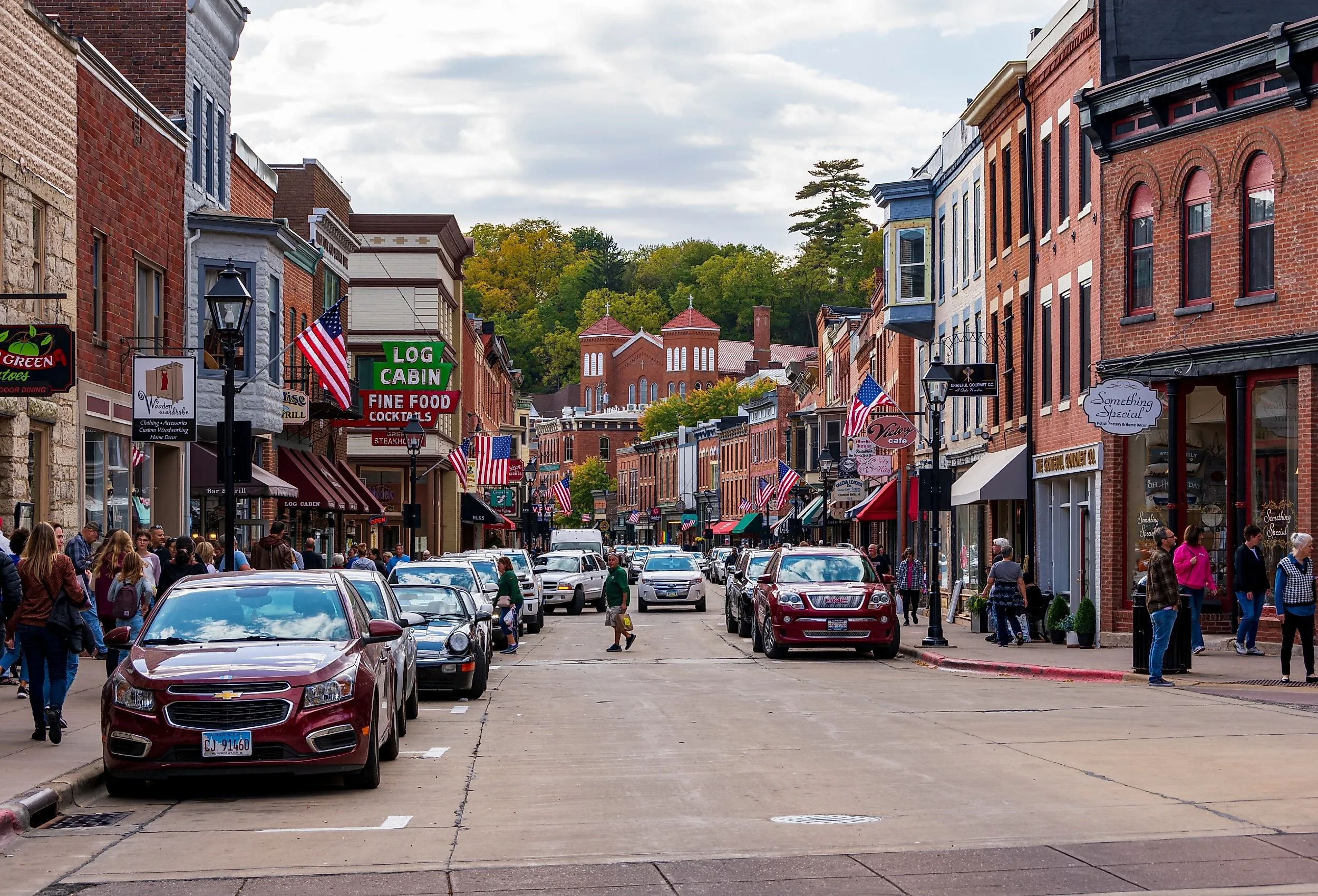
Galena is highly walkable, but nobody would call it flat. The preserved center packs major historic sites into a narrow river valley. The 1845 Old Market House on North Commerce Street is a useful starting point, and the Greek Revival building now serves as the Galena Welcome Center. Cross to Main Street and head south through the long run of 19th-century storefronts, then use Green and Bench streets to reach the Galena and US Grant Museum at 211 South Bench Street. Its 1858 merchant's mansion holds more than 6,000 square feet of exhibits on lead mining, steamboating, and Grant. Descend to Main and cross the pedestrian bridge over the Galena River. Grant Park waits on the far bank. Monuments, cannons, a gazebo, and a fountain face the town from there. From the park, follow Park Avenue to Bouthillier Street and climb to the Ulysses S. Grant Home State Historic Site. The last section is steep, and some brick sidewalks are uneven. Sturdy shoes matter here.
Alton

Alton's downtown rises from the Mississippi River, making this another outing with a noticeable slope. At Lincoln-Douglas Square, Broadway and Landmarks Boulevard meet beside statues recalling the seventh and final debate of the 1858 Senate campaign, held here on October 15. West of that square, the Jacoby Arts Center occupies 208 State Street at the foot of the hill, in the former State Street Market building it moved into in 2025. Exhibitions, art classes, and a clay studio fill the space, and State Street keeps climbing north behind it. The route then returns to Broadway and follows the lower Landmarks corridor to Old Bakery Beer Company at 400 Landmarks Boulevard, which serves lunch and certified organic beer. Signed access leads on to Riverfront Park, where the paths open views of the Mississippi and the Clark Bridge. The entire course stays downtown, and the grade makes Alton best for walkers comfortable with hills.
Level Grids And Hill Climbs
A town center makes its case between the stops. A theater marquee appears around the corner, a river path begins where the storefronts end, and the next museum may already be visible from the last doorway. Six of these eight downtowns sit on level ground, where the walk is a question of blocks rather than effort. Galena and Alton ask for more, and they pay it back with the Grant Home and the Clark Bridge at the top of the grade. The practical difference between the two groups is footwear rather than distance. None of these routes runs much more than a mile and a half in either direction, and the street itself is part of the visit.