8 Adorable Small Towns on the Gulf Coast
Morning on a working Gulf Coast waterfront looks much the way it did a century ago. Shrimp boats unload at Apalachicola docks the same morning oysters get shucked at the festival running on the wharf. Bay St. Louis opens its galleries at ten and keeps them open until sundown. Cedar Key's clam farmers are already on their second cup of coffee by then. The eight small towns ahead share a Gulf of Mexico shoreline and not much else, with each working a different angle on the same body of water.
Apalachicola, Florida

Apalachicola sits on the Apalachicola River in the Florida Panhandle and runs as the historic oyster capital of the Gulf, with a downtown National Register Historic District holding more than 900 buildings, many dating to the 1830s and 1840s when this was the third-busiest port on the Gulf Coast. The John Gorrie Museum State Park honours the local physician who invented mechanical refrigeration here in 1851 (U.S. Patent No. 8080) while trying to cool his yellow-fever patients; the museum holds a working replica of the original ice machine. The Florida Seafood Festival each November (running since 1963) is the oldest maritime festival in the state with oyster-shucking contests and blue-crab races. Apalachicola's working waterfront still ships local oysters, and the riverfront restaurants on Water Street serve them straight off the boats.
Bay St. Louis, Mississippi

Bay St. Louis on the Mississippi Gulf Coast was named for the canonised King Louis IX of France in 1699. The town now runs as one of the strongest small-town arts scenes on the coast, including Clay Creations, the Alice Moseley Folk Art Museum (housed on the top floor of the restored L&N Train Depot), and Second Saturday Artwalk on the second Saturday of every month, when galleries stay open late and bands play in the street. The Beach Boulevard Historic District runs nearly two miles along the Mississippi Sound with 1940s bungalow cottages, Greek Revival homes, and the 1799 Spanish Customs House, the oldest standing structure in town. The town celebrates Mardi Gras with two parades each year, and historical ghost tours run on foot and by boat year-round.
Cedar Key, Florida

Cedar Key is a Gulf-side island town in Levy County with about 700 residents and a working clam-farming industry that produces roughly 90 percent of Florida's farmed clams. The town's downtown wraps along Dock Street with a handful of seafood restaurants serving the local catch. The Cedar Key Museum State Park covers 18 acres including the St. Clair Whitman Museum, which holds a personal seashell collection alongside Native American artifacts going back to the Seminole Wars era. The Cedar Key Historical Society Museum in town traces the town's pre-railroad pencil-cedar lumber boom (cedar from here was once used by Eberhard Faber and Eagle Pencil Companies). Two-thirds of the town sits inside the Cedar Keys National Wildlife Refuge, which protects rookeries for brown pelicans, herons, and egrets across 13 outer islands.
Fairhope, Alabama

Fairhope sits on the eastern shore of Mobile Bay in Alabama, founded in 1894 as a single-tax colony based on the economic theories of Henry George (the experimental tax model still applies to the original colony's land today). The walkable downtown grid sits a few blocks back from a 1,448-foot municipal pier extending into the bay. North Beach Park and South Beach Park hold short stretches of white sand on either side of the pier. The Fairhope Museum of History, in a 1928 Spanish Mission building that once served as City Hall, traces the colony's early years. The Fairhope Arts and Crafts Festival each March draws roughly 200,000 visitors over three days. Pier Street and Fairhope Avenue between them hold about a hundred independent restaurants, galleries, and bookshops, including the long-standing Page & Palette bookstore (open since 1968).
Grand Isle, Louisiana

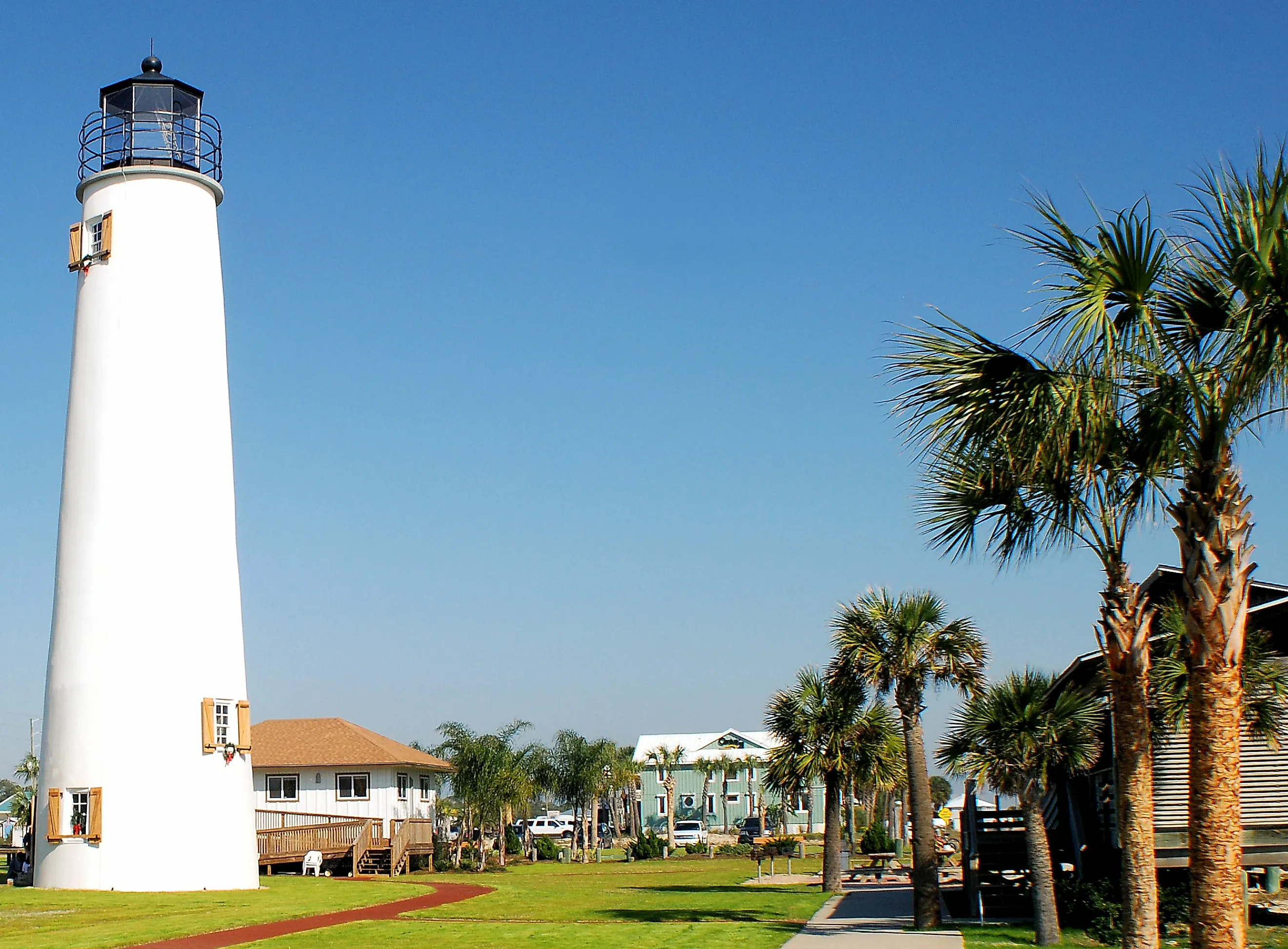
Grand Isle is Louisiana's only inhabited barrier island, a roughly 7-mile strip in the Gulf at the mouth of Barataria Bay. The island took a direct hit from Hurricane Ida in 2021 and has been slowly rebuilding since, with elevated stilt-built homes and beach restoration ongoing through 2026. Grand Isle State Park on the eastern end holds a 2.5-mile nature trail and the ruins of Fort Livingston (built between 1834 and 1858, used by Confederate forces in the Civil War). The annual Grand Isle Tarpon Rodeo each July, running since 1928, is one of the oldest fishing competitions in the United States. The island was a hideout for the privateer Jean Lafitte's smuggling operation in the early 1800s, and parts of that history are preserved at the Grand Isle Lighthouse Maritime Museum.
Ocean Springs, Mississippi

Ocean Springs calls itself the "City of Discovery" because the French naval officer Pierre Le Moyne d'Iberville established the first French colony of the Louisiana territory here in 1699 (a year before New Orleans). The downtown along Washington Avenue runs as one of the most-active small-town arts scenes on the coast, anchored by the Walter Anderson Museum of Art (dedicated to the local painter who covered the walls of his Ocean Springs home with murals only discovered after his death in 1965). The Charnley-Norwood House on East Beach was designed in 1890 by Louis H. Sullivan (the Chicago architect known as the "Father of the Skyscraper" and Frank Lloyd Wright's mentor) and is open for tours. The Old Fort Bayou Coastal Preserve north of town protects 13 miles of pine flatwoods and bayou waterways for paddling. The annual Peter Anderson Arts & Crafts Festival each November draws around 100,000 people for the largest fine-arts festival in Mississippi.
Pass Christian, Mississippi

Pass Christian, known locally as "The Pass," was settled in 1699 by French-Canadians and named for an early French navigator. Three U.S. presidents (Zachary Taylor, Andrew Jackson, and Woodrow Wilson) vacationed here in the 19th and early 20th centuries, when the Gulf-front resorts along Scenic Drive ranked among the country's most prestigious. Hurricane Katrina destroyed much of the historic streetscape in 2005; the town has been slowly rebuilding since, and the surviving 19th-century homes along Scenic Drive's National Register Historic District make a memorable self-guided tour. The jazz clarinetist Captain John Handy was born here in 1900 and is buried in the local Live Oak Cemetery. The Pass Christian Yacht Club, founded in 1849, is the second-oldest yacht club in the country.
Port Aransas, Texas

Port Aransas, locally called "Port A," sits on Mustang Island at the mouth of Aransas Pass and is the only town on the entire 18-mile barrier island. Farley Boat Works, restored as a community boat-building shop, was the builder of the first specialized fishing boat designed to catch tarpon in the early 1900s. The Chapel on the Dunes, built in 1937 by Texas Poet Laureate Aline Carter, is a one-room structure with biblical murals painted by Texas artist John Patrick Cobb across the entire interior (free guided tours run through the Port Aransas Museum). The Nature Preserve at Charlie's Pasture covers 1,217 acres of coastal wetland with a 1.5-mile boardwalk that birders use during the spring and fall migrations along the Central Flyway. The town's Whooping Crane Festival each February celebrates the endangered whooping crane population that winters at the nearby Aransas National Wildlife Refuge.
The Gulf Coast's Small-Town Side
The Gulf Coast is more than the Florida Panhandle stretch most travelers default to. Apalachicola and Cedar Key hold the Florida side without the high-rise condo backdrop. Bay St. Louis, Ocean Springs, and Pass Christian run the Mississippi arts-and-history corridor. Fairhope and Grand Isle handle the Alabama and Louisiana shores respectively. And Port Aransas keeps the Texas Gulf in the mix. Eight small towns, eight different angles on the same sea.