7 Most Walkable Town Centers In England
Some of the best walking in England lies within its small towns. In Southwold, colourful houses share the streetscape with a lighthouse steps from the North Sea. Cobbled Mermaid Street in Rye winds past medieval buildings down to Strand Quay. Chipping Campden sits at the northern end of the Cotswolds and the Cotswold Way, which runs all the way to Bath. In Sandwich, a stroll along the old town wall takes in a town that, for its size, has more protected historic buildings than anywhere else in the country. These are seven of the most walkable town centers in England, including towns along the Northumberland coast down to the Sussex marshes.
Alnwick

The gate of Alnwick Castle is a five-minute walk from the bus station. Narrowgate, the street that leads there from the Market Place, was repaved in granite and is now car-free. The castle itself has been the Percy family seat since 1309. Visitors can tour the State Rooms, try archery, and even take part in broomstick training in the outer bailey, where the flying lesson in the first Harry Potter film was filmed. Elsewhere in town, Barter Books occupies a corner of the 2,970-square-meter (32,000-square-foot) old Alnwick railway terminus, with open fires and a model railway running above the shelves. For something greener, The Alnwick Garden on Denwick Lane gives guided tours of the Poison Garden and grows 329 Taihaku cherry trees, the largest collection of that variety in the world. Farther out, Hulne Park has about 1,200 hectares (3,000 acres) of parkland at the edge of town, and a medieval priory from 1240 stands inside it.
Keswick

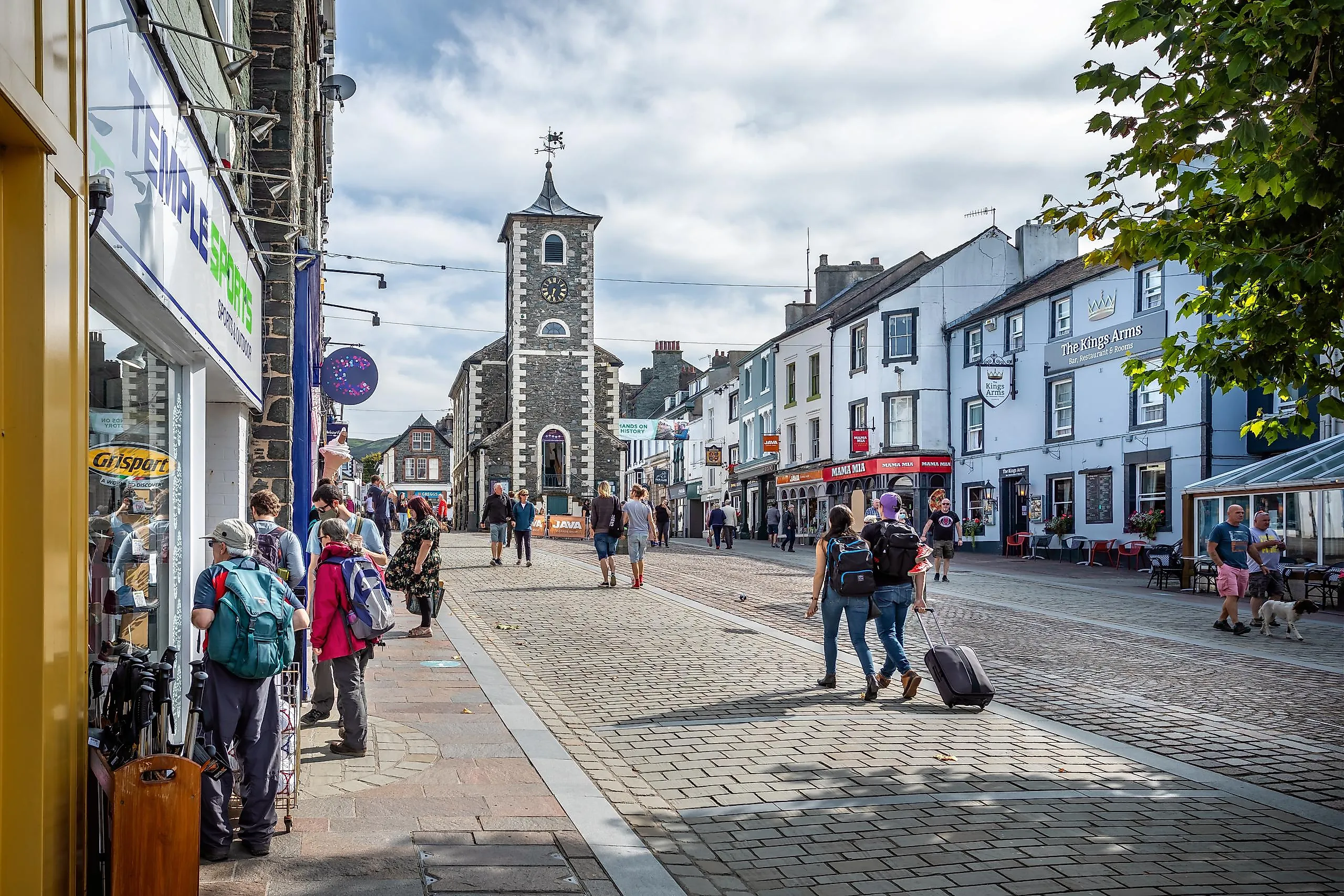
Keswick sits at the north end of Derwentwater, and the lake is a 10-minute walk from Market Square down Lake Road, through Hope Park. Back in the center, the market has operated on Main Street since a charter of 1276. On the way down to the water, Theatre by the Lake stands between the square and the shore and runs productions in repertory year-round in a 400-seat main house and a 100-seat studio. Nearby, Keswick Museum in Fitz Park covers geology, Lakeland life, literature, and the metalwork of the Keswick School of Industrial Arts. For a unique landmark, a 6.4-kilometer (four-mile) round walk from Market Square reaches Castlerigg Stone Circle, 38 stones in an open field ringed by fells.
Chipping Campden

Chipping Campden has its shops and inns along one High Street at the north edge of the Cotswolds. The buildings vary in age from the 14th to the 17th century. Standing on that same street, Market Hall was built in 1627 by Sir Baptist Hicks for the dairy and poultry traders, and today it remains open-air, with its cobbled floor intact. A hand-carved marker stone beside it is the northern end of the Cotswold Way, which runs 167 kilometers (102 miles) from here to Bath. A turn off the High Street leads to Church Street. Inside St James's Church, a large memorial brass over 1.5 meters (5 feet) long is set in the chancel floor for William Grevel, a wool merchant who died in 1401. Court Barn, on the same street, showcases the work of the craftspeople, designers, and artists who have worked in the north Cotswolds from 1900 to the present. The walking continues past the houses: Dover's Hill is 1.6 kilometers (a mile) out of town, on a 7.2-kilometer (four and a half mile) circular walk from the Market Hall. The Cotswold Olimpick Games, founded by Robert Dover, are still held here.
Bradford on Avon

The Avon splits Bradford on Avon into two halves. The shops along Market Street and Silver Street on the north bank and the railway station on St Margaret's Street on the south are joined by the Town Bridge. History sits close to both banks. The Saxon Church of St Laurence on Church Street is one of the most complete Anglo-Saxon buildings left in England, and repair work in 1856 uncovered two carved stone angels above the original chancel arch. Farther along the water, the tithe barn at Barton Farm is 51 meters (168 feet) long under a timber cruck roof, with displays in the West Barn opposite. The same site opens out into parkland, and Barton Farm Country Park spans 12 hectares (30 acres), about five minutes on foot from the town center. The canal towpath through it runs for 1.6 kilometers (a mile) toward the Avoncliff aqueduct.
Southwold

Southwold sits between the sea and the mouth of the Blyth, with its greens, marketplace, and beach within the same grid of streets. That grid keeps the landmarks close together. Southwold Lighthouse stands among the houses rather than out on a headland, and the climb to the lantern is 113 steps with a ladder at the end. Away from the streets, Southwold Pier juts 190 meters (623 feet) into the North Sea and houses the Under the Pier Show, nearly 20 mechanical amusement machines built by the engineer and cartoonist Tim Hunkin. Back inland, St Edmund's Church on Bartholomew Green has Southwold Jack, an armoured figure from the Wars of the Roses who strikes a bell with his axe to announce services. Nearby, the Sailors' Reading Room on East Cliff, built in 1864, remains a working reading room, hung with portraits of local fishermen, ship models, and seascapes.
Sandwich

The street layout of Sandwich is much the same now as it was in the 11th century, and for its size, the town has more protected historic buildings than anywhere else in the country. The way in on foot is the Barbican, a 14th-century gatehouse with two round towers and conical tiled roofs at the river crossing. From there, a circular path follows the line of the old town wall by way of The Butts, the Ropewalk, Millwall, and The Bulwarks, with boards along the way explaining what stood where. Back inside the old walls, the Guildhall Museum displays the town's own Magna Carta and the Charter of the Forest, both from 1300, as well as its 16th-century courtroom. A few streets on, St Peter's has an onion dome added by Flemish Protestant refugees who settled here, and the curfew bell is still rung from its tower each evening.
Rye

Rye stands on a hill above the marshes, and the streets of its old town are still cobbled, Mermaid Street and Church Square among them, along with Watchbell Street and Ockman Lane. Mermaid Street drops steeply from West Street to Strand Quay, past buildings dating from the medieval period onward. Uphill again, St Mary's Church on Church Square opens its tower for the climb past the eight bells to the roof, and its turret clock, made in the mid 1500's by the Huguenot Lewys Billiard, is one of the oldest still working in the country. Back on West Street, Lamb House, home to Henry James and later E. F. Benson, is open to visitors, including both the rooms and the walled garden behind it. A short walk on, Ypres Tower, built around 1249 and now operating as Rye Castle Museum, has the old cells, a medieval herb garden, and the Women's Tower, a prison built for female inmates in 1837.
Seven towns offer seven experiences easily enjoyed on foot. Between them, there's a castle gate at the top of a granite street, a Saxon chapel, a pier over the North Sea, and a cobbled lane down to a quay. With historic landmarks set against England's scenic natural backdrops, these are seven of the most walkable town centers in England.