The Oldest Castles in England
Castle-building came to England with the Normans. The fortified ringworks built by Edward the Confessor's Norman knights in the 1040s and 1050s are the earliest examples, scattered along the Welsh border in Herefordshire. The numbers expanded dramatically after the Battle of Hastings on 14 October 1066, when William the Conqueror erected timber motte-and-bailey castles to secure his conquest at landing points, river crossings, and major Anglo-Saxon towns. Stone keeps replaced timber over the next half-century, producing the great square towers that still survive at Norwich, Rochester, and the Tower of London. The twelve castles below span the years roughly 1048 to 1100. The earliest are mostly earthworks today, with motte mounds and bailey ditches still visible in the landscape. Hastings is now a partial ruin, where a century of coastal erosion has carved away half the structure. Windsor Castle, at the other end of the spectrum, has been in continuous royal use for nearly a thousand years and remains the official residence of the reigning British monarch. Most are open to the public; several remain inhabited.
Ewyas Harold Castle (c.1048)
Ewyas Harold sits in southern Herefordshire above the Dulas Brook, and the motte-and-bailey earthworks here are generally considered the oldest castle remains in England. The first castle on the site was raised around 1048 by Osbern Pentecost, a Norman knight in the service of King Edward the Confessor's court. It is one of only three or four castles known to have been built in England before the Norman Conquest, alongside Richard's Castle and Hereford Castle (both also in Herefordshire) and possibly Clavering in Essex. The original castle was destroyed in 1052 when Earl Godwin returned from exile and ordered the expulsion of Edward's Norman favourites. It was rebuilt after 1066 by William FitzOsbern, Earl of Hereford, and survived as an active fortification into the 14th century. Nothing of the masonry remains today. The motte mound, the surrounding bailey ditches, and a 12th-century priory foundation in the bailey are visible on private land.
Pevensey Castle (1066)

Pevensey is two fortifications stacked on top of one another. The outer walls are Roman, built around AD 290 as the Saxon Shore fort of Anderitum under the breakaway emperor Carausius, and they still stand close to their original height of 28 feet with stretches more than 500 metres long. The Norman castle inside them dates from the morning of 28 September 1066, when William the Conqueror landed his fleet of around 700 ships at Pevensey Bay and threw up a temporary timber stronghold inside the disused Roman walls. A stone keep and inner bailey were added in the 12th century. The castle was besieged five times across the medieval period and never successfully stormed, although its garrisons were starved into surrender twice. The Roman walls were pressed back into service in 1940, with concealed machine-gun posts cut into the masonry. The site is now in the care of English Heritage.
Hastings Castle (1066)

William's army marched 14 miles up the coast within two weeks of landing at Pevensey and put up a second timber castle on the cliff above the town of Hastings. The Bayeux Tapestry depicts the construction directly, with William's men shown raising a motte under the supervision of his half-brother Robert of Mortain. The Battle of Hastings followed on 14 October 1066, fought against King Harold's army at Senlac Hill seven miles to the north-west. After the victory William ordered the timber castle replaced with a stone fortress. The cliff edge at Hastings has retreated significantly through coastal erosion in the centuries since, taking roughly half the medieval castle into the English Channel. The surviving fragments include sections of the curtain wall and the ruined east arch of the collegiate church. The site is open to the public and runs alongside an exhibition on 1066.
Berkhamsted Castle (1066)

Berkhamsted holds a particular place in English history because William the Conqueror accepted the formal surrender of the English nobility here in December 1066. The castle was built immediately afterwards by Robert of Mortain on the Roman road north-west of London, on a site commanding the route into the Chilterns. The Norman earthworks are unusually well preserved: the motte still rises about 12 metres above the bailey, and the unusual double moat (a rare feature in English castle design) still holds water in places. Stone curtain walls and a keep were added in the 12th century, and Thomas Becket lived here as Chancellor in the 1150s. The castle declined in importance after the 15th century. The Grand Junction Canal and the London-to-Birmingham railway both cut close by in the early 19th century, leaving the earthworks intact between them. The site is free to visit.
Norwich Castle (1067)

Norwich was the second-largest town in Anglo-Saxon England by population, and William the Conqueror ordered a wooden motte-and-bailey castle here in 1067 on a site that demolished 113 Saxon houses to make space. The current stone keep dates from the reign of Henry I, with construction running roughly 1095 to 1115. The keep is faced in Caen limestone from Normandy and decorated with the most elaborate Norman blind arcading on any surviving English keep. The castle served as the county gaol for nearly six centuries between 1220 and 1887, and is now home to Norwich Castle Museum and Art Gallery. A £15 million Royal Palace Reborn project completed in 2024 reconstructed the keep's interior to its original 12th-century layout, including new floors and a viewing platform on the roof of the keep.
Warwick Castle (1068)

William the Conqueror built the original motte-and-bailey castle at Warwick in 1068 on a sandstone bluff above the River Avon, during his northward march to secure the Midlands. The original motte (Ethelfleda's Mound) still survives within the modern grounds and is one of the largest surviving castle mottes in the country. The stone curtain wall, the great hall, and the showpiece towers (Caesar's Tower at 44 metres and Guy's Tower at 39 metres) were added during the 14th century under the powerful Beauchamp earls of Warwick. The Greville family held the castle from 1604 to 1978, when it was sold to the Tussauds Group; it is now operated by Merlin Entertainments as a major tourist attraction. The castle draws around 1.3 million visitors annually and includes both medieval interpretation and a working trebuchet that fires during summer demonstrations.
Windsor Castle (c.1070)

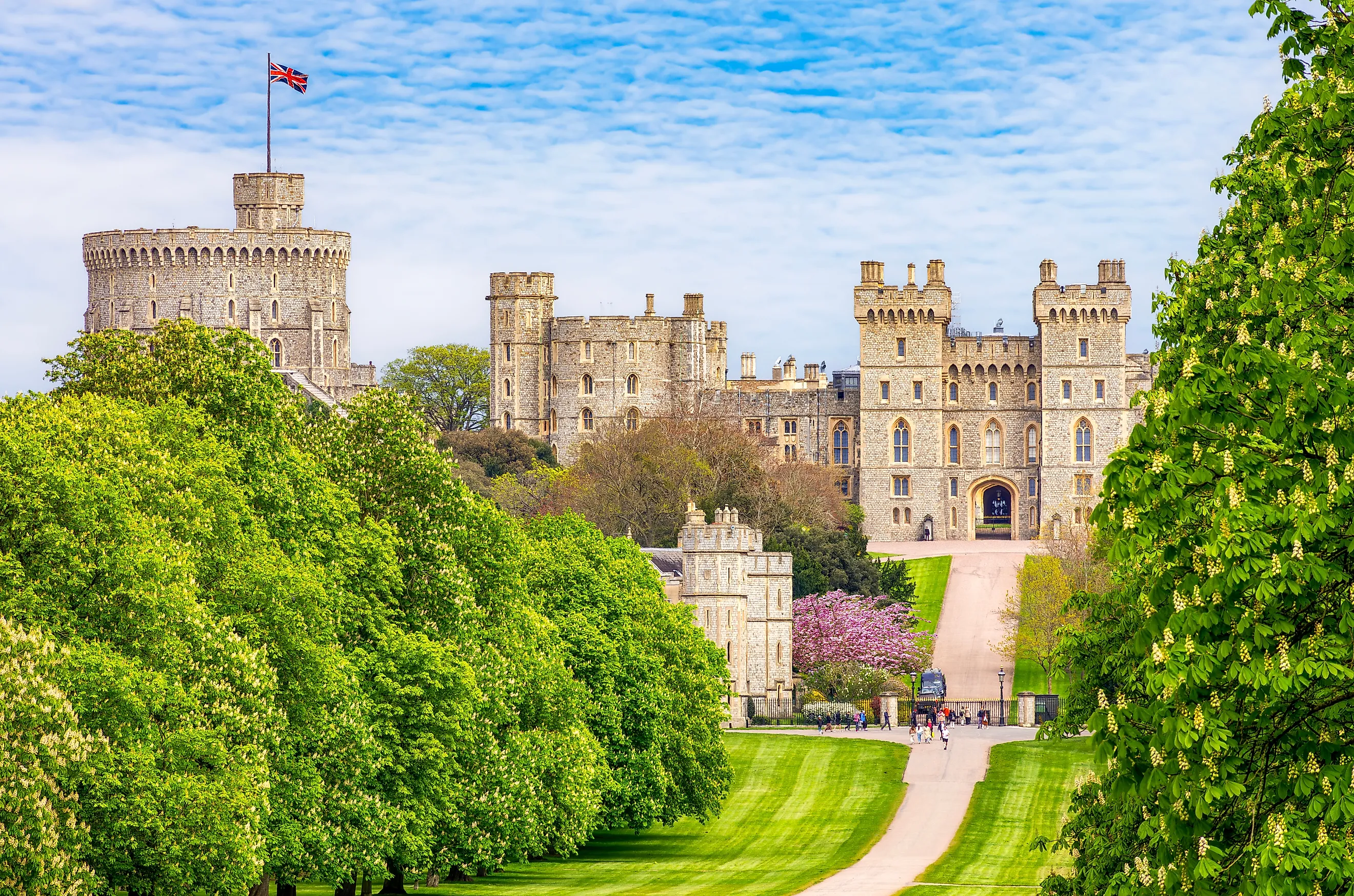
Windsor Castle has been continuously occupied for more than 950 years, longer than any other castle or palace in Europe. William the Conqueror chose the site around 1070 as part of a ring of nine castles thrown around London after the Conquest, positioned about 20 miles west of the city above the Thames Valley. The original motte-and-bailey was completed within roughly 16 years. The Round Tower still stands on William's original motte mound, although the current shell-keep dates from a rebuilding in the 1170s under Henry II. Windsor has served as a residence of the reigning monarch since the time of Henry I (1100-1135). The site covers 13 acres and contains more than 1,000 rooms, making it the largest inhabited castle in the world by floor area. Edward III founded the Order of the Garter here in 1348, and St George's Chapel within the grounds is the burial place of ten English monarchs, most recently Queen Elizabeth II in September 2022. The State Apartments and St George's Chapel are open to the public; the castle remains the official residence of the British monarch.
Richmond Castle (c.1071)

Richmond Castle, on a rocky platform above the River Swale in North Yorkshire, holds more surviving 11th-century architecture than any other castle in England. Construction began around 1071 under Alan Rufus (Alan the Red), a Breton kinsman of William the Conqueror who had received the lordship in return for service at Hastings. The earliest surviving buildings include long stretches of the curtain wall, the great archway in the ground floor of the keep, and Scolland's Hall, which is one of the earliest documented domestic halls in England. The substantial stone keep that dominates the gatehouse today is a 12th-century addition by Conan, Duke of Brittany, who was a great-nephew of Alan Rufus. Richmond was never besieged in its medieval history and fell out of military use by the 16th century. It is in the care of English Heritage and is described in their official records as the best-preserved early Norman castle in the country.
Oxford Castle (1071)

Oxford Castle was raised in 1071 by Robert D'Oyly, one of William the Conqueror's senior commanders, on a site at the western edge of the Saxon town. St George's Tower within the castle complex was built around 1074 and is the oldest surviving stone structure in Oxford. It stands roughly 26 metres tall and tilts noticeably outward at the base, a deliberate construction technique known as a battered base. The motte still survives behind the tower at a height of about 18 metres. The castle was best known in the 12th century for the dramatic escape of Empress Matilda in 1142, when she fled across the frozen River Thames by night during the civil war against King Stephen, dressed in white to avoid detection in the snow. The site served as the county gaol from the 14th century until 1996. Most of the medieval prison buildings have been converted into the Malmaison Oxford hotel, with the historic core open to the public as the Oxford Castle and Prison heritage attraction.
Durham Castle (1072)

Durham Castle was built in 1072 on the orders of William the Conqueror, on a sandstone peninsula formed by a tight loop in the River Wear in northeast England. The castle's primary purpose was to project Norman authority north towards the Scottish border, and it served as the principal residence of the Prince-Bishops of Durham (the bishops who held secular as well as religious authority across the county palatine) until 1837. The Norman chapel beneath the keep, completed in 1078, is among the oldest intact Norman buildings in England. Durham Castle and the adjacent Norman cathedral were jointly designated a UNESCO World Heritage Site in 1986, on the criterion of their outstanding example of Norman ecclesiastical and military architecture. Since 1837 the castle has been part of University College, one of the residential colleges of Durham University, and roughly 100 undergraduates still live within the castle walls during term. Tours operate when the castle is not in academic use.
Colchester Castle (c.1076)

Colchester Castle holds the largest Norman keep ever built in Europe, measuring roughly 46 by 34 metres at the base, which is about 50 percent larger by floor area than the White Tower in London. Construction began around 1076 under William the Conqueror, designed by Gundulf, Bishop of Rochester (the same architect responsible for the White Tower and Rochester Castle). The keep was deliberately built on the platform of the Roman Temple of Claudius, the largest classical temple ever built in Britain, which had been destroyed by Boudicca's forces in AD 60 during the Iceni revolt. Roman masonry is still visible reused in the lower courses of the keep walls. The upper storeys of the castle were dismantled in the 1680s for building stone, leaving the keep at roughly half its medieval height. The interior houses the Colchester Castle Museum, which holds one of the most significant Roman archaeological collections in northern Europe.
The Tower of London (1078)

The Tower of London was founded by William the Conqueror at the end of 1066 as a wooden palisade fort set into the south-east corner of the surviving Roman city walls of London. Construction of the great stone keep at the centre of the complex (the White Tower, which gives the whole castle its name) began around 1078 under the supervision of Gundulf, Bishop of Rochester. The keep was built of Caen limestone imported from Normandy for the dressed corners and window surrounds, with Kentish ragstone for the bulk of the walls. It rises 27 metres tall, with walls up to 4.6 metres thick at the base, and was the tallest building in London for several centuries after its completion around 1100. The Tower's first recorded prisoner was Ranulf Flambard, the corrupt former chief minister of William II, held in the keep in 1100; he became the Tower's first escapee by lowering himself out of a window on a rope smuggled inside a wine cask. The Tower has since served as a royal palace, a treasury, a royal mint, the Royal Menagerie (1235 to 1835), a record office, and an arsenal, and continues to hold the Crown Jewels. It was designated a UNESCO World Heritage Site in 1988 and draws around 2.8 million visitors a year.
The Norman Legacy
The first century of Norman castle-building reshaped the English landscape in a way that is still visible. By 1100, more than 500 castles had been raised across England, the majority as motte-and-bailey timber structures along the lines of those described above. Roughly 250 motte mounds still survive in English villages and market towns, some carrying later stone keeps, many reduced to grassed-over earthworks. Eleven Norman square keeps from the 11th and early 12th centuries survive in substantially complete form, including those at the Tower of London, Colchester, Rochester, Norwich, Hedingham, and Dover. Six of the castles above still function as royal residences or active heritage sites in continuous use, with Windsor at the head of the list as the longest continuously occupied palace in Europe. The technology of castle-building moved on quickly through the medieval period (concentric curtain walls in the 13th century, gatehouses in the 14th, artillery forts under Henry VIII), but the founding generation of Norman castles set the pattern that defined the English military landscape for more than 500 years.