Where People Are Moving To In Italy In 2026
Italy's population is barely changing nationally, but the map of where people live continues to shift northward. Through April 2026, ISTAT counted 482,000 transfers of residence between Italian municipalities, while the national population of Italy stood at 58.94 million, virtually unchanged from the start of the year, down 636. The latest full-year figures show the strongest internal-migration gains concentrated in the North, where Lombardy and Emilia-Romagna each gained about 10,000 residents through internal migration in 2025, followed by Piedmont and Veneto. Meanwhile, the Mezzogiorno lost about 45,000 residents through internal migration, with the biggest losses across the southern regions of Campania, Sicily, Calabria, and Puglia. The result is a continuing movement toward employment-rich northern cities and regional service centers, with younger adults particularly important to the flow.
Bologna

Bologna entered 2026 with one of the clearest migration-led growth stories in Italy. The city had 395,446 residents at the end of 2025, up from 392,791 a year earlier, and its latest municipal demographic report recorded a positive migration balance of more than 3,700 people in 2025. Migration more than compensated for a natural balance weakened by roughly 4,500 deaths against 2,425 births. The latest data show that 57% of people moving into Bologna were between 15 and 34, while 63.8% were Italian citizens.
The internal-migration pattern is particularly revealing. Bologna gained residents from other Italian regions, especially southern Italy and the islands, while losing population in exchanges with other Emilia-Romagna provinces and its surrounding metropolitan area. That makes the city both a destination for long-distance movers and a center toward which people from nearby municipalities continue to relocate. The reason is its unusually large daily employment and university catchment, and ISTAT estimates roughly 504,000 people are present in the city on a typical day for work and study, far above its resident population. The Navile district and the broader university-oriented urban area remain important anchors for this growth.
Parma

Parma is another Emilia-Romagna city where the population story is being driven by migration rather than natural increase. The city passed 202,000 residents in 2025, and its municipal demographic analysis says its long-term population increase has been attributed entirely to a positive migration balance, which has consistently offset a negative natural balance. That makes Parma particularly relevant in 2026 because its growth is not dependent on a temporary birth-rate improvement.
The broader regional pattern reinforces Parma's position. Emilia-Romagna recorded one of Italy's strongest internal-migration balances in 2025, gaining roughly 10,000 residents, or 2.1 per 1,000 inhabitants. Nearly 60% of internal moves nationally occur within the same province, so Parma's growth also reflects redistribution inside its own regional labor market rather than only long-distance migration. The city's employment, university, and healthcare base gives people reasons to remain within the province while moving toward a larger service center. Parma's housing stock is already heavily oriented toward smaller households, with 44% of registered households are one-person households. The largest residential concentrations include Lubiana, Cittadella, and San Leonardo, giving the migration story a concrete urban footprint.
Bergamo

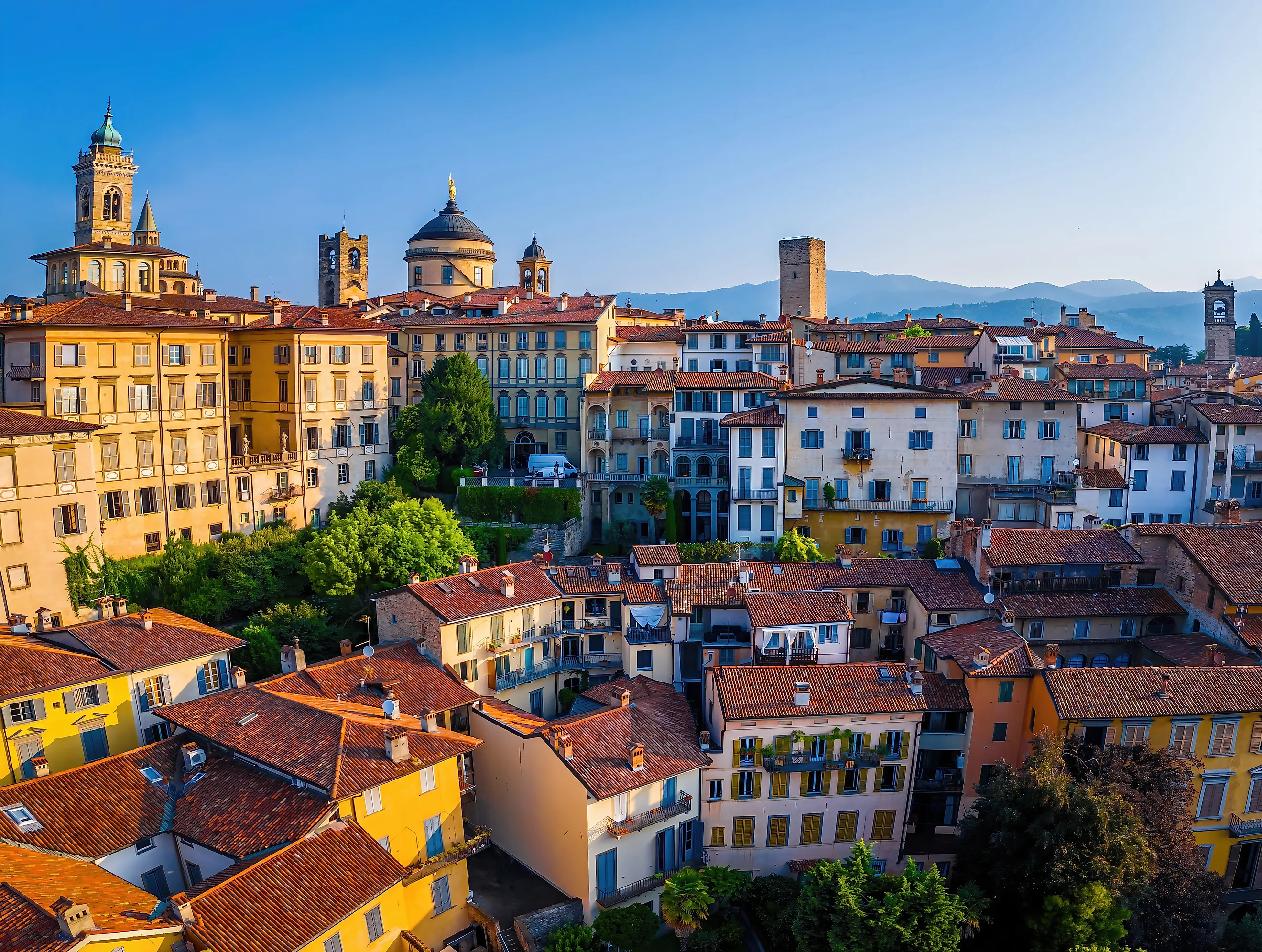
Bergamo entered 2026 with a population of roughly 122,000 residents, continuing a gradual upward trajectory supported by migration. The city's 2025 demographic balance recorded 5,265 arrivals and 4,145 departures, producing a positive overall migration balance of more than 1,100 people. Most importantly for an in-state migration story, 3,879 of those arriving came from other Italian municipalities. Milan was the single largest named origin, with 216 newcomers, followed by nearby Seriate with 154 and Dalmine with 98.
The pattern fits the wider Lombardy shift. In 2024, Bergamo province recorded a net internal migration balance of 3,221, the strongest of any Lombardy province, while the region as a whole gained 12,657 residents through internal migration. Milan, by contrast, had a negative internal-migration balance of 6,079. That contrast points to a redistribution away from the metropolitan core toward connected cities rather than a simple movement into the region from elsewhere. Bergamo offers access to the same broad employment corridor while serving as a smaller urban center in its own right. Borgo Palazzo and Redona provide examples of established residential neighborhoods absorbing this continuing demand.
Trento

Trento is one of the strongest examples of a smaller regional capital gaining residents while the natural balance remains negative. The latest provincial statistics put Trentino's population at 548,684 on January 1, 2026, up 2,111 residents, or 3.9 per 1,000, from the previous year. The province recorded a natural balance of -1,497 but a migration balance of +3,608, meaning migration more than compensated for the demographic deficit. The 2026 figure is provisional but is the most recent population measurement available for the province.
The migration story is not simply international. Trentino's long-term attraction includes movement within the province toward its larger service and employment centers. In the latest Census, the province's population reached 546,573 in 2024, with both internal and international migration balances positive enough to offset natural decline. More than one-fifth of the province's population lives in the municipality of Trento, giving the capital an outsized role in regional redistribution.
The reason people continue to settle here is structural rather than seasonal. Trento concentrates higher education, public administration, healthcare, and professional services within a province whose smaller mountain communities have much weaker demographic prospects. Its urban neighborhoods provide a regional alternative to remaining in smaller valleys while keeping residents within Trentino. The city's expanding demand for childcare and school places is a practical sign of population pressure accompanying that migration-led growth.
Modena

Modena's growth story is increasingly visible in the 2026 data. At January 1, 2026, the wider province had 711,502 residents, up 3,162 from the previous year and 1,069 from October 2025. Population growth was widespread rather than concentrated in a single city. The metropolitan area gained 1,548 residents, the lower plain gained 1,279, and the hills and mountains gained another 335. Several municipalities recorded especially strong growth, including San Prospero, Camposanto, San Felice sul Panaro, Ravarino, Bomporto, and Carpi.
That makes the Modena area especially useful for understanding where people are moving in 2026, because the flow is not simply from southern Italy into a major city. It is also in-state redistribution toward connected towns and smaller urban centers. Emilia-Romagna had one of the country's strongest relative internal-migration rates in 2025, at +2.1 per 1,000, behind only Valle d'Aosta, and gained roughly 10,000 residents through internal migration overall.
Modena's appeal is tied to its manufacturing and services economy and its position inside one of northern Italy's strongest employment corridors. The movement is also spreading beyond the provincial capital. Carpi, Bomporto, and Ravarino illustrate how population gains are reaching communities around the larger employment centers rather than remaining confined to a single city. That broader distribution makes the Modena corridor one of the clearest places to watch in 2026.
Bolzano

Bolzano is another northern city benefiting from a province whose population continues to grow despite Italy's natural demographic decline. The latest Census put the province of South Tyrol at 539,679 residents at the end of 2024, up 2,146 people, or 0.4%, from 2023. ISTAT attributed the increase to positive internal and international migration, along with the statistical adjustment, which outweighed the province's natural demographic decline. Nearly one-fifth of the province's population lives in Bolzano itself.
The migration pattern is especially significant because South Tyrol combines strong employment with a comparatively small urban network. Bolzano acts as the province's main administrative, employment, and service center, so internal migration toward the city and its surrounding communities is part of a broader regional concentration. The province's population growth is not being produced by births, and it recorded just 4,537 births in 2024, another record low.
The 2026 picture therefore rests on a durable demographic mechanism. People are continuing to move toward places where jobs and services are concentrated while smaller communities face the consequences of aging and low birth rates. Bolzano's urban neighborhoods around Gries and the city center illustrate the established residential base supporting that concentration. At the same time, the province's unusually strong economic position makes the city part of a wider South Tyrol labor market rather than an isolated population center.
The Shape of the 2026 Map
Italy's 2026 migration map is becoming clearer even though the country as a whole is not growing. The strongest destinations remain concentrated in the North, particularly the Emilia-Romagna and Lombardy corridors, while southern regions continue to lose residents through internal migration. The most important movement is not simply from one region to another. People are also shifting from expensive or smaller communities toward better-connected regional employment centers. For residents already inside Italy, that means the fastest-growing corridors are likely to face increasing housing, transportation, and school pressure even as depopulation continues elsewhere.