The 13 Most Charming Small Towns In Italy
Italy's small towns do something the big cities cannot. They hand you the cliffside, the lentil plain, the harbor that fits two boats, and a piazza that the locals still treat like a living room. The 13 towns below run from Tuscan hill country to Sicilian limestone to the cliff-clinging Cinque Terre. Each one is small enough to walk in a morning and rich enough that you will not want to. Some are world-famous and some get skipped for the next valley. All of them earn the trip.
Arezzo, Toscana

Arezzo sits an hour south of Florence and two hours from Rome, which makes it an easy day trip and a better weekend. The town hosts Italy's oldest antiques fair, the Fiera Antiquaria, every first Sunday of the month and the Saturday before, when more than 500 dealers fill Piazza Grande and the Logge Vasari with paintings, watches, vintage linens, and the occasional Roman coin. The fair has run continuously since 1968.
Arezzo also stood in for the wartime town in Roberto Benigni's Oscar-winning Life is Beautiful, which Benigni filmed near his home territory in the province. Piero della Francesca left two of his greatest works here: the Legend of the True Cross fresco cycle inside the Basilica of San Francesco, and the Mary Magdalene fresco at the cathedral, which also holds a baptismal font with a Baptism of Christ relief attributed to Donatello.
Brisighella, Ravenna

Brisighella is a medieval village of around 7,000 people in the Emilia-Romagna region, between Faenza and the Tuscan border. It is known locally as the village of the three hills, after the trio of chalk outcrops that rise straight out of town. The Rocca Manfrediana fortress went up on the first hill in 1310. The Monticino Sanctuary, an 18th-century pilgrimage church, sits on the second. The Clock Tower crowns the third on a 13th-century defensive base.
The food is the other reason to come. Brisighella sits in a province famous for its kitchens, so build the day around the local table: a Volpina pear with the local DOP olive oil, Sangiovese di Romagna by the glass, slow-roasted Mora Romagnola pork, and Conciato cheese aged in the gypsum caves under those three hills. The town's thermal baths handle the recovery.
Castelluccio, Umbria

Castelluccio sits at 1,452 meters in the Sibillini Mountains, one of the highest inhabited settlements in the Apennines, looking down on the Piano Grande plateau. From late May into July the plain becomes the Fioritura, a slow-burning bloom of poppies, lentils, cornflowers, and rapeseed that draws photographers and hikers from across Europe.
The village itself is a hard story. The October 2016 earthquake collapsed roughly 60 percent of the built area, and reconstruction is still underway, with completion projected for 2028. A handful of farmers, lentil growers, and small operators have kept the place alive from temporary structures, and the plateau remains spectacular regardless of what is or is not standing in the village above. Bring something home from the kiosks if you go.
Cefalù, Sicily

Cefalù is a medieval seaside town of just under 15,000 on Sicily's northern coast, about an hour east of Palermo by train. The limestone headland that towers over the old town is what gives Cefalù its name, from the Greek kephalē meaning head, and it is also the spot to climb for the sunset.
The Norman-Arab cathedral on Piazza del Duomo is the centerpiece, with its 12th-century gold-ground mosaics of Christ Pantocrator in the apse. Cinephiles will recognize the seafront from Giuseppe Tornatore's Cinema Paradiso, which used the port and Porta Marina for several of its set-piece scenes. The whole town is walkable in a long afternoon, with seafood restaurants thick on the seafront promenade.
Gallipoli, Puglia

Gallipoli sits on a small limestone island off the Salento coast in Puglia, connected to the mainland by a single 17th-century bridge. The name comes from the Greek kale polis, beautiful city, which is a hard claim to argue with as you walk the seawall. The 13th-century Angevin fortress anchors the harbor end, and Baroque churches and courtyards open off the maze of whitewashed alleys behind it.
Veer right out of the historic center and you reach some of the Ionian coast's best beaches, with the water in the unreal turquoise shade that Puglia is known for. The kitchens here lean on the local catch, and the trattorie do simple grilled fish and raw seafood platters as well as anywhere in the country.
Manarola, Liguria

Manarola is one of the five villages of the Cinque Terre, the cliff-perched string on the Ligurian coast inside its own national park and UNESCO site. The village is small, vertical, and stacked in pastel, and the marina viewpoint at golden hour is one of the most photographed scenes in Italy for a reason.
The Via dell'Amore footpath from Riomaggiore reopened in 2025 after years of closure, so you can again walk in along the old cliff route. From Manarola, head north along the coastal trail toward Corniglia for the sunset, then come back to the village after dark, when the colored facades glow against the water. December brings the largest illuminated nativity scene in the world, built into the terraced hillside above town by a retired railway worker over decades.
Orta San Giulio, Piedmont

Orta San Giulio is a medieval village on a small promontory on the eastern shore of Lake Orta, the smallest of the major lakes of northern Italy and the one most often skipped for nearby Como and Maggiore. Piazza Motta, the lakeside square, is built straight out of a film set: pastel facades, a frescoed 16th-century Palazzo della Comunità, ferry boats, and one of the more pleasant cafés in Piedmont.
The five-minute boat ride from the piazza lands you on Isola San Giulio, the lake's only island. Legend has it Saint Julius arrived in the 4th century, drove out the dragons and snakes, and built the first church on the spot. The current Romanesque Basilica di San Giulio was built over those foundations between the 11th and 12th centuries, with frescoes from the Middle Ages and an active Benedictine nuns' monastery still in residence. The walk around the island is signposted the Way of Silence.
Portofino, Liguria

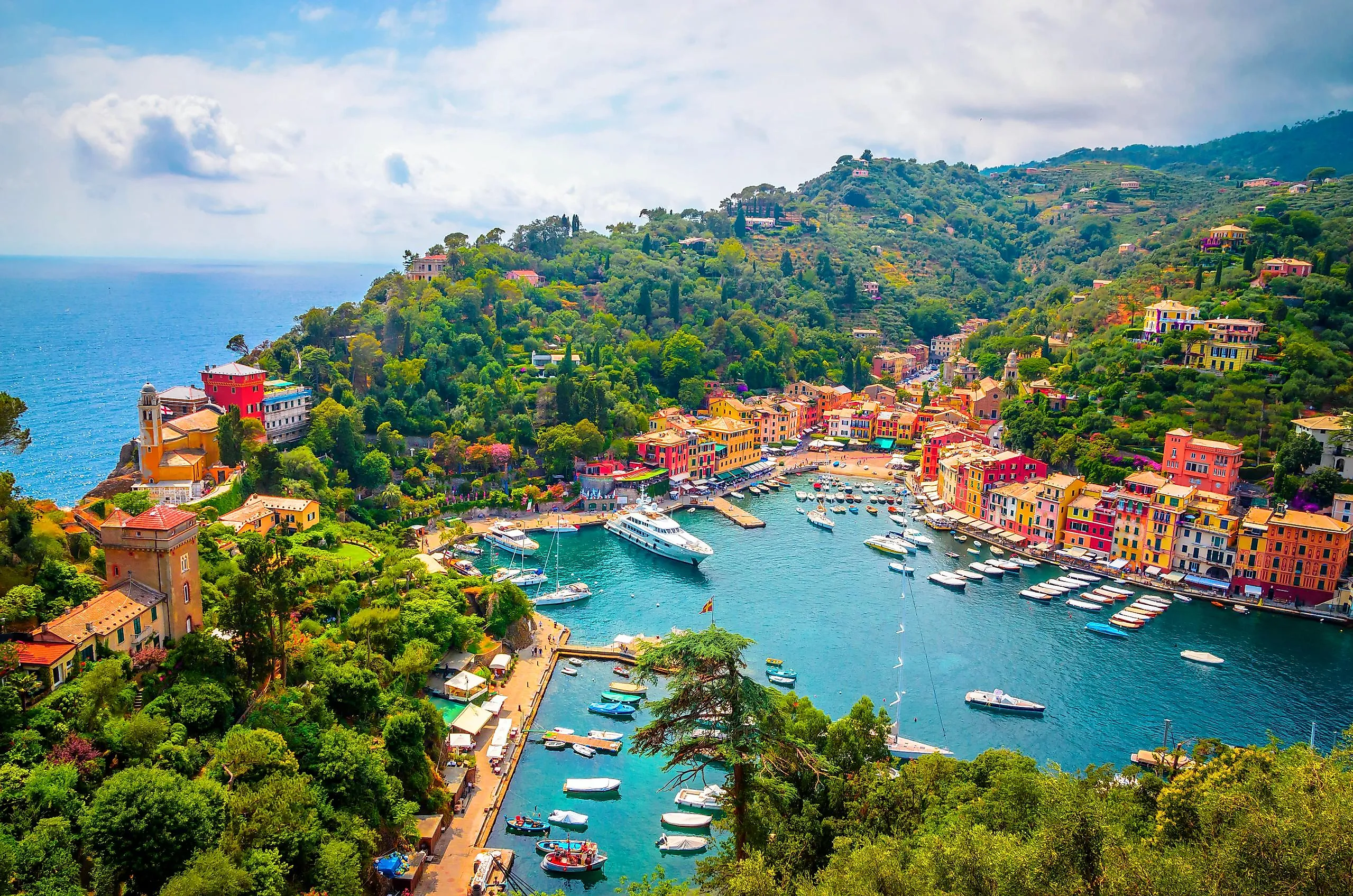
Portofino is the small, expensive harbor town that sits at the tip of the Portofino promontory on the Italian Riviera. Pastel houses ring a tight natural harbor, café tables line the water, and the wooded hills above hide private villas, including Dolce & Gabbana's. In summer the mega-yachts drop anchor; in the off-season it quiets down to mostly local day-trippers, which is the better time to come.
Walk up to the Castello Brown for the harbor view, eat fritto misto at Taverna del Marinaio without ceremony, and book the Belmond Splendido Mare if you want to splurge on a room with a piazzetta view. The DaV Mare at the Belmond is the sit-down splurge with the view, and the rest of the village rewards an aimless wander.
Positano, Campania

Positano stacks down the cliffs of the Amalfi Coast like a poured drink, with pastel houses, bougainvillea, and ceramic shops cascading from the ridge to the pebble beach below. The single road through town narrows and switchbacks until it gives up and lets pedestrians take over for the last descent to Spiaggia Grande and the dome of Santa Maria Assunta.
John Steinbeck arrived here in 1953 and wrote that Positano was a place that does not seem real when you are there and grows more real after you have gone, which still describes the experience. Arrive by ferry from Sorrento or Salerno if you can. The approach from the water is the reason Positano became Positano in the first place.
Scilla, Calabria

Scilla is the Calabrian fishing town that gave the world the original Scylla. Homer set the six-headed sea monster on the rock here in the Odyssey, opposite the whirlpool Charybdis across the Strait of Messina. The phrase between Scylla and Charybdis came from this stretch of water.
The modern town divides into three: the headland with its castle and lighthouse, the upper village on the cliff, and Chianalea, the fishermen's quarter at sea level, where stone houses sit so close to the water that the waves break under their walls. Order a swordfish steak in one of the trattorie along the harbor and watch the lights of Sicily come on across the strait at dusk.
Sorrento, Campania

Sorrento has 16,000 residents, a year-round tourist trade, and a cliff-edge old town that has been a holiday destination since the Romans built villas here. Greek mythology placed the sirens on the rocks just offshore, and tradition links the town's name to the Sirenusae, the islands they were said to inhabit.
The town sits at the southern tip of the Bay of Naples and works as a base for the entire south: ferries leave from Marina Piccola for Capri and Naples, the train runs to Pompeii in half an hour, and the Amalfi Coast starts just over the mountain at Positano. Stay an extra night and walk the historic center after the day-trippers leave on the last ferry.
Tropea, Calabria

Tropea sits on a sandstone cliff above the Tyrrhenian on the Costa degli Dei, the Coast of the Gods, a few kilometers north of the Capo Vaticano headland. The old town hangs at the cliff's edge with a vertical drop straight down to a crescent of white-sand beach, and on a clear day the volcano island of Stromboli is visible smoking offshore.
Tropea is the home of the famous IGP-protected sweet red onion, which turns up in pasta, in jam, and yes, as a gelato flavor sold at most of the local gelaterie. Book a room at Villa Paola, a 16th-century convent on the headland now converted into an adults-only hotel, and walk down to the Santa Maria dell'Isola sanctuary on its own rocky islet at the foot of town.
Vernazza, Liguria

Vernazza is the only Cinque Terre village with a natural harbor, and most people who have hiked the Sentiero Azzurro will tell you it is also the prettiest. The village slopes down a narrow valley to a small sandy beach, with the colorful tower houses of the old town stacked on either side and the 11th-century Castello Doria looking out from the harbor headland.
The best meal in the village is at Belforte, a seafood restaurant built into the castle walls with tables that hang directly over the water. The other ritual is gelato. There are enough gelaterie on the main street to do a tasting tour without repeating yourself.
From the Amalfi cliffs to the Apennine plain to the corners of Sicily and Calabria, these 13 towns are what Italy looks like once you step off the high-speed train at Rome or Milan and keep going. Most are within a short drive or a regional-rail hop from a major city, which means a day trip is realistic and a long weekend is better.
Pick one Tuscan hilltop, one Ligurian harbor, one Calabrian fishing village, and you have an itinerary that no single Italian city can match. The cliché about Italy being a country of villages is a cliché because it is true.