7 Fairy-Tale Small Towns In Texas
Fairy tales usually live in a storybook, but the following Texas towns bring that magic to life before your eyes. A bat cave that empties into the evening sky, antique shops with hidden treasures and a courthouse built around a spiral staircase all sit within a few hours' drive of one another in Texas. With the gem-panning hills of Mason to the cypress-lined swimming holes of Wimberley, these seven fairy-tale small towns in Texas turn an ordinary road trip into something worth remembering.
Mason

Mason goes by the Gem of the Hill Country, and the nickname is literal. Blue topaz turns up in the granite outcrops and creek beds around Streeter, Grit, and Katemcy. Mason County is the only county in Texas where the state gemstone occurs naturally. The ranches that once sold day passes to rock hunters have closed to the public, so the surest place to see a Texas topaz now is the Mason Square Museum, which displays a 6,480-carat crystal on loan from the Smithsonian. Southwest of town, roughly four million female Mexican free-tailed bats occupy the Eckert James River Bat Cave Preserve between May and September and pour out at dusk in a dark spiral.
The Nature Conservancy opens the preserve Thursday through Sunday evenings during the season. Back on the square, the neon marquee of the 1928 Odeon Theatre still lights up for first-run movies, and the building claims the longest continuous run of any theatre in West Texas. Disney premiered Old Yeller there in 1957, adapted from the novel by Mason native Fred Gipson. Sandstone Cellars pours Mason County wine a block off the square. Fort Mason, the 1851 frontier post the town is named for, stood on Post Hill just south of downtown. A reconstructed officers' quarters marks the site today.
Fredericksburg

Fredericksburg sits about 42 miles south of Mason and carries its 1846 German founding in its architecture, its food, and its name. Enchanted Rock rises 17 miles north of downtown, a 425-foot pink granite dome and the largest monadnock of its kind in the country, meaning an isolated hill of hard rock left standing as softer ground eroded around it. The dome creaks and groans after dark as the granite contracts from the day's heat. The Tonkawa heard spirits in the sound, and the name stuck. Main Street runs through blocks of 19th-century limestone storefronts, some topped with the steep gables and half-timber work of Bavarian villages. The Pioneer Museum holds ten historic structures on a 3.5-acre complex, several of them relocated from elsewhere in Gillespie County, including a one-room schoolhouse and a Sunday house. East of town, Wildseed Farms sows entire fields of bluebonnets and other wildflowers for an April peak.
Comfort

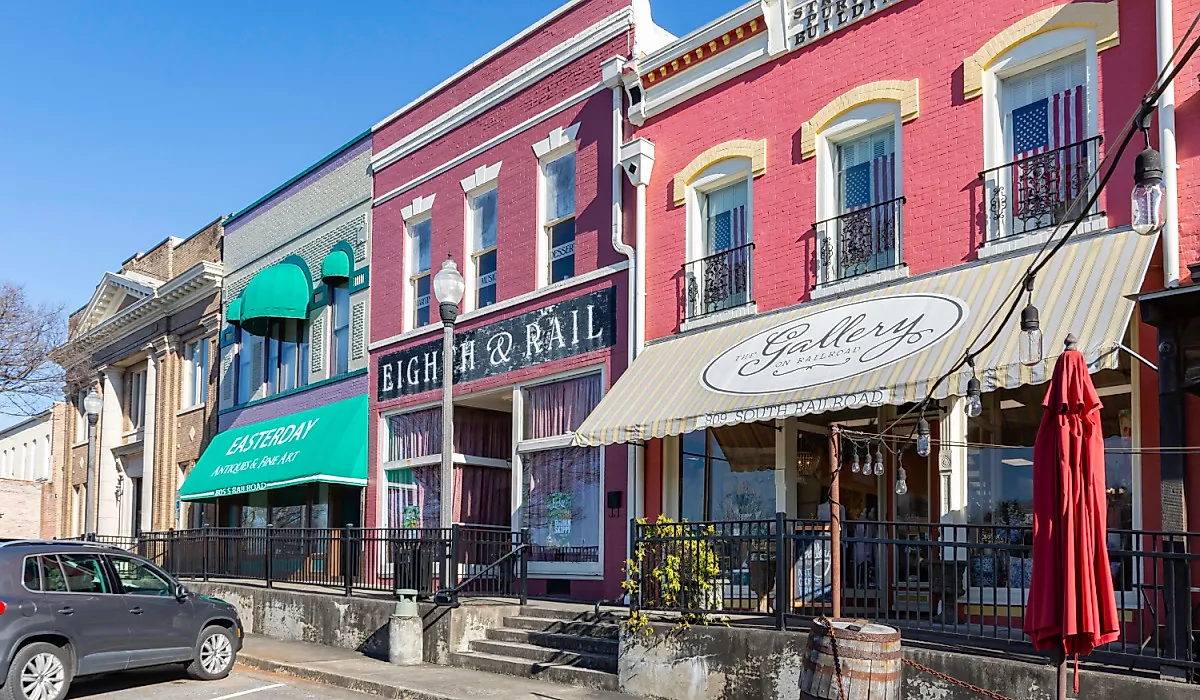
Comfort is 23 miles south of Fredericksburg. German freethinkers founded it in 1854, and the town never incorporated, so it still runs without a city government of its own. Its historic district covers nearly all of the original townsite and includes more than 100 buildings built between 1854 and 1954, many of them limestone. Antique dealers occupy a good share of them now, and the Comfort Antique Mall spreads roughly 8,000 square feet of vendor booths across copper cookware and European furniture. On High Street, under a stand of live oaks, the Treue der Union Monument marks the graves of German Unionists killed near the Nueces River in August 1862 after refusing to swear a loyalty oath to the Confederacy. Dedicated in 1866, it is the oldest Civil War monument in Texas, and the flag above it flies permanently at half-staff.
Wimberley

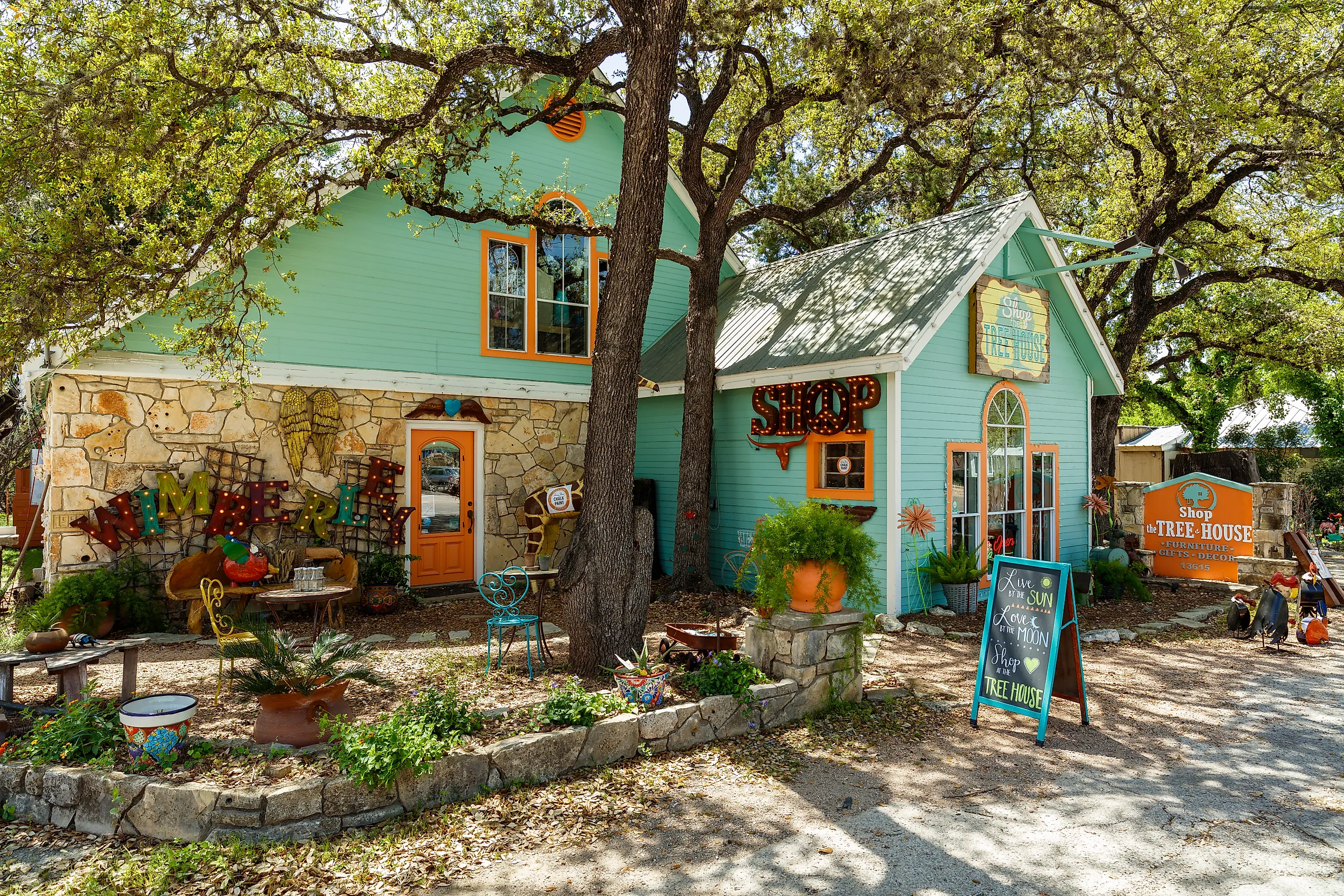
Wimberley built its reputation on spring water clear enough to see the bottom, and it holds near 68 degrees year-round. Jacob's Well is the source, a 140-foot shaft opening into one of the longest underwater cave systems in Texas and the headwaters of Cypress Creek. Prolonged drought and rising groundwater demand have cut its flow to near zero in recent years, and Hays County has kept the well closed to swimmers every summer since 2022, with conditions reassessed month by month. The natural area itself stays open for hiking and guided tours. Downstream, Blue Hole Regional Park sits low enough to keep drawing water from the same aquifer. Its swim season runs May 1 through Labor Day plus September weekends, with reservations required and rope swings still hanging from the cypress limbs. Cypress Creek carries that water on to the Blanco River, where kayaks drift past limestone bluffs. Galleries and creekside cafes fill restored buildings on the town square.
Luling

Luling decorates its oil wells. Plywood cutouts turn working pump jacks into a cow jumping over the moon, a shark mid-bite, and a man eating a slice of watermelon. Many of the wells underneath are still producing. The field dates to August 9, 1922, when Edgar B. Davis brought in the town's first well and turned Luling into one of the wildest boomtowns in Texas. The Central Texas Oil Patch Museum tells that story from inside an 1885 mercantile building downtown that sold hardware and shoes until 1984. Watermelons carry the other half of the town's identity. The Watermelon Thump has run every June since 1954 and lands on the last full weekend of the month. Its seed-spitting contest produced a Guinness record of 68 feet 9 1/8 inches, set by local grower Lee Wheelis in 1989 and still unbeaten. A 154-foot water tower painted as a striped melon stands over the whole operation. South of downtown, Zedler Mill Park pairs a restored gristmill with the put-in for a paddling trail down the San Marcos River.
La Grange

La Grange sits about 55 miles east of Luling, on the Colorado River in Fayette County. James Riely Gordon designed its 1891 courthouse, a Romanesque Revival building of white Belton limestone and blue Muldoon sandstone with pink Burnet granite columns and a clock tower over the square. A block away stands the old Fayette County Jail, a Victorian Gothic block of native stone from the early 1880s that held prisoners until 1985 and now houses the Texas Heroes Museum. Two restored 1890s storefronts nearby hold the Texas Quilt Museum, which shows antique and contemporary quilts against brick walls and original hardwood floors. The bluff south of town carries Monument Hill and Kreische Brewery State Historic Site. Heinrich Kreische, a German stonemason, built a limestone house up there in the 1850s and a brewery below it that ranked third-largest in Texas by 1879. The monument the hill takes its name from is a tomb holding Texans killed in the Dawson Massacre and the Mier Expedition of the 1840s.
Sulphur Springs

Sulphur Springs sits roughly 300 miles northeast of the Hill Country, in the Blackland Prairie country of Hopkins County. Its courthouse came from the same architect as La Grange's. Gordon built it in 1894 and 1895 out of red sandstone and pink granite, with entrances on the corners instead of the sides and a double-helix staircase spiralling up the central light well. The tower has no clock, on the reasoning of one county father that anyone who rises with the sun can do without one. Outside, Celebration Plaza runs an interactive fountain cut in the shape of the Texas star and hosts a Saturday market through the warm months. The plaza also holds two see-through public restrooms, installed in 2012 with one-way mirrored glass so the occupant looks out over downtown while everyone outside sees a mirrored box. Coleman Park's 2.5-mile concrete trail circles a lake and passes two waterfalls, three bridges, and a tunnel. North of the square, the Hopkins County Museum and Heritage Park has gathered eleven acres of relocated county buildings onto one site, including a working blacksmith shop and a one-room schoolhouse.
Timing Matters More Than Distance
Whether exploring Mason’s bat-filled skies and Fredericksburg’s glowing granite dome or Wimberley’s clear swimming holes, these seven fairy-tale towns in Texas turn real history and scenery into storybook settings. Comfort adds limestone streets and antique treasures, while Luling’s painted pump jacks bring playful characters to life. La Grange and Sulphur Springs complete the journey with ornate courthouses, historic buildings, and old-world architecture. Together, they prove that Texas has plenty of places where the landscape, landmarks, and local traditions feel touched by magic.