7 Fairy-Tale Small Towns In Michigan
Michigan’s fairy-tale towns are not built on scenery alone. Mackinac Island replaces cars with horse-drawn carriages, Frankenmuth stages the Pied Piper beneath a towering glockenspiel, and Charlevoix’s stone “mushroom houses” look drawn from a storybook. Elsewhere, Sleeping Bear Dunes carries an Ojibwe legend, Saugatuck still operates a hand-cranked ferry, and Leland’s weathered fishing shanties remain part of a working waterfront. These seven small towns preserve Michigan history, architecture, and folklore for visitors to explore.
Mackinac Island

Motorized vehicles have been prohibited on Mackinac Island since the 1890s, which means the traffic on Main Street is bicycles, freight drays, and horses. Gough Livery Carriages runs private narrated tours in one-hour, 90-minute, and two-hour lengths, and the longer routes reach the island interior that most day-trippers skip. The circuit passes Arch Rock, a natural limestone span standing high above the Lake Huron shoreline on the island's east side. Trails braid the woods below it, and the state park protects better than 80 percent of the island around them.
The Grand Hotel has been open since 1887, and its front porch runs 660 feet, which the hotel bills as the longest in the world. Rocking chairs line the whole span, and the view aims straight down the Straits of Mackinac. Dinner in the Main Dining Room comes with a coat-and-tie code and the hotel orchestra; the Gate House and The Jockey Club handle the casual end. The Jewel splits its 18 holes into two nines, and a carriage shuttles golfers between them.
Saugatuck

The chain ferry Diane crosses the Kalamazoo River in Saugatuck the same way it always has, by an operator turning a crank against a submerged chain. It is the last hand-cranked chain ferry still working in the United States. Accounts of when the crossing began differ, with the city citing 1857 and state tourism material citing 1838, and the boat now in service was built in the 1960s. The landing on the far bank puts you at the foot of Mount Baldhead, a half-mile walk down Perryman Street from Oval Beach.
Oval Beach is the town's main stretch of sand, backed by dunes and repeatedly named to national beach lists, including one of National Geographic Traveler's top freshwater beaches in the country. Saugatuck Dune Rides works the sand on the other side of the river, and the guides use the trip to tell the story of Singapore. That lumber town stood at the river mouth in the 1800s until its own mills stripped the surrounding forest, the wind moved in, and the sand simply buried it. Nothing of it shows today, which is the whole point of the ride.
Leland

Leland sits on the site of one of the oldest and largest Odawa villages on the Leelanau Peninsula, a settlement recorded as Mishi-me-go-bing. The draw was a natural fish ladder where the Leland River, historically the Carp, empties into Lake Michigan. Antoine Manseau and his partners dammed that river in 1853 and raised the water behind it into what is now Lake Leelanau. Commercial fishermen followed and built the weathered shanties, smokehouses, and overhanging docks that became Fishtown.
Fishtown still works, which separates it from most preserved districts. Carlson's Fishery smokes whitefish on site and sells it off the dock, the tugs Joy and Janice Sue remain in the fleet under the Fishtown Preservation Society, and Manitou Island Transit runs the passenger boat out to North and South Manitou, though they are not running in 2026. Charter captains fish the Manitou Passage for salmon, lake trout, steelhead, and brown trout. Carlson's will fillet and ice whatever comes back for a fee, and The Cove, a short walk up the river, will cook it for you. Their own menu leans on Lake Michigan whitefish and chowder if the boat comes back empty.
Frankenmuth

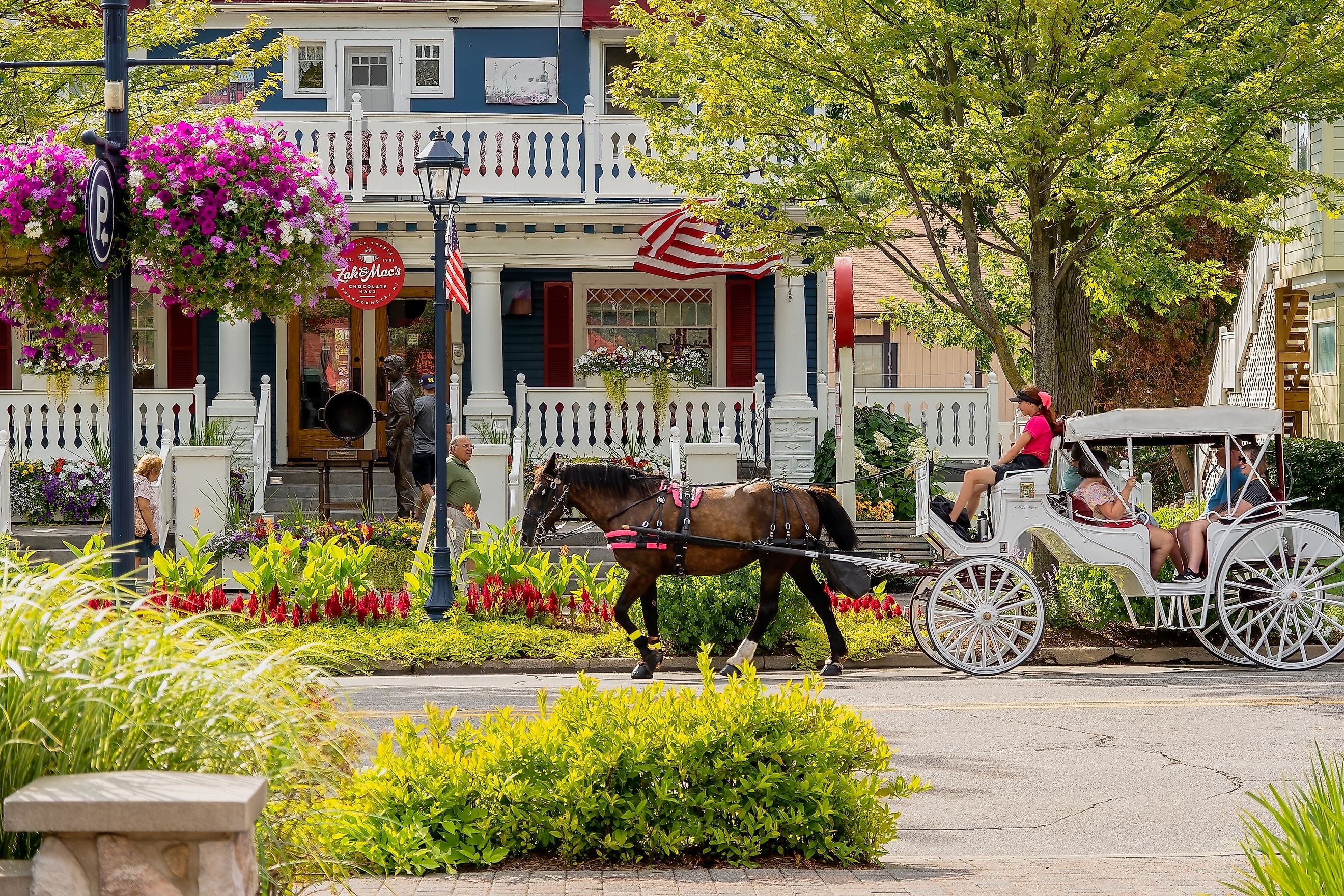
Franconian Lutherans founded Frankenmuth in 1845, and the town has spent the last several decades leaning hard into that German inheritance. The Bavarian Inn Restaurant opened in 1888 as the Union House Hotel under Theodore Fischer, and the Fischer family is credited with starting the all-you-care-to-eat family-style chicken dinner that the town now runs on. The Zehnders bought the place in 1950 and gave it the Bavarian exterior in 1959. The glockenspiel on the tower stands 50 feet and plays out the legend of the Pied Piper of Hamelin, which is the most literal fairy tale on this list.
Zehnder's sits directly across Main Street in a building that started as the Exchange Hotel in 1856. William and Emilie Zehnder sold their farm to buy it in 1928 and opened for business on Mother's Day 1929, serving 312 guests at a dollar apiece. The James Beard Foundation gave it an America's Classics award in 2020. Both kitchens still send out family-style chicken, and the two families were fierce competitors for two decades before one bought the other.
Bronner's CHRISTmas Wonderland has been selling Christmas since Wally Bronner started the business in 1945, and it promotes itself as the world's largest Christmas store. The grounds cover 27 acres, and roughly 100,000 lights run the half-mile length of Christmas Lane after dark. At the southern edge stands the Silent Night Memorial Chapel, a 56-foot replica built in 1992 of the chapel at Oberndorf near Salzburg, where the carol was first sung on Christmas Eve in 1818. Admission is free, the doors are open during store hours, and the walkway outside carries the lyrics in hundreds of languages.
Empire

The dune that gives Sleeping Bear Dunes National Lakeshore its name comes with an Ojibwe story. A mother bear and two cubs swam Lake Michigan to escape a fire on the Wisconsin shore. The cubs tired and drowned within sight of land while the mother reached the beach and lay down to wait. The Great Spirit raised North and South Manitou Islands where the cubs went under and left a solitary dune on the bluff for the mother. The Empire Bluff Trail, about a mile and a half round trip from the village edge, ends at the overlook that makes the geography of that story legible.
The lighthouse most visitors photograph in Empire is the Robert H. Manning Memorial Light, and it sits in the village's Lake Michigan Beach Park rather than inside the national lakeshore. Manning was a lifelong resident who fished the lake and joked for years that the town needed a light to bring him home. He died in 1989, and his family and friends raised the money for the 38-foot tower, dedicated in 1991. The Coast Guard lists it as a private aid to navigation and it does flash, though there are no tours and the interior stays closed. The only historic light station inside park boundaries stands on South Manitou Island.
Grocer's Daughter Chocolate has been working out of a small shop south of the village since 2004. Mimi Wheeler founded it after a career in social work, having grown up in a Danish farm village where her family ran the grocery store, which is where the name comes from. She sold the business to longtime friends Jody and DC Hayden in 2013, and they still make truffles, caramels, bars, and drinking chocolate on site.
Charlevoix

Earl Young spent roughly six decades building houses in Charlevoix out of glacial boulders he hauled in himself, capping them with undulating cedar-shake roofs and low doorways. Locals call them mushroom houses or gnome houses, and about two dozen of them stand in town, clustered in the Boulder Park neighborhood and along a few downtown streets. Young also designed the Weathervane Restaurant above the channel. Its dining-room fireplace is capped by a nine-ton boulder he dug up in 1928, buried again for safekeeping, and unearthed a quarter century later when he finally had a use for it.
Beaver Island Boat Company runs the ferry out of the harbor downtown, and the crossing to the island takes about two hours over 32 miles of open water. Beaver Island earned the nickname America's Emerald Isle from the County Donegal fishermen who settled it and spoke Gaelic there for generations. Before them came James Jesse Strang, a Mormon splinter leader who had himself crowned king of his church on the island in July 1850, complete with robe, sceptre, and tin crown. He served in the state legislature, was assassinated in 1856, and left behind a print shop that now holds a museum.
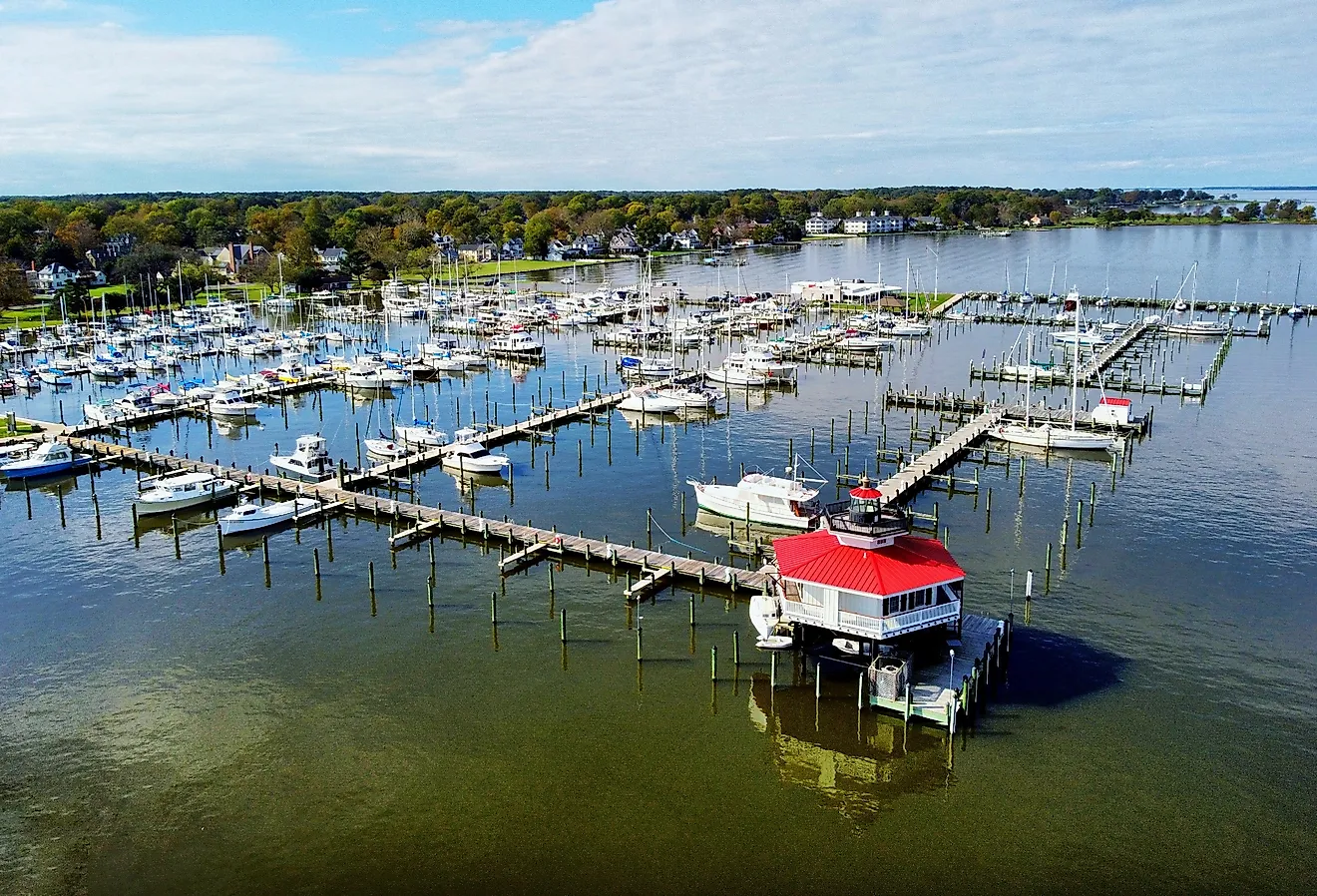
The Charlevoix South Pier Light Station stands where its name says, on the south pier flanking the Pine River Channel. The original wooden tower was built on the north pier in 1885, moved to the south pier in 1914, and replaced by the current steel structure in 1948. The city owns it, the Charlevoix Historical Society restored it and returned it to its red paint in 2009, and the Coast Guard still runs the light. Four miles from downtown, Fisherman's Island State Park covers 2,678 acres and has more than six miles of shoreline, with a 2.5-mile trail through dunes of maple, birch, and aspen. The beach there is one of the better places in the state to hunt Petoskey stones, which are fossilized coral rather than stones at all.
Frankfort

Two breakwaters reach into Lake Michigan off the sand at Frankfort Public Beach to form the harbor, and the squat Frankfort North Breakwater Light sits at the end of the northern one. It is a short walk out and one of the most photographed sunset positions on this stretch of coast. A few miles up the shore, Point Betsie Lighthouse marks the southern entrance to the Manitou Passage, the shipping lane that runs past the Manitou Islands toward Leland.
Point Betsie first lit in 1858 after four years of construction, and its keepers worked the kerosene lamps by hand in a spot so isolated that the nearest road was 40 miles off. The keeper's residence, fog signal building, and Boathouse Museum are all open in season, and docents run tower climbs up the 34 steps every 20 minutes. The Boathouse Museum tells the story of one of the more remarkable rescues in Lake Michigan's records.
Across Betsie Bay in Elberta, the village-owned Elberta Dunes South Natural Area protects glacial moraines, dunes, forest, and Lake Michigan shoreline; a state grant supported the acquisition in 2010, and the village took ownership in 2011. The trail is short at roughly six-tenths of a mile, and it climbs steeply to a crest 225 feet above Lake Michigan with views over the Betsie River wildlife area and the shoreline. The preserve also shelters Pitcher's thistle, a federally threatened plant, and piping plovers nest along the beach below.
Where the Legends Actually Hold Up
Two different things earn these towns their reputation. Some of it is inherited: the bear and her cubs on the Sleeping Bear bluff, the Pied Piper marching across a clock face in Frankenmuth, a self-crowned king buried in the Beaver Island record. The rest was built on purpose by people with an odd idea and the stubbornness to finish it, which covers Earl Young hauling boulders through Charlevoix for sixty years and Wally Bronner raising an Austrian chapel in a Saginaw County parking lot. What keeps the whole thing from tipping into a theme park is that the working parts still work. Carlson's smokehouse runs on a real catch, a college student cranks the Saugatuck ferry across by hand every summer, and the light at Point Betsie is still on.