7 Best Minnesota Towns For A Weekend Trip
Minnesota’s small towns make ideal weekend escapes, pairing memorable landmarks with outdoor adventure, local culture, and distinctive places to stay. Walk or bike across Stillwater’s historic Lift Bridge, sail Lake Superior from Grand Marais, watch wolves in Ely, ride mountain-bike trails through Crosby’s flooded mine country, explore Bluff Country from Lanesboro, or sample German heritage and historic brewing in New Ulm. These seven towns offer enough scenery, attractions, and character to easily fill a weekend.
Stillwater

Stillwater was founded in October 1843, fifteen years before Minnesota became a state, and the lift bridge is the piece of it everyone photographs. The span has crossed the St. Croix since 1931 and is one of only three vertical-lift bridges still standing in Minnesota and Wisconsin. Cars stopped using it in August 2017. It reopened in June 2020 for walkers and cyclists, and throughout the lift season, it rises on the half-hour whenever a boat is waiting underneath. Ten minutes of walking puts you in Houlton, Wisconsin, and the 4.7-mile St. Croix Crossing Loop Trail brings you back over the newer highway bridge downstream.
Main Street holds more than 100 independently owned shops and restaurants. Lift Bridge Brewery and River Siren Brewing Co. both pour within a few blocks of the water, and River Siren's taproom patio looks straight out over the river. Three miles north of downtown, the St. Croix Boom Site marks where crews once sorted millions of logs coming downriver. It is now a National Historic Landmark, with interpretive signs where the sorting booms used to be. The Water Street Inn is the only lodging in town actually on the river, set inside the Lumber Exchange Building that Stillwater's lumber barons put up around 1890. Charlie's Irish Pub downstairs occupies the space where the building's original saloon once stood.
Duluth

Every ship entering the port of Duluth passes under the Aerial Lift Bridge, and the horn signal that goes with it is the sound the city runs on. Crews built the bridge between 1901 and 1905 as an aerial transfer span, then rebuilt it as a vertical lift in 1929 and 1930. It still lifts for traffic moving into the Duluth Ship Canal. Canal Park sits right beside it with breweries and shops, and the paved Lakewalk runs out of it along the shoreline for miles. Up on the hill, Enger Tower is free to climb. The view from the top takes in the harbor, the bridge, downtown, and the open water of Lake Superior. That is the largest freshwater lake on Earth by surface area.
Chester and Clara Congdon finished Glensheen in 1908 on a 12-acre lakefront estate, and the University of Minnesota Duluth has run it as a house museum since the 1970s. The standard tour takes about 90 minutes and covers what an early-1900s Duluth iron fortune actually bought. For a room, Fitger's Inn occupies a former brewery complex on the National Register of Historic Places, a tenth of a mile off the Lakewalk and a short walk from Canal Park.
Grand Marais

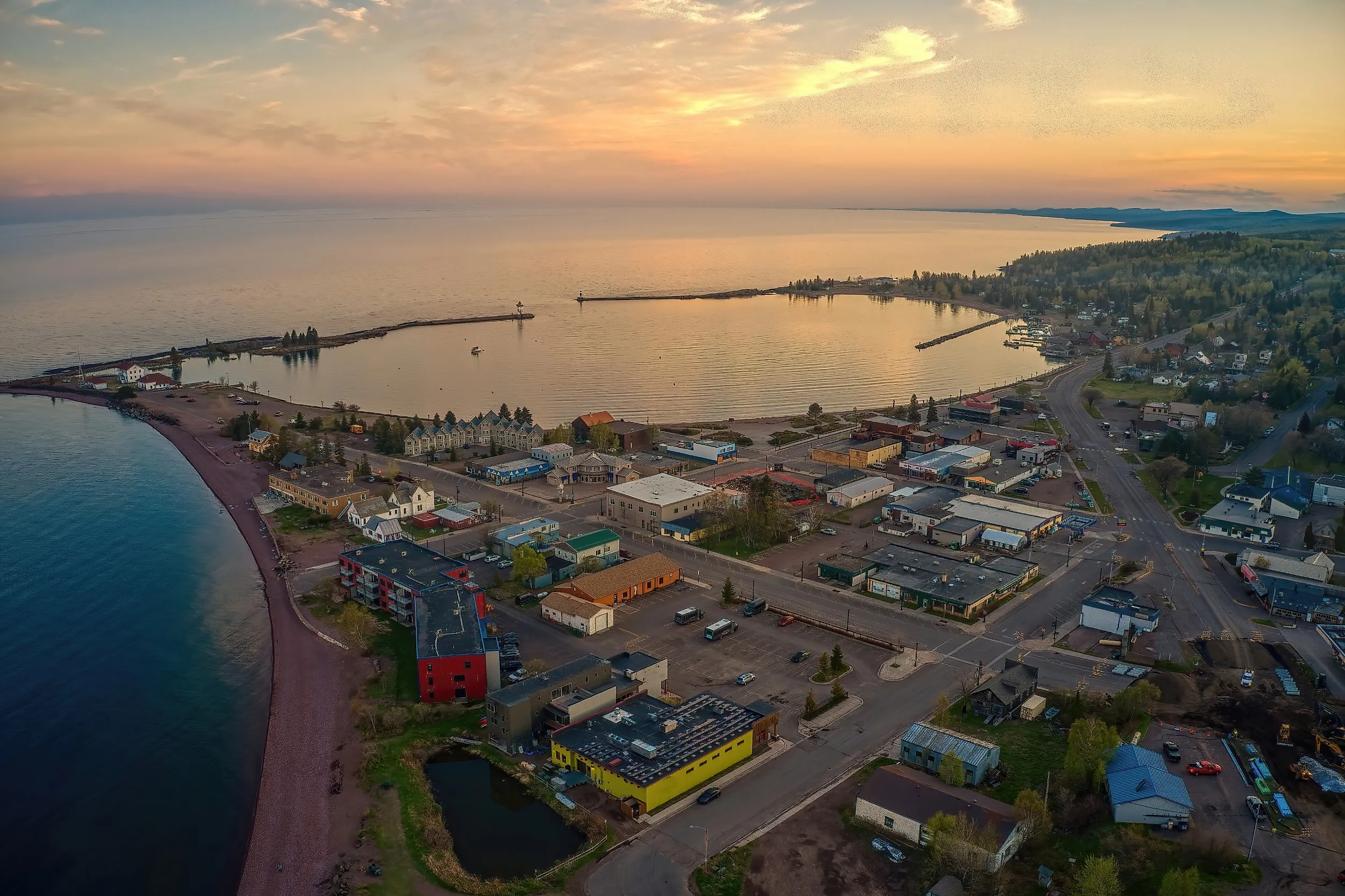
In the summer of 1947, a Minneapolis School of Art instructor named Birney Quick brought twenty students up to Grand Marais for an eight-week outdoor painting session. Several of them were veterans studying on the G.I. Bill. That class became the Grand Marais Art Colony, the longest-running art colony in the state, and it still teaches year-round in five studios. Sivertson Gallery downtown grew out of a different lineage, opened in 1980 by Jan Sivertson and her father, Howard, a commercial fisherman turned painter. The whole town is about 1,350 people.
North House Folk School has worked the harbor since 1997. It runs more than 350 courses a year in traditional northern crafts, including boat building, blacksmithing, and timber framing. Late May through early October, it sails the Hjørdis, a 50-foot steel schooner, out on the lake most days. Artist's Point is a five-minute walk from the harbor and puts the lighthouse, the breakwater, and open water in one view. Grand Marais is also the eastern doorway into the Boundary Waters, with the Gunflint Trail running inland and the Superior Hiking Trail passing through. East Bay Suites keeps guests within walking distance of all of it, with water-facing balconies and bikes for the ride into town.
Ely

Ely calls itself the Canoe Capital of the World. The town is the main western entry point to the Boundary Waters Canoe Area Wilderness, a 1,090,000-acre roadless area with more than 1,100 lakes and 1,200 miles of mapped canoe routes. Highway 1 runs into town through Finland and the Superior National Forest, which is a couple of hours inland from the North Shore. The International Wolf Center on the east edge of town keeps a resident Exhibit Pack and runs naturalist programs daily.
The Dorothy Molter Museum is housed in the reassembled cabin that the woman canoeists knew as the Root Beer Lady. Molter lived on Knife Lake's Isle of Pines for 56 years, and after she died in 1986, crews hauled her home out to Ely by dogsled and snowmobile. Burntside Lodge, a few miles northwest on Burntside Lake, has taken guests since 1913 and is the oldest surviving guest lodge in the Ely area. Its log cabins went up mostly in the 1920s and 1930s, and the whole property is on the National Register. Worth knowing before you book: Burntside is a summer operation that opens in late May and closes in late September. The lake it sits on runs about 7,100 acres and holds more than 100 islands.
Crosby

The Cuyuna Iron Range got its name from surveyor Cuyler Adams and his St. Bernard, Una. Adams spent twenty years mapping the ore his magnetic readings kept pointing at. Mining started in 1911, and the last shipment left in 1984. The pits were filled with groundwater, and in 1993, the state turned the leftovers into the Cuyuna Country State Recreation Area. Today, Crosby sits in the middle of one of the deepest lake districts in central Minnesota. Mahnomen Mine Lake bottoms out at 525 feet. Portsmouth Mine Lake, at roughly 395 feet, is the deepest lake lying entirely inside the state.
Motors are heavily restricted on the mine lakes, which leaves them to swimmers, paddlers, and scuba divers working along submerged rail beds and rock walls. Divers report visibility of up to 80 feet on a good day. Above the waterline, the park carries more than 50 miles of singletrack, with the paved Cuyuna Lakes State Trail linking the riding areas for anyone who wants a flatter afternoon. In town, the Soo Line Depot Museum fills the 1910 railroad depot with the Milford Mine disaster of February 5, 1924, when Foley Lake broke through, and 41 of the 48 men underground died. The museum also displays a life-size replica of the Man High II capsule, which carried Major David Simons into the stratosphere from the dry Portsmouth pit in August 1957. The Sanctuary, an eight-room hotel in a converted 1920s Lutheran church, still boasts the original 30-foot ceilings and stained glass.
Lanesboro

Lanesboro answers to the title of Bed and Breakfast Capital of Minnesota. The nickname dates to the boom years after the Root River State Trail opened in the late 1980s, when as many as fifteen operated at once. Four are running today, including the Historic Scanlan House and the James A. Thompson House, with the rest sold off or returned to private homes as owners retired. The governor also named Lanesboro the Rhubarb Capital of Minnesota in 2008, and the town throws a festival for it the first weekend in June.
Most people arrive on two wheels. The Root River State Trail runs 42 paved miles between Fountain and Houston on an old railroad grade, and the Harmony-Preston Valley State Trail branches off it for a combined network topping 60 miles through the bluffs. Berwood Hill Inn sits on a 200-acre ridge property five miles out of town with the Root River valley spread out below it. Back downtown, the Commonweal Theatre runs a full professional season, and Niagara Cave, a short drive south near Harmony, has an underground waterfall in it.
New Ulm

German immigrants founded New Ulm at the meeting of the Minnesota and Cottonwood Rivers. The Sons of Hermann dedicated the Hermann Heights Monument in September 1897 after nine years of construction and fundraising trouble. The copper statue on top stands 32 feet, the whole structure reaches 102 feet, and it remains the third-largest copper statue in the country behind the Statue of Liberty and Portlandia. A spiral staircase inside the base climbs to a platform under Hermann's feet with the Minnesota River Valley below. Congress named it a national symbol of German-American heritage in 2000. The city is currently pursuing a major restoration of the monument, so check the season's opening hours before you drive out.
Downtown, the Glockenspiel is a 45-foot carillon clock that sends twelve figurines around a track several times a day. August Schell, who left Germany's Black Forest at twenty and helped found the town, started his brewery here in 1860. It is the second-oldest family-owned brewery in America after Yuengling, and it became Minnesota's largest when the family bought the Grain Belt brands in 2002. The brewery grounds and mansion are on the National Register, and the hour-long tour ends with a tasting. The Grand Center for Arts and Culture keeps the old Grand Hotel building in service, with live music downstairs at the Grand Kabaret on weekends.
Minnesota's Small Town Getaways
From Lake Superior harbors and Boundary Waters gateways to mine lakes, river valleys, and German heritage, these seven Minnesota towns each offer a different kind of weekend escape. Whether you want to bike, paddle, explore historic landmarks, or simply slow down somewhere scenic, each destination has enough to see and do to make the trip worthwhile.

.jpg)