2026's 10 Best Small Towns To Visit In Hawaii
Matsumoto Shave Ice has worked the same window in Haleʻiwa since 1951, and the line still wraps the building most afternoons. A short walk north, the Anahulu Stream Bridge has carried traffic into town since 1921. Small towns across the islands tend to run on that kind of continuity: a plantation village that kept its storefronts, a royal fishpond that became a bird sanctuary, a 1928 theater that outlasted the six others in its town. The ten towns below sit on three islands, and each one offers something unexpected and unforgettable.
Haleʻiwa

The concrete bridge at the top of town replaced a wooden one in 1921, and its twin arches earned it the name locals still use, the Rainbow Bridge. Anahulu Stream runs beneath it, and outfitters launch kayaks and paddleboards from the banks. Haleʻiwa held fewer than 5,000 residents at the 2020 census, so there is no real downtown, just a compact strip of plantation-era buildings holding surf shops, galleries, and Matsumoto's. Two beach parks flank the small boat harbor. Haleʻiwa Beach Park on the north side stays calm enough for swimming and beginner surf lessons, which sets it apart on a coast where winter faces can top 30 feet between November and March. The friendliest small town in Hawaii also runs an annual arts festival that draws residents and visitors into the same grassy field.
Hilo

Liliʻuokalani Gardens covers nearly 25 acres on Banyan Drive and is the largest authentic ornamental Japanese garden outside Japan. Queen Liliʻuokalani donated the original fishpond, and the grounds were dedicated in 1917 to honor the first Japanese immigrants who worked the island's sugar cane fields. Arched bridges cross the ponds, a teahouse sits among the plantings, and a footbridge crosses to Mokuola, also called Coconut Island. Entry is free, and the gardens have no fence, so they never close. Downtown, the wooden and concrete storefronts along Kamehameha Avenue are roughly a century old rather than centuries old, most of them built between 1910 and 1932 during Hilo's boom as the islands' second commercial center. The tsunamis of 1946 and 1960 took every building on the seaward side of that street, which is why a highway now separates the town from its own bay. The Lyman Museum keeps the 1839 mission house next door, and the Hilo Farmers Market fills with island jams, tropical fruit, and locally roasted coffee.
Kapolei

Four sheltered lagoons sit along the Ko Olina shoreline west of town, linked by roughly a mile and a half of paved seaside path. The water inside them stays calm enough for weak swimmers, and the path is public even where the resorts front it. Ko Olina Golf Club runs an 18-hole course and a teaching academy on the inland side. Wet'n'Wild Hawaii sits a few minutes up Farrington Highway and remains the only water park in the state. More than 25 attractions fill its 29 acres. The tallest is the Volcanic Wedgeee, spelled with three e's on the park's own signage, which drops riders close to 70 feet at speeds reaching 30 miles per hour. Ka Makana Aliʻi anchors the retail side of Kapolei, and the town's own beaches ask visitors to carry out what they carry in.
Waipahu

Sugar built this town, and Hawaii's Plantation Village is the reason to come. The living history museum reconstructs the camp housing that Japanese, Chinese, Filipino, Portuguese, Korean, and Puerto Rican laborers lived in. The houses are arranged along the ethnic lines the plantations imposed, which tells you something the placards do not have to. A botanical garden holds the crops that those families grew, and guides hand out food samples along the way. Waikele Premium Outlets stands a short distance down the same road, which makes an odd but efficient pairing of nineteenth-century labor history and discount retail. The Waikele Country Club opens its public course and restaurant to anyone, and the back nine looks out toward Pearl Harbor.
Kailua

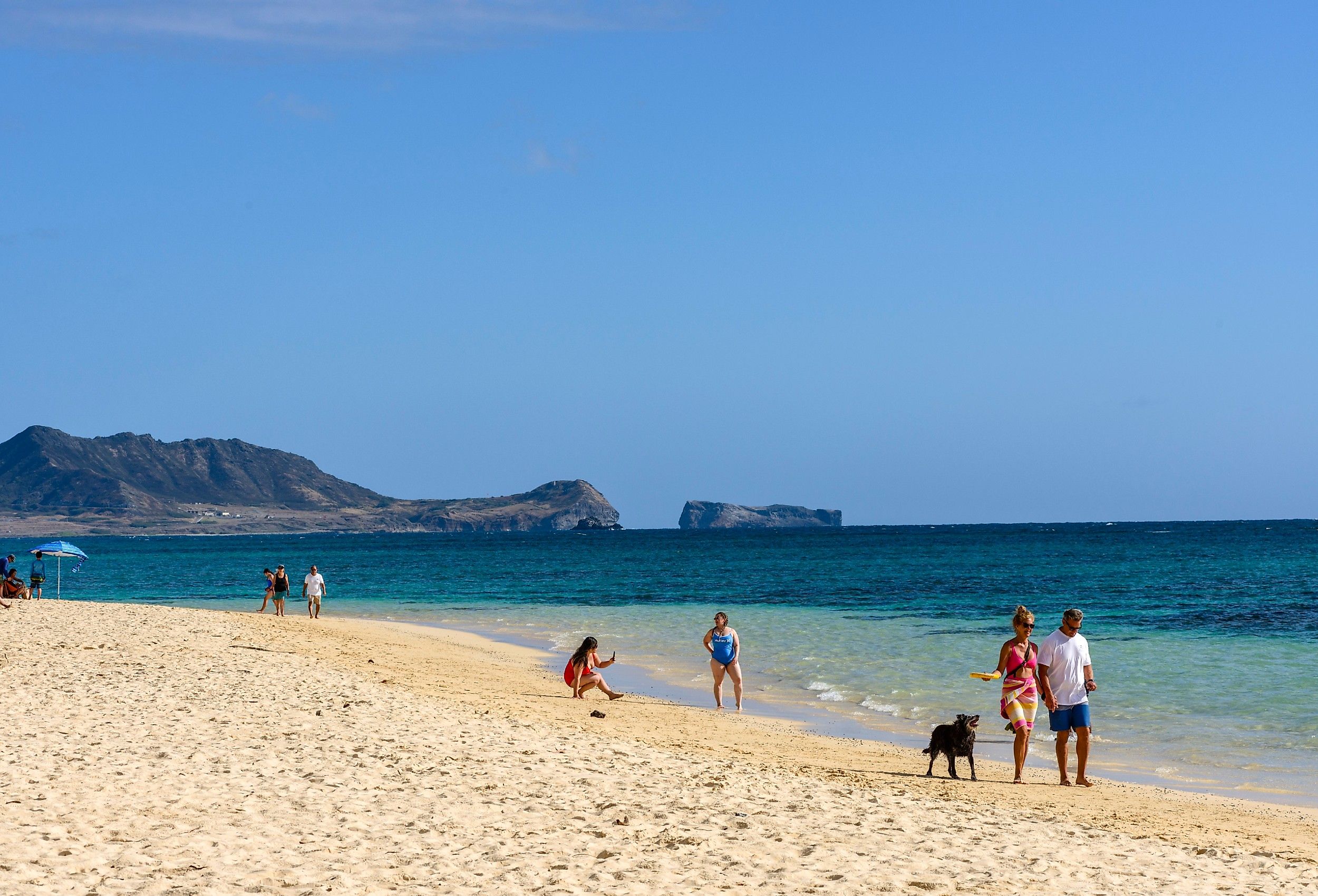
The Independence Day parade here has run for more than seven decades, and families stake out spots along the 1.5-mile stretch of Kainalu Drive the night before. Fireworks follow over the bay after dark. The rest of the year, the town keeps a quieter rhythm. A free hula series runs on the first Sunday of each month, and a free music series on the second Saturday. Both are staged in the parking garage behind the drugstore, which is less strange than it sounds and reliably packed. Kailua Beach Park handles the kayaks, paddleboards, and kitesurfers, while Lanikai Beach to the south draws the crowds for its clear shallows. Mornings at Lanikai are usually calm, but trade winds and currents strengthen through the day, particularly toward the Mokulua Islands offshore. Kailua town itself is walkable, with an independent bookstore, yoga studios, and a bakery that serves dogs.
Kāneʻohe

At 17 square miles, Kāneʻohe Bay is the largest sheltered body of water in the main Hawaiian Islands, and a barrier reef holds the open ocean off. Out in the middle of it, a sand and coral platform called Ahu o Laka rises to knee depth as the tide drops and disappears again a few hours later. The name means altar of Laka, the goddess of hula, and the site is a wahi pana where the state permanently bans alcohol. Boats and kayaks are the only way out. On land, the Byodo-In Temple was dedicated in 1968 for the centennial of Japanese immigration to Hawaii. It is a half-scale replica of the roughly 900-year-old temple at Uji in Kyoto Prefecture, and it was assembled without nails. It is non-denominational and has no resident monastic community, so visitors of any faith simply walk the grounds, ring the three-ton brass bell, and look at the gold-leafed Amida Buddha in Phoenix Hall. Hoʻomaluhia Botanical Garden covers 400 acres up against the Koʻolau cliffs, with plantings grouped by the tropical region they came from and enough birds to hold a birdwatcher for an afternoon.
Kahului

Kanahā Pond was a pair of royal fishponds long before the state made it the first wildlife sanctuary in the islands in 1951. It now sits in the middle of town, within sight of the airport runway. The brackish wetland supports more than 100 native plant and invertebrate species and 86 species of birds, among them the endangered Hawaiian stilt and Hawaiian coot. A paved walkway and viewing shelter on the Keolani Place side stay open every day between sunrise and sunset. The short trails off Amala Place open only between the end of August and the end of March, since the birds nest through spring and summer. Across from War Memorial Stadium, Maui Nui Botanical Gardens works a different angle on the same idea: five acres of native Hawaiian and Polynesian-introduced plants grown in a coastal dune system, the only collection of its kind in the state. A phone app carries audio notes on more than 102 species, free with the $10 admission that Hawaii residents skip entirely. Tasaka Guri-Guri has been selling its pineapple and strawberry frozen dessert at Maui Mall Village for generations, and the recipe stays in the family. The Maui Swap Meet runs Saturday mornings until 1 p.m. with more than 100 vendors.
Kailua-Kona

After dark, boats anchor offshore and switch on lights that pull plankton up through the water column, and manta rays follow the plankton. Snorkelers float on the surface while the rays feed underneath them, sometimes within arm's reach. The other reason to be here grows on the slopes above town. The Kona coffee belt runs about 30 miles along the western flanks of Hualālai and Mauna Loa, and roughly 650 farms work it, most of them around three acres. The terrain is too uneven for machines, so every cherry is picked by hand, which is a large part of why Kona sells as one of the priciest coffees in the world. Dozens of those farms run tours, many of them free, and the Kona Coffee Cultural Festival takes over Historic Kailua Village each November. At Kahaluʻu Beach Park, sea turtles haul out on the rocks most mornings. North of town at Maniniʻōwali, better known as Kua Bay, high surf brings rip currents and a hard shorebreak that catches swimmers out.
Wailuku

In 1953, Frank Sinatra and Ava Gardner sat in the ʻĪao Theater on North Market Street for the Hawaii premiere of "From Here to Eternity." The theater opened in August 1928, cost $40,000 to build, and was the last of Wailuku's seven theaters to go up. Its concrete construction is why it is the only one still standing, and one of just three pre-1930 theaters left in the state. Maui County bought it in 1993, and Maui OnStage produces plays and concerts inside its 413 seats. Two miles up the road, ʻĪao Valley State Monument reopened in late June 2026 after a two-month closure for bridge safety work. A paved 0.6-mile loop leads to a viewpoint of Kukaʻemoku, better known as the ʻĪao Needle. The eroded spire rises 1,200 feet off the valley floor. The same loop passes a garden of the plants Hawaiians brought with them. The valley was the site of the 1790 battle of Kepaniwai, where the forces of Kamehameha I defeated the Maui army. Out-of-state visitors now need advance entry and parking reservations. Down in town, Hale Hōʻikeʻike at the Bailey House holds the Maui Historical Society's collections, one of Duke Kahanamoku's surfboards among them. Outside is an ethnobotanical garden of rare and endangered Hawaiian plants.
Lāʻie

The Polynesian Cultural Center spreads across 42 acres and organizes itself into six island villages, each staffed by people demonstrating the crafts, music, and games of that culture. Its canoe pageant, "Huki: A Canoe Celebration," runs on operating days, and the center keeps a seasonal schedule worth checking before building a day around it. Lāʻie Point State Wayside sits a few minutes east, a rugged finger of shoreline with seabirds overhead and the Koʻolau Range standing behind the town. Hukilau Beach suits swimming, bodyboarding, and fishing. Pounders Beach is named for exactly what its shallow sandbar does to incoming swells. The shorebreak and currents there demand respect. At the southern end, fishermen work the water below a limestone cliff for oʻio, moi, papio, and ulua.
What Separates These Ten
The towns on this list divide fairly cleanly into two kinds. Hilo, Wailuku, and Haleʻiwa are historic centers whose main draw is the built environment itself, the storefronts, theaters, and gardens that survived tsunamis, demolition orders, and the end of sugar. Kailua-Kona, Kāneʻohe, Lāʻie, and Kahului trade instead on one feature of the landscape apiece: a coffee belt, a sheltered bay, a stretch of shoreline, a wetland that outlasted the airport built beside it. Kapolei and Waipahu belong to a third group, newer and closer to Honolulu, where the appeal is a specific institution rather than the town around it. Knowing which kind of place you are driving to matters more than the mileage, because a morning in Hilo asks for a walk, and a morning at Kua Bay asks whether the surf is up.