11 Small Towns In The Pacific Northwest Were Ranked Among US Favorites
Port Townsend was supposed to be the western terminus for the entire Northern Pacific Railway. When the Northern Pacific chose Tacoma instead in 1873, the boom collapsed and froze the Victorian downtown mid-construction. Most of those buildings are still standing today, which is why Port Townsend now ranks among the few National Historic Landmark Victorian seaport districts in the country. The other ten small towns ahead across Washington and Oregon work on a similar principle. Each one was shaped into its current form by a single specific event, industry, or decision that did not happen anywhere else in the region.
Anacortes, Washington

Anacortes sits on Fidalgo Island and serves as the mainland departure point for the Washington State Ferries San Juan Islands run, the busiest international ferry route on the U.S. West Coast. About 17,000 people live here year-round, and the population swells significantly during the spring tulip season, when the surrounding Skagit Valley produces more tulip bulbs than any other county in the country. The Skagit Valley Tulip Festival runs every April and draws roughly a million visitors over the month.
The town traces back to 1879, when Amos Bowman platted the original townsite and named it for his wife, Anna Curtis. Anacortes ran on salmon canneries from the 1890s through the 1970s, and the old cannery building on Q Avenue now holds the Anacortes Museum. Mount Erie, the high point on Fidalgo Island at 1,273 feet, has a paved summit road and trail network used heavily by climbers practicing on its basalt walls. The Washington Park Loop, a 2.2-mile drive at the western edge of town, traces forested headlands overlooking the entry to the San Juans.
Bainbridge Island, Washington

Bainbridge Island reaches downtown Seattle in 35 minutes by Washington State Ferry, which makes the island both a feasible commute and one of the most expensive ZIP codes in the state. About 25,000 people live here, with the median home sale price running around $1.1 million in 2025.
The Bainbridge Island Japanese American Exclusion Memorial commemorates the first 227 Japanese Americans removed from the West Coast under Executive Order 9066 in March 1942. They left from the Eagledale ferry dock, and the memorial sits at that spot. Bloedel Reserve, a 150-acre estate at the north end of the island, runs as a public garden with woodland trails, a Japanese garden, and a moss garden built around an old Bloedel family residence. The Saturday Farmers Market at Town Square runs April through October and includes some of the region's most established farm stands.
Bandon, Oregon

Bandon Dunes Golf Resort, opened in 1999, runs five 18-hole links courses and has appeared in every Golf Digest top-ten list of U.S. courses since. The resort sits on a clifftop just north of Bandon proper and employs roughly 600 people, making it the largest employer in Coos County. Golf Pacific, the resort's caddie program, hires roughly 200 caddies for each season.
The town itself runs about 3,300 people and sits at the mouth of the Coquille River. Face Rock State Scenic Viewpoint, the most photographed spot in town, names a sea stack just offshore tied to a Coquille legend about a chief's daughter turned to stone. A devastating fire in 1936 burned most of the original downtown, which forced a 1937 rebuild that gives the current Old Town its consistent late-1930s storefront character. The Bandon Cheese Factory, which operated from 1939 to 2002, was the town's other anchor industry; cranberries took over the agricultural role and now cover about 1,800 acres in the surrounding bogs.
Lincoln City, Oregon

Lincoln City stretches seven miles along the coast and was incorporated in 1965 by merging five smaller towns: Oceanlake, Delake, Nelscott, Taft, and Cutler City. The city retained the five-town character, with each former town anchoring a distinct district. About 9,400 people live here year-round.
The Finders Keepers program, started in 1999, places approximately 3,000 hand-blown glass floats along the seven miles of public beach between October and Memorial Day. Whoever finds one keeps it. Local glassblowers at the Jennifer L. Sears Glass Art Studio in the Taft District produce the floats, and visitors can blow their own for about $75. Devils Lake, the only lake within an Oregon city's limits with public boat launches, sits east of Highway 101 and runs about 700 acres. The lake holds the record for the shortest river in the world: the D River, which connects Devils Lake to the Pacific, runs 120 feet end to end.
Cannon Beach, Oregon

Haystack Rock rises 235 feet straight out of the surf at Cannon Beach and is one of the most photographed sea stacks in the world. The Marine Garden surrounding its base is a federally protected area where tide-pooling is permitted but rock-climbing is banned to protect the tufted puffin colony that nests on the upper ledges between April and August. About 1,600 people live in the town year-round.
The annual Sandcastle Contest, running since 1964, is the longest-continuously-running sandcastle competition in the Pacific Northwest. The Coaster Theatre Playhouse, a 1972 conversion of a 1920s roller-skating rink, runs a year-round community theater season. Ecola State Park, immediately north of town, holds the trailhead for the Tillamook Head section of the Oregon Coast Trail; Lewis and Clark's expedition reached this headland in January 1806 and described the view as "the grandest and most pleasing prospects" of their journey.
Chelan, Washington

Lake Chelan runs 50.5 miles long and reaches 1,486 feet deep, the third-deepest lake in the United States after Crater Lake and Lake Tahoe. The lake bottom sits about 386 feet below sea level. The town of Chelan, about 4,200 residents, anchors the southeastern tip where the lake meets the Columbia River drainage; the northwestern end is unreachable by road and requires either the four-hour Lady of the Lake ferry or a floatplane to reach the village of Stehekin.
The Lake Chelan AVA, designated in 2009, runs about 30 working wineries on the slopes above the lake. The unique soils, glacial till mixed with volcanic ash from Mount Mazama (the eruption that created Crater Lake about 7,700 years ago), give the region's wines a distinct mineral character. The Slidewaters water park has run on a hillside above the town since 1983 and stays busy through the summer high season.
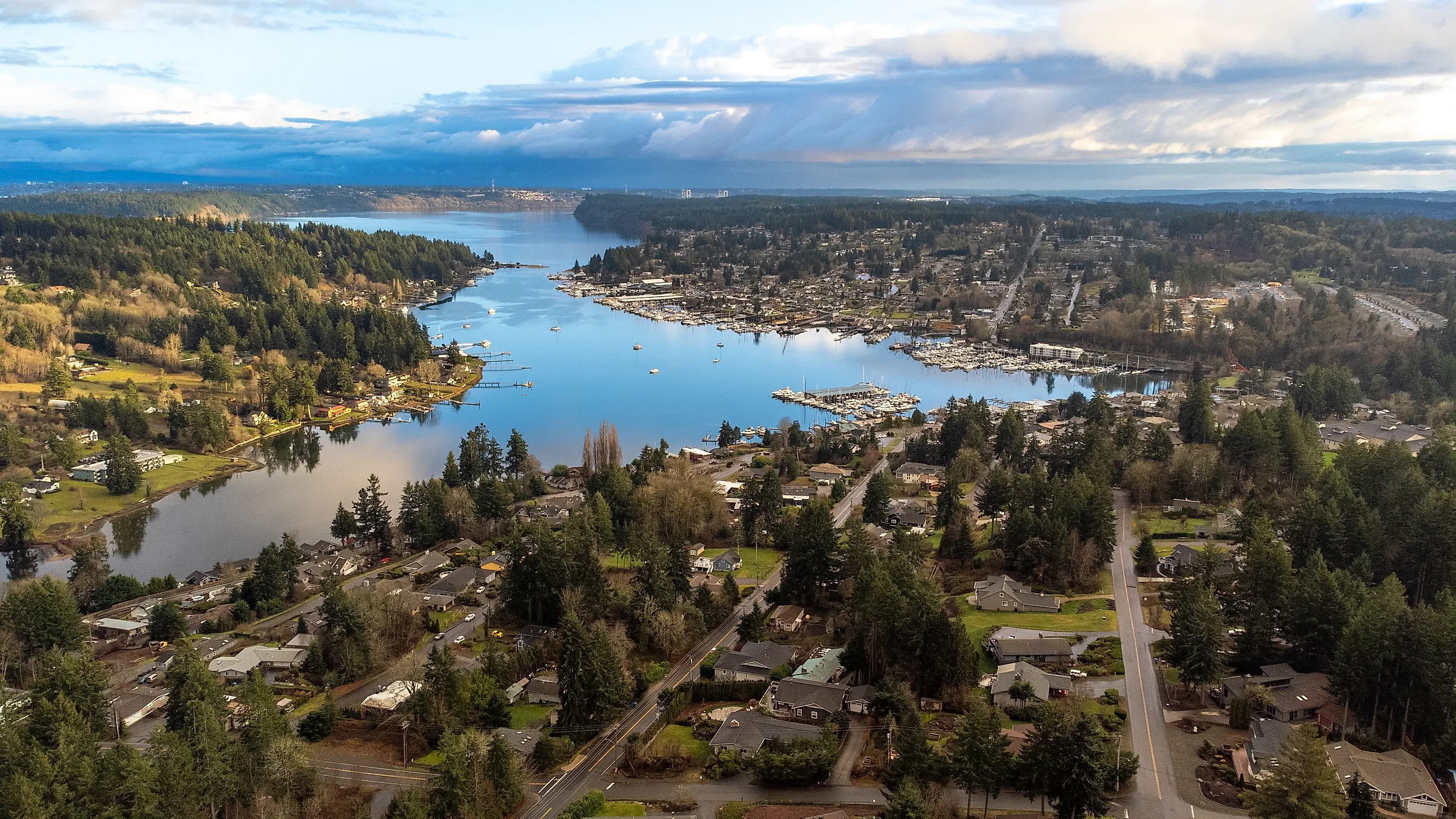
Gig Harbor, Washington

The 1940 Tacoma Narrows Bridge ("Galloping Gertie"), which collapsed dramatically on film in November of that year four months after opening, sits at the bottom of the channel between Gig Harbor and Tacoma; the wreckage is now a protected dive site. The current twin span bridges, built in 1950 and 2007, carry Highway 16 into the town of about 13,000 people.
Gig Harbor took its name from the small Captain's gig that surveyed the inlet in 1841 during the Wilkes Expedition. Croatian and Norwegian fishermen settled here heavily in the late 1800s, and the working fishing fleet still operates from the inner harbor. The Harbor History Museum on Harborview Drive holds the restored Shenandoah, a 65-foot purse seiner built in Gig Harbor in 1925 and one of the few wooden fishing boats from that era still standing intact. Cushman Trail, a 6.5-mile paved rail-trail, connects the town to the pedestrian deck of the 2007 Narrows Bridge.
Langley, Washington

Langley occupies 1.05 square miles on the southeast end of Whidbey Island, the longest island in the contiguous United States at 55 miles. Jacob Anthes founded the village in 1890 and named it for Judge J.W. Langley of Seattle. About 1,150 people live in town. The Langley Whale Center, run by the Orca Network volunteer organization, tracks gray whale activity in Saratoga Passage every spring, when as many as ten resident gray whales feed in the shallows between March and May.
The Whidbey Island Center for the Arts on First Street runs a year-round performing arts schedule, and the town's Mystery Weekend festival each February has had attendees solving an original mystery script written by local volunteers since 1984. Langley's working ferry connection at Clinton, about a fifteen-minute drive south, runs to Mukilteo every half hour and connects the island to the Seattle metro.
Leavenworth, Washington

Leavenworth rebranded itself as a Bavarian-themed village in 1965 after the railroad reroute had effectively killed the town's economy. The reinvention was deliberate. City leaders worked with the University of Washington's architecture program to enforce an Alpine design code on every commercial building. About 2,200 people live here permanently, and the town now draws roughly 3 million visitors annually, with Oktoberfest and the Christmas tree lighting being the two largest events.
The Leavenworth Nutcracker Museum on Front Street holds over 9,000 nutcrackers from 40 countries, the largest collection in the world. The Bavarian Icefest in January runs ice sculpture demonstrations and snow tubing on Front Street. Real backcountry sits a few minutes outside town: the Enchantments, a series of granite peaks and alpine lakes in the Alpine Lakes Wilderness, sees roughly 12,000 permit applications each year for fewer than 200 daily overnight permits, making it one of the most competitive wilderness permits in the country.
Newport, Oregon

Yaquina Head Lighthouse, completed in 1873 at the tip of a basalt headland north of Newport, stands 93 feet tall and is the tallest lighthouse on the Oregon coast. The light still operates as a working aid to navigation, and the surrounding 100-acre Yaquina Head Outstanding Natural Area protects nesting colonies of common murres, pelagic cormorants, and tufted puffins on the offshore rocks.
The Oregon Coast Aquarium opened in 1992 and was Keiko's home from 1996 to 1998, the orca who starred in Free Willy and was rehabilitated in a custom-built tank before his eventual release in Iceland. The aquarium now anchors the south side of Yaquina Bay, with the Hatfield Marine Science Center, Oregon State University's coastal research facility, across the parking lot. Newport's commercial fishing fleet still lands the largest catch by tonnage of any port on the Oregon coast, with Dungeness crab as the highest-value species. The town runs about 10,300 residents.
Port Townsend, Washington

Port Townsend holds one of only three Victorian seaport National Historic Landmark Districts in the country, alongside Galveston, Texas, and Cape May, New Jersey. The brick-and-stone downtown filled in during the 1880s boom, when local boosters expected the town to become the rail terminus for the transcontinental Northern Pacific Railway. The railroad chose Tacoma instead in 1873, and Port Townsend's growth collapsed in 1893, which is why so many of the original Victorian buildings survived intact.
About 10,000 people live here today. The Northwest Maritime Center on the waterfront runs the Wooden Boat Festival every September, the largest gathering of wooden boats in North America with about 300 vessels and 30,000 attendees over three days. Fort Worden State Park, a 434-acre former Army coastal artillery installation, sits at the north end of town and now operates as a conference and arts campus with the Centrum Foundation running year-round music workshops, including the Jazz Port Townsend festival every July.
What These Towns Hold That Bigger Cities Don't
Seattle and Portland anchor the regional economy, but the eleven towns above hold the experiences worth driving for. The wooden boat festival in Port Townsend has no equivalent in the urban Northwest. The Bandon Dunes courses are not matched anywhere else on the West Coast. The depth of Lake Chelan, the height of Haystack Rock, the 9,000 nutcrackers in Leavenworth, the working gray whale watching off Langley, the Japanese American memorial on Bainbridge: none of these can be substituted by a bigger city nearby. Each town does one thing better than anywhere else does, which is the working definition of a place worth visiting.