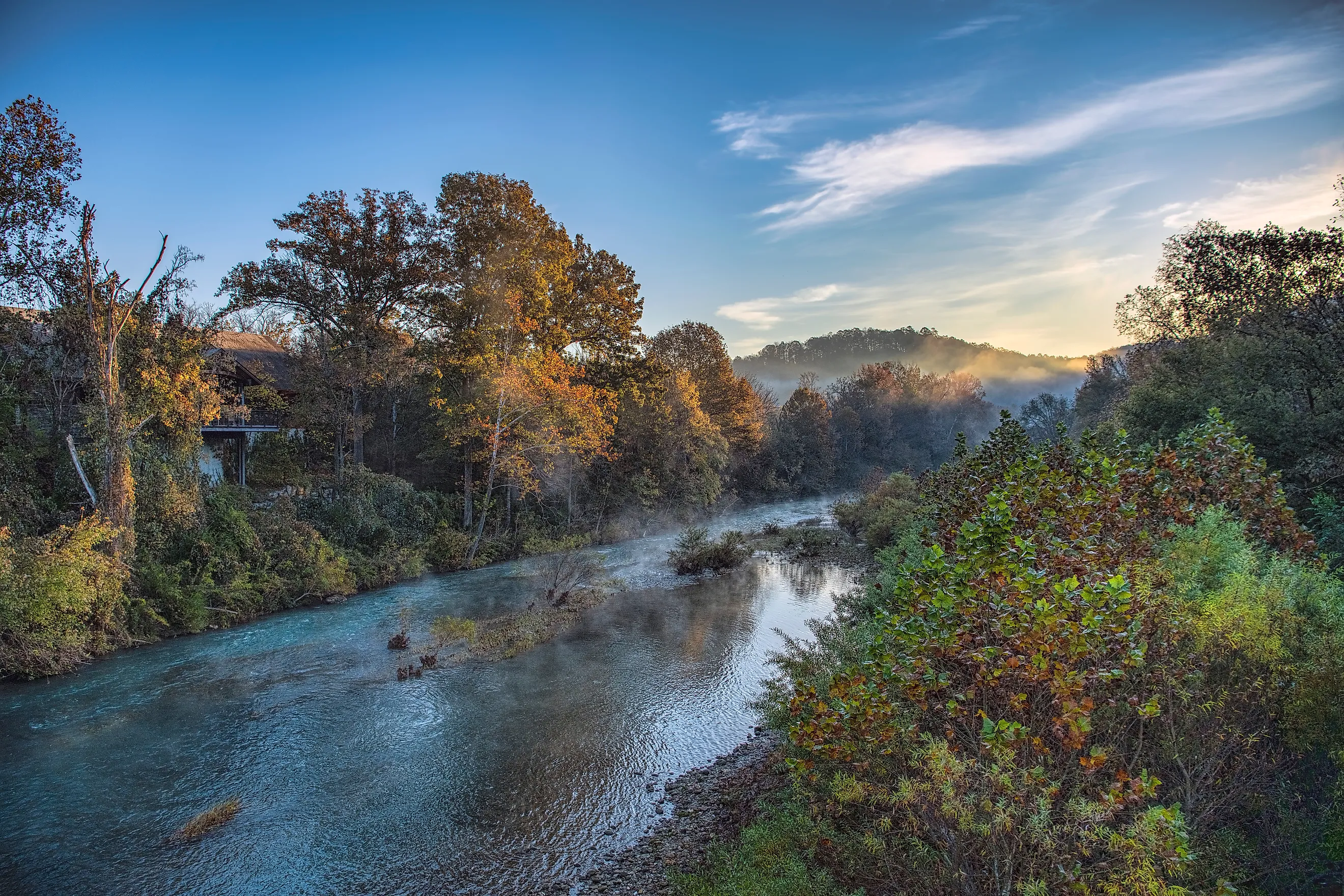
This Quiet Arkansas Town Is An Underrated Gem For Nature Lovers
Jasper sits at the heart of the Upper District of the Buffalo National River, the first stream the United States designated as a national river in 1972. The Ozark National Forest surrounds the town and Boxley Valley holds the only free-ranging elk herd in Arkansas just minutes from downtown. Hawksbill Crag is the most photographed natural feature in the state and sits within a 25-mile drive. The tallest waterfall between the Rockies and the Appalachians, Hemmed-In-Hollow Falls, also sits nearby. The entire setup runs at a scale visitors rarely expect from one Arkansas town.
America's First National River

Established by an act of Congress in 1972, the Buffalo National River flows for 135 miles with no dams. Jasper sits in the heart of the Upper River District, with three ranger-managed access points within easy reach.
The Pruitt Ranger Station, just north of town, provides a launch point for exploring the upper river area. Just downstream, Pruitt Landing gives river access to canoes and kayaks. About 16 miles west of Jasper, the Steel Creek access near Ponca is one of the most photographed spots on the river thanks to the 500-foot-tall sandstone bluffs that surround it.
Spring is a strong time to visit as the waters are at their highest. That is when whitewater paddlers tackle the challenging Hailstone section above Boxley, a 15-mile stretch known for its waterfalls, sinkholes, and 500-foot bluffs. By summer, the upper river is typically too low for paddling, so the action shifts to the middle and lower districts.
Campgrounds at Steel Creek, Kyles Landing, and Erbie offer first-come, first-served riverside tent sites with picnic tables and grills. Outfitters like the Buffalo Outdoor Center in Ponca rent kayaks, canoes, and rafts, and provide shuttle services to get visitors back to the starting point.
The river has also been designated an International Dark Sky Park for its exceptionally low light pollution. The first such site in Arkansas, it is an ideal spot for stargazing alongside the typical daytime recreation.
Hiking the Buffalo National River

Two of the most popular hikes in the Buffalo River corridor begin close to Jasper. The Lost Valley Trail, a 2.3-mile out-and-back route near Ponca, is the most-hiked path in the Buffalo National River area. It follows Clark Creek through a box canyon and passes a natural bridge with an eight-foot waterfall. It also passes the 200-foot-long Cob Cave, a bluff shelter named for the corn cobs left behind by Native American inhabitants.
The trail's highlight is Eden Falls, a 53-foot drop into a clear pool, and the small Eden Falls Cave just above it. A 200-foot crawl into the cave leads to a 25-foot underground waterfall worth the effort for those willing to navigate the tight passage.
The Hemmed-In-Hollow Falls Trail leads to the tallest waterfall between the Rocky Mountains and the Appalachians. At 209 feet, the falls drop into a hollow surrounded by towering bluffs. The trail descends roughly 1,200 feet to the base of the falls, making the hike back steep. The fall views, especially after heavy rain, are worth the effort.
The Elk Capital of Arkansas

Jasper has been nicknamed the "Elk Capital of Arkansas" for good reason. Eastern elk, once abundant in the state, disappeared from Arkansas by the 1840s due to overhunting. To remedy this, the Arkansas Game and Fish Commission released 112 Rocky Mountain elk along the Buffalo River corridor starting in 1981, a herd that has since grown to around 500 individuals.
The best place to catch sight of the only free-ranging elk herd in the state is Boxley Valley, a roughly seven-mile-long protected valley just southwest of Jasper. The valley is unusual, with working farms and historic structures preserved alongside elk habitat. Pull-offs offer a safe place to stop and view the herd, with dawn and dusk being the best times to catch a glimpse.
Autumn's rutting season is a strong time to view the elk, when males gather in the valley and "bugle" their intent to mate. June is also a good time as Jasper hosts its Buffalo River Elk Festival, which includes the Arkansas State Elk Bugling Championships.
Other viewing areas include the fields near Erbie Campground south of Jasper, and the nearby community of Carver. The free Ponca Nature Center carries educational displays on the elk and the broader Buffalo River ecosystem.
Hawksbill Crag and Scenic Byways

Located 25 miles southwest of Jasper, the Whitaker Point Trail leads to Hawksbill Crag. The most photographed natural wonder in Arkansas, this sandstone overhang juts out from a bluff line roughly 30 feet at a height of 200 feet above Whitaker Creek.
Its profile resembles the curved beak of a hawk, and the views from it are exceptional, especially in the fall. The three-mile round-trip trail is rated moderate but requires caution due to exposed roots, rocky sections, and steep drop-offs. Tread carefully near the edge.
For those who enjoy a memorable drive, Arkansas Scenic Byway 7 (the state's first designated scenic byway) is worth the time. A stretch of this 290-mile route passes through Jasper and is by far the most dramatic section. Winding through steep grades and hairpin turns, the views into the surrounding river valleys will have drivers frequently pulling over with cameras in hand.
The Arkansas Grand Canyon

Just south of Jasper, several pull-offs look out over a deep valley nicknamed the Arkansas Grand Canyon. The view stretches for miles across forested ridges into Big Creek Valley and is especially captivating at sunset. Memorable views can also be had from the Cliff House Inn, a few miles south of town with a deck that hangs directly over the canyon.
Another notable natural attraction near town is the Henry R. Koen Experimental Forest. It has several nature trails through the forest, including a wheelchair-accessible interpretive trail. More than 34 native Ozark tree and plant species can be seen here. For a quick stop in town, Bradley Park runs along the Little Buffalo River and features swimming holes and fishing spots for smallmouth bass and bluegill.
An Ozark Town Worth the Drive
Despite sitting in the heart of some of the best Ozark scenery, Jasper stays largely unknown outside Arkansas. Within a short drive of downtown, visitors can paddle a free-flowing federally protected river, watch hundreds of wild elk graze, hike to the state's tallest waterfall, and stand on the most photographed bluff in the state. For those willing to take the winding roads needed to reach it, Jasper offers one of the country's most rewarding concentrations of natural attractions in a single town.