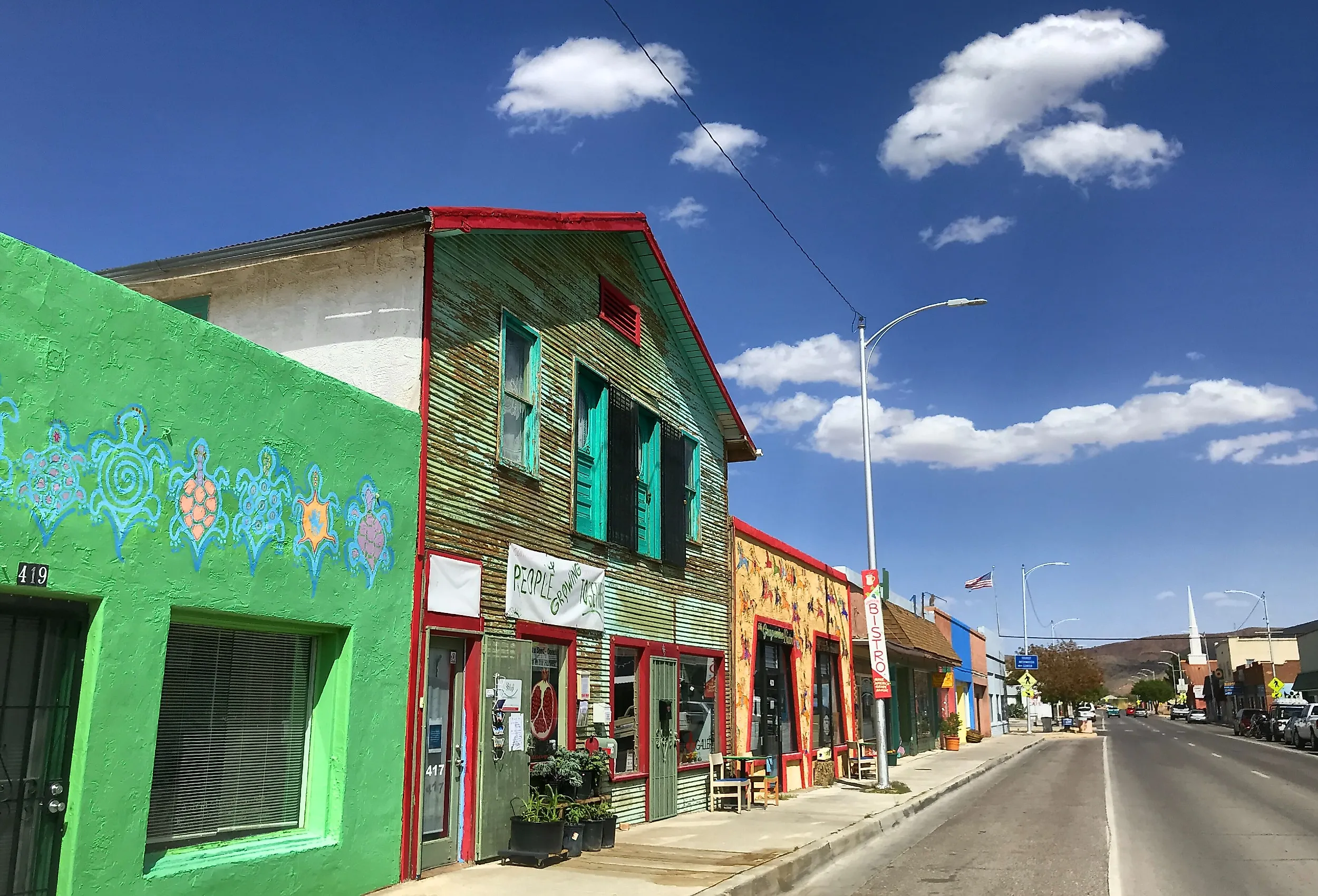
11 New Mexico Towns With Unforgettable Main Streets
A flash flood tore Silver City's main street out of the ground in 1895. The town rebuilt one block over and left the hole alone. Bullard Street has faced that canyon ever since. Main streets across New Mexico hold intriguing histories. Cloudcroft sits at 8,676 feet inside the Lincoln National Forest. Tucumcari began as a railroad camp known as Six-Shooter Siding. Tour unforgettable main streets lined with local shops, cultural festivals, Native art, and landmarks found nowhere else.
Gallup

The trading posts along Coal Avenue keep back rooms full of Navajo weavings, and the good ones will pull rugs off the stack and talk you through the regional styles until you can tell them apart. Zuni turquoise inlay and coiled baskets fill the cases out front. Gallup's other claim sits a few miles east at Fort Wingate, where the first 29 Navajo Code Talkers were sworn into the Marine Corps on May 4, 1942, after riding a bus over from Fort Defiance; they shipped out through the Gallup railroad depot. The El Morro Theatre, a 1928 movie house on Coal Avenue, still runs films and live shows. Out on Route 66, the El Rancho Hotel keeps the log-and-stone lobby where John Wayne and Katharine Hepburn stayed during location shoots. Every August, the Gallup Inter-Tribal Indian Ceremonial, running since 1922, brings dozens of Native nations together for night parades, social dances, and open-air markets.
Truth or Consequences

In 1950, the town of Hot Springs voted to rename itself after a radio program. Ralph Edwards had offered to broadcast the tenth-anniversary episode of his NBC game show from any town that would take its name, and Hot Springs took the deal. Broadway still runs over the geothermal rift that made the place: mineral water surfaces at around 110 degrees, and the 1930s bathhouse motels along the strip let you walk in off the asphalt and drop into a hand-cemented indoor tub. Truth or Consequences Brewing at 410 Broadway Street works as the town's front room, with food-truck fare and a mixed crowd of soakers, artists, and travelers. Fiesta arrives the first full weekend of May with a parade down Broadway, live music, and the junk boat race on the Rio Grande at Ralph Edwards Park. The Geronimo Springs Museum on Main Street holds Mimbres pottery, a pioneer log cabin, and a room devoted to the broadcast that renamed the town.
Alamogordo

New York Avenue carries the restored early 20th-century storefronts that Alamogordo spent the last decade bringing back, along with public art and a rebuilt streetscape. The Oppenheimer Gasthaus at 902 N. New York Avenue serves scratch-made schnitzel and goulash at communal beer-hall tables, recalling the German Air Force presence at nearby Holloman Air Force Base from 1992 until flight training ended in 2019. Picacho Brewing pours drinks a block away on the same avenue. Climb the hill east of downtown, and the New Mexico Museum of Space History looks out over the whole Tularosa Basin. Thirty minutes west, White Sands National Park holds the largest gypsum dunefield on Earth, and the crystal stays cool underfoot even in June.
Zuni Pueblo

In July 2012, Zuni Pueblo became the first Native American community in the United States to receive a MainStreet designation, and it remains the only one. The district runs along State Road 53, a scenic byway that doubles as the village's main street, beneath the sandstone face of Dowa Yalanne. Roughly 80 percent of Zuni households depend on income from art: silverwork, inlay, pottery, stone carving, and weaving. Hand-watered waffle gardens still sit within a few steps of older adobe homes. Halona Marketplace is at the east end of the corridor, where Elaine's Deli and Bakery turns out hot lunches, bread, and pastries. The MainStreet Festival lands in May with a two-day market of more than 50 artists, food vendors, dances, and music. A short walk off the corridor on Ojo Caliente Road, the A:shiwi A:wan Museum and Heritage Center tells Zuni history through oral accounts and community photographs rather than object labels; its Hawikku exhibit covers the ancestral village that Coronado's expedition attacked in 1540 while hunting the Seven Cities of Gold.
Aztec

Drive half a mile north off Main Avenue, past 1950s ranch houses on Ruins Road, and the pavement dead-ends at a 900-year-old masonry city. Aztec Ruins National Monument protects the Aztec West great house, roughly 400 rooms of Chacoan stonework, plus a reconstructed Great Kiva; it is part of the UNESCO-listed Chaco Culture property. The name is a 19th-century mistake that stuck, made by settlers who credited the ruins to the Aztec Empire of Mexico. Downtown itself sits in the green Animas River valley, and the brick storefronts along Main Avenue run to antique shops and small galleries. Two blocks off the main drag, 550 Brewing at 119 E. Chuska Street pours small-batch beer with food trucks parked outside and a large patio. Each October, the Aztec Highland Games and Celtic Festival takes over Riverside Park on the riverbank, with caber tossing, stone throwing, pipe bands, and highland dance competitions.
Silver City

Billy the Kid grew up here, and his first arrest came from stealing clothes out of a local laundry; he got out of jail by climbing the chimney. That was 1875, when Silver City was a five-year-old mining camp. The 1895 flood that carved the Big Ditch dropped as much as 55 feet below the old street grade, and the town simply moved commerce over to Bullard Street. Bullard now runs on mining money turned into something else: artist co-ops, murals, independent bookstores, and the college crowd from Western New Mexico University up the hill. Little Toad Creek Brewery and Distillery at 200 N. Bullard puts hikers coming off the Continental Divide Trail on the same corner patio as local painters. The Silver City Blues Festival fills Gough Park with free music, food, and vendors each Memorial Day weekend. The WNMU Museum in Fleming Hall holds the largest permanent exhibition of Mimbres pottery and artifacts in the world, including the NAN Ranch Collection, with black-on-white animal and geometric work about a thousand years old.
Las Vegas

About 900 buildings here sit on the National Register of Historic Places, which is why film crews keep showing up; the town stood in for West Texas in No Country for Old Men. The result is an 1880s brick and cast-iron streetscape in the desert foothills, built by railroad money after the Santa Fe arrived in 1879. The lawlessness that came with it was real. On February 8, 1880, a masked mob pulled three men accused of killing Marshal Joe Carson out of the old town jail and hanged them from the disused windmill standing in the plaza. That April, the vigilance committee ran a notice in the Las Vegas Optic telling every other lawbreaker to leave or answer for it. The Plaza Hotel at 230 Plaza Street opened in 1882 and hosted the first Rough Riders reunion in 1899, with Theodore Roosevelt himself in the room. The city's self-guided Historic Home Trail covers the residential districts on foot, and Storrie Lake State Park sits four miles north for windsurfing, boating, and birding.
Tucumcari

The neon along Route 66 Boulevard comes on around dusk, and the whole strip turns into something closer to a museum exhibit. Tee Pee Curios pulls travelers in through a giant concrete-and-plaster teepee. The Blue Swallow's sign draws the same crowd two blocks down. Long before any of it, this was a Rock Island Railroad construction camp thrown up in 1901 and nicknamed Six-Shooter Siding for the number of gunfights; the founders renamed the townsite Tucumcari the following year, after the flat-topped mountain south of town. Del's Restaurant has been feeding Route 66 traffic on the boulevard for more than fifty years, with green chile in most of what it serves. Each March, the Mesalands Community College foundry hosts the Iron Pour, a week that draws roughly fifty artists from around the country to break down scrap iron, fire cupola furnaces, and pour molten metal into molds in front of a public crowd. Those same foundry students cast the bronze fossil replicas at the Mesalands Dinosaur Museum, which claims the largest collection of bronze fossil casts in the world.
Raton

Raton exists because a grading crew won a footrace. In February 1878, the Santa Fe Railroad got men onto Raton Pass before dawn and started work ahead of the rival Denver and Rio Grande, taking the only practical rail route between Colorado and New Mexico. The town that followed two years later got built with coal and railroad money, which explains a streetscape that looks nothing like adobe New Mexico: brick and brownstone commercial blocks along First Street, including the 1896 Palace Hotel in Romanesque Revival stone across from the depot. Amtrak still stops there twice a day. The volcanic mesa of Goat Hill stands over the grid at nearly 6,700 feet. Bruno's Pizza and Wings on Cook Avenue, half a block off First, does scratch pies and wings in a neighborhood pub room. Labor Day weekend brings the Gate City Music Festival to First Street and the Shuler Theater, with cowboy poets and street performers alongside the bands. The Shuler opened in 1915 and keeps its Rococo interior and a set of 1930s lobby murals of frontier scenes.
Cloudcroft

Burro Avenue runs on wooden boardwalks rather than concrete, and the timber planks are the village's oldest surviving idea about itself. Cloudcroft came out of the 1899 push by the Alamogordo and Sacramento Mountain Railway, which built 58 trestles across a 32-mile mountain route to reach the timber up here and then discovered it could sell the climb to tourists. The line gained more than 4,000 feet and earned the name Cloud Climbing Railroad. At 8,676 feet, the village runs about twenty degrees cooler than the basin floor, which is the entire reason anyone built a resort here. Cloudcroft Brewing Company at 1301 Burro Avenue keeps outdoor fire pits going and wood-fired pizza coming. Lumberjack Day, each September, plays the logging history straight, with axe throwing, chainsaw carving, and two-man crosscut saw races. Half a mile northwest of US 82, the Mexican Canyon Trestle survives from that original 1899 line: 323 feet of curved wooden trestle standing 52 feet above the canyon floor, visible from a highway overlook or reachable on a short trail.
Mesilla

On August 27, 1871, two rival political parades met on the Mesilla plaza, and nine men died before federal troops shut it down. Ten years later, the courthouse on the same square was where Billy the Kid stood trial for murder and was sentenced to hang. Mesilla Plaza is a National Historic Landmark now, framed by the San Albino Basilica and nineteenth-century storefronts, and local ordinance keeps modern corporate architecture off it. The packed-earth side streets and thick adobe walls behind the plaza are the reason the village reads the way it does. Residents gathered on this plaza in 1854 to mark the Gadsden Purchase that made the land American. La Posta de Mesilla at 2410 Calle de San Albino occupies an 1840s adobe that served as a Butterfield Overland Mail stop, and serves red and green chile enchiladas around a zaguan corridor and a live tropical aviary. Every September, the Diez y Seis de Septiembre Fiestas fill the plaza with mariachi, folklorico dancers, and street food. Pecan orchards and chile fields run right up to the village edge along the Rio Grande, inside the Chihuahuan Desert.
What Built These Streets
Transport made four of them. Raton and Tucumcari were laid out by railroads and then kept alive by a highway, and Gallup and Alamogordo grew where the rails met a resource worth hauling. Extraction made Silver City, and the mining money is still visible in the Victorian blocks above the Big Ditch. Cloudcroft and Truth or Consequences sold a climate instead, one cool and one hot, and both built their main streets around the customer who came for it. Zuni Pueblo and Mesilla predate every one of those, which is why their streets follow an older layout. The through line is that each of these downtowns still bears the physical evidence of its past.